


16 Sep UPSC 2024: Central Minister Launches Swachhata Abhiyan 6.0 Portal for Governance Cleanliness
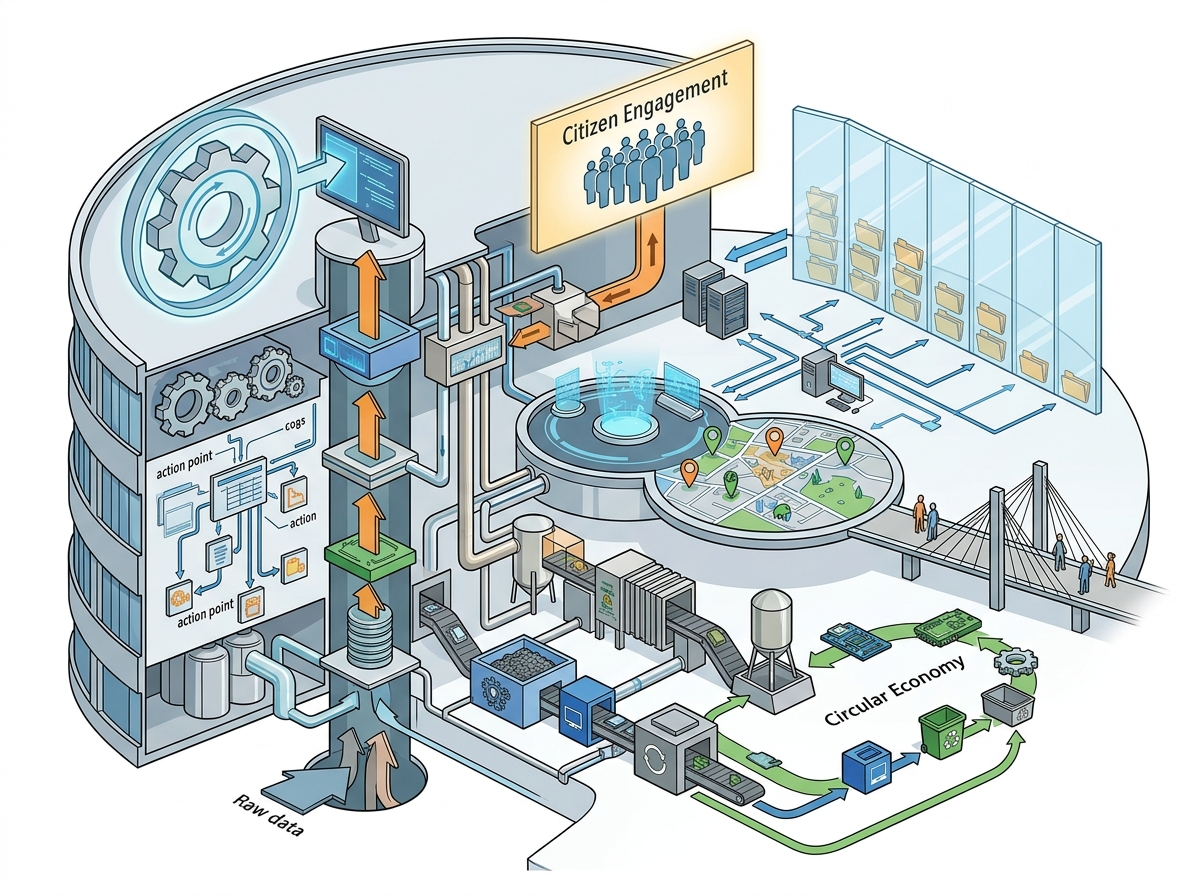
✎ Special Campaign 6.0 is a mission-mode governance initiative under DARPG that integrates digital monitoring, scientific waste management, and economic value creation through scrap disposal to enhance administrative efficiency and…
Subject Relevance — Where This Topic Fits
- GS Paper II — Governance, Transparency and Accountability | GS Paper III — Environment and Sustainable Development, Waste Management and Circular Economy | GS Paper IV — Ethics in Governance: Citizen-Centric Administration and Public Service Delivery
- Prelims: Swachh Bharat Mission (SBM), Special Campaign 6.0, E-waste Management Rules 2022, Solid Waste Management Rules 2016, Government e-Marketplace (GeM), Litter-Free India, Mission LiFE, Circular Economy, Administrative Reforms and Public Grievances Department (DARPG), Office Space Optimization, File Disposal Policy
- Essay: Governance as a Jan Andolan: Transforming Public Behaviour for Nation-Building, Sustainable Development through Waste Management: Balancing Economic Growth and Environmental Stewardship
Quick Revision: Special Campaign 6.0 is a mission-mode governance initiative under DARPG that integrates digital monitoring, scientific waste management, and economic value creation through scrap disposal to enhance administrative efficiency and environmental sustainability.
Why is this in the news?
The launch of the web portal for Special Campaign 6.0 by the Union Minister Dr. Jitendra Singh marks a significant institutional milestone in India’s ongoing national sanitation movement. This initiative, building on the legacy of the Swachh Bharat Mission, integrates digital governance, economic value creation through waste management, and systemic administrative reforms. The campaign’s focus on scientific waste disposal, e-waste management, and reduction of pending cases underscores its alignment with contemporary environmental governance frameworks and circular economy principles.
Background
- The Swachh Bharat Mission (SBM), launched in 2014, was India’s flagship sanitation initiative aimed at eliminating open defecation and improving solid waste management across rural and urban areas.
- Special Campaigns (SCs) were introduced as time-bound, mission-mode initiatives under the Department of Administrative Reforms and Public Grievances (DARPG) to accelerate pending tasks, optimize office space, and promote efficiency in government operations.
- The economic dimension of sanitation has gained prominence with the monetisation of scrap disposal, which has generated substantial revenue while reducing environmental pollution.
- Administrative reforms under DARPG have emphasised file disposal, office space rationalisation, and reduction of pendency to enhance governance efficiency and transparency.
- The integration of digital portals in Special Campaigns reflects the government’s push towards e-governance, real-time monitoring, and citizen engagement in public service delivery.
What is Special Campaign 6.0?
- Special Campaign 6.0 is the sixth iteration of a time-bound, mission-mode initiative launched under the Department of Administrative Reforms and Public Grievances (DARPG) to accelerate pending tasks, optimise office space, and promote efficiency in government operations.
- The campaign focuses on scientific waste management, including the disposal of e-waste, reduction of pending cases, and the monetisation of scrap to generate economic value while ensuring environmental sustainability.
- The newly launched web portal serves as a centralised digital platform for monitoring, reporting, and grievance redressal, aligning with the principles of transparency, accountability, and citizen participation in governance.
- Special Campaigns are designed to function as ‘Whole-of-Government’ initiatives, involving multiple ministries, departments, and agencies to ensure coordinated action and resource optimisation.
- The campaign builds on the success of previous iterations, which have collectively freed up over 1,000 lakh square feet of office space, disposed of approximately 2 crore files, and generated ₹5,000 crore through scrap disposal over the past five years.
- Special Campaign 6.0 emphasises behavioural change among government employees and citizens, fostering a culture of cleanliness, efficiency, and accountability in public service delivery.
- The initiative is aligned with broader national missions such as Mission LiFE (Lifestyle for Environment) and the Swachh Bharat Mission, reinforcing India’s commitment to sustainable development and circular economy principles.
- The campaign’s focus on e-waste management is particularly significant given the exponential growth in electronic waste generation and the need for formalised disposal mechanisms to mitigate environmental and health risks.
Key Features
| Feature | Significance |
|---|---|
| Launch of Special Campaign 6.0 Web Portal | Provides a unified digital platform for monitoring and reporting progress under the campaign, enhancing transparency and accountability in waste management and sanitation initiatives. |
| Focus on Scientific Waste Management | Emphasizes systematic segregation, recycling, and disposal of waste, including e-waste, to minimize environmental degradation and promote circular economy principles. |
| Liquidation of Pending Cases | Targets reduction of backlog files and pending matters across government offices, improving administrative efficiency and resource utilization. |
| Revenue Generation from Scrap Disposal | Leverages monetization of scrap and redundant assets, contributing to fiscal consolidation and optimal use of public resources. |
| Office Space Optimization | Facilitates decluttering and reallocation of office spaces, enhancing workplace productivity and cost-effectiveness. |
Why it Matters
Governance and Public Administration
- Demonstrates the integration of sanitation and waste management into a whole-of-government approach, aligning with the principles of cooperative federalism and inter-ministerial coordination.
- Highlights the role of administrative reforms in driving behavioral change among citizens and government officials, fostering a culture of efficiency and accountability.
- Showcases the potential of citizen-centric governance models to address fundamental quality-of-life issues through structured national campaigns.
Economic and Fiscal
- Illustrates the economic viability of waste management through revenue generation from scrap disposal, contributing to fiscal sustainability.
- Underscores the importance of resource optimization in public administration, reducing operational costs and enhancing asset utilization.
- Demonstrates how systematic waste reduction can create secondary markets for recyclables, supporting local economies and green industries.
Environmental and Social
- Promotes sustainable waste management practices, reducing landfill dependency and mitigating pollution risks associated with improper disposal.
- Addresses critical gaps in sanitation infrastructure, particularly in rural and peri-urban areas, improving public health outcomes and gender equity.
- Encourages behavioral change toward cleaner environments, aligning with global commitments such as the Sustainable Development Goals (SDGs).
Challenges
1. Behavioral Resistance to Change
- Lack of awareness or resistance among government officials and citizens toward adopting new waste management practices.
- Inertia in traditional administrative processes, which may hinder the implementation of scientific waste management protocols.
UPSC Link: GS-II (Governance)
2. Infrastructure and Technology Gaps
- Inadequate facilities for e-waste recycling and hazardous waste disposal across regions, particularly in rural areas.
- Limited access to modern waste segregation and processing technologies in government offices and public spaces.
UPSC Link: GS-III (Environment)
3. Resource Constraints and Capacity Building
- Shortage of trained personnel for waste management operations and monitoring within government departments.
- Insufficient budgetary allocations for scaling up infrastructure and technology adoption in sanitation initiatives.
UPSC Link: GS-II (Governance)
4. Data Gaps and Monitoring Mechanisms
- Inadequate real-time data collection systems to track progress and identify bottlenecks in waste management campaigns.
- Lack of standardized metrics for evaluating the impact of sanitation initiatives across diverse administrative units.
UPSC Link: GS-II (Governance)
5. Inter-Ministerial Coordination
- Fragmented implementation across ministries, leading to duplication of efforts or gaps in coverage.
- Delays in policy alignment and resource sharing between central and state agencies.
UPSC Link: GS-II (Federalism)
Challenges — UPSC Perspective
| Issue | Concern |
|---|---|
| Public Awareness and Participation | Low engagement of citizens in waste segregation and recycling initiatives, leading to suboptimal outcomes. |
| E-Waste Management | Absence of dedicated e-waste processing facilities in many regions, exacerbating environmental and health risks. |
| Administrative Backlog | Prolonged pendency of files and cases in government offices, undermining operational efficiency. |
| Urban-Rural Disparities | Unequal access to sanitation infrastructure and waste management services across geographical regions. |
| Financial Sustainability | Over-reliance on one-time revenue from scrap disposal, with limited long-term funding mechanisms. |
Way Forward
- Strengthen inter-ministerial task forces to ensure seamless coordination and avoid duplication of efforts in waste management.
- Expand public awareness campaigns through digital and grassroots platforms to foster behavioral change and community participation.
- Invest in technology-driven solutions, such as AI-based waste segregation and IoT-enabled monitoring, to enhance efficiency.
- Establish regional e-waste recycling hubs and hazardous waste disposal facilities to address infrastructure gaps.
- Develop standardized data dashboards for real-time tracking of progress and impact assessment across all campaign sites.
- Integrate sanitation initiatives with existing flagship programs, such as Swachh Bharat Mission 2.0, for synergy and scalability.
- Promote public-private partnerships to leverage private sector expertise and resources in waste management and recycling.
- Conduct periodic capacity-building programs for government officials to train them in modern waste management practices.
UPSC Value Addition
Keywords for Mains Answer-Writing
Swachhata Abhiyan · Special Campaign 6.0 · Waste Management Policy · Government Resource Optimisation · E-waste Disposal · Scientific Waste Management · Jan Andolan for Cleanliness · Administrative Reforms · Circular Economy · Kabad Nistanan Scheme · Office Space Optimization · Pending File Disposal · Sustainable Governance · Behavioural Change for Cleanliness · Digital Portal for Governance
Concept Flow
National sanitation campaign → Whole-of-government approach → Behavioral change in citizens and officials → Systematic waste management → Revenue generation and resource optimization → Environmental sustainability and public health improvement.
Prelims Practice Questions
Q1. Consider the following statements regarding the Special Campaign 6.0 under the Swachhata Abhiyan:
1. The campaign focuses exclusively on physical cleanliness drives in government offices.
2. It has generated ₹5,000 crore through scrap disposal over the past five years.
3. The campaign mandates the disposal of 2 crore pending files as part of its administrative reforms.
4. The portal launched under the campaign is designed to track only the progress of cleanliness drives.
How many of the above statements are correct?
- Only one
- Only two
- Only three
- All
Answer: Only three — Statements 2 and 3 are correct. Statement 1 is incorrect as the campaign extends beyond physical cleanliness to include scientific waste management and administrative reforms. Statement 4 is incorrect as the portal tracks broader governance outcomes, including resource optimisation and file disposal.
Q2. Assertion (A): The Swachhata Abhiyan has evolved into a Jan Andolan (people’s movement) due to its focus on behavioural change and citizen participation.
Reason (R): The campaign’s success in generating economic value through scrap disposal has incentivised large-scale public participation.
In the context of the above two statements, which one of the following is correct?
- Both A and R are true, and R is the correct explanation of A.
- Both A and R are true, but R is not the correct explanation of A.
- A is true, but R is false.
- A is false, but R is true.
Answer: A is true, but R is false. — Both statements are true. The campaign has indeed fostered a Jan Andolan by promoting behavioural change and citizen engagement. However, the economic value generated through scrap disposal (₹5,000 crore) is a consequence of the movement rather than its primary driver of public participation.
Q3. Match the following initiatives under the Swachhata Abhiyan with their respective objectives:
Column I (Initiative) | Column II (Objective)
———————————————–|———————————————–
A. Scientific Waste Management | 1. Disposal of pending government files
B. Kabad Nistanan (Scrap Disposal) | 2. Economic value generation through recycling
C. Pending File Disposal | 3. Reduction of hazardous waste in offices
D. Office Space Optimization | 4. Freeing up unused government office space
Select the correct match:
- A-3, B-2, C-1, D-4
- A-2, B-3, C-1, D-4
- A-1, B-4, C-2, D-3
- A-4, B-1, C-3, D-2
Answer: A-3, B-2, C-1, D-4 — The correct match is: A-3 (Scientific Waste Management aims to reduce hazardous waste), B-2 (Kabad Nistanan generates economic value through recycling), C-1 (Pending File Disposal involves disposing of 2 crore files), and D-4 (Office Space Optimization frees up unused space).
Mains Practice Question
✍ The Swachhata Abhiyan, initially a modest cleanliness drive, has metamorphosed into a comprehensive governance reform under the rubric of ‘Whole of Government’ and ‘Whole of Nation’. Critically analyse the evolution of this initiative, highlighting its administrative, economic, and behavioural dimensions. Also examine the role of digital portals in enhancing the efficacy of such mass campaigns in contemporary governance. (15 Marks)
Approach: MODEL-ANSWER SKELETON:
1. **Evolution of Swachhata Abhiyan**:
– **2014 Origins**: Launched as a cleanliness drive under the broader Swachh Bharat Mission (SBM), focusing on sanitation and open defecation elimination.
– **Expansion to Governance**: Post-2019, the initiative was rebranded as ‘Swachhata Hi Seva’ and later integrated into the Special Campaign framework, emphasizing ‘Whole of Government’ and ‘Whole of Nation’ approaches.
– **Key Milestones**: 1,000 lakh sq. ft. of office space freed; 2 crore files disposed; ₹5,000 crore generated via scrap disposal.
2. **Administrative Reforms**:
– **Pending File Disposal**: Systematic reduction of backlog files to enhance administrative efficiency.
– **Resource Optimisation**: Freeing up unused office space for productive use.
– **Institutional Mechanisms**: Role of the Department of Administrative Reforms and Public Grievances (DARPG) in monitoring and implementation.
3. **Economic and Environmental Dimensions**:
– **Circular Economy**: Transition from linear to circular waste management models.
– **E-waste and Scientific Disposal**: Focus on hazardous waste reduction and compliance with e-waste management rules.
– **Economic Value Generation**: ₹5,000 crore revenue from scrap disposal as a model for monetising waste.
4. **Behavioural Change and Jan Andolan**:
– **Citizen Participation**: Shift from top-down directives to grassroots mobilisation.
– **Cultural Shift**: Embedding cleanliness and waste management as societal norms.
– **Role of Leadership**: Prime Minister’s emphasis on cleanliness as a national priority.
5. **Digital Portals and Governance Efficacy**:
– **Portal Launch**: Web portal for Special Campaign 6.0 to track progress, ensure transparency, and facilitate real-time monitoring.
– **Data-Driven Governance**: Use of digital tools for tracking waste disposal, file disposal, and office space utilisation.
– **Challenges**: Digital divide, data privacy, and ensuring last-mile connectivity.
6. **Critical Evaluation**:
– **Successes**: Tangible outcomes in waste management, administrative efficiency, and citizen engagement.
– **Limitations**: Sustainability of behavioural change, scalability in rural areas, and integration with existing waste management systems.
7. **Conclusion**:
– The Swachhata Abhiyan exemplifies how a governance initiative can transcend its original scope to become a transformative force. Digital portals further amplify its impact by enabling data-driven decision-making and citizen participation.
Source: PIB (Press Information Bureau)
Generated by AanyaAi for educational purpose.
Related guides on our sites
- Best PSIR optional coaching for upsc
- Best PSIR optional teacher for upsc
- Best teacher of PSIR optional for upsc
- Best PSIR optional coaching in delhi for UPSC

- स्वामित्व योजना: मध्यप्रदेश में 50 लाख संपत्तियों की मुफ्त रजिस्ट्री शुरू, जानिए पूरा विवरण - September 17, 2026
- MP Swamitva Yojana: Free Property Registration for 50L Rural Properties - September 17, 2026
- AI नियमों के लिए UN की पहल: क्या है वैश्विक दृष्टिकोण? - September 17, 2026

No Comments