


17 Sep UPSC Exam: Mineral Ministry Launches E-Waste Management Drive Under Special Campaign 6.0
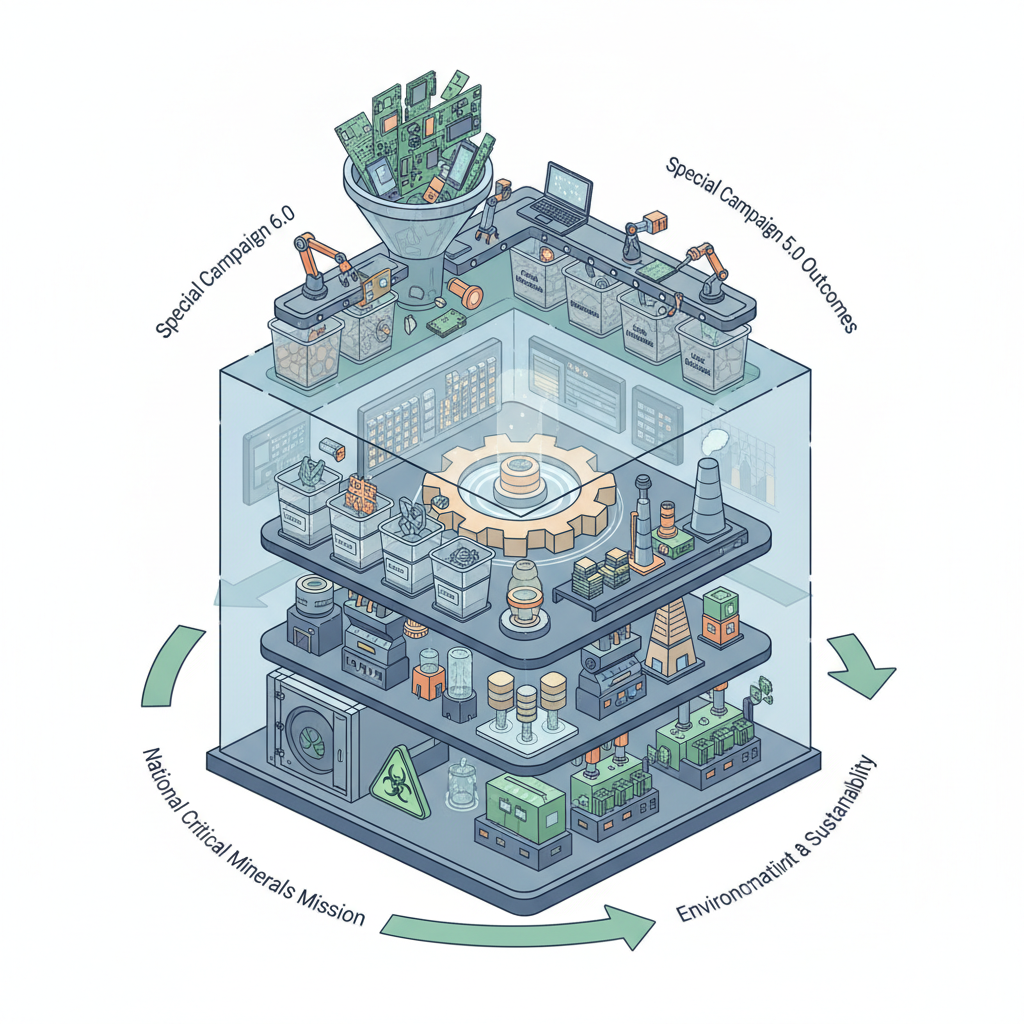
✎ Special Campaign 6.0 (2 Oct–31 Oct 2026) prioritises e-waste management in government offices, leveraging MAIT to establish collection booths and recover critical minerals under the NCMM framework.
Subject Relevance — Where This Topic Fits
- GS Paper II — Governance, Transparency and Accountability | GS Paper III — Environment and Sustainable Development
- Prelims: E-waste (Management) Rules, 2022, Extended Producer Responsibility (EPR), National Critical Minerals Mission (NCMM), Jawaharlal Nehru Aluminium Research Development and Design Centre (JNARDDD), Government e-Marketplace (GeM), Swachh Bharat Mission, Circular Economy
- Essay: Sustainable Resource Management as a Pillar of Good Governance, Technology and Environmental Stewardship in Public Administration
Quick Revision: Special Campaign 6.0 (2 Oct–31 Oct 2026) prioritises e-waste management in government offices, leveraging MAIT to establish collection booths and recover critical minerals under the NCMM framework.
Why is this in the news?
The Ministry of Mines has announced the launch of Special Campaign 6.0 (2 October – 31 October 2026), building on the outcomes of Special Campaign 5.0, with a dedicated focus on the safe collection, segregation, and disposal of e-waste from government offices. This initiative aligns with broader national objectives of administrative efficiency, resource optimisation, and environmental sustainability, particularly in the context of India’s commitment to circular economy principles and the National Critical Minerals Mission (NCMM).
Background
- The Special Campaign series, launched by the Government of India, is a time-bound, mission-mode initiative aimed at improving governance through administrative reforms, record management, and resource efficiency in government offices.
- Special Campaign 5.0 (October 2025) achieved significant milestones, including the resolution of 1,772 public grievances, disposal of 3,751 physical files, and the release of 1.7 lakh square feet of office space, thereby enhancing administrative efficiency and resource utilisation.
- The campaign also generated revenue of approximately ₹19.33 crore through the disposal of scrap, demonstrating the potential for circular economy practices in public administration.
- E-waste, defined under the E-waste (Management) Rules, 2022, includes discarded electrical and electronic equipment, which poses environmental and health risks if not managed responsibly.
- The National Critical Minerals Mission (NCMM), launched in 2023, aims to secure India’s critical mineral supply chain, including the recycling and recovery of valuable minerals from e-waste.
- India’s commitment to sustainable development is reflected in initiatives like the Swachh Bharat Mission and the adoption of the Circular Economy Action Plan.
What is Special Campaign 6.0 and its focus on e-waste management?
- Special Campaign 6.0 is a time-bound governance initiative launched by the Ministry of Mines from 2 October to 31 October 2026, as part of the broader Special Campaign series aimed at improving administrative efficiency and resource governance in government offices.
- The campaign prioritises the effective collection, segregation, and safe disposal of e-waste from government offices, in alignment with the E-waste (Management) Rules, 2022 and the principles of the circular economy.
- A preparatory phase (15–30 September 2026) will identify pending references, grievances, and appeals for resolution, alongside a review of records and management systems in coordination with Members of Parliament, the Prime Minister’s Office, and state governments.
- The implementation phase (2–31 October 2026) will involve coordinated efforts by the Ministry of Mines, its attached and subordinate offices, Central Public Sector Enterprises (CPSEs), and autonomous bodies to achieve set targets for e-waste management.
- The initiative aims to facilitate the recycling and recovery of critical minerals from e-waste, contributing to the objectives of the National Critical Minerals Mission (NCMM) and reducing reliance on virgin mineral imports.
- The campaign underscores the Ministry’s commitment to environmental sustainability, efficient governance, and the responsible management of resources, including the reduction of carbon footprints in government operations.
- By institutionalising e-waste management practices, the campaign seeks to set a precedent for other ministries and departments, fostering a culture of environmental stewardship in public administration.
Key Features
| Feature of Special Campaign 6.0 | Significance |
|---|---|
| E-waste management focus | Aligns with national priorities on resource efficiency, circular economy, and environmental sustainability under frameworks like the National Critical Minerals Mission (NCMM). |
| Preparation phase (15–30 Sept 2026) | Involves identification of pending references, grievances, and parliamentary assurances for systematic disposal, ensuring administrative readiness. |
| Implementation phase (2–31 Oct 2026) | Coordinated action across CPSEs, autonomous bodies, and subordinate offices to achieve predefined targets in e-waste collection, segregation, and disposal. |
| Designation of JNARDDC as nodal agency | Facilitates establishment of e-waste collection booths in government offices, enabling efficient recycling and recovery of critical minerals. |
| Revenue generation from scrap disposal | Demonstrates fiscal prudence by monetising redundant assets, contributing to resource optimisation within government operations. |
Why it Matters
Administrative Efficiency
- Demonstrates the Union Government’s commitment to reducing bureaucratic red tape through systematic disposal of redundant records and grievance redressal.
- Highlights the role of Special Campaigns in institutionalising best practices for record management and office space utilisation.
- Shows measurable progress in administrative reform metrics, such as the resolution of 1,772 public grievances and disposal of 3,751 physical files.
Resource Efficiency and Circular Economy
- Promotes the principles of circular economy by prioritising the safe disposal and recycling of e-waste, reducing environmental degradation.
- Supports the recovery of critical minerals from e-waste, aligning with the objectives of the National Critical Minerals Mission (NCMM).
- Contributes to the reduction of hazardous waste in landfills, thereby mitigating soil and water pollution.
Sustainable Development Goals (SDGs)
- Directly contributes to SDG 12 (Responsible Consumption and Production) by ensuring safe and efficient management of e-waste.
- Supports SDG 13 (Climate Action) through reduced emissions from improper e-waste disposal and resource conservation.
- Indirectly aligns with SDG 8 (Decent Work and Economic Growth) by fostering green jobs in the recycling and recovery sector.
Governance and Accountability
- Institutionalises a culture of accountability through structured phases of preparation and implementation, ensuring measurable outcomes.
- Enhances transparency by mandating the disposal of redundant records and systematic grievance redressal.
- Strengthens inter-departmental coordination, particularly between the Ministry of Mines, CPSEs, and autonomous bodies.
Challenges
1. Logistical Challenges in E-waste Collection
- Establishing a pan-India network of e-waste collection booths in government offices requires significant logistical coordination.
- Ensuring the participation of all stakeholders, including state governments and local bodies, to maximise coverage.
- Addressing the lack of awareness among government employees about proper e-waste disposal protocols.
UPSC Link: Environmental Pollution: Issues and Solutions
2. Technological and Infrastructure Gaps
- Limited capacity of recycling facilities to handle the volume of e-waste generated from government offices.
- High initial costs associated with setting up advanced e-waste processing units.
- Need for technology transfer and capacity building to improve recycling efficiency.
UPSC Link: Solid Waste Management: Challenges and Strategies
3. Regulatory and Compliance Hurdles
- Ensuring strict adherence to the E-Waste (Management) Rules, 2022, across all government offices and CPSEs.
- Monitoring and enforcement challenges in tracking e-waste flows from collection to final disposal.
- Coordination with state pollution control boards to streamline compliance.
UPSC Link: Environmental Governance: Legal and Institutional Framework
4. Financial Sustainability
- Sustaining revenue generation from scrap disposal requires consistent efforts in monetising redundant assets.
- Balancing the costs of e-waste management with the benefits of resource recovery and environmental protection.
- Securing long-term funding for scaling up e-waste recycling infrastructure.
UPSC Link: Public Finance: Budgeting and Resource Mobilisation
5. Behavioural Change and Awareness
- Overcoming resistance to change among government employees regarding new disposal protocols.
- Educating stakeholders on the environmental and economic benefits of proper e-waste management.
- Ensuring behavioural compliance across diverse administrative hierarchies.
UPSC Link: Sustainable Development: People, Planet, and Prosperity
Challenges — UPSC Perspective
| Challenge | Associated Concern |
|---|---|
| Logistical coordination | Ensuring timely and efficient establishment of e-waste collection booths across government offices. |
| Technological gaps | Limited processing capacity to handle the volume of e-waste generated. |
| Regulatory compliance | Strict adherence to E-Waste (Management) Rules, 2022, across all stakeholders. |
| Financial sustainability | Balancing costs of e-waste management with revenue from scrap disposal. |
| Awareness and behavioural change | Ensuring compliance and participation from government employees in e-waste disposal protocols. |
| Monitoring and enforcement | Tracking e-waste flows from collection to final disposal to prevent illegal dumping. |
Government Initiatives — Must-Memorise for Prelims
- E-Waste (Management) Rules, 2022
- National Critical Minerals Mission (NCMM)
- Swachh Bharat Mission (Urban)
Way Forward
- Conduct nationwide awareness campaigns to educate government employees on e-waste segregation and disposal protocols.
- Strengthen inter-departmental coordination by establishing a dedicated task force for e-waste management under the Ministry of Mines.
- Scale up recycling infrastructure by partnering with private sector entities and leveraging technology for efficient processing.
- Enhance monitoring mechanisms through real-time tracking of e-waste collection and disposal using digital platforms.
- Develop financial incentives for government offices to monetise scrap materials, ensuring sustainable revenue streams.
- Integrate e-waste management into the annual performance appraisal system of government employees to ensure accountability.
- Collaborate with state governments to align local e-waste management policies with national frameworks.
- Promote research and innovation in e-waste recycling technologies through public-private partnerships.
UPSC Value Addition
Keywords for Mains Answer-Writing
Special Campaign 6.0 · e-waste management · Ministry of Mines · sustainable resource management · Government of India initiatives · E-waste (Management) Rules 2022 · critical minerals · National Critical Minerals Mission · administrative efficiency · circular economy · resource efficiency · Swachh Bharat Mission · sustainable development goals · government record management
Concept Flow
Government offices generate e-waste → Ministry of Mines initiates Special Campaign 6.0 → Focus on safe e-waste disposal and recycling → Alignment with NCMM and SDGs → Institutionalisation through nodal agency (JNARDDC) → Establishment of collection booths → Recovery of critical minerals → Reduction in environmental pollution → Contribution to circular economy and sustainable development.
Prelims Practice Questions
Q1. Consider the following statements regarding the Special Campaign 6.0 launched by the Ministry of Mines:
1. It is a continuation of Special Campaign 5.0 and focuses on effective collection, segregation, and disposal of e-waste.
2. The campaign includes a preparation phase from 15 to 30 September 2026 and an implementation phase from 2 to 31 October 2026.
3. The campaign aims to address only administrative efficiency and does not include environmental sustainability goals.
How many of the above statements are correct?
- Only one
- Only two
- All
- None
Answer: Only two — Statement 1 is correct as the campaign focuses on e-waste management. Statement 2 is correct as the phases are explicitly mentioned. Statement 3 is incorrect because the campaign also aligns with environmental sustainability goals such as the National Critical Minerals Mission.
Q2. Assertion (A): The Special Campaign 6.0 by the Ministry of Mines aims to facilitate the recycling and recovery of critical minerals from e-waste.
Reason (R): The campaign is aligned with the objectives of the National Critical Minerals Mission (NCMM).
Options: A. Both A and R are true, and R is the correct explanation of A.
B. Both A and R are true, but R is not the correct explanation of A.
C. A is true, but R is false.
D. A is false, but R is true.
Answer: ? — Both the assertion and reason are true. The campaign’s focus on e-waste management and critical mineral recovery is directly aligned with the objectives of the NCMM, making R the correct explanation of A.
Q3. Match the following initiatives with their respective ministries/organisations:
Column I (Initiative) | Column II (Ministry/Organisation)
— | —
1. Special Campaign 6.0 | A. Ministry of Mines
2. National Critical Minerals Mission | B. Ministry of Environment, Forest and Climate Change
3. E-waste (Management) Rules 2022 | C. NITI Aayog
4. Swachh Bharat Mission | D. Ministry of Housing and Urban Affairs
- 1-A, 2-C, 3-B, 4-D; 1-A, 2-B, 3-C, 4-D; 1-B, 2-A, 3-D, 4-C; 1-D, 2-C, 3-A, 4-B
- answer_explain_pairs_indexed_by_qformat_match_0_1_2_3_4_5_6_7_8_9_10_11_12_13_14_15_16_17_18_19_20_21_22_23_24_25_26_27_28_29_30_31_32_33_34_35_36_37_38_39_40_41_42_43_44_45_44
- answer_explain_pairs_indexed_by_qformat_match_0_1_2_3_4_5_6_7_8_9_10_11_12_13_14_15_16_17_18_19_20_21_22_23_24_25_26_27_28_29_30_31_32_33_34_35_36_37_38_39_40_41_42_43_44_45
- answer_explain_pairs_indexed_by_qformat_match_0_1_2_3_4_5_6_7_8_9_10_11_12_13_14_15_16_17_18_19_20_21_22_23_24_25_26_27_28_29_30_31_32_33_34_35_36_37_38_39_40_41_42_43_44
Answer: 1-A, 2-C, 3-B, 4-D; 1-A, 2-B, 3-C, 4-D; 1-B, 2-A, 3-D, 4-C; 1-D, 2-C, 3-A, 4-B — 1-A: Special Campaign 6.0 is launched by the Ministry of Mines. 2-C: The National Critical Minerals Mission is under NITI Aayog. 3-B: The E-waste (Management) Rules 2022 are notified by the Ministry of Environment, Forest and Climate Change. 4-D: Swachh Bharat Mission is implemented by the Ministry of Housing and Urban Affairs.
Mains Practice Question
✍ The Special Campaign 6.0, launched by the Ministry of Mines, represents a significant step towards sustainable resource management in India. Critically examine the objectives, institutional mechanisms, and potential challenges associated with this campaign in the context of e-waste management and the circular economy. (15 Marks)
Approach: MODEL-ANSWER SKELETON:
1. **Objectives of Special Campaign 6.0** (3 points):
– Effective collection, segregation, and disposal of e-waste in government offices.
– Alignment with the National Critical Minerals Mission (NCMM) to facilitate recycling and recovery of critical minerals.
– Enhancement of administrative efficiency through record management and disposal of redundant files.
– Promotion of sustainable development and resource efficiency as part of the Swachh Bharat Mission.
2. **Institutional Mechanisms** (4 points):
– Role of the Ministry of Mines and its autonomous body, JNARDDC, in coordinating e-waste collection booths.
– Collaboration with the Ministry of Environment, Forest and Climate Change (MoEFCC) for compliance with the E-waste (Management) Rules, 2022.
– Involvement of CPSEs and autonomous bodies under the Ministry of Mines in the implementation phase.
– Use of digital platforms for tracking and monitoring e-waste disposal and recycling.
3. **Potential Challenges** (5 points):
– **Awareness and Participation**: Ensuring active participation from government offices and citizens in e-waste segregation and disposal.
– **Infrastructure Gaps**: Limited infrastructure for e-waste recycling and recovery, particularly in rural and remote areas.
– **Regulatory Compliance**: Ensuring strict adherence to the E-waste (Management) Rules, 2022, and penalising non-compliance.
– **Data Management**: Maintaining accurate records of e-waste generation, collection, and disposal to prevent illegal dumping.
– **Economic Viability**: Ensuring the financial sustainability of e-waste recycling initiatives, including revenue generation from recovered critical minerals.
4. **Conclusion** (3 points):
– Special Campaign 6.0 is a commendable initiative that aligns with India’s commitment to sustainable development and circular economy principles.
– Success depends on robust institutional coordination, public awareness, and infrastructure development.
– The campaign can serve as a model for other ministries and states to adopt similar initiatives for holistic resource management.
Source: PIB (Press Information Bureau)
Generated by AanyaAi for educational purpose.
Related guides on our sites
- Best PSIR optional coaching for upsc
- Best PSIR optional teacher for upsc
- Best teacher of PSIR optional for upsc
- Best PSIR optional coaching in delhi for UPSC

- AI नियमों के लिए UN की पहल: क्या है वैश्विक दृष्टिकोण? - September 17, 2026
- UN’s AI Governance Push: Can Global Rules Prevent Existential Risks? - September 17, 2026
- अल्लाहाबाद हाईकोर्ट का बड़ा फैसला: धर्म और जीवनसाथी चुनने का अधिकार - September 17, 2026

No Comments