


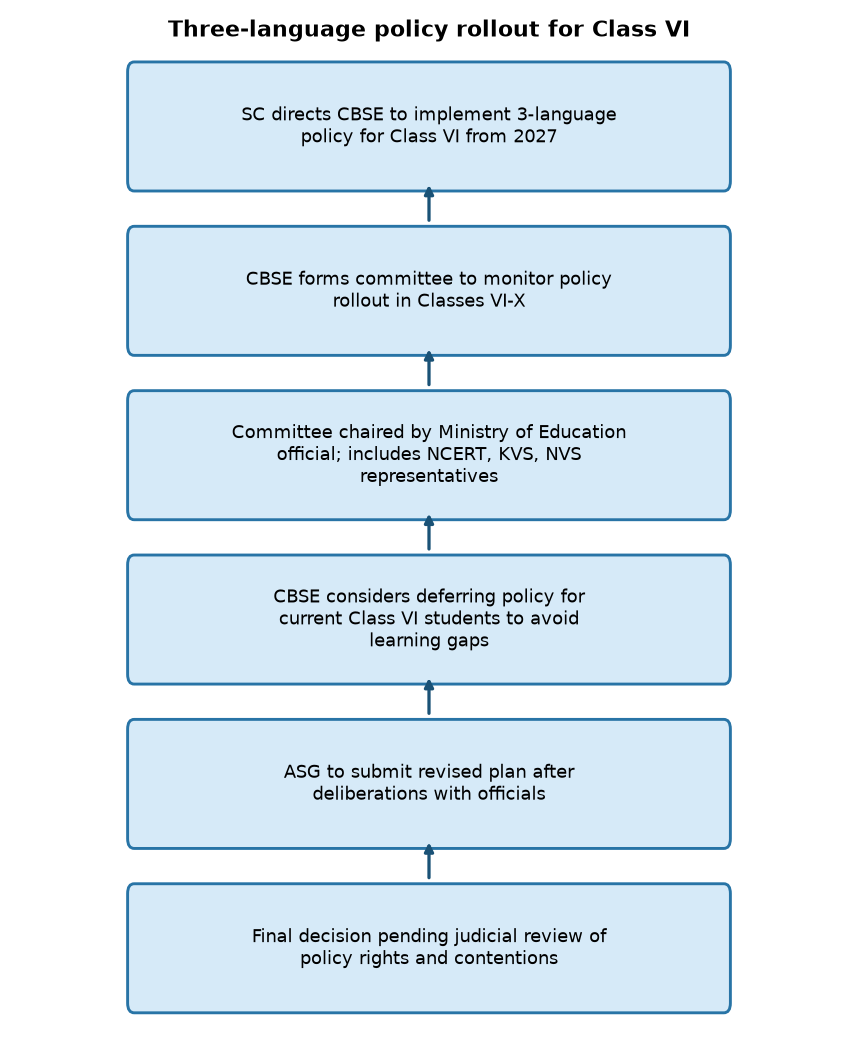
17 Sep Supreme Court directs CBSE to implement three-language policy for Class VI from 2027
✎ The three-language policy in India, rooted in the Kothari Commission’s recommendations and reinforced by the NEP 2020, mandates the study of three languages—including at least two Indian languages—to promote multilingualism and…
Subject Relevance — Where This Topic Fits
- GS Paper II — Fundamental Duties and Directive Principles of State Policy (Article 51A(h)) | GS Paper II — Constitutional Provisions Relating to Education (Article 29, 30, 350A)
- Prelims: Three-language formula, Article 350A, Kothari Commission (1964-66), National Education Policy (NEP) 2020, CBSE Circular on Three-Language Policy, Directive Principles of State Policy (DPSP), Right to Education (RTE) Act, 2009
- Essay: Language and national integration: Balancing unity and diversity in India, The role of education policy in fostering cultural pluralism and social cohesion
Quick Revision: The three-language policy in India, rooted in the Kothari Commission’s recommendations and reinforced by the NEP 2020, mandates the study of three languages—including at least two Indian languages—to promote multilingualism and national integration, while implementation challenges such as resource constraints and learning gaps necessitate judicial and institutional oversight.
Why is this in the news?
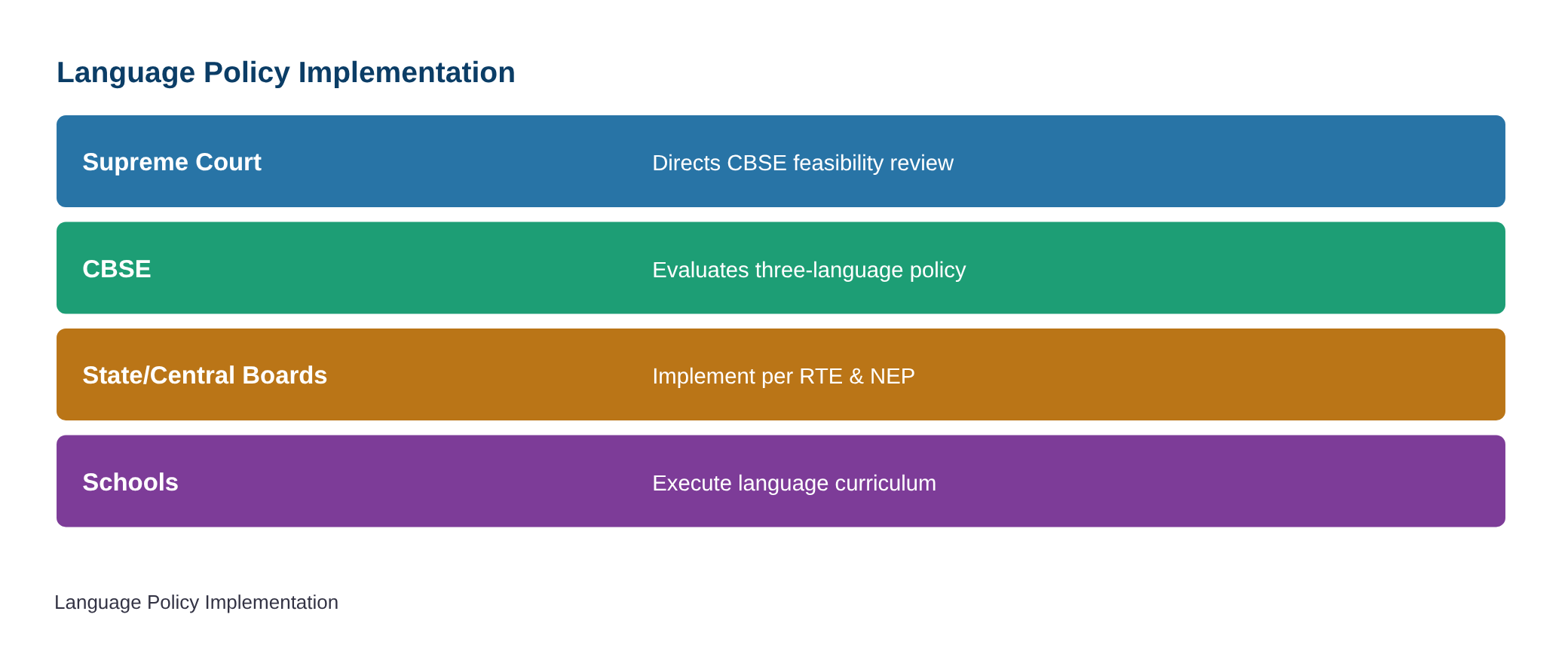
The Supreme Court of India, in a suo motu consideration of a policy challenge, has asked the Central Board of Secondary Education (CBSE) to evaluate the feasibility of implementing the three-language policy for Class VI students from the next academic session starting 2027. The apex court’s intervention underscores the constitutional and pedagogical dimensions of language policy in India’s education system, while also highlighting implementation challenges such as teacher availability, resource constraints, and potential learning gaps.
Background
- The three-language formula was first recommended by the Kothari Commission (1964-66) to promote national integration while respecting regional linguistic diversity.
- The National Education Policy (NEP) 2020 reaffirmed the three-language formula, advocating for flexibility in language choice while ensuring at least two Indian languages are studied.
- The Right to Education (RTE) Act, 2009, mandates free and compulsory education for children aged 6-14 but does not explicitly prescribe language policies, leaving implementation to state and central education boards.
- The Supreme Court’s intervention follows a plea challenging the policy’s feasibility and potential adverse impacts on students, particularly those transitioning between academic sessions.
- The CBSE has constituted a high-level committee chaired by the Director of School Education and Literacy, Ministry of Education, to oversee the implementation of the three-language framework in Classes VI to X.
What is the Three-Language Policy in Indian Education?
- The three-language policy is an educational framework designed to promote multilingualism, national integration, and cultural preservation by mandating the study of three languages in schools.
- The policy typically includes: (a) the mother tongue or regional language, (b) Hindi (for non-Hindi-speaking states) or another Indian language, and (c) English or a foreign language, though variations exist based on regional and state-specific requirements.
- The Kothari Commission (1964-66) first formalized the three-language formula to balance the promotion of Hindi with the protection of regional languages, addressing concerns of linguistic chauvinism and cultural hegemony.
- Article 350A of the Constitution directs states to provide facilities for instruction in the mother tongue at the primary stage of education, reinforcing the policy’s linguistic inclusivity.
- The National Education Policy (NEP) 2020 reaffirms the three-language formula while emphasizing flexibility in language choice to accommodate India’s linguistic diversity and global integration.
- The policy aims to foster cognitive development, enhance communication skills, and prepare students for a multilingual workforce in a globalized economy.
- Critics argue that the policy may impose administrative burdens on schools, exacerbate teacher shortages, and create learning gaps, particularly for students transitioning between language streams.
- Proponents contend that the policy strengthens national unity, preserves cultural heritage, and equips students with linguistic competencies essential for socio-economic mobility.
UPSC Value Addition
Keywords for Mains Answer-Writing
Three-language formula · National Education Policy 2020 · CBSE Class VI curriculum · Supreme Court directive on education policy · Indian languages in school education · Ministry of Education · NCERT textbooks · Language policy implementation challenges · Constitutional provisions on education · Multilingualism in pedagogy
Prelims Practice Questions
Q1. Consider the following statements regarding the Three-Language Formula in India:
1. It mandates the study of three languages in schools, including at least two Indian languages.
2. The Supreme Court has recently directed the CBSE to implement this policy for Class VI students from the academic session 2027.
3. The policy was first introduced in the National Policy on Education, 1968.
4. The CBSE has constituted a committee chaired by the Secretary, Department of School Education and Literacy to oversee its implementation.
How many of the above statements are correct?
- Only one
- Only two
- Only three
- All four
Answer: All four — Statements 1, 2, and 4 are correct. Statement 3 is incorrect as the Three-Language Formula was introduced in the National Policy on Education, 1986, not 1968.
Q2. Assertion (A): The Supreme Court has directed the CBSE to implement the Three-Language Formula for Class VI students from the academic session 2027.
Reason (R): The policy aims to promote multilingualism and preserve native Indian languages in school education.
Options:
A. Both A and R are true, and R is the correct explanation of A.
B. Both A and R are true, but R is not the correct explanation of A.
C. A is true, but R is false.
D. A is false, but R is true.
- A
- B
- C
- D
Answer: B — Both the Assertion (A) and Reason (R) are true. The Supreme Court’s directive to CBSE is indeed aimed at promoting multilingualism and preserving native Indian languages, making R the correct explanation of A.
Q3. Match the following committees/initiatives with their respective roles in the implementation of the Three-Language Formula:
Column I
1. Committee chaired by Bhagwati Prasad Kalal
2. National Council of Educational Research and Training (NCERT)
3. Central Board of Secondary Education (CBSE)
4. Kendriya Vidyalaya Sangathan (KVS)
Column II
A. Develops textbooks and digital content
B. Monitors implementation of the policy in affiliated schools
C. Reviews language options and assesses teacher availability
D. Provides academic support and administrative oversight in central schools
Select the correct match:
1. 1-C, 2-A, 3-B, 4-D
2. 1-B, 2-A, 3-C, 4-D
3. 1-C, 2-B, 3-A, 4-D
4. 1-D, 2-A, 3-B, 4-C
- 1
- 2
- 3
- 4
Answer: 2 — The correct match is: 1-C (Committee chaired by Bhagwati Prasad Kalal reviews language options and assesses teacher availability), 2-A (NCERT develops textbooks and digital content), 3-B (CBSE monitors implementation in affiliated schools), 4-D (KVS provides academic support and administrative oversight).
Mains Practice Question
✍ Critically examine the constitutional and pedagogical rationale behind the Three-Language Formula in India. Also, analyse the challenges in its implementation, particularly in the context of the Supreme Court’s recent directive to the CBSE for its adoption in Class VI from the academic session 2027. (15 Marks)
Approach: MODEL-ANSWER SKELETON:
1. **Constitutional and Pedagogical Rationale** (6 points):
– **Constitutional Basis**: Article 29(2) and 350A of the Constitution emphasize the preservation of minority languages and the promotion of mother-tongue education.
– **National Education Policy (NEP) 2020**: Advocates for a multilingual approach, citing cognitive benefits and cultural preservation.
– **Three-Language Formula**: Introduced in the National Policy on Education, 1986, to balance regional, national, and international languages.
– **Pedagogical Justification**: Multilingualism enhances cognitive flexibility, cultural identity, and socio-economic mobility (citing studies by Bialystok, 2009, or Indian scholars like Dr. B. R. Ambedkar’s emphasis on education).
– **Link to NEP 2020**: NEP 2020 reaffirms the formula, aiming for a seamless transition from school to higher education.
– **Supreme Court’s Role**: The judiciary’s intervention underscores the need for uniformity in educational standards (e.g., Unnikrishnan vs. State of Andhra Pradesh, 1993).
2. **Challenges in Implementation** (5 points):
– **Resource Constraints**: Shortage of qualified teachers in regional languages and lack of standardized textbooks (e.g., NCERT’s role in curriculum development).
– **Curricular Overload**: Potential for increased academic pressure on students, particularly in Class VI.
– **Regional Disparities**: Uneven availability of language options across states (e.g., Hindi-speaking vs. non-Hindi-speaking states).
– **Administrative Bottlenecks**: CBSE’s note highlights the need for a phased rollout to avoid learning gaps (Supreme Court’s suggestion for deferral).
– **Cultural Resistance**: Local communities may resist the imposition of certain languages due to identity politics.
3. **Balancing Views and Way Forward** (4 points):
– **Proponents’ View**: Argue that the formula fosters national integration and global competitiveness (e.g., India’s demographic dividend).
– **Critics’ View**: Highlight the risk of elitism (e.g., English as a dominant language) and the neglect of indigenous languages.
– **Policy Recommendations**: Suggest a flexible implementation model (e.g., state-specific adaptations) and teacher training programs.
– **Judicial Precedent**: The Supreme Court’s directive aligns with its role in ensuring equitable education (e.g., Right to Education Act, 2009).
**Key Takeaway**: The Three-Language Formula is a well-intentioned policy with strong constitutional and pedagogical foundations, but its success hinges on addressing implementation challenges through collaborative governance and resource allocation.
Source: orissapost.com
Generated by AanyaAi for educational purpose.
Related guides on our sites
- Anthropology VS PSIR
- Best PSIR optional coaching
- Best PSIR optional coaching online
- Best PSIR optional teacher

- यूएन महासभा में भारत के विदेश मंत्री जयशंकर के उच्चस्तरीय दौरे का महत्व - September 21, 2026
- मध्य प्रदेश: हाईकोर्ट ने बलात्कार मामले में आरोपी को डीएनए सबूत के आधार पर किया दोषमुक्त - September 21, 2026
- MP High Court Acquits Rape Convict Due to Negative DNA Evidence - September 21, 2026

No Comments