


18 Sep Adarana-3 Scheme Relaunch: Pensions for Vishwabrahmin Artisans at 50
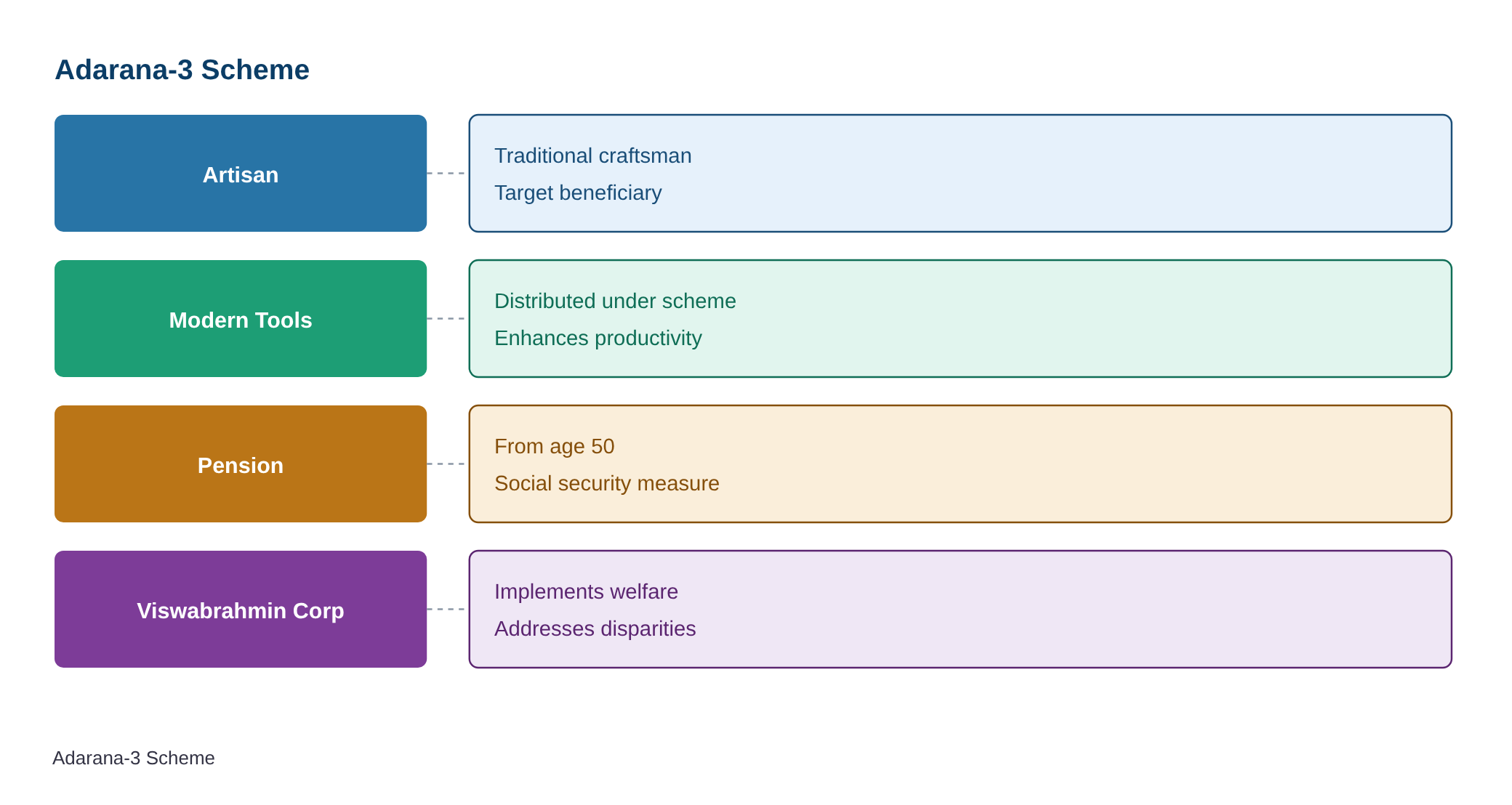
✎ Adarana-3 is a state-led scheme in Andhra Pradesh aimed at modernising traditional artisanal practices through the provision of modern tools and the introduction of pensions for artisans from the age of 50, with implementation…
Subject Relevance — Where This Topic Fits
- GS Paper II — Governance, Welfare Schemes for Vulnerable Sections | GS Paper III — Development and Employment in Rural and Artisanal Sectors
- Prelims: Adarana scheme, Viswabrahmin Welfare and Development Corporation, Vishwakarma Bhagavan Jayanti, artisan pensions, modernisation of traditional crafts
- Essay: The role of state-led welfare schemes in preserving cultural heritage while fostering economic empowerment, Balancing tradition and modernity: The challenge of integrating artisanal livelihoods with contemporary economic models
Quick Revision: Adarana-3 is a state-led scheme in Andhra Pradesh aimed at modernising traditional artisanal practices through the provision of modern tools and the introduction of pensions for artisans from the age of 50, with implementation overseen by the Viswabrahmin Welfare and Development Corporation.
Why is this in the news?
The Andhra Pradesh government is set to relaunch the Adarana-3 scheme, aimed at distributing modern tools to traditional artisans, particularly Vishwabrahmins, as part of a broader welfare initiative. This development follows a proposal to introduce pensions for artisans from the age of 50, reflecting the state’s commitment to the economic and social upliftment of this historically marginalised community. The announcement was made during the State-level celebrations of Devashilpi Virat Vishwakarma Bhagavan Jayanti, underscoring the cultural and economic significance of artisans in the state.
Background
- The Adarana scheme was first introduced in Andhra Pradesh to modernise traditional artisanal practices and enhance the livelihoods of artisans, particularly those belonging to the Vishwabrahmins, a community traditionally associated with craftsmanship and temple architecture.
- The scheme aligns with the broader objectives of the Viswabrahmin Welfare and Development Corporation, which was established to address the socio-economic challenges faced by Vishwabrahmins, including limited access to resources, market linkages, and financial security.
- Artisans in India, including those in Andhra Pradesh, have historically faced challenges such as declining demand for handcrafted goods, lack of access to modern tools, and inadequate social security measures, which have exacerbated their vulnerability to economic shocks.
- The Vishwakarma Bhagavan Jayanti celebrations, held annually, serve as a platform to recognise the contributions of artisans to cultural heritage and to advocate for their welfare through policy interventions.
- The proposal for pensions for artisans from the age of 50 is a significant step towards providing social security, addressing the precarious nature of artisanal livelihoods, which often lack formal employment benefits or retirement provisions.
What is the Adarana-3 Scheme?
- The Adarana scheme is a state-led initiative in Andhra Pradesh designed to modernise traditional artisanal practices by providing artisans with access to contemporary tools, machinery, and training.
- Adarana-3, the latest iteration of the scheme, is expected to focus on the distribution of modern equipment to artisans, thereby enhancing their productivity and competitiveness in the market.
- The scheme targets Vishwabrahmins, a community historically engaged in craftsmanship, temple architecture, and allied professions, with the aim of preserving their cultural heritage while improving their economic prospects.
- A key component of the relaunch is the proposal to introduce pensions for artisans from the age of 50, which would provide a financial safety net and address the lack of formal retirement benefits in artisanal professions.
- The scheme is implemented through the Viswabrahmin Welfare and Development Corporation, which coordinates with the Backward Classes Welfare Department to ensure targeted delivery of benefits.
- The modernisation of traditional crafts under Adarana-3 is expected to bridge the gap between artisanal practices and contemporary market demands, thereby enhancing the sustainability of these livelihoods.
- The scheme also includes provisions for skill upgradation and capacity-building initiatives to ensure that artisans remain competitive in a rapidly evolving economic landscape.
- The relaunch of Adarana-3 is part of a broader welfare agenda in Andhra Pradesh, which prioritises the socio-economic development of marginalised communities, including artisans.
Key Features
| Feature | Significance |
|---|---|
| Relaunch of Adarana-3 | A targeted welfare initiative aimed at modernising traditional artisan communities by providing advanced tools and equipment. |
| Pension provision for artisans aged 50+ | A proposed social security measure to ensure financial stability for Vishwabrahmin artisans post-retirement. |
| State-level Vishwakarma Jayanti celebrations | Institutional recognition of the cultural and economic contributions of traditional artisans, fostering community pride and engagement. |
| Special action plan for Vishwabrahmin community | A structured policy framework to address socio-economic challenges faced by the artisan class. |
| Distribution of modern tools | Enhancement of productivity and competitiveness of artisans through technological upgradation. |
Why it Matters
Economic
- Promotes formalisation and technological adoption among traditional artisans, bridging the gap between heritage craftsmanship and modern market demands.
- Enhances income security for artisans through pension provisions, reducing vulnerability to economic shocks.
- Strengthens local economies by sustaining artisanal livelihoods, which are often community-centric and culturally rooted.
Social
- Recognises and preserves intangible cultural heritage by supporting artisans who are custodians of traditional knowledge systems.
- Empowers marginalised artisan communities through institutional welfare measures, addressing historical socio-economic disparities.
- Fosters inter-generational knowledge transfer by ensuring the viability of artisanal professions.
Policy
- Demonstrates a state-led approach to inclusive development, integrating cultural preservation with socio-economic upliftment.
- Highlights the role of specialised corporations (e.g., Viswabrahmin Welfare and Development Corporation) in targeted welfare delivery.
- Illustrates the alignment of cultural policy with economic policy to achieve holistic community development.
Challenges
1. Implementation Gaps in Artisan Welfare Schemes
- Disparities in access to scheme benefits due to geographical, informational, or bureaucratic barriers.
- Inadequate monitoring mechanisms to ensure equitable distribution of tools and pensions.
- Low awareness among target beneficiaries regarding eligibility and application processes.
UPSC Link: GS-II: Welfare schemes for vulnerable sections
2. Sustainability of Artisanal Livelihoods
- Competition from mass-produced goods and lack of market linkages threaten traditional craftsmanship.
- Aging artisan population with limited succession planning, risking loss of traditional skills.
- Climate change and resource depletion impacting availability of raw materials for artisans.
UPSC Link: GS-III: Employment and livelihood
3. Institutional Coordination
- Need for seamless collaboration between state corporations, departments, and local bodies for effective scheme delivery.
- Potential delays in policy approvals and fund disbursements due to multi-tiered governance structures.
UPSC Link: GS-II: Government policies and interventions
Challenges — UPSC Perspective
| Issue | Concern |
|---|---|
| Awareness deficit | Limited outreach to artisans in remote or marginalised regions. |
| Bureaucratic delays | Slow processing of proposals and disbursements under the pension scheme. |
| Market access | Inadequate platforms for artisans to showcase and sell their products. |
| Skill attrition | Declining interest among youth in traditional artisanal professions. |
| Resource constraints | Insufficient funding for modern tools and infrastructure upgradation. |
| Monitoring inefficiencies | Lack of real-time tracking of scheme utilisation and impact. |
Government Initiatives — Must-Memorise for Prelims
- Adarana-3
- Viswabrahmin Welfare and Development Corporation initiatives
Way Forward
- Conduct district-wise awareness campaigns to educate artisans about eligibility and benefits.
- Establish a grievance redressal mechanism for timely resolution of implementation issues.
- Strengthen market linkages through partnerships with e-commerce platforms and craft fairs.
- Introduce skill upgradation programmes to enhance artisans’ adaptability to modern demands.
- Develop a centralised database of artisans for targeted and transparent benefit delivery.
- Allocate dedicated funds for research and development in traditional craftsmanship.
- Promote public-private partnerships to scale up tool distribution and pension schemes.
- Integrate climate-resilient practices in artisanal training to address environmental challenges.
UPSC Value Addition
Keywords for Mains Answer-Writing
Adarana-3 scheme · Viswabrahmin Corporation · artisan welfare · pension for artisans · traditional crafts · backward classes welfare · state-level schemes · economic empowerment of artisans · modern tools for artisans · Andhra Pradesh government initiatives · Vishwakarma Bhagavan Jayanti · artisan pension schemes · backward classes development · craft-based livelihoods · government schemes for marginalised communities
Constitutional & Policy Linkages
- Article 46: Promotion of educational and economic interests of weaker sections.
- Article 38: Directive Principles of State Policy on securing social and economic justice.
Concept Flow
State recognition of traditional artisans’ cultural and economic contributions → Policy formulation (Adarana-3 and pension proposal) → Institutional mechanisms (Viswabrahmin Corporation) → Implementation (tool distribution and pension disbursement) → Impact assessment and feedback loop for continuous improvement.
Prelims Practice Questions
Q1. Consider the following statements regarding the Adarana-3 scheme:
1. It is a welfare scheme for traditional artisans.
2. It aims to provide modern tools to artisans.
3. It includes a proposal to provide pensions to artisans from the age of 50.
4. It is implemented exclusively by the central government.
How many of the above statements are correct?
- Only one
- Only two
- Only three
- All
Answer: Only three — Statements 1, 2, and 3 are correct as they align with the reported objectives of the Adarana-3 scheme. Statement 4 is incorrect because the scheme is implemented by the Andhra Pradesh government, not the central government.
Q2. Which of the following is NOT a stated objective of the Adarana-3 scheme as reported in the news?
- Provision of modern tools to artisans
- Distribution of pensions to artisans from the age of 50
- Promotion of traditional dance forms
- Economic development of Vishwabrahmins
Answer: Promotion of traditional dance forms — The Adarana-3 scheme focuses on providing modern tools to artisans, economic development, and pension proposals for artisans. Promotion of traditional dance forms is not mentioned as an objective in the report.
Q3. Assertion (A): The Adarana-3 scheme is a state-level initiative by the Andhra Pradesh government.
Reason (R): The scheme aims to provide pensions to artisans from the age of 50 and distribute modern tools to traditional craftsmen.
In the context of the above statements, which of the following is correct?
- Both A and R are true, and R is the correct explanation of A
- Both A and R are true, but R is not the correct explanation of A
- A is true, but R is false
- A is false, but R is true
Answer: Both A and R are true, but R is not the correct explanation of A — Both the assertion and reason are true. The Adarana-3 scheme is indeed a state-level initiative by the Andhra Pradesh government (A), and the provision of pensions and modern tools (R) are its stated objectives, making R the correct explanation of A.
Mains Practice Question
✍ The Adarana-3 scheme represents a state-led initiative to address the socio-economic challenges faced by traditional artisans. Critically examine the significance of such schemes in the context of India’s craft-based livelihoods and the constitutional mandate for the welfare of backward classes. (15 Marks)
Approach: MODEL-ANSWER SKELETON:
1. **Context and Objectives**: Define the Adarana-3 scheme (provision of modern tools, pension proposals, economic empowerment) and its alignment with state welfare policies for artisans.
2. **Constitutional Framework**: Reference Articles 46 (Directive Principles of State Policy) and 29(2) (protection of cultural and educational rights of minorities) as the constitutional basis for such schemes. Highlight the role of state governments in implementing welfare measures under the Seventh Schedule (State List, Entry 25: Welfare of backward classes).
3. **Economic and Social Significance**:
– **Livelihood Sustainability**: Discuss the decline of traditional crafts due to market competition, lack of access to modern tools, and inadequate social security.
– **Pension Proposals**: Evaluate the proposal to provide pensions from age 50 as a measure to address the vulnerability of artisans in old age, citing examples of similar schemes (e.g., PM Kisan Maan-Dhan Yojana for farmers).
– **Cultural Preservation**: Emphasise the scheme’s role in preserving India’s intangible cultural heritage (UNESCO’s 2003 Convention for the Safeguarding of the Intangible Cultural Heritage).
4. **Challenges and Criticisms**:
– **Implementation Gaps**: Highlight issues such as bureaucratic delays, lack of awareness, and inadequate funding.
– **Sustainability**: Discuss the long-term viability of such schemes without robust market linkages or skill upgradation.
5. **Comparative Perspective**: Compare with other state-led artisan welfare schemes (e.g., Tamil Nadu’s ‘Kalaignar’ scheme, Karnataka’s ‘Unnati’ programme) to illustrate best practices.
6. **Conclusion**: Summarise the scheme’s potential to enhance artisan welfare while acknowledging the need for multi-stakeholder collaboration (government, NGOs, market) for sustainable impact.
Source: The Hindu
Generated by AanyaAi for educational purpose.
Related guides on our sites
- Current affairs for upsc 2026
- Best PSIR optional coaching for upsc
- Best PSIR optional teacher for upsc
- Best teacher of PSIR optional for upsc

- Adarana-3 Scheme Relaunch: Pensions for Vishwabrahmin Artisans at 50 - September 18, 2026
- डाक विभाग का विशेष अभियान 6: स्वच्छता और ई-कचरे के निपटान पर फोकस - September 18, 2026
- UPSC Alert: Postal Dept Launches Swachhata Abhiyan 6 for E-Waste & Pending Cases - September 18, 2026

No Comments