


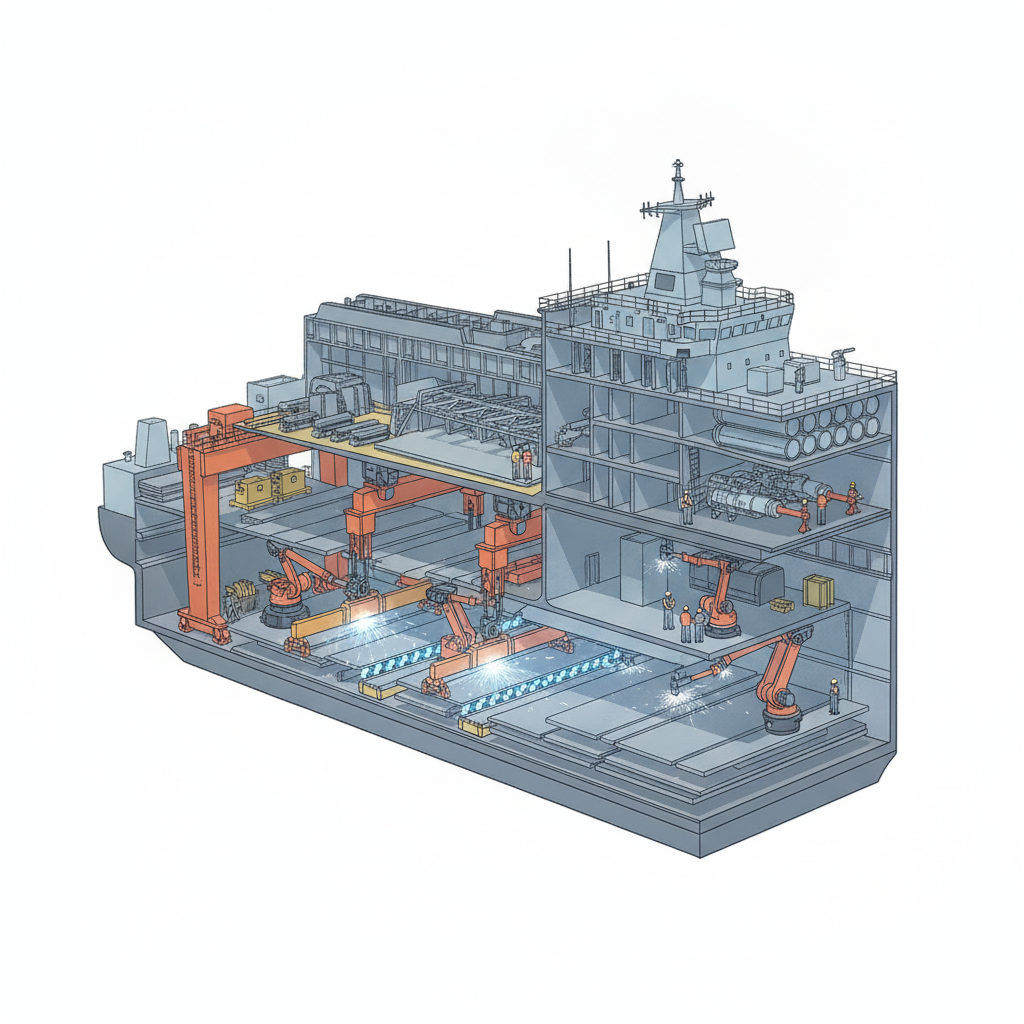
18 Sep UPSC Alert: Indian Navy’s 2nd Next-Gen Missile Vessel Steel Cutting at CSL Kochi
✎ The NGMV project represents a critical step in India’s indigenous naval modernisation, with the second vessel’s steel cutting ceremony at CSL, Kochi, underscoring the nation’s commitment to self-reliance in defence manufacturing…
Subject Relevance — Where This Topic Fits
- GS Paper III — Science and Technology (Indigenous Defence Manufacturing) | GS Paper III — Security Challenges and Defence Preparedness | GS Paper III — Government Schemes and Initiatives (Atmanirbhar Bharat, Make in India)
- Prelims: Next-Generation Missile Vessel (NGMV), Cochin Shipyard Limited (CSL), Atmanirbhar Bharat in Defence, Indigenous defence production, Steel cutting ceremony, Indian Navy’s Project 18, Rear Admiral Kapil Mehta, Hind Mahasagar region operations
- Essay: India’s journey towards self-reliance in defence manufacturing: Challenges and opportunities, The role of indigenous innovation in enhancing national security and strategic autonomy
Quick Revision: The NGMV project represents a critical step in India’s indigenous naval modernisation, with the second vessel’s steel cutting ceremony at CSL, Kochi, underscoring the nation’s commitment to self-reliance in defence manufacturing and operational readiness in the Indian Ocean Region.
Why is this in the news?
The steel cutting ceremony of the second Next-Generation Missile Vessel (NGMV) for the Indian Navy, held at Cochin Shipyard Limited (CSL), Kochi, on 17 September 2026, marks a significant milestone in India’s indigenous defence manufacturing capabilities. This event underscores the strategic commitment of the Indian Navy to modernise its fleet with advanced, domestically produced warships, aligning with the broader national initiatives of ‘Atmanirbhar Bharat’ and ‘Make in India’. The NGMV project is a critical component of India’s naval modernisation strategy, aimed at enhancing operational readiness in the complex maritime environment of the Indian Ocean Region (IOR).
Background
- The Indian Navy’s modernisation programme is a multi-decade endeavour aimed at transforming the fleet into a technologically advanced and combat-ready force, capable of addressing emerging maritime security challenges.
- The Next-Generation Missile Vessel (NGMV) project is part of the Indian Navy’s modernisation efforts, which envisages the construction of advanced guided-missile vessels equipped with state-of-the-art weaponry and sensors.
- The contract for the construction of the NGMVs was concluded between the Ministry of Defence and Cochin Shipyard Limited (CSL) in March 2023.
- CSL, a premier shipbuilding yard, is a key player in India’s indigenous shipbuilding industry, with a proven track record in constructing warships, including the INS Vikrant (Indigenous Aircraft Carrier).
- The Indian Ocean Region (IOR) presents complex maritime security challenges, including piracy, illegal fishing, and strategic competition, necessitating a robust and modern naval fleet.
- India’s defence production strategy, encapsulated in initiatives like ‘Atmanirbharta’ (self-reliance) and ‘Make in India’, aims to reduce import dependency and enhance indigenous manufacturing capabilities in critical sectors, including defence.
What is the Next-Generation Missile Vessel (NGMV) Project?
- The NGMV project is a naval modernisation initiative designed to construct advanced guided-missile vessels with enhanced combat capabilities.
- The NGMVs are intended to replace older missile vessels in the Indian Navy’s fleet, providing a significant boost to its offensive and defensive operational capabilities in the Indian Ocean Region (IOR).
- Each NGMV will be equipped with state-of-the-art weaponry, sensors, and communication systems, ensuring ‘future-ready’ combat readiness.
- The vessels are being constructed indigenously by Cochin Shipyard Limited (CSL), Kochi, leveraging advanced shipbuilding technologies and domestic manufacturing capabilities.
- The project exemplifies India’s commitment to self-reliance in defence manufacturing, as all major systems and equipment are being developed and produced domestically, in line with the ‘Atmanirbhar Bharat’ and ‘Make in India’ initiatives.
- The NGMVs are designed to operate effectively in the challenging maritime environment of the Indian Ocean, including high-sea conditions and littoral waters, ensuring operational flexibility and survivability.
- The construction of the NGMVs is part of a broader naval modernisation programme, which includes the induction of aircraft carriers, submarines, and other advanced platforms to enhance India’s maritime security architecture.
Key Features
| Feature | Significance |
|---|---|
| Steel cutting of second Next Generation Missile Vessel (NGMV) | Initiates the physical construction phase of the vessel, marking a critical milestone in indigenous warship production. |
| Advanced weaponry and sensor integration | Enhances combat capabilities, aligning with the Indian Navy’s vision of a ‘future-ready and combat-ready’ force. |
| Indigenous development of mission-critical equipment | Demonstrates self-reliance in defence manufacturing, reducing import dependency and strengthening the ‘Make in India’ ecosystem. |
| Construction at Cochin Shipyard Limited (CSL), Kochi | Leverages India’s premier shipbuilding infrastructure, ensuring high standards of quality and timely delivery. |
| Design for complex maritime environments of the Indian Ocean Region (IOR) | Ensures operational effectiveness in the strategically significant IOR, supporting India’s maritime security objectives. |
Why it Matters
Strategic Security
- Augments the Indian Navy’s combat readiness by introducing modern, technologically advanced missile vessels capable of multi-role operations.
- Strengthens India’s maritime domain awareness and deterrence posture in the Indian Ocean Region, a critical area for global trade and security.
- Supports India’s ‘SAGAR’ (Security and Growth for All in the Region) vision by enhancing regional stability through a robust naval presence.
Indigenous Defence Manufacturing
- Promotes self-reliance in defence production, reducing reliance on foreign suppliers and enhancing India’s strategic autonomy.
- Fosters innovation and skill development within the domestic defence industrial base, particularly in shipbuilding and naval systems.
- Contributes to the ‘Atmanirbhar Bharat’ initiative by demonstrating India’s capability to design, develop, and manufacture advanced naval platforms.
Economic Impact
- Boosts employment and industrial capacity in the shipbuilding sector, particularly in Kerala and coastal regions.
- Generates ancillary economic activity through supply chain linkages with MSMEs and ancillary industries across the country.
- Enhances India’s export potential in defence platforms, aligning with the ‘Make for the World’ initiative.
Technological Advancement
- Incorporates cutting-edge technologies in weaponry, sensors, and platform design, positioning India at the forefront of naval innovation.
- Encourages collaboration between defence PSUs, private sector, and research institutions to develop indigenous solutions.
- Serves as a catalyst for further R&D in naval architecture, propulsion systems, and integrated combat systems.
Challenges
1. Indigenous Technology Maturation
- Ensuring the reliability and combat effectiveness of domestically developed systems, particularly advanced sensors and weaponry.
- Balancing the need for rapid deployment with rigorous testing and validation to meet operational standards.
UPSC Link: GS3: Defence indigenisation
2. Supply Chain and Vendor Development
- Addressing bottlenecks in the supply chain for critical components, including electronics, propulsion systems, and structural materials.
- Strengthening the ecosystem of MSMEs and ancillary industries to support large-scale defence manufacturing.
UPSC Link: GS3: Industrial policy
3. Cost and Time Overruns
- Mitigating risks of delays in project timelines due to technical challenges, regulatory hurdles, or external factors.
- Ensuring fiscal discipline while maintaining quality and innovation in defence procurement.
UPSC Link: GS3: Defence procurement
4. Skilled Manpower Development
- Addressing the shortage of skilled labour in advanced shipbuilding and naval systems integration.
- Investing in vocational training, apprenticeship programs, and partnerships with educational institutions to build a future-ready workforce.
UPSC Link: GS3: Skill development
5. Integration with Existing Fleet
- Ensuring seamless interoperability and compatibility of new vessels with existing naval platforms and command-and-control systems.
- Managing the transition and training requirements for naval personnel to operate and maintain the advanced systems.
UPSC Link: GS3: Naval modernisation
Challenges — UPSC Perspective
| Issue | Concern |
|---|---|
| Technology readiness | Risk of delays due to unproven indigenous systems in critical naval applications. |
| Vendor dependency | Over-reliance on a limited number of domestic suppliers for advanced components. |
| Regulatory compliance | Navigating complex defence procurement and certification processes. |
| Global supply chain disruptions | Potential delays in importing specialised materials or components. |
| Human resource constraints | Shortage of trained personnel for shipbuilding, system integration, and maintenance. |
| Cost escalation | Pressure to balance innovation with budgetary constraints in defence spending. |
Government Initiatives — Must-Memorise for Prelims
- Make in India (Defence Sector)
- Atmanirbhar Bharat (Defence Manufacturing)
Way Forward
- Accelerate indigenous R&D in naval systems, particularly sensors, propulsion, and combat management systems, to reduce import dependency.
- Strengthen the defence industrial base by fostering partnerships between PSUs, private sector, and MSMEs for component manufacturing.
- Invest in skill development programs focused on shipbuilding, naval architecture, and advanced manufacturing technologies.
- Streamline defence procurement processes to ensure timely approvals, cost control, and adherence to project timelines.
- Enhance collaboration between the Indian Navy, DRDO, and academic institutions to drive innovation in naval technologies.
- Develop a robust vendor development program to nurture domestic suppliers and reduce supply chain vulnerabilities.
- Establish a dedicated fund for rapid prototyping and testing of indigenous naval systems to expedite deployment.
- Promote export-oriented defence manufacturing by showcasing India’s capabilities in global markets.
UPSC Value Addition
Keywords for Mains Answer-Writing
Next Generation Missile Vessel (NGMV) · Cochin Shipyard Limited (CSL) · Indian Navy modernisation · Indigenous warship construction · Make in India initiative · Atmanirbhar Bharat · Defence Production Policy 2020 · Hind Mahasagar naval capabilities · Steel cutting ceremony · Maritime security framework · Defence Acquisition Procedure 2020 · Naval indigenous technology development
Concept Flow
Indian Navy’s requirement for modern, multi-role missile vessels to enhance combat readiness. → Initiation of the Next Generation Missile Vessel (NGMV) project under indigenous design and construction. → Award of contract to Cochin Shipyard Limited (CSL) in March 2023 for the construction of NGMVs. → Steel cutting ceremony marks the commencement of physical construction, initiating the shipbuilding process. → Integration of advanced weaponry, sensors, and indigenous systems to achieve ‘future-ready’ capabilities. → Delivery and commissioning of vessels, enhancing the Indian Navy’s operational effectiveness in the Indian Ocean Region. → Continuous feedback loop for technology upgrades and indigenous innovation in naval platforms.
Prelims Practice Questions
Q1. Consider the following statements regarding the Next Generation Missile Vessel (NGMV) project:
1. The NGMV project is being executed by Cochin Shipyard Limited (CSL) under a contract signed in March 2023.
2. The NGMV vessels are designed to operate exclusively in the Pacific Ocean region.
3. The project aligns with the ‘Make in India’ and ‘Atmanirbhar Bharat’ initiatives of the Government of India.
4. The NGMV vessels will be equipped with indigenous sensors and weapons systems.
How many of the above statements are correct?
- Only one
- Only two
- Only three
- All
Answer: All — Statements 1, 3, and 4 are correct. Statement 2 is incorrect as the NGMV vessels are designed for operations in the Indian Ocean region, not the Pacific Ocean.
Q2. Assertion (A): The ‘Steel Cutting’ ceremony marks the commencement of the actual construction phase of a warship.
Reason (R): It signifies the initiation of the fabrication process where steel plates are cut and assembled as per the ship’s design.
Options:
A. Both A and R are true, and R is the correct explanation of A.
B. Both A and R are true, but R is not the correct explanation of A.
C. A is true, but R is false.
D. A is false, but R is true.
Answer: ? — Both the Assertion (A) and Reason (R) are true, and R correctly explains A. The steel cutting ceremony is a symbolic and practical initiation of the shipbuilding process.
Q3. Match the following initiatives with their respective objectives:
Column I (Initiative) | Column II (Objective)
———————————————–|———————————————–
1. Make in India | A. Promoting self-reliance in defence production
2. Atmanirbhar Bharat | B. Encouraging local manufacturing and innovation
3. Defence Production Policy 2020 | C. Enhancing indigenous capability in defence
4. Next Generation Missile Vessel (NGMV) | D. Modernising naval combat capabilities
Options:
A. 1-B, 2-A, 3-C, 4-D
B. 1-A, 2-B, 3-C, 4-D
C. 1-B, 2-C, 3-A, 4-D
D. 1-C, 2-B, 3-A, 4-D
Answer: ? — The correct match is: 1-B (Make in India encourages local manufacturing), 2-A (Atmanirbhar Bharat promotes self-reliance), 3-C (Defence Production Policy 2020 aims to enhance indigenous capability), and 4-D (NGMV modernises naval combat capabilities).
Mains Practice Question
✍ The construction of the Next Generation Missile Vessel (NGMV) by Cochin Shipyard Limited (CSL) represents a significant milestone in India’s indigenous warship-building capabilities. Critically examine the strategic significance of the NGMV project for India’s maritime security architecture. Also, analyse how this project aligns with the broader objectives of the Defence Production Policy 2020 and the ‘Atmanirbhar Bharat’ initiative. (15 Marks)
Approach: MODEL-ANSWER SKELETON:
1. **Strategic Significance of NGMV Project**:
– Enhancement of naval combat capabilities in the Indian Ocean Region (IOR).
– Strengthening India’s maritime security framework amid geopolitical shifts.
– Contribution to the ‘Blue Water Navy’ ambition and projection of power.
– Integration with the broader maritime security doctrine (e.g., SAGAR initiative).
2. **Indigenous Warship Construction**:
– Reduction in dependence on foreign defence imports.
– Development of a robust domestic defence industrial base.
– Technological self-reliance in critical areas such as sensors, weapons, and propulsion systems.
3. **Alignment with Defence Production Policy 2020**:
– Emphasis on indigenous design, development, and manufacturing.
– Promotion of private sector participation and MSMEs in defence production.
– Focus on reducing import dependency and achieving self-sufficiency in defence equipment.
4. **Integration with ‘Atmanirbhar Bharat’ Initiative**:
– Direct contribution to the ‘Make in India’ and ‘Make for the World’ pillars.
– Creation of employment opportunities and skill development in the defence sector.
– Enhancement of India’s export potential in defence technologies.
5. **Challenges and Way Forward**:
– Ensuring timely delivery and quality control in indigenous projects.
– Addressing technological gaps and sustaining innovation.
– Strengthening public-private partnerships and R&D investments.
Source: PIB (Press Information Bureau)
Kerala PCS (Kerala PSC (KAS)) — State PCS Practice
Prelims: Which of the following organizations is responsible for the construction of the second Next Generation Missile Vessel (NGMV) for the Indian Navy at Cochin Shipyard Limited, Kochi?
- A. Garden Reach Shipbuilders and Engineers (GRSE), Kolkata
- B. Mazagon Dock Shipbuilders Limited (MDL), Mumbai
- C. Cochin Shipyard Limited (CSL), Kochi
- D. Goa Shipyard Limited (GSL), Goa
Answer: C. Cochin Shipyard Limited (CSL), Kochi — Cochin Shipyard Limited (CSL), Kochi, is the designated organization for constructing the second Next Generation Missile Vessel (NGMV) for the Indian Navy.
Mains: Discuss the significance of the construction of the second Next Generation Missile Vessel (NGMV) at Cochin Shipyard Limited, Kochi, for the Indian Navy and its strategic implications for India’s maritime security.
Generated by AanyaAi for educational purpose.
Related guides on our sites
- Current affairs for upsc 2026
- How to prepare for GS paper 1 for UPSC CSE mains exam
- Best UPSC coaching for IFOS exam
- Best mentorship programme for upsc

- CCI Approves Acquisition of Rajasthan Royals & Two Global Cricket Franchises - September 18, 2026
- दक्षिणी राज्यों के कृषि रोडमैप: शिवराज सिंह चौहान का लक्ष्य-निर्धारण और परिणामों पर जोर - September 18, 2026
- Shivraj Singh Chouhan Urges Southern States to Fast-Track Agricultural Reforms for UPSC 2026 - September 18, 2026

No Comments