


19 Sep Telangana HC jails police officer for 1 month in contempt case
✎ Contempt of Court, as defined under the Contempt of Courts Act, 1971, is a legal mechanism to ensure compliance with judicial orders and uphold the authority of the judiciary.
Subject Relevance — Where This Topic Fits
- GS Paper II — Judiciary and Constitutional Framework | GS Paper III — Role of Police and Law Enforcement
- Prelims: Contempt of Court Act, 1971, Judicial Review, Judicial Accountability, Protection from Arrest, Police Reforms, Judicial Orders and Compliance
- Essay: Judicial Independence vs. Executive Accountability, Rule of Law and its Enforcement in a Democratic Setup
Quick Revision: Contempt of Court, as defined under the Contempt of Courts Act, 1971, is a legal mechanism to ensure compliance with judicial orders and uphold the authority of the judiciary.
Why is this in the news?
The Telangana High Court’s sentencing of a police officer to one-month imprisonment for contempt of court underscores the legal principle that judicial orders must be strictly adhered to by all authorities, including law enforcement. The case highlights the consequences of non-compliance with judicial directives, particularly in matters involving personal liberty, and reinforces the doctrine of judicial supremacy in upholding constitutional guarantees.
Background
- The Contempt of Courts Act, 1971, defines and regulates the powers of courts to punish acts that scandalise or obstruct the administration of justice.
- Judicial orders, including those granting protection from arrest, are binding on all authorities and individuals, as per Article 141 (doctrine of judicial precedent).
- Police officers, as state functionaries, are duty-bound to comply with judicial orders, failing which they may face contempt proceedings.
- The case involved a dowry death investigation where the High Court had explicitly directed that the accused not be arrested until a specified date.
- The arrest of the accused despite the judicial order led to a contempt petition, resulting in the officer’s conviction.
- The suspension of the sentence pending appeal reflects the procedural safeguards in contempt cases to allow for judicial review.
Contempt of Court: Legal Framework and Implications
- Contempt of Court refers to any act that obstructs or interferes with the due course of judicial proceedings or diminishes the authority or dignity of the judiciary. It is classified into civil contempt (willful disobedience of court orders) and criminal contempt (scandalising the judiciary or prejudicing judicial proceedings).
- The Contempt of Courts Act, 1971, empowers courts to punish contempt with imprisonment up to six months or a fine, or both. The Act also provides for appeals to higher courts.
- Judicial orders, including interim injunctions and protection orders, are legally enforceable and must be complied with by all authorities, including the police. Non-compliance constitutes contempt.
- The doctrine of judicial review ensures that the judiciary can review and invalidate executive or legislative actions that violate constitutional provisions or judicial orders.
- Police officers, as part of the executive, are subordinate to judicial authority and must ensure strict adherence to court directives to uphold the rule of law.
- Contempt proceedings serve as a mechanism to maintain judicial discipline and ensure that the authority of the judiciary is not undermined by executive overreach.
- The suspension of the sentence pending appeal in the Telangana case aligns with the principle of natural justice, allowing the accused to seek redressal through higher judicial forums.
- The case underscores the importance of institutional accountability, where judicial orders are not merely advisory but legally binding and enforceable.
Key Features
| Feature | Significance |
|---|---|
| Contempt of Court | Ensures adherence to judicial orders, upholding the rule of law and the authority of the judiciary. |
| Judicial Immunity | Protects the judiciary from actions that undermine its dignity and functioning. |
| Protection from Arrest | Safeguards individuals from arbitrary detention pending judicial proceedings. |
| Suspension of Sentence | Allows for appellate review while ensuring immediate compliance with judicial directives. |
| Judicial Scrutiny of Executive Actions | Highlights the judiciary’s oversight role over executive decisions, particularly in law enforcement. |
Why it Matters
Judicial-Executive Relations
- Reinforces the principle that executive actions, including those by police officers, must comply with judicial orders to prevent contempt of court.
- Demonstrates the judiciary’s authority to hold executive officials accountable for violations of court directives, ensuring checks and balances.
- Highlights the need for inter-institutional coordination to prevent conflicts between law enforcement and judicial processes.
Rule of Law and Due Process
- Emphasizes the importance of due process in criminal investigations, particularly in cases involving protective orders.
- Underscores that law enforcement officers must verify judicial orders before taking coercive actions to avoid contempt.
- Serves as a deterrent against arbitrary arrests and ensures respect for judicial safeguards.
Protection of Individual Rights
- Affirms the judiciary’s role in safeguarding individuals from unlawful detention, especially in sensitive cases like dowry deaths.
- Illustrates how judicial orders can act as a shield against potential misuse of police powers.
- Reinforces the constitutional guarantee of personal liberty under Article 21.
Challenges
1. Compliance with Judicial Orders
- Executive agencies often face challenges in real-time awareness of judicial orders, leading to unintended violations.
- Lack of robust internal communication systems within law enforcement agencies can result in oversight.
- Training and sensitization of officers on judicial procedures and contempt laws are essential to mitigate such risks.
UPSC Link: Constitutional Law – Judicial Review
2. Accountability in Law Enforcement
- Instances of contempt highlight systemic gaps in holding officers accountable for procedural lapses.
- Delays in disciplinary action or appeals can undermine public trust in law enforcement.
- Strengthening internal oversight mechanisms is critical to ensure adherence to judicial directives.
UPSC Link: Administrative Law – Delegated Legislation
3. Judicial-Executive Coordination
- Coordination between courts and police departments is often ad-hoc, leading to avoidable conflicts.
- Establishing formal channels for real-time communication of judicial orders can reduce such incidents.
- Judicial activism in contempt cases may strain inter-institutional relations if not balanced with procedural fairness.
UPSC Link: Constitutional Law – Separation of Powers
Challenges — UPSC Perspective
| Issue | Concern |
|---|---|
| Awareness of Judicial Orders | Lack of real-time dissemination of court orders to field officers. |
| Procedural Lapses | Failure to verify protective orders before taking coercive action. |
| Disciplinary Delays | Prolonged appeals process undermining accountability. |
| Inter-Institutional Trust | Potential erosion of trust between judiciary and executive due to contempt findings. |
| Training Gaps | Inadequate sensitization of officers on contempt laws and judicial procedures. |
Way Forward
- Enhance real-time communication systems between courts and law enforcement agencies to ensure immediate awareness of judicial orders.
- Conduct mandatory training programs for police officers on contempt laws, judicial procedures, and due process requirements.
- Strengthen internal oversight mechanisms within police departments to monitor compliance with judicial directives.
- Establish formal protocols for verifying protective orders before initiating arrests in sensitive cases.
- Encourage appellate courts to expedite hearings in contempt cases to ensure timely resolution.
- Promote inter-institutional dialogues between the judiciary and executive to foster mutual understanding and coordination.
- Publicize contempt judgments to deter similar violations and reinforce the rule of law.
UPSC Value Addition
Keywords for Mains Answer-Writing
Contempt of Court · Judicial Independence · Judicial Review · Constitutional Morality · Judicial Contempt Jurisdiction · Judicial Process · Judicial Accountability · Protection from Arrest · Judicial Orders · Rule of Law · Judicial Precedent · Judicial Hierarchy · Judicial Discretion · Judicial Ethics · Contempt of Court Act, 1971 · Judicial Power · Judicial Review of Executive Action · Judicial Accountability Mechanisms · Judicial Discipline
Constitutional & Policy Linkages
- Article 21 – Right to Personal Liberty
- Article 129 – Contempt of Court Powers of Supreme Court
- Article 215 – Contempt of Court Powers of High Courts
Concept Flow
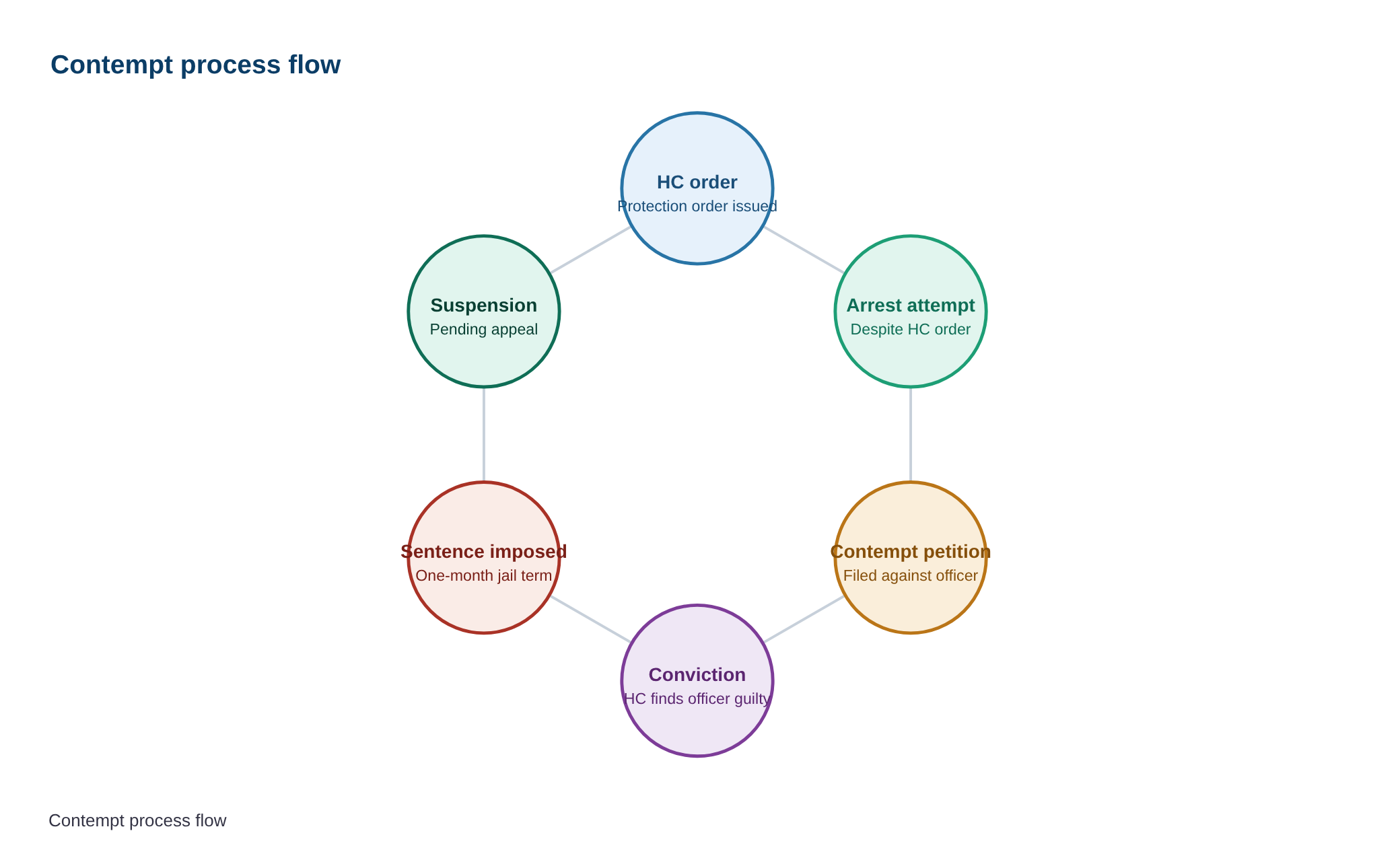
Police officer (executive action) → Arrests individual despite HC protection order → Contempt petition filed → HC convicts officer for contempt → Sentence imposed → Suspension of sentence to allow appeal → Highlights need for judicial-executive coordination.
Prelims Practice Questions
Q1. Consider the following statements regarding the Contempt of Court Act, 1971:
1. Civil contempt refers to willful disobedience of any judgment, decree, direction, order, writ, or other process of a court.
2. Criminal contempt includes publication of any matter that scandalises or tends to scandalise the authority of any court.
3. The Supreme Court of India has the power to punish for contempt of itself and of all courts subordinate to it.
How many of the above statements are correct?
- Only one
- Only two
- All
- None
Answer: All — Statements 1 and 2 are correct as per Section 2(b) and 2(c) of the Contempt of Court Act, 1971. Statement 3 is incorrect because the Supreme Court can punish for contempt of itself and of courts subordinate to it, but high courts have the same power for their subordinate courts.
Q2. Assertion (A): The power to punish for contempt is an inherent power of the judiciary to uphold the rule of law and maintain its dignity.
Reason (R): The Contempt of Court Act, 1971, provides a statutory framework for exercising this power, but the judiciary’s power is not limited to this Act.
Options:
A. Both A and R are true, and R is the correct explanation of A.
B. Both A and R are true, but R is not the correct explanation of A.
C. A is true, but R is false.
D. A is false, but R is true.
Answer: ? — Both A and R are true. The power to punish for contempt is an inherent judicial power to preserve the authority and dignity of the court (A). While the Contempt of Court Act, 1971, provides a statutory framework (R), the judiciary’s power is not exhaustive and includes inherent powers beyond the Act.
Q3. Which of the following pairs is correctly matched?
1. Article 129 – Supreme Court’s power to punish for contempt
2. Article 215 – High Court’s power to punish for contempt
3. Section 10 of the Contempt of Court Act, 1971 – Power of High Courts to try offences
Options:
A. 1 and 2 only
B. 2 and 3 only
C. 1 and 3 only
D. All of the above
- A
- B
- C
- D
Answer: D — Pair 1 is correct: Article 129 empowers the Supreme Court to punish for contempt. Pair 2 is correct: Article 215 empowers High Courts to punish for contempt. Pair 3 is correct: Section 10 of the Contempt of Court Act, 1971, confers power on High Courts to try offences under the Act.
Mains Practice Question
✍ The power of courts to punish for contempt is essential for upholding judicial authority and ensuring compliance with judicial orders. In this context, critically examine the constitutional and statutory framework governing contempt jurisdiction in India. Also, analyse the implications of non-compliance with judicial orders by executive authorities, citing relevant judicial precedents. (15 Marks)
Approach: MODEL-ANSWER SKELETON:
1. **Introduction (2 marks)**
– Define contempt of court: civil vs. criminal contempt (Sections 2(b) and 2(c) of the Contempt of Court Act, 1971).
– Mention constitutional provisions: Articles 129 and 215 empowering Supreme Court and High Courts to punish for contempt.
2. **Constitutional and Statutory Framework (5 marks)**
– **Constitutional Basis**: Articles 129 and 215; inherent power of courts to punish for contempt as part of judicial independence (In re: Vinay Chandra Mishra, 1995).
– **Statutory Basis**: Contempt of Court Act, 1971 (Sections 2, 10, 12, 15).
– **Judicial Interpretation**: Landmark cases like E.M.S. Namboodiripad v. T.N. Nambiar (1970) on scope of contempt; Supreme Court Bar Association v. Union of India (1998) on balancing free speech and contempt.
3. **Implications of Non-Compliance by Executive Authorities (5 marks)**
– **Rule of Law**: Non-compliance undermines judicial authority and the rule of law (B.R. Ambedkar’s emphasis on judicial independence).
– **Judicial Precedents**: Case of Prashant Bhushan (2020) where the Supreme Court held that criticism of judges must not scandalise the judiciary; In re: Arundhati Roy (2002) on punishing civil contempt.
– **Consequences**: Erosion of public trust, judicial paralysis, and potential constitutional crisis (e.g., situations where executive flouts judicial orders, as in the case of the Sabarimala temple entry issue).
4. **Balancing Judicial Authority and Fundamental Rights (3 marks)**
– **Free Speech vs. Contempt**: Article 19(1)(a) vs. Article 129/215; judicial interpretation to balance both (e.g., Subramanian Swamy v. Union of India, 2016).
– **Proportionality**: Courts must ensure punishment for contempt is proportionate and does not stifle legitimate criticism (e.g., recent trends in contempt jurisprudence).
5. **Conclusion (2 marks)**
– Reiterate the necessity of contempt jurisdiction for judicial independence.
– Highlight the need for executive compliance with judicial orders to strengthen constitutional democracy.
Source: The Hindu
Telangana PCS (TGPSC (TSPSC)) — State PCS Practice
Prelims: Which of the following actions by a police officer in Telangana would most likely lead to a contempt of court case, as per the recent judgment by the Telangana High Court?
- Disobeying a court order related to the investigation of a criminal case
- Failing to submit a progress report on a pending case within the stipulated time
- Refusing to arrest a suspect named in an FIR without valid reasons
- Delaying the registration of an FIR beyond the legally permissible period
Answer: Disobeying a court order related to the investigation of a criminal case — The Telangana High Court recently awarded a one-month jail term to a police officer for contempt after the officer disobeyed a court order related to an investigation, demonstrating the judiciary’s strict stance on non-compliance with its directives.
Mains: Critically analyze the role of the judiciary in upholding accountability among law enforcement agencies in Telangana, with special reference to the recent High Court judgment imposing contempt proceedings against a police officer. Suggest measures to prevent such incidents in the future.
Generated by AanyaAi for educational purpose.
Related guides on our sites
- Best PSIR optional coaching for upsc
- Best PSIR optional teacher for upsc
- Best teacher of PSIR optional for upsc
- Best PSIR optional coaching in delhi for UPSC

- KWML’s Feasibility Reports for Water Metro in 18 Cities: UPSC & PCS Insights - October 3, 2026
- ओडिशा में वन्यजीव अनुसंधान अनुदान कार्यक्रम शुरू, सिमिलिपाल में 300 कैमरे और बढ़ेंगे - October 3, 2026
- India Summons Pakistan High Commission Official Over Violation - October 3, 2026

No Comments