


21 Sep Tamil Nadu Private Universities Bill 2026: Key Amendments & Controversy Explained for UPSC
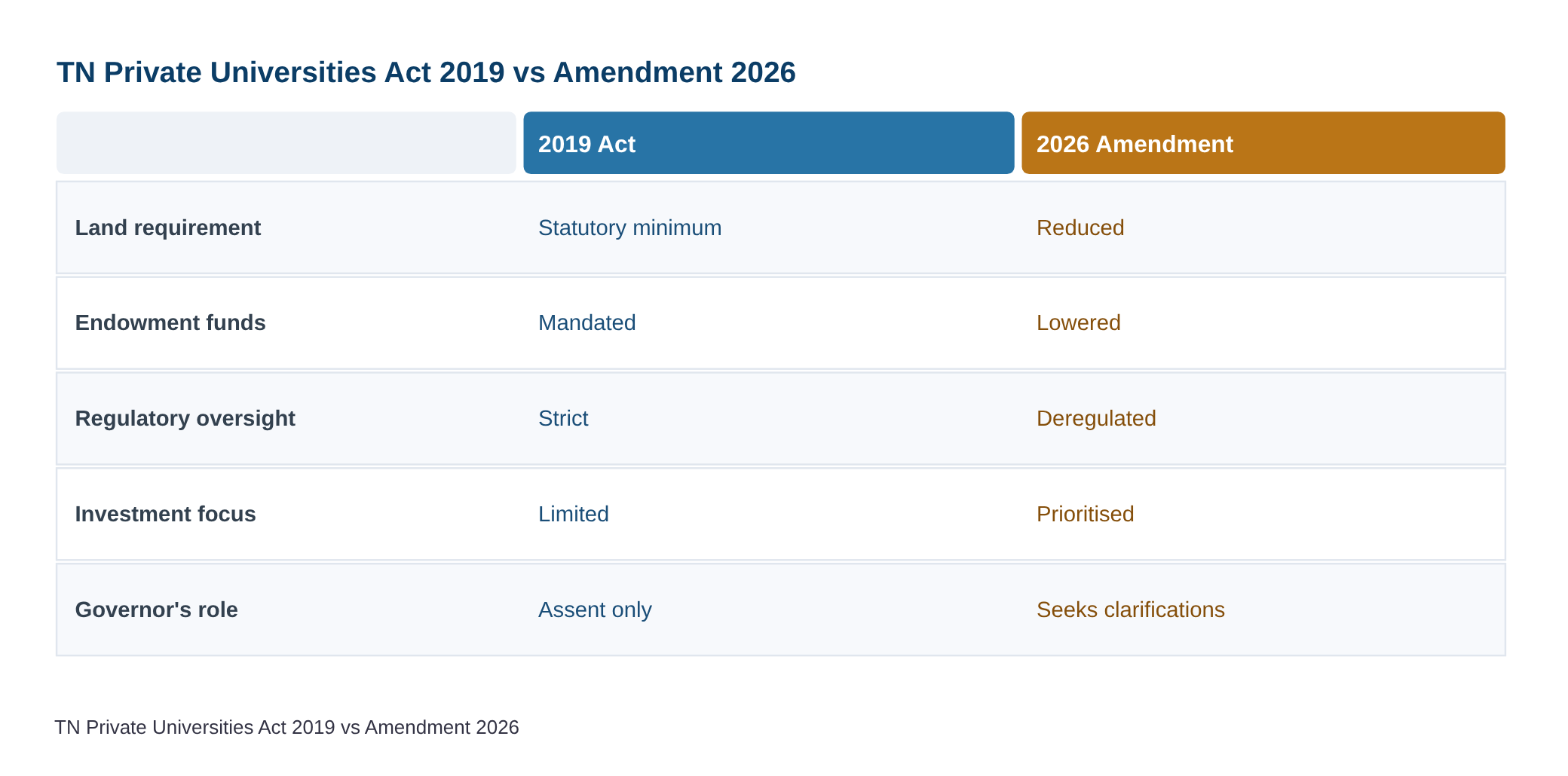
✎ The Tamil Nadu Private Universities (Amendment) Bill, 2026, reduces land and endowment requirements for private universities to align with national deregulation goals, but raises concerns over potential compromises in academic…
Subject Relevance — Where This Topic Fits
- GS Paper II — Governance, Transparency and Accountability | GS Paper II — Role of State Governments in Education Policy
- Prelims: Private Universities Act, 2019, UGC (Institutions Deemed to be Universities) Regulations, 2023, Ease of Doing Business (EoDB) Index, National Education Policy (NEP) 2020, Task Force on Compliance Reduction and Deregulation, Gross Enrolment Ratio (GER) in Higher Education, State List (Entry 25, Concurrent List)
- Essay: The tension between regulatory liberalisation and academic accountability in higher education
Quick Revision: The Tamil Nadu Private Universities (Amendment) Bill, 2026, reduces land and endowment requirements for private universities to align with national deregulation goals, but raises concerns over potential compromises in academic infrastructure and financial sustainability.
Why is this in the news?
On 8 September 2026, the Tamil Nadu Legislative Assembly passed the Tamil Nadu Private Universities (Amendment) Bill, 2026, which seeks to reduce statutory land and endowment requirements for establishing private universities. The Bill has drawn criticism for potentially compromising infrastructure standards and academic rigour, while the government argues that it aligns with national deregulation efforts to attract investment and improve the ease of doing business. The Governor has sought clarifications on the amendments, underscoring the constitutional oversight role of the Governor in state legislation.
Background
- The Tamil Nadu Private Universities Act, 2019, was enacted to regulate the establishment and functioning of private universities in the state, ensuring minimum standards of land, infrastructure, and financial sustainability.
- Prior to the 2019 Act, private universities such as Shiv Nadar University and Sai University were established through special legislations, bypassing the general regulatory framework.
- The National Education Policy (NEP) 2020 encourages the establishment of private higher educational institutions to expand access to quality education while emphasising the need for regulatory oversight to maintain academic standards.
- Tamil Nadu’s Gross Enrolment Ratio (GER) in higher education lags behind national averages, prompting state interventions to attract investment in the education sector.
- The Governor’s reference of the Bill to the State government reflects the constitutional provision under Article 200 of the Constitution, which allows the Governor to seek clarification on state legislation before giving assent.
What is the Tamil Nadu Private Universities (Amendment) Bill, 2026?
- The Bill amends the Tamil Nadu Private Universities Act, 2019, by reducing the minimum land requirement for establishing private universities: 12 acres within the Greater Chennai Corporation area, 18 acres for other municipal corporations, and 25 acres for the rest of the state.
- The Bill reduces the mandatory permanent endowment fund from ₹50 crore to ₹25 crore, aimed at lowering financial barriers for new entrants in the higher education sector.
- The State government’s rationale for the amendments is to align with the Union Government’s Task Force recommendations on deregulation and ease of doing business, particularly in the education sector.
- The Bill seeks to attract world-class educational institutions to Tamil Nadu by reducing regulatory hurdles, thereby enhancing the state’s higher education ecosystem and competitiveness.
- Critics argue that the reduced land and endowment requirements may compromise infrastructure quality, academic standards, and financial sustainability of private universities.
- The Bill reflects a broader policy shift towards liberalisation in higher education, balancing the need for expansion with concerns over academic integrity and regulatory oversight.
- The Governor’s request for clarifications underscores the constitutional mechanism for ensuring legislative compliance and safeguarding public interest in state governance.
Key Features
| Feature | Significance |
|---|---|
| Reduction in minimum contiguous land requirement | Facilitates establishment of private universities in land-scarce urban and peri-urban areas, potentially accelerating higher education infrastructure development. |
| Reduction in permanent endowment fund from ₹50 crore to ₹25 crore | Lowers financial barriers for promoters, encouraging investment in private higher education institutions. |
| Applicability to existing private universities under the 2019 Act and pre-2019 institutions | Ensures uniformity in regulatory treatment across all private universities in Tamil Nadu, including legacy institutions like Shiv Nadar University and Sai University. |
| Alignment with Union government’s Task Force on Compliance Reduction and Deregulation | Demonstrates adherence to national-level policy frameworks aimed at ease of doing business in the education sector. |
| Governor’s referral for clarifications before assent | Highlights the constitutional role of the Governor in scrutinising state legislation, particularly when it alters regulatory frameworks in higher education. |
Why it Matters
Higher Education Governance
- The amendments reflect a shift in Tamil Nadu’s regulatory approach toward private universities, prioritising accessibility over stringent land and financial prerequisites.
- The reduction in land requirements may enable the establishment of universities in urban clusters, addressing spatial constraints in the Greater Chennai Corporation area.
- The lowering of the endowment fund requirement could attract mid-tier promoters, diversifying the ecosystem of private higher education institutions.
- The amendments underscore the tension between regulatory stringency and the need for rapid expansion of higher education infrastructure in a populous state.
Economic Implications
- Lower capital requirements may stimulate investment in the education sector, potentially creating employment opportunities in teaching, research, and administrative roles.
- The policy change could position Tamil Nadu as a more attractive destination for private higher education providers, including foreign universities seeking to establish campuses in India.
- Commercialisation concerns may arise if reduced regulatory thresholds lead to profit-driven institutions with inadequate infrastructure or academic rigour.
- The amendments may reduce the financial burden on sponsoring bodies, but long-term sustainability of institutions remains contingent on academic and administrative governance.
Federalism and Policy Coherence
- The amendments align with the Union government’s deregulatory agenda, as articulated by the Task Force on Compliance Reduction and Deregulation, reflecting a trend toward harmonising state-level higher education policies with national priorities.
- The move exemplifies the dynamic interplay between state autonomy in education policy and central government recommendations, particularly in areas like ease of doing business.
- The Governor’s referral for clarifications highlights the federal structure’s checks and balances, where state legislation may be scrutinised for constitutional and policy coherence before receiving assent.
Challenges
1. Regulatory Arbitrage and Commercialisation Risks
- Reduced land and endowment requirements may lead to the proliferation of low-quality, commercially driven institutions prioritising revenue over academic excellence.
- Inadequate infrastructure in urban areas could compromise the learning environment, particularly in institutions established on smaller land parcels.
- The dilution of financial safeguards (e.g., endowment funds) may leave institutions vulnerable to financial distress during economic downturns or mismanagement.
UPSC Link: GS2: Higher Education Institutions
2. Infrastructure and Urban Planning Constraints
- Land scarcity in urban areas, particularly in the Greater Chennai Corporation region, may still pose challenges despite reduced acreage requirements.
- Municipal and state planning authorities may face difficulties in accommodating new educational institutions without compromising other critical urban infrastructure needs.
- Environmental and zoning regulations may conflict with the rapid establishment of private universities, leading to legal and administrative hurdles.
UPSC Link: GS1: Urbanisation and Infrastructure
3. Governance and Accountability Gaps
- Lowering regulatory thresholds without commensurate strengthening of oversight mechanisms risks compromising academic integrity and student welfare.
- The absence of robust accreditation and monitoring frameworks may allow substandard institutions to operate, undermining the credibility of Tamil Nadu’s higher education system.
- Stakeholder consultations, including academia and civil society, appear limited in the amendment process, raising concerns about transparency and inclusivity in policy formulation.
UPSC Link: GS2: Regulatory Bodies in Education
4. Federalism and Legislative Scrutiny
- The Governor’s referral for clarifications introduces a layer of scrutiny that may delay or alter the implementation of the amendments, raising questions about the balance of power between the executive and constitutional authorities.
- The amendments’ alignment with central government recommendations does not preclude challenges on grounds of state autonomy or constitutional validity, particularly if they contravene existing state policies or laws.
UPSC Link: GS2: Federalism
5. Equity and Accessibility Concerns
- While the amendments aim to expand access to higher education, they may inadvertently favour urban and well-connected regions, exacerbating regional disparities in educational opportunities.
- Students from marginalised backgrounds may face barriers in accessing institutions established under relaxed norms, particularly if these institutions prioritise revenue generation over inclusive admissions.
UPSC Link: GS1: Social Justice and Education
6. Long-Term Sustainability of Institutions
- Reduced financial safeguards may leave private universities vulnerable to financial instability, particularly in the event of mismanagement or economic downturns.
- The absence of a robust grievance redressal mechanism for students and faculty could lead to systemic issues in governance, affecting the long-term viability of these institutions.
UPSC Link: GS2: Higher Education Quality Assurance
Challenges — UPSC Perspective
| Issue | Concern |
|---|---|
| Land requirement reduction | Potential compromise in infrastructure quality due to smaller land parcels in urban areas. |
| Endowment fund reduction | Increased financial vulnerability of institutions to mismanagement or economic shocks. |
| Limited stakeholder consultation | Risk of policy formulation without adequate input from academia, students, or civil society. |
| Governor’s referral for clarifications | Possible delays or alterations in the amendment’s implementation, raising questions about executive-legislative balance. |
| Regulatory oversight gaps | Lack of robust monitoring mechanisms to ensure academic standards and student welfare. |
| Regional disparities | Urban-centric expansion may exacerbate educational inequalities between regions. |
Way Forward
- Constitute a multi-stakeholder committee comprising educators, students, and civil society representatives to review the amended provisions and recommend safeguards against commercialisation.
- Strengthen the Tamil Nadu Higher Education Regulatory Authority (TNHEERA) with enhanced powers to monitor and accredit private universities, ensuring adherence to academic and infrastructural standards.
- Introduce mandatory transparency measures, including public disclosure of financial audits, land utilisation plans, and academic performance metrics for all private universities.
- Develop a grievance redressal mechanism for students and faculty to address governance issues, academic malpractices, or financial mismanagement in private universities.
- Collaborate with urban planning authorities to integrate private university establishments into broader city development plans, ensuring compatibility with infrastructure and environmental regulations.
- Establish a periodic review mechanism to assess the impact of the amendments on higher education quality, accessibility, and regional equity after two years of implementation.
- Promote partnerships between private universities and public institutions to ensure knowledge sharing, resource optimisation, and equitable access to facilities.
- Incorporate provisions for mandatory social responsibility obligations, such as scholarships for economically disadvantaged students, to mitigate equity concerns.
UPSC Value Addition
Keywords for Mains Answer-Writing
Tamil Nadu Private Universities Act, 2019 · Private Universities (Amendment) Bill, 2026 · Land and endowment requirements for private universities · Commercialisation of higher education · Task Force on Compliance Reduction and Deregulation · Governor’s role in State legislation · Autonomy vs regulation in higher education · Infrastructure adequacy in private universities · Dissolution of private universities · Union-State coordination in education policy
Concept Flow
State government identifies land scarcity and regulatory bottlenecks as impediments to private university establishment → Task Force on Compliance Reduction and Deregulation recommends deregulation → Tamil Nadu introduces amendments to the 2019 Act → Reduction in land and endowment requirements proposed → Concerns raised over commercialisation and infrastructure adequacy → Governor seeks clarifications on legislative provisions → Multi-stakeholder debate on regulatory balance and academic standards → Policy implementation awaits resolution of clarifications and potential modifications.
Prelims Practice Questions
Q1. Consider the following statements regarding the Tamil Nadu Private Universities (Amendment) Bill, 2026:
1. The Bill reduces the minimum contiguous land requirement for private universities in the Greater Chennai Corporation area to 12 acres.
2. The Bill increases the permanent endowment fund requirement for private universities from ₹25 crore to ₹50 crore.
3. The Bill applies to all private universities established under the Tamil Nadu Private Universities Act, 2019, and to Shiv Nadar University and Sai University.
How many of the above statements are correct?
- Only one
- Only two
- All three
- None
Answer: Only two — Statement 1 is correct as the Bill reduces the land requirement to 12 acres for the GCC area. Statement 2 is incorrect because the endowment fund requirement is reduced to ₹25 crore, not increased. Statement 3 is correct as the Bill extends to all private universities under the 2019 Act and the two specified institutions.
Q2. Assertion (A): The Tamil Nadu Private Universities (Amendment) Bill, 2026, aims to simplify regulatory compliance for private universities in alignment with the Union government’s Task Force recommendations.
Reason (R): The Task Force on Compliance Reduction and Deregulation recommended eliminating minimum land and endowment fund requirements for higher educational institutions.
Code:
- Both A and R are true, and R is the correct explanation of A
- Both A and R are true, but R is not the correct explanation of A
- A is true, but R is false
- A is false, but R is true
Answer: Both A and R are true, and R is the correct explanation of A — The Assertion (A) is true as the Bill cites the Task Force recommendations to justify its amendments. The Reason (R) is also true and directly explains the rationale behind the Assertion, as the Task Force explicitly recommended reducing regulatory burdens.
Q3. Match the following provisions of the Tamil Nadu Private Universities Act, 2019 with their amended requirements under the Tamil Nadu Private Universities (Amendment) Bill, 2026:
Column I (Provision) | Column II (Amended Requirement)
1. Minimum contiguous land in GCC area | A. ₹50 crore
2. Minimum contiguous land outside GCC area | B. ₹25 crore
3. Permanent endowment fund requirement | C. 25 acres
4. Minimum contiguous land in other municipal corporations | D. 12 acres
Select the correct match:
- 1-D, 2-C, 3-B, 4-A
- 1-D, 2-C, 3-A, 4-B
- 1-A, 2-B, 3-D, 4-C
- 1-B, 2-A, 3-C, 4-D
Answer: 1-D, 2-C, 3-B, 4-A — 1 matches D (12 acres for GCC), 2 matches C (25 acres outside GCC), 3 matches B (₹25 crore endowment fund), and 4 matches A (₹50 crore for other municipal corporations).
Mains Practice Question
✍ The Tamil Nadu Private Universities (Amendment) Bill, 2026, seeks to reduce statutory land and endowment requirements for private universities. Critically examine the implications of these amendments for the autonomy of higher educational institutions, infrastructure adequacy, and the potential for commercialisation of education. (15 Marks)
Approach: MODEL-ANSWER SKELETON:
1. **Context and Provisions**:
– Summarise the key amendments: reduction of land requirement (12 acres in GCC, 18 acres in other municipal corporations, 25 acres elsewhere) and endowment fund (₹25 crore).
– Reference the Tamil Nadu Private Universities Act, 2019, and the Union government’s Task Force on Compliance Reduction and Deregulation.
2. **Autonomy vs Regulation**:
– Discuss how reduced regulatory requirements may enhance institutional autonomy and ease of establishment.
– Contrast with the need for regulatory oversight to maintain academic standards and prevent commercialisation.
3. **Infrastructure Adequacy**:
– Analyse concerns over whether reduced land requirements may compromise campus infrastructure, student amenities, and long-term sustainability.
– Reference the rationale provided by the government (scarcity of land in GCC area) and counter-arguments from stakeholders.
4. **Commercialisation of Education**:
– Examine the risk of prioritising profit over academic quality, citing global examples where reduced regulatory oversight led to substandard institutions.
– Discuss the role of endowment funds in ensuring financial stability during dissolution.
5. **Governor’s Role and Federalism**:
– Explain the Governor’s constitutional role in assenting to State Bills under Article 200 and the discretion exercised in seeking clarifications.
– Analyse the balance between State autonomy in education policy and Union government recommendations.
6. **Balanced View and Conclusion**:
– Present a balanced view: acknowledge the need for regulatory simplification while emphasising safeguards against commercialisation.
– Conclude with a reasoned stance on whether the amendments strike an appropriate balance.
Source: The Hindu
Tamil Nadu PCS (TNPSC) — State PCS Practice
Prelims: Which of the following is a primary reason for the controversy surrounding the Tamil Nadu Private Universities (Amendment) Bill, 2026?
- A. It seeks to cap tuition fees for private universities without state funding
- B. It proposes to grant private universities full autonomy in curriculum design, excluding state oversight
- C. It mandates reservation quotas for Tamil Nadu students in private universities, excluding non-residents
- D. It allows private universities to operate without UGC approval, raising quality concerns
Answer: B. It proposes to grant private universities full autonomy in curriculum design, excluding state oversight — The Bill proposes to grant private universities full autonomy in curriculum design, which critics argue could dilute state control over education standards and social justice commitments.
Mains: Critically analyze the potential implications of the Tamil Nadu Private Universities (Amendment) Bill, 2026, on the state’s higher education system, with a focus on equity, quality, and governance. (250 words)
Generated by AanyaAi for educational purpose.
Related guides on our sites
- Current affairs for upsc 2026
- Best PSIR optional coaching for upsc
- Best PSIR optional teacher for upsc
- Best teacher of PSIR optional for upsc

- Tamil Nadu Private Universities Bill 2026: Key Amendments & Controversy Explained for UPSC - September 21, 2026
- स्वच्छ सागर सुरक्षित सागर 5.0: 15 लाख लोगों ने ली महासागर संरक्षण की शपथ, जानें पूरा विवरण - September 21, 2026
- 15 लाख लोगों ने ली महासागर संरक्षण की शपथ: स्वच्छ सागर सुरक्षित सागर 5.0 अभियान की सफलता - September 21, 2026

No Comments