


22 Sep Madras HC gives Tamil Nadu 4 weeks to revise bus fares amid diesel price surge
✎ The Motor Vehicles Act, 1988 empowers state governments to fix fares for stage carriages under Section 67, but such decisions must be based on cost recovery principles and inclusive consultations, failing which judicial…
Subject Relevance — Where This Topic Fits
- GS Paper II — Functions and Responsibilities of the Union and the States, Issues and Challenges Pertaining to the Federal Structure | GS Paper III — Infrastructure: Energy, Ports, Roads, Airports, Railways and Human Resource Development | GS Paper III — Government Budgeting and Fiscal Policy
- Prelims: Fare fixation mechanisms, Motor Vehicles Act, 1988, State Transport Undertakings, Judicial review of administrative decisions, Diesel pricing and subsidy burden, Regulatory commissions for transport, Public Interest Litigation (PIL), Cost recovery in public transport
- Essay: The role of judicial intervention in ensuring equitable public service delivery, Balancing fiscal sustainability and affordability in public infrastructure
Quick Revision: The Motor Vehicles Act, 1988 empowers state governments to fix fares for stage carriages under Section 67, but such decisions must be based on cost recovery principles and inclusive consultations, failing which judicial intervention may be sought.
Why is this in the news?
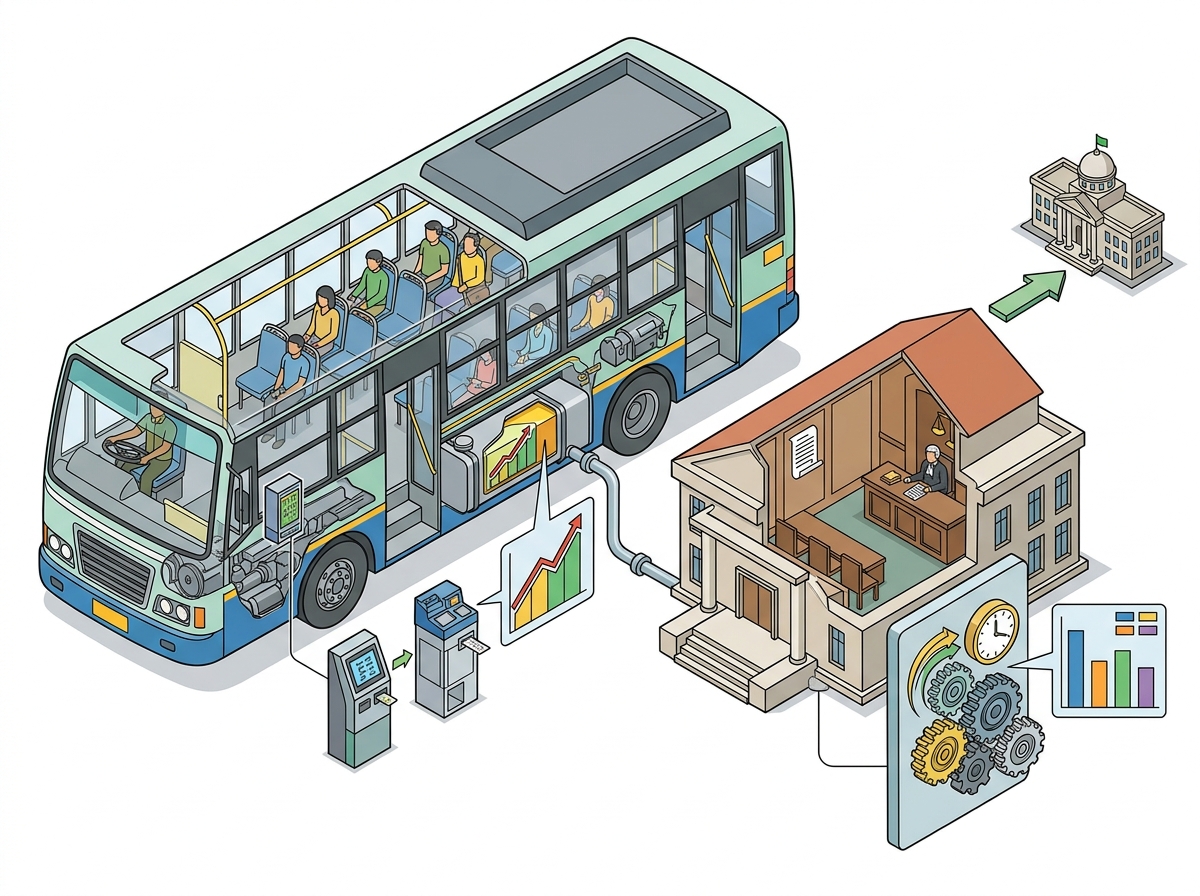
The Madras High Court has granted the Tamil Nadu government an additional four weeks to finalise the revision of bus fares for both private and government-operated stage carriages, a decision pending since 2018. The delay in revision, juxtaposed with a significant increase in diesel prices, has led to financial strain on operators and raised questions about the adequacy of the existing fare fixation mechanism under the Motor Vehicles Act, 1988. The case underscores the interplay between judicial oversight, executive decision-making, and stakeholder consultations in regulating public transport fares.
Background
- The fare for stage carriages in Tamil Nadu was last revised in 2018 and fixed at ₹0.58 per kilometre, a rate significantly lower than those in neighbouring southern states such as Kerala (₹1.10 per km in 2022), Karnataka (₹1 per km in 2020), and Andhra Pradesh (₹1.02 per km in 2022).
- Diesel prices in India have risen from approximately ₹67.50 per litre in 2018 to around ₹100 per litre in 2026, exacerbating the cost burden on bus operators while fares remained unchanged.
- The Motor Vehicles Act, 1988, empowers state governments to fix fares for stage carriages (public transport buses operating on fixed routes) under Section 67, subject to periodic reviews and consultations with stakeholders.
- In December 2024, the Tamil Nadu government constituted a high-level committee comprising the Home Secretary, Transport Secretary, and Finance Secretary to examine the demand for fare revision, following representations from private bus operators.
- An expert committee headed by the Transport and Road Safety Commissioner submitted its report to the high-level committee on February 19, 2026, after consultations with state transport undertakings, private operators, and commuters.
- The Federation of Bus Operators Association of Tamil Nadu filed a writ petition in 2025, seeking judicial intervention to expedite the fare revision process, citing financial unsustainability due to unrevised fares.
What is the regulatory framework for fixing public transport fares in India, and how does judicial oversight function in such cases?
- The Motor Vehicles Act, 1988, is the primary legislation governing the regulation of road transport in India, including the fixation of fares for stage carriages (public transport buses operating on fixed routes) under Section 67.
- State governments are empowered to fix fares through notifications, subject to periodic reviews and consultations with stakeholders such as transport operators, commuters, and expert committees.
- The fixation of fares is typically based on cost recovery principles, including operational costs (fuel, maintenance, staff salaries), depreciation of assets, and a reasonable return on investment for private operators.
- Judicial oversight in fare fixation cases often arises through Public Interest Litigations (PILs) or writ petitions, where courts examine whether the executive has acted within the bounds of its authority and whether the decision-making process has been fair, transparent, and inclusive.
- Courts may direct the government to expedite consultations, submit reports, or reconsider decisions if they find delays unjustified or the process flawed, as seen in the Madras High Court’s intervention in the Tamil Nadu bus fare revision case.
- The principle of natural justice mandates that affected parties, such as bus operators and commuters, be given a fair hearing before any fare revision is implemented, ensuring procedural fairness.
- The fixation of fares also intersects with broader fiscal policies, including subsidies for public transport, diesel pricing, and the financial health of state transport undertakings, which often operate at a loss due to social obligations.
- In cases where fares are not revised for prolonged periods, courts may intervene to prevent financial distress to operators or ensure that the public transport system remains viable, balancing affordability with sustainability.
Key Features
| Feature | Significance |
|---|---|
| Fare revision mechanism | Ensures cost recovery and sustainability of public and private bus operations amid rising fuel costs and inflation. |
| Judicial intervention | High Court’s directive ensures adherence to procedural fairness and stakeholder consultations before final decision. |
| Expert committee report | Provides data-driven recommendations on fare structure, balancing operator viability and commuter affordability. |
| Stakeholder consultations | Includes transport undertakings, private operators, and commuters to address diverse interests and mitigate opposition. |
| Comparative benchmarking | Analysis of fare structures in neighboring states (Kerala, Karnataka, Andhra Pradesh, Telangana) informs Tamil Nadu’s policy decision. |
Why it Matters
Economic
- Prevents financial strain on state transport undertakings (STUs) by enabling fare revisions to offset rising operational costs, particularly diesel prices (₹67.50/litre in 2018 vs. ~₹100/litre in 2026).
- Supports private bus operators’ viability, reducing risks of service disruptions or reduced fleet availability due to unsustainable costs.
- Influences urban mobility patterns by maintaining affordable public transport, a critical factor for economic productivity in Tamil Nadu’s urban agglomerations.
Administrative
- Demonstrates the role of judicial oversight in ensuring transparency and accountability in policy decisions involving public welfare and economic regulation.
- Highlights the procedural rigor of multi-stakeholder consultations, a model for complex infrastructure pricing decisions.
- Showcases inter-departmental coordination (Transport, Finance, Home) in addressing sectoral challenges through committee-based governance.
Social
- Balances commuter affordability with operator sustainability, a key consideration for equitable access to mobility, especially for low-income groups.
- Mitigates risks of service cuts or reduced frequency due to financial unsustainability, which disproportionately affects marginalized communities.
- Reflects the state’s commitment to inclusive urban transport planning, aligning with Sustainable Development Goal 11 (Sustainable Cities and Communities).
Policy
- Serves as a case study for fare revision frameworks in India’s public transport sector, where fuel costs constitute a significant share of operational expenses.
- Illustrates the challenges of long-term price controls in dynamic markets, where input costs (e.g., diesel) fluctuate beyond administrative control.
- Provides a template for periodic fare reviews, ensuring alignment with macroeconomic realities without resorting to ad-hoc adjustments.
Challenges
1. Stakeholder Divergence
- Private operators demand immediate fare hikes to offset diesel price increases, while commuters advocate for minimal increases to maintain affordability.
- State transport undertakings (STUs) face pressure to balance financial viability with social obligations, complicating consensus-building.
- Potential for public backlash if revisions are perceived as excessive, leading to political sensitivities.
UPSC Link: GS2: Government policies and interventions for development in various sectors
2. Economic Viability vs. Affordability
- Rising diesel prices (₹67.50 to ~₹100/litre) erode margins for operators, necessitating fare adjustments to prevent service disruptions.
- High fares may deter low-income commuters from using public transport, exacerbating urban congestion and pollution.
- Delayed revisions risk creating a financial gap, requiring subsidies or debt burdens on state exchequer.
UPSC Link: GS3: Infrastructure – Transport and its economic impact
3. Regulatory and Legal Constraints
- Judicial directives (e.g., four-week extension) impose time-bound decision-making, adding pressure to balance thoroughness with urgency.
- Need to comply with constitutional provisions on reasonable regulation of trade and commerce (Article 301) and public interest.
- Risk of litigation if fare revisions are challenged on grounds of arbitrariness or lack of stakeholder consensus.
UPSC Link: GS2: Judiciary and its role in governance
4. Comparative Policy Benchmarking
- Tamil Nadu’s fare of ₹0.58/km (2018) is the lowest among southern states, complicating adjustments without perceived favoritism.
- Neighboring states (e.g., Kerala at ₹1.10/km) offer higher fare structures, raising questions about Tamil Nadu’s competitive positioning.
- Lack of a uniform national fare policy for buses necessitates state-specific solutions, increasing complexity.
UPSC Link: GS2: Federalism and inter-state coordination
5. Operational Implementation Challenges
- Logistical hurdles in revising fare structures across diverse routes (urban, rural, inter-state) and vehicle types (ordinary, express, AC).
- Need for real-time monitoring of fuel costs and inflation to ensure fare adjustments remain relevant.
- Potential for black-market practices or informal transport alternatives if official fares become uncompetitive.
UPSC Link: GS3: Logistics and supply chain management
Challenges — UPSC Perspective
| Issue | Concern |
|---|---|
| Fuel price volatility | Unpredictable diesel costs complicate long-term fare planning and operator budgeting. |
| Stakeholder opposition | Risk of protests or legal challenges from commuters or operators if revisions are perceived as unjust. |
| Administrative delays | Prolonged decision-making may lead to financial stress for operators and reduced service quality. |
| Urban-rural disparity | Uniform fare structures may not account for cost differentials between dense urban and sparse rural routes. |
| Subsidy dependency | Excessive reliance on state subsidies to offset fare hikes may strain public finances. |
| Technology integration | Lack of digital fare systems in some regions may hinder smooth implementation of revised fares. |
Way Forward
- Conduct a detailed cost-benefit analysis of fare revisions, incorporating fuel price trends, inflation, and commuter affordability metrics.
- Implement a phased fare revision mechanism, linking periodic adjustments to a transparent index (e.g., Wholesale Price Index for diesel).
- Expand stakeholder consultations to include rural representatives and women commuters, ensuring inclusive policy design.
- Develop a real-time monitoring system for fuel costs and operational expenses to enable data-driven decision-making.
- Strengthen public transport alternatives (e.g., metro, suburban rail) to reduce dependency on buses and mitigate fare hike impacts.
- Explore public-private partnerships (PPPs) for bus operations to share financial risks and improve service efficiency.
- Establish a state-level transport regulatory authority to oversee fare revisions and resolve disputes impartially.
- Launch awareness campaigns to educate commuters on the necessity of fare revisions and the state’s subsidy mechanisms.
UPSC Value Addition
Keywords for Mains Answer-Writing
Public transport regulation · Fare fixation mechanism · Judicial intervention in policy · State transport undertakings · Diesel price volatility · Stakeholder consultations · Madras High Court jurisdiction · Transport policy formulation · Regulatory governance · Inter-state comparison of bus fares
Constitutional & Policy Linkages
- [‘Article 301: Freedom of trade and commerce’, ‘Regulation of bus fares must balance economic freedom with public interest.’]
- [‘Article 21: Right to life and livelihood’, ‘Affordable transport is integral to access to employment and essential services.’]
- [‘Article 14: Equality before law’, ‘Fare structures must avoid arbitrary discrimination between routes or user groups.’]
Concept Flow
Rising diesel prices (₹67.50 to ~₹100/litre) → Increased operational costs for bus operators → Financial strain on STUs and private operators → Demand for fare revisions. → Public interest litigation (2025) → Madras High Court intervention → Directives for stakeholder consultations and expert committee report → Four-week extension for final decision. → Expert committee analysis → Comparative benchmarking with neighboring states → Recommendations on fare structure and phased adjustments → Submission to high-level committee. → High-level committee deliberations → Balancing operator viability, commuter affordability, and state subsidies → Final fare revision proposal → Judicial approval and implementation. → Post-revision monitoring → Assessment of impact on ridership, service quality, and financial sustainability → Iterative policy adjustments as needed.
Prelims Practice Questions
Q1. Consider the following statements regarding the regulation of bus fares in India:
1. Bus fares in Tamil Nadu were last revised in 2018 at ₹0.58 per km.
2. The current diesel price in Tamil Nadu is approximately ₹100 per litre.
3. Kerala revised its bus fares to ₹1.10 per km in 2022.
4. The Madras High Court has no jurisdiction over fare fixation policies of state transport undertakings.
How many of the above statements are correct?
- Only one
- Only two
- Only three
- All
Answer: Only three — Statements 1, 2, and 3 are correct. Statement 4 is incorrect as the Madras High Court has granted extensions to the Tamil Nadu government on fare revision policies, indicating its jurisdiction over such matters.
Q2. Assertion (A): The fixation of bus fares by state governments is a purely administrative function and not subject to judicial review.
Reason (R): The Madras High Court recently granted extensions to the Tamil Nadu government for revising bus fares, demonstrating judicial oversight over administrative decisions.
Options:
A. Both A and R are true, and R is the correct explanation of A.
B. Both A and R are true, but R is not the correct explanation of A.
C. A is true, but R is false.
D. A is false, but R is true.
Answer: ? — Assertion (A) is false because judicial review can extend to administrative decisions, especially when they impact public interest. Reason (R) is true as the Madras High Court’s intervention in the Tamil Nadu fare revision case demonstrates judicial oversight.
Q3. Match the following states with their respective bus fare rates per kilometre as of recent revisions:
Column I (State) | Column II (Fare Rate per km)
— | —
A. Tamil Nadu | 1. ₹0.83
B. Kerala | 2. ₹1.00
C. Karnataka | 3. ₹1.10
D. Telangana | 4. ₹0.58
Options:
A. A-4, B-3, C-2, D-1
B. A-1, B-2, C-3, D-4
C. A-2, B-1, C-4, D-3
D. A-3, B-4, C-1, D-2
- A
- B
- C
- D
Answer: A — The correct matches are: Tamil Nadu (₹0.58), Kerala (₹1.10), Karnataka (₹1.00), and Telangana (₹0.83).
Mains Practice Question
✍ The fixation of bus fares by state governments involves a complex interplay of economic, administrative, and judicial considerations. Critically examine the mechanisms employed by state governments in India for revising bus fares, with particular reference to the recent developments in Tamil Nadu. (15 Marks)
Approach: MODEL-ANSWER SKELETON:
1. **Introduction**: Define bus fare fixation as a regulatory function under the Motor Vehicles Act, 1988, and the role of state governments in determining fares for stage carriages.
2. **Mechanisms for Fare Fixation**:
– **Administrative Process**: Role of State Transport Authorities (STAs) and expert committees in assessing operational costs, fuel prices, and inflation.
– **Stakeholder Consultations**: Mandate to include views of private operators, commuters, and transport undertakings (e.g., Tamil Nadu’s high-level committee in 2024).
– **Judicial Oversight**: Reference to the Madras High Court’s intervention in Tamil Nadu’s fare revision case, highlighting the balance between executive discretion and judicial review.
3. **Economic and Social Factors**:
– Impact of diesel price volatility (e.g., ₹67.50 in 2018 vs. ₹100 in 2026) on operational costs.
– Affordability concerns and the need to balance public interest with operator viability.
4. **Comparative Analysis**: Contrast Tamil Nadu’s fare rate (₹0.58/km) with other southern states (Kerala ₹1.10, Karnataka ₹1.00) to highlight policy divergence.
5. **Challenges and Criticisms**:
– Delays in revision due to bureaucratic hurdles or political considerations.
– Lack of uniformity in fare fixation mechanisms across states.
6. **Conclusion**: Emphasise the need for transparent, data-driven, and participatory mechanisms to ensure sustainable public transport while addressing economic realities.
Source: The Hindu
Tamil Nadu PCS (TNPSC) — State PCS Practice
Prelims: The Madras High Court recently granted the Tamil Nadu government an additional four weeks to finalize its decision on the revision of bus fares. Under which constitutional provision does the state government primarily exercise its authority to revise public transport fares?
- Article 292 of the Constitution of India
- Entry 24 of List II (State List) of the Seventh Schedule
- Article 142 of the Constitution of India
- Entry 34 of List I (Union List) of the Seventh Schedule
Answer: Entry 24 of List II (State List) of the Seventh Schedule — The authority to regulate public transport fares in Tamil Nadu falls under the State List (List II) of the Seventh Schedule, specifically Entry 24, which empowers the state government to legislate on matters related to transport.
Mains: Examine the socio-economic implications of revising bus fares in Tamil Nadu, particularly for marginalized communities. Suggest measures to mitigate the adverse impacts while ensuring sustainable public transport operations.
Generated by AanyaAi for educational purpose.
Related guides on our sites
- Current affairs for upsc 2026
- Best PSIR optional coaching for upsc
- Best PSIR optional teacher for upsc
- Best teacher of PSIR optional for upsc

- Madras HC gives Tamil Nadu 4 weeks to revise bus fares amid diesel price surge - September 22, 2026
- कुल्लू: NHPC की पार्वती-2 परियोजना के खिलाफ एफआईआर, 12 सदस्यीय जांच समिति गठित - September 21, 2026
- NHPC Tunnel Leak in Kullu: FIR Filed, 5-Day Probe Deadline for Project Failures - September 21, 2026

No Comments