


22 Sep UP High Court Directs DM & Chief Secretary on School Vehicle Safety: Key Facts for UPSC/PCS
✎ The Allahabad High Court’s Lucknow Bench has issued strict directives to the Uttar Pradesh government, mandating the constitution of District School Vehicle Safety Committees (DSVSCs) and the submission of compliance reports…
Subject Relevance — Where This Topic Fits
- GS Paper II — Governance, Constitution and Polity (Judicial Review and Writs) | GS Paper IV — Ethics, Integrity and Aptitude (Accountability and Responsibility of Public Institutions) | GS Paper III — Environment and Disaster Management (Safety Regulations and Compliance)
- Prelims: Writ Jurisdiction of High Courts (Article 226), District Magistrate’s administrative powers (Article 239AA), Motor Vehicles (Amendment) Act, 2019, Permit system for school vehicles, Public Interest Litigation (PIL), Child Safety Regulations, Compliance Reporting Mechanism
- Essay: Role of Judiciary in Ensuring Public Welfare, Balancing Development and Child Safety in Governance
Why is this in the news?
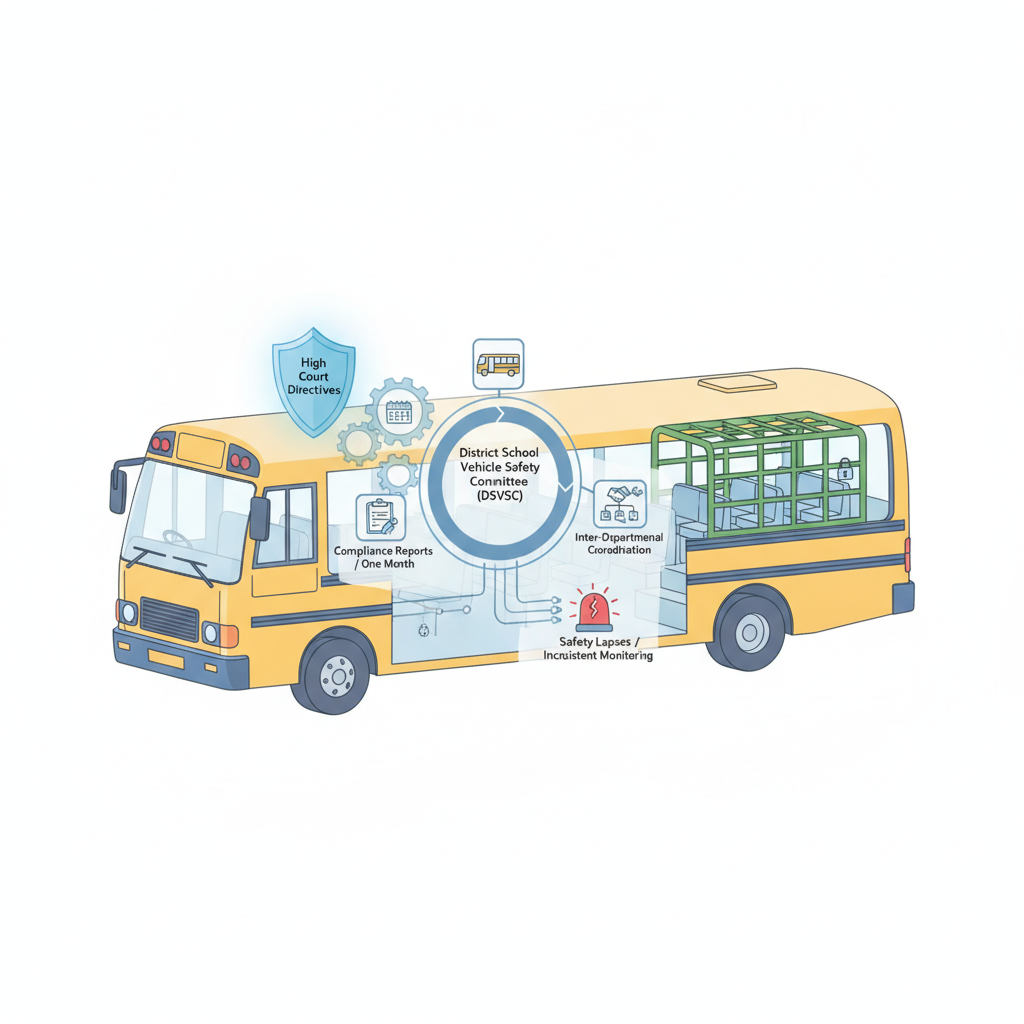
The Allahabad High Court’s Lucknow Bench has issued strict directives to the Uttar Pradesh government, mandating the constitution of District School Vehicle Safety Committees (DSVSCs) and the submission of compliance reports within one month. This judicial intervention underscores the judiciary’s proactive role in enforcing child safety regulations in school transport, particularly in light of recent incidents and public interest litigation. The directives align with statutory provisions under the Motor Vehicles (Twenty-sixth Amendment) Rules, 2019, and highlight the need for inter-departmental coordination to ensure systemic accountability.
Background
- Despite statutory mandates, compliance monitoring has been inconsistent, leading to safety lapses in school transport systems across states, including Uttar Pradesh.
- Public Interest Litigation (PIL) has emerged as a critical tool for enforcing child welfare norms, with courts frequently intervening to ensure executive accountability.
- The Allahabad High Court’s suo motu or PIL-driven directives reflect a broader judicial trend of using writ jurisdiction (Article 226) to enforce fundamental duties under Article 21 (Right to Life and Personal Liberty) and Article 39(f) (Child Welfare).
- The Uttar Pradesh government’s response to the directives will be scrutinised for its adherence to the rule of law and the principles of good governance, including transparency and accountability.
- The case exemplifies the judiciary’s role in bridging gaps between statutory provisions and ground-level implementation, particularly in sectors critical to public welfare.
What are School Vehicle Safety Committees and their Legal Framework?
- District School Vehicle Safety Committees (DSVSCs) are statutory bodies constituted under Rule 222G of the Uttar Pradesh Motor Vehicle (Twenty-sixth Amendment) Rules, 2019, to monitor and enforce school transport safety norms.
- The committees are chaired by the District Magistrate (DM) and include representatives from the Transport Department, Education Department, Traffic Police, and local authorities, ensuring multi-stakeholder oversight.
- Key responsibilities of DSVSCs include verifying the validity of school vehicle permits, ensuring compliance with safety standards (e.g., speed limits, seating capacity, and driver training), and conducting periodic inspections.
- Rule 222E empowers DSVSCs to take corrective actions, including suspending permits, imposing penalties, or recommending legal action against errant operators or institutions.
- The judiciary’s intervention in this case highlights the role of Public Interest Litigation (PIL) in ensuring that executive agencies comply with statutory and constitutional obligations for child safety.
- The directives issued by the Allahabad High Court reinforce the principle of judicial review (Article 226) as a mechanism to enforce accountability in governance, particularly in sectors affecting vulnerable populations such as children.
- The case also underscores the importance of inter-departmental coordination, as school transport safety requires collaboration between the Education Department, Transport Department, Traffic Police, and local administration.
Key Features
| Feature | Significance |
|---|---|
| Formation of District School Vehicle Safety Committees (DSVSC) | Ensures decentralised monitoring of school transport safety norms at the district level, aligning with Rule 222G of the Uttar Pradesh Motor Vehicles (26th Amendment) Rules, 2019. |
| Mandatory Permits for School Vehicles (Rule 222A) | Legal requirement for all school transport vehicles to obtain permits, distinguishing between institutional and private operators to enforce compliance. |
| Monthly Compliance Reporting by DMs | Institutionalises accountability through structured reporting to the High Court, ensuring periodic review of safety measures. |
| Judicial Oversight via PIL | High Court’s suo motu intervention ensures adherence to constitutional obligations under Article 21 (Right to Life and Personal Liberty) for child safety. |
| Inclusion of CBSE and ICSE as Parties | Expands institutional oversight to national-level educational boards, standardising safety protocols across affiliated schools. |
Why it Matters
Governance and Accountability
- Strengthens the role of district administrations in enforcing transport safety, reducing bureaucratic delays in implementation.
- Judicial directives accelerate administrative action, bypassing procedural inertia in public service delivery.
- Mandates inter-departmental coordination between education, transport, and police authorities for holistic safety measures.
Child Rights and Welfare
- Reinforces the state’s obligation under the UN Convention on the Rights of the Child (ratified by India) to ensure safe school transportation.
- Mitigates risks of accidents, overcrowding, and unregulated operators through structured regulatory oversight.
- Promotes inclusive safety frameworks for children with disabilities, aligning with the Rights of Persons with Disabilities Act, 2016.
Legal and Regulatory Framework
- Highlights the interplay between state-specific rules (UP Motor Vehicles Rules) and national safety standards (e.g., Central Motor Vehicles Rules).
- Demonstrates judicial activism in public interest litigation to enforce statutory duties of public authorities.
- Exemplifies the use of Rule 222G to institutionalise safety committees, filling gaps in existing regulations.
Judicial Precedent and Policy Impact
- Sets a precedent for similar interventions in other states facing school transport safety challenges.
- Encourages proactive judicial review of executive inaction in matters of public safety and child welfare.
- May influence future amendments to the Motor Vehicles Act, 1988, to include stricter school transport norms nationally.
Challenges
1. Implementation Gaps in Existing Rules
- Rule 222G mandates DSVSC formation, yet no committees are currently functional, indicating systemic non-compliance.
- Lack of standardised training for committee members on transport safety protocols and emergency response.
- Inadequate data on school transport accidents due to fragmented reporting mechanisms across districts.
UPSC Link: GS-II (Governance) – Regulatory Mechanisms
2. Operational Challenges for District Authorities
- Limited financial and human resources allocated for monitoring school transport fleets in rural and semi-urban areas.
- Resistance from private operators due to increased compliance costs, leading to evasion of regulatory checks.
- Delayed issuance of permits under Rule 222A due to bureaucratic bottlenecks in transport departments.
UPSC Link: GS-II (Governance) – Public Service Delivery
3. Judicial Enforcement and Compliance Monitoring
- High Court directives risk becoming symbolic without sustained follow-up and penalties for non-compliance.
- Over-reliance on judicial intervention may undermine the autonomy of district administrations in long-term planning.
- Absence of a centralised grievance redressal mechanism for parents and children to report safety violations.
UPSC Link: GS-II (Judiciary) – Judicial Activism
4. Socio-Economic Disparities in Access to Safe Transport
- Children in low-income groups are disproportionately affected by unregulated school transport, exacerbating educational inequities.
- Lack of affordable and safe public transport alternatives forces reliance on unsafe private operators.
- Cultural and geographical barriers in hilly or remote areas hinder the enforcement of uniform safety standards.
UPSC Link: GS-I (Social Issues) – Inequality
5. Technological and Infrastructure Constraints
- Absence of GPS tracking and real-time monitoring systems for school vehicles in most districts.
- Poor road infrastructure and lack of pedestrian safety measures around school zones increase accident risks.
- Inadequate emergency response systems, such as first-aid training for drivers and access to nearby healthcare facilities.
UPSC Link: GS-III (Infrastructure) – Transport
Challenges — UPSC Perspective
| Issue | Concern |
|---|---|
| Non-functional DSVSCs | Failure to constitute committees as mandated by Rule 222G, leading to unmonitored transport operations. |
| Permit Delays | Bureaucratic hurdles in issuing permits under Rule 222A, allowing unregulated operators to function. |
| Resource Constraints | Insufficient funds and personnel in district administrations to enforce safety norms effectively. |
| Private Operator Resistance | Pushback from private transport providers due to increased compliance costs and reduced profits. |
| Data Fragmentation | Lack of a unified database on school transport accidents and violations across districts. |
Way Forward
- Constitute District School Vehicle Safety Committees (DSVSC) within the stipulated timeframe, ensuring representation from education, transport, police, and civil society.
- Streamline the permit issuance process under Rule 222A by digitising applications and reducing bureaucratic delays.
- Mandate GPS tracking and real-time monitoring for all school vehicles, with alerts for route deviations or over-speeding.
- Conduct capacity-building workshops for DSVSC members on transport safety protocols, emergency response, and regulatory compliance.
- Establish a centralised grievance redressal portal for parents and children to report safety violations, with a 48-hour resolution timeline.
- Integrate school transport safety into the annual district development plans, with dedicated budget allocations for infrastructure upgrades.
- Collaborate with CBSE and ICSE to standardise safety audits for affiliated schools, ensuring uniform enforcement across the state.
- Launch public awareness campaigns to educate parents and communities on identifying compliant school transport services.
UPSC Value Addition
Keywords for Mains Answer-Writing
School Vehicle Safety · District School Vehicle Safety Committee (DSVSC) · Section 222G of the Motor Vehicles Act, 1988 · High Court directives on child safety · School Transport Safety Committees · Compliance reporting mechanisms · Judicial activism in governance · Child protection in transport · Permit regime for school vehicles · Uttar Pradesh Motor Vehicles (26th Amendment) Rules, 2019 · Judicial review of executive inaction · Traffic safety regulations for minors · Public interest litigation and governance · Role of District Magistrate in safety compliance · Regulatory oversight in school transport
Constitutional & Policy Linkages
- Article 21 (Right to Life and Personal Liberty) – Ensuring safe transportation as a fundamental right.
- Article 45 (DPSP – Provision for early childhood care and education) – Implies state responsibility for child safety.
- Article 39(e) (DPSP – Protection of children from exploitation) – Extends to safe transport conditions.
Concept Flow
Public Interest Litigation (PIL) filed on school transport safety → High Court issues suo motu directives → State government directed to form DSVSCs → Rule 222G mandates committee formation → Committees monitor compliance with Rule 222A (permits) → Permits ensure regulated operators → Safe transport reduces accident risks → Realisation of child rights under Article 21.
Prelims Practice Questions
Q1. Consider the following statements regarding the regulatory framework for school vehicle safety in India:
1. Section 222G of the Motor Vehicles Act, 1988 mandates the constitution of a District School Vehicle Safety Committee (DSVSC) under the chairmanship of the District Magistrate.
2. The Uttar Pradesh Motor Vehicles (26th Amendment) Rules, 2019 require a valid permit for all school vehicles as per Rule 222A.
3. The District School Vehicle Safety Committee (DSVSC) is empowered to monitor compliance with traffic safety regulations for school vehicles under Rule 222E.
How many of the above statements are correct?
- Only one
- Only two
- All three
- None
Answer: All three — Statements 1 and 3 are correct. Section 222G of the Motor Vehicles Act, 1988 provides for the constitution of a District School Vehicle Safety Committee (DSVSC) under the chairmanship of the District Magistrate. Rule 222E empowers this committee to monitor compliance with traffic safety regulations. Statement 2 is also correct as Rule 222A of the Uttar Pradesh Motor Vehicles (26th Amendment) Rules, 2019 mandates a valid permit for all school vehicles.
Q2. Assertion (A): The High Court of Uttar Pradesh has directed the Chief Secretary to issue instructions for the constitution of District School Vehicle Safety Committees (DSVSC) within one week of receiving the certified copy of the order.
Reason (R): The DSVSC is statutorily mandated under Section 222G of the Motor Vehicles Act, 1988 to ensure compliance with safety regulations for school vehicles.
In the context of the above two statements, which of the following is correct?
- Both A and R are true, and R is the correct explanation of A.
- Both A and R are true, but R is NOT the correct explanation of A.
- A is true, but R is false.
- A is false, but R is true.
Answer: Both A and R are true, but R is NOT the correct explanation of A. — Both Assertion (A) and Reason (R) are true. The High Court’s directive to the Chief Secretary aligns with the statutory mandate under Section 222G of the Motor Vehicles Act, 1988, which requires the constitution of DSVSCs. The directive is issued to ensure compliance with safety regulations for school vehicles, making R the correct explanation of A.
Q3. Match the following provisions of the Motor Vehicles Act, 1988 and the Uttar Pradesh Motor Vehicles (26th Amendment) Rules, 2019 with their respective functions:
Column I
1. Section 222G of the Motor Vehicles Act, 1988
2. Rule 222A of the Uttar Pradesh Motor Vehicles (26th Amendment) Rules, 2019
3. Rule 222E of the Uttar Pradesh Motor Vehicles (26th Amendment) Rules, 2019
Column II
A. Mandates the constitution of District School Vehicle Safety Committee (DSVSC)
B. Requires a valid permit for all school vehicles
C. Empowers the DSVSC to monitor compliance with traffic safety regulations
Select the correct match:
- 1-A, 2-B, 3-C
- 1-B, 2-A, 3-C
- 1-C, 2-A, 3-B
- 1-A, 2-C, 3-B
Answer: 1-A, 2-B, 3-C — The correct match is: 1-A (Section 222G mandates the constitution of DSVSC), 2-B (Rule 222A requires a valid permit for all school vehicles), and 3-C (Rule 222E empowers the DSVSC to monitor compliance with traffic safety regulations).
Mains Practice Question
✍ The recent directives of the High Court of Uttar Pradesh, mandating the constitution of District School Vehicle Safety Committees (DSVSCs) and compliance reporting within a stipulated timeframe, underscore the judiciary’s proactive role in ensuring child safety in school transport. Critically examine the constitutional and statutory framework governing school vehicle safety in India, with reference to the Motor Vehicles Act, 1988, and recent judicial interventions. Also, analyse the challenges in effective implementation of these provisions and suggest measures for their redressal. (15 Marks)
Approach: MODEL-ANSWER SKELETON:
1. **Constitutional and Statutory Framework**:
– Article 21 (Right to Life and Personal Liberty) and Article 39(e) (Directive Principles of State Policy) as the constitutional basis for child safety in transport.
– Section 222G of the Motor Vehicles Act, 1988: Mandate for constitution of DSVSCs under the chairmanship of the District Magistrate.
– Rule 222A of the Uttar Pradesh Motor Vehicles (26th Amendment) Rules, 2019: Requirement of valid permits for school vehicles.
– Rule 222E: Powers of DSVSCs to monitor compliance with traffic safety regulations.
2. **Judicial Interventions**:
– Recent High Court directives in Uttar Pradesh: Constitution of DSVSCs, compliance reporting, and monitoring mechanisms.
– Role of Public Interest Litigation (PIL) in addressing governance gaps and ensuring accountability.
– Judicial activism in child safety: Landmark cases such as *M.C. Mehta v. Union of India* (1986) on environmental protection and child welfare.
3. **Challenges in Implementation**:
– Lack of awareness among stakeholders (schools, parents, transport operators).
– Inadequate infrastructure and enforcement mechanisms.
– Corruption and collusion in the issuance of permits and compliance checks.
– Limited capacity of DSVSCs due to lack of resources and training.
4. **Measures for Redressal**:
– Strengthening DSVSCs: Regular training, resource allocation, and capacity building.
– Public awareness campaigns: Engaging schools, parents, and local communities.
– Technology-driven solutions: GPS tracking, digital permit issuance, and real-time monitoring.
– Strengthening inter-departmental coordination: Involvement of police, transport departments, and education authorities.
5. **Conclusion**:
– The judiciary’s proactive role in ensuring child safety in school transport is commendable but must be complemented by robust executive action and societal awareness. The constitutional and statutory framework provides a strong foundation, but effective implementation remains the key challenge.
Source: amarujala.com
Generated by AanyaAi for educational purpose.
Related guides on our sites
- Current affairs for upsc 2026
- Best PSIR optional coaching for upsc
- Best economics optional coaching for upsc
- Best PSIR optional teacher for upsc

- प्रियदर्शिनी फ्री ट्रैवल स्कीम: 100 दिन में महिला सफर का बड़ा बदलाव, जानिए पूरा विश्लेषण - September 22, 2026
- Kerala’s Priyadarshini Scheme: 100 Days of Free Travel & Its Impact on Polity - September 22, 2026
- बॉम्बे हाईकोर्ट ने गणेशोत्सव में ध्वनि एवं वायु प्रदूषण पर उठाई चिंता - September 22, 2026

No Comments