


22 Sep Kerala’s Priyadarshini Scheme: 100 Days of Free Travel & Its Impact on Polity
✎ The Priyadarshini scheme exemplifies a state-led public transport subsidy designed to enhance gender inclusivity, with its financial viability dependent on periodic state reimbursements to the KSRTC.
Subject Relevance — Where This Topic Fits
- GS Paper II — Governance, Transparency and Accountability | GS Paper III — Infrastructure: Energy, Ports, Roads, Airports, Railways and Public Transport
- Prelims: Kerala State Road Transport Corporation (KSRTC), Public transport subsidy, Gender-inclusive policy, Urban mobility, Fiscal federalism, State transport undertakings
- Essay: The role of public policy in reducing gender disparities in mobility, Balancing social welfare with fiscal sustainability in public utilities
Quick Revision: The Priyadarshini scheme exemplifies a state-led public transport subsidy designed to enhance gender inclusivity, with its financial viability dependent on periodic state reimbursements to the KSRTC.
Why is this in the news?
The Priyadarshini free travel scheme, launched by the Government of Keralam on 15 June 2026, completed 100 days on 22 September 2026. The scheme provides free bus travel for women and transgender persons on KSRTC services and has recorded an average daily ridership of 12.93 lakh journeys, imposing a financial liability of approximately ₹267 crore on the public utility. The initiative coincides with a deepening crisis among private bus operators in the state, raising questions about the interplay between social welfare policies and the sustainability of public and private transport ecosystems.
Background
- Keralam’s public transport system is a hybrid model comprising the Kerala State Road Transport Corporation (KSRTC), private bus operators, and other modes such as auto-rickshaws and metro rail.
- Private bus operators in Keralam have historically played a significant role in intra-state and inter-district connectivity, especially in rural and semi-urban areas.
- The state has witnessed a decline in private bus operations due to rising operational costs, fuel prices, and regulatory constraints, compounded by the COVID-19 pandemic’s impact on ridership and revenues.
- The Priyadarshini scheme was introduced as part of the state government’s broader agenda to promote gender inclusivity and economic empowerment through enhanced mobility for women and transgender persons.
- KSRTC, a state-owned public transport utility, operates under the administrative control of the Kerala Transport Department and is mandated to provide affordable, accessible, and reliable transport services.
- The scheme’s financial sustainability is contingent on state government reimbursements, as KSRTC is a non-profit entity with a social service mandate.
What is the Priyadarshini Free Travel Scheme?
- The Priyadarshini scheme is a gender-inclusive public transport initiative launched by the Government of Keralam on 15 June 2026, providing free bus travel for women and transgender persons on all KSRTC-operated buses across the state.
- Eligibility extends to all women and transgender persons residing in Keralam, with no income-based restrictions, ensuring universal access to the benefit.
- The scheme is implemented through a digital ticketing system, where eligible passengers receive zero-fare tickets upon boarding, verified by KSRTC conductors and inspectors.
- The financial burden of the scheme is borne by the state exchequer, with KSRTC receiving periodic reimbursements from the government to offset the revenue loss.
- The scheme is part of a broader policy framework aimed at reducing gender disparities in mobility, aligning with the United Nations Sustainable Development Goal 5 (Gender Equality) and the National Urban Transport Policy’s emphasis on inclusive urban mobility.
- The initiative is complemented by other state-led initiatives such as the ‘Kudumbashree’ women’s self-help groups and the ‘Keralam Women’s Code’ to foster economic independence among women.
- The scheme’s operational success is measured through metrics such as daily ridership, ticket value, and passenger feedback, with data indicating a 25.7% increase in daily ridership within the first 13 weeks.
Key Features
| Feature | Significance |
|---|---|
| Scope of Beneficiaries | The scheme exclusively targets women and transgender persons, expanding social welfare coverage to historically marginalised mobility segments in Keralam. |
| Zero-Fare Mechanism | Eliminates direct financial burden on beneficiaries while transferring the fiscal liability to the state exchequer, ensuring equitable access to public transport. |
| KSRTC Operational Integration | Leverages existing public transport infrastructure, minimising administrative overhead and ensuring seamless service delivery without parallel systems. |
| Real-Time Ridership Data | Enables evidence-based policy adjustments through granular daily and weekly ridership metrics, facilitating adaptive governance. |
| State Fiscal Commitment | The government’s assurance to reimburse KSRTC’s financial outlay (₹267 crore so far) underscores the scheme’s sustainability through institutionalised funding mechanisms. |
Why it Matters
Social Equity
- Advances gender-inclusive urban mobility by removing cost barriers for women and transgender persons, aligning with Sustainable Development Goal 5 (Gender Equality).
- Enhances economic participation of women by lowering transport costs, particularly in informal and formal employment sectors.
- Promotes social cohesion by ensuring equitable access to public services across socio-economic strata.
Economic Impact
- Stimulates demand for public transport, potentially reducing private vehicle dependency and associated externalities (congestion, pollution).
- Generates secondary economic activity through increased footfall in commercial areas served by KSRTC routes.
- Shifts fiscal burden from individual households to the state, redistributing welfare benefits progressively.
Governance Innovation
- Demonstrates the use of data analytics in public policy design, enabling evidence-based decision-making for transport governance.
- Showcases inter-departmental coordination between the Transport Department and KSRTC for seamless implementation.
- Highlights the role of public utilities in delivering social welfare, reducing reliance on private sector solutions for public good.
Policy Precedent
- Sets a model for other states to replicate similar gender-focused transport schemes, fostering national policy diffusion.
- Illustrates the trade-offs between social welfare expansion and fiscal sustainability in public utility operations.
- Provides a case study for balancing competing stakeholder interests (beneficiaries vs. private operators) within a welfare framework.
Challenges
1. Fiscal Sustainability of KSRTC
- The scheme imposes a recurring financial liability on KSRTC, estimated at ₹267 crore over 100 days, raising concerns about long-term fiscal viability.
- Dependence on state reimbursements may create cash-flow mismatches, affecting KSRTC’s operational liquidity.
- Potential erosion of KSRTC’s revenue base if private operators exit the market entirely, reducing cross-subsidisation from profitable routes.
UPSC Link: GS3: Infrastructure – Transport
2. Private Operator Crisis
- Displacement of private bus operators due to reduced ridership and revenue, particularly in non-metropolitan regions (e.g., Kollam, Wayanad).
- Staff shortages and reduced service frequency among private operators, exacerbating transport accessibility gaps.
- Risk of service collapse in rural and semi-urban areas if private operators withdraw entirely, leading to transport deserts.
UPSC Link: GS3: Infrastructure – Transport
3. Equity vs. Efficiency Trade-off
- The scheme’s universal zero-fare model may inadvertently subsidise higher-income women who could afford minimal fares, reducing allocative efficiency.
- Opportunity cost of allocating ₹267 crore to free travel versus alternative welfare interventions (e.g., skill training, healthcare).
- Potential crowding out of other KSRTC services due to resource diversion, affecting non-beneficiary commuters.
UPSC Link: GS2: Welfare Schemes
4. Operational Bottlenecks
- Increased ridership strains KSRTC’s fleet capacity, leading to overcrowding and reduced service quality during peak hours.
- Logistical challenges in ticketing and verification systems, particularly in high-density urban routes.
- Need for real-time monitoring to prevent misuse or fraud, adding administrative overhead.
UPSC Link: GS2: Governance
5. Stakeholder Discontent
- Private operators’ protests and potential service disruptions threaten the stability of the transport ecosystem.
- Perceived inequity among non-beneficiary commuters (e.g., men, senior citizens) who bear the full fare burden.
- Media and public scrutiny over the scheme’s fiscal impact may erode political capital, affecting policy continuity.
UPSC Link: GS2: Pressure Groups
Challenges — UPSC Perspective
| Issue | Concern |
|---|---|
| Financial Viability | Risk of KSRTC’s operational losses accumulating due to unmet revenue gaps from the scheme. |
| Market Distortion | Private operators’ exit disrupts the competitive transport market, reducing service diversity. |
| Accessibility Gaps | Private sector withdrawal in rural areas may leave vulnerable populations without alternative transport options. |
| Resource Allocation | Opportunity cost of diverting ₹267 crore from other developmental priorities. |
| Service Quality | Overcrowding and reduced frequency in KSRTC buses due to high ridership. |
| Policy Coherence | Lack of alignment between the scheme’s social objectives and the private sector’s economic viability. |
Way Forward
- Conduct a comprehensive cost-benefit analysis of the scheme’s fiscal impact on KSRTC, including long-term projections for revenue erosion and operational sustainability.
- Explore phased fare rationalisation for non-beneficiary commuters to cross-subsidise the scheme, ensuring revenue neutrality.
- Strengthen KSRTC’s fleet augmentation and route optimisation to handle increased ridership without compromising service quality.
- Institute a grievance redressal mechanism for private operators, including subsidies or concessions to incentivise continued service in underserved regions.
- Develop a multi-modal transport policy to integrate private operators into a unified mobility framework, reducing market distortions.
- Expand the scheme’s beneficiary base incrementally (e.g., senior citizens, persons with disabilities) to diversify fiscal pressure.
- Enhance real-time data analytics to monitor ridership patterns, enabling dynamic adjustments to fleet deployment and route planning.
- Establish a dedicated fund for KSRTC’s operational losses, ring-fenced from the state budget to ensure timely reimbursements.
UPSC Value Addition
Keywords for Mains Answer-Writing
Kerala State Road Transport Corporation (KSRTC) · Priyadarshini free travel scheme · Gender-responsive public transport policy · Subsidised mobility for women and transgender persons · Public utility financial sustainability · State transport undertakings (STUs) fiscal challenges · Private bus operators crisis in Kerala · Kerala Transport Department · Social equity in transport infrastructure · Fiscal federalism and state finances · Constitutional provisions for welfare schemes (Article 21, Directive Principles) · Public-private partnership in transport · Kerala State Planning Board · State Finance Commission · Gender budgeting in public expenditure
Concept Flow
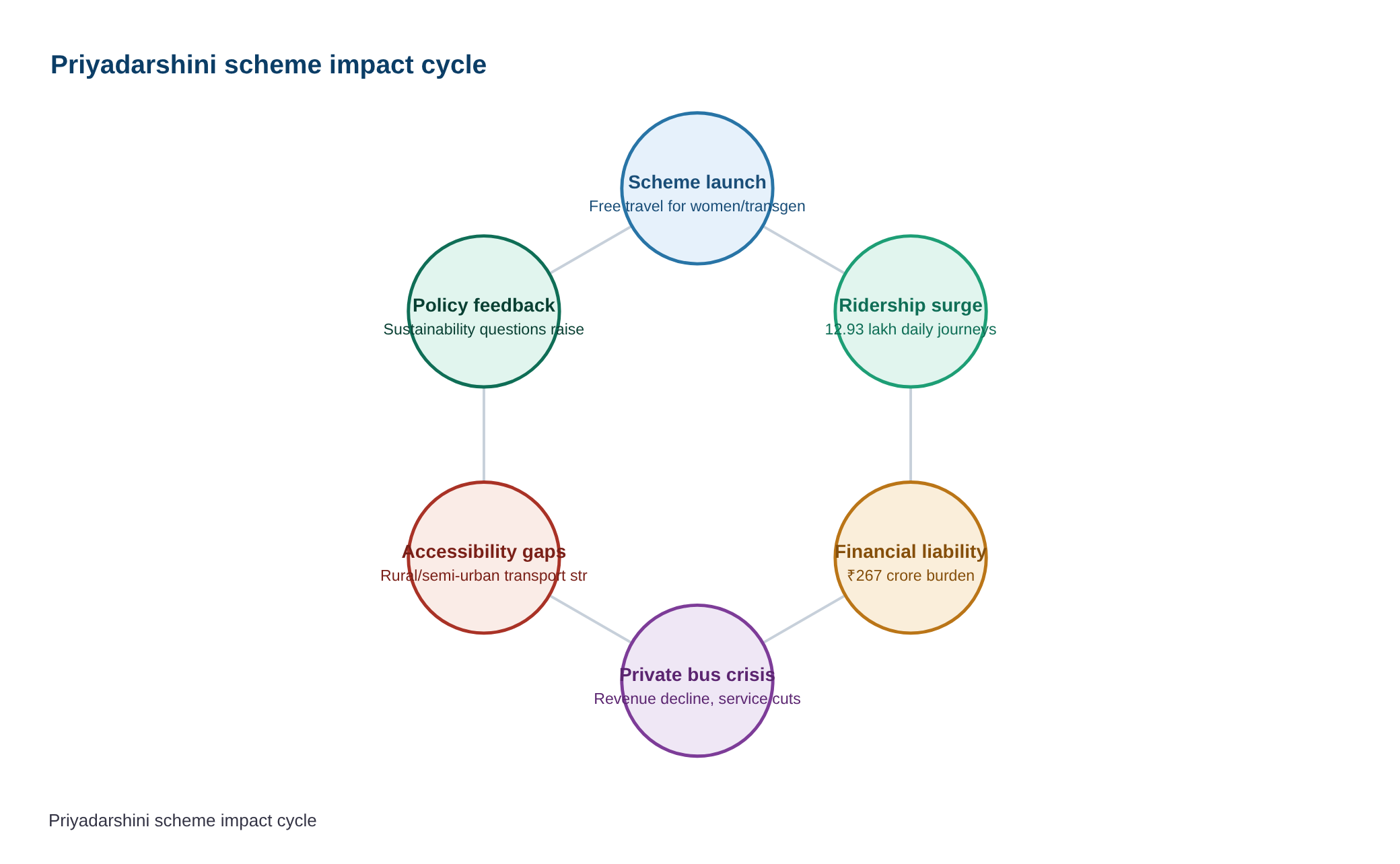
Decline in private bus operator revenues due to reduced ridership → Financial distress among operators → Staff shortages and service cuts → Transport accessibility gaps in rural/semi-urban areas → Potential collapse of private sector transport ecosystem → Increased reliance on KSRTC → Strain on KSRTC’s operational capacity and fiscal health → Need for state intervention to stabilise transport services → Expansion of Priyadarshini scheme as a welfare measure → Transfer of fiscal liability to state exchequer → Long-term sustainability concerns for KSRTC and private operators → Policy dilemma between social equity and economic viability.
Prelims Practice Questions
Q1. Consider the following statements regarding the Priyadarshini free travel scheme in Kerala:
1. The scheme provides free bus travel for women and transgender persons on KSRTC buses.
2. The scheme was launched on June 15, 2026.
3. The scheme has resulted in an average daily ridership of 12.93 lakh journeys.
4. The scheme is funded entirely by the Union Government.
How many of the above statements are correct?
- Only one
- Only two
- Only three
- All
Answer: Only three — Statements 1, 2, and 3 are correct. Statement 4 is incorrect as the scheme is funded by the Kerala State Government, not the Union Government.
Q2. Assertion (A): The Priyadarshini free travel scheme in Kerala has significantly increased the daily ridership on KSRTC buses.
Reason (R): The scheme provides free travel, making public transport more accessible to women and transgender persons.
In the context of the above two statements, which one of the following is correct?
- Both A and R are true, and R is the correct explanation of A
- Both A and R are true, but R is not the correct explanation of A
- A is true, but R is false
- A is false, but R is true
Answer: Both A and R are true, and R is the correct explanation of A — Both the Assertion (A) and Reason (R) are true. The increase in ridership is directly attributed to the scheme’s provision of free travel, making public transport more accessible.
Q3. Match the following committees/initiatives with their respective roles in Kerala’s transport sector:
Column I
A. Padmakumar Committee
B. Priyadarshini free travel scheme
C. Kerala State Road Transport Corporation (KSRTC)
D. All Kerala Bus Operators Organisation
Column II
1. Operates state-owned buses and implements welfare schemes
2. Represents private bus operators and advocates for their interests
3. Formed to address the crisis faced by private bus operators
4. Provides free bus travel for women and transgender persons
Select the correct match:
- A-3, B-4, C-1, D-2
- A-1, B-2, C-3, D-4
- A-4, B-3, C-2, D-1
- A-2, B-1, C-4, D-3
Answer: A-3, B-4, C-1, D-2 — A-3: The Padmakumar Committee was appointed by the Kerala government to address the crisis faced by private bus operators. B-4: The Priyadarshini scheme provides free bus travel for women and transgender persons. C-1: KSRTC operates state-owned buses and implements welfare schemes. D-2: The All Kerala Bus Operators Organisation represents private bus operators and advocates for their interests.
Mains Practice Question
✍ The Priyadarshini free travel scheme in Kerala represents a significant intervention in gender-responsive public transport policy. Critically analyse the scheme’s objectives, implementation challenges, and its broader implications for fiscal federalism and social equity in India. (15 Marks)
Approach: MODEL-ANSWER SKELETON:
1. Objectives of the Priyadarshini scheme:
– Provide free bus travel for women and transgender persons on KSRTC buses.
– Enhance accessibility and mobility for marginalised gender groups.
– Promote gender equality and social inclusion in public transport.
2. Implementation challenges:
– Financial sustainability: Average daily ridership of 12.93 lakh journeys with a liability of ₹267 crore; state government’s financial assistance to KSRTC.
– Impact on private bus operators: 700 buses ceased operations; reduced services; staff shortages; demands for fare hikes and student concession increases.
– Role of the Padmakumar Committee: Assessed the crisis but offered limited solutions.
3. Broader implications:
– Fiscal federalism: State’s financial burden and reliance on own resources for welfare schemes; constitutional provisions (Article 21, Directive Principles) supporting welfare measures.
– Social equity: Scheme aligns with Sustainable Development Goal 5 (gender equality) and promotes inclusive growth.
– Public-private partnership: Need for balanced policies to address the crisis faced by private operators while ensuring equitable access.
4. Balanced view:
– Scheme’s success in increasing ridership and promoting gender inclusivity.
– Challenges in balancing fiscal sustainability, private sector viability, and social equity.
– Need for long-term strategies to integrate public and private transport sectors.
Source: The Hindu
Generated by AanyaAi for educational purpose.
Related guides on our sites
- Best PSIR optional coaching for upsc
- Best PSIR optional teacher for upsc
- Best teacher of PSIR optional for upsc
- Best PSIR optional coaching in delhi for UPSC

- Kerala’s Priyadarshini Scheme: 100 Days of Free Travel & Its Impact on Polity - September 22, 2026
- बॉम्बे हाईकोर्ट ने गणेशोत्सव में ध्वनि एवं वायु प्रदूषण पर उठाई चिंता - September 22, 2026
- Bombay HC Raps Noise, Air Pollution During Ganeshotsav: Key UPSC Perspective - September 22, 2026

No Comments