


22 Sep Bombay HC Raps Noise, Air Pollution During Ganeshotsav: Key UPSC Perspective
✎ The Bombay High Court’s suo motu PIL underscores the constitutional duty of state authorities to enforce noise and air pollution regulations during festivals, ensuring that cultural practices do not infringe upon the right to a…
Subject Relevance — Where This Topic Fits
- GS Paper II — Fundamental Rights and Directive Principles of State Policy | GS Paper III — Environmental Pollution and Degradation
- Prelims: Noise Pollution (Regulation and Control) Rules, 2000, Air (Prevention and Control of Pollution) Act, 1981, Environmental Impact Assessment (EIA) Notification, 2006, Bombay High Court suo motu PIL jurisdiction, Public Interest Litigation (PIL) under Article 226 of the Constitution, National Green Tribunal (NGT), Urban Air Quality Management, Decibel (dB) limits for public address systems
- Essay: Balancing cultural rights with environmental sustainability: A judicial perspective, The role of the judiciary in safeguarding public health and environmental justice
Quick Revision: The Bombay High Court’s suo motu PIL underscores the constitutional duty of state authorities to enforce noise and air pollution regulations during festivals, ensuring that cultural practices do not infringe upon the right to a healthy environment under Article 21.
Why is this in the news?
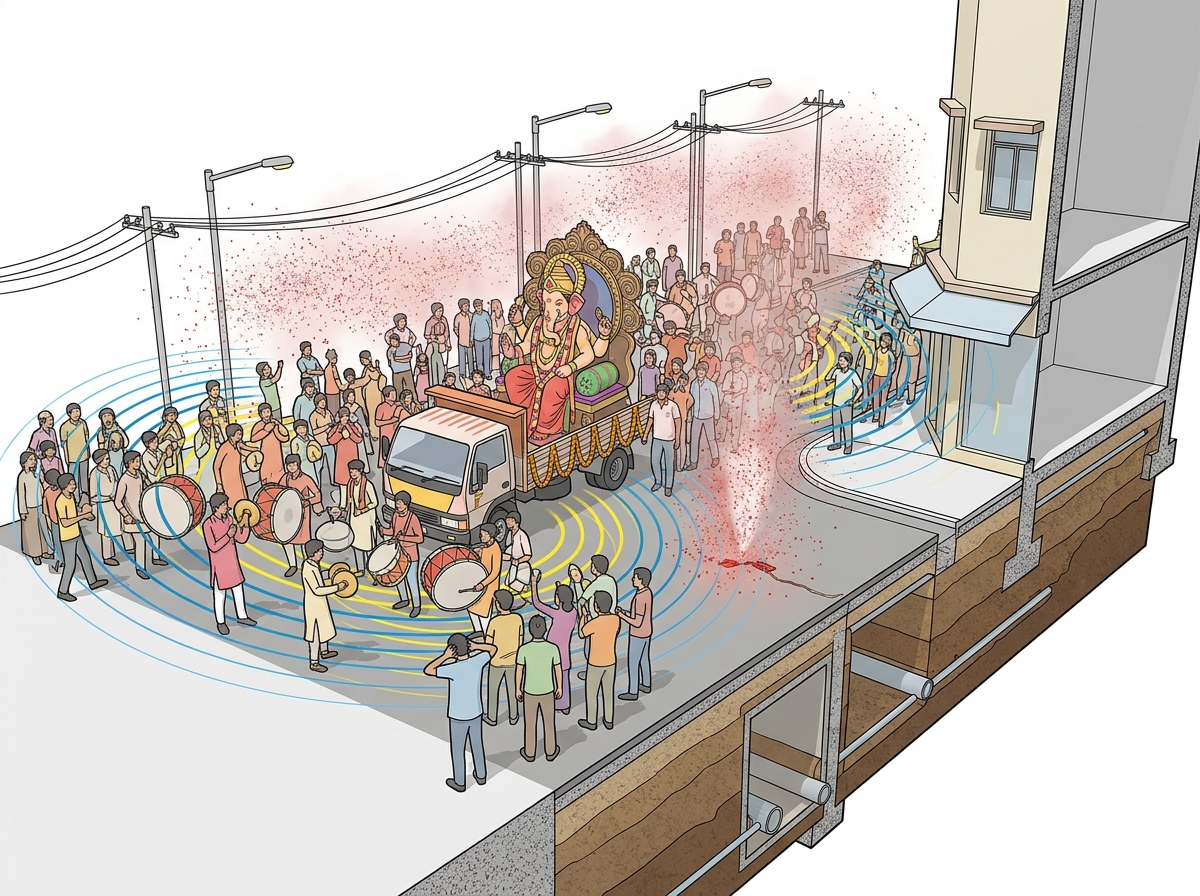
The Bombay High Court, acting suo motu, initiated a Public Interest Litigation (PIL) to address the exacerbation of noise and air pollution during Ganeshotsav in Maharashtra, highlighting systemic failures in the implementation of existing environmental regulations. The Court’s observations underscore the conflict between cultural festivities and the constitutional mandate to protect public health and the environment, warranting a re-examination of regulatory enforcement mechanisms during festival seasons.
Background
- Ganeshotsav is a ten-day Hindu festival celebrated with public processions, music, and firecrackers across Maharashtra, particularly in Mumbai.
- Noise and air pollution during Ganeshotsav have been a recurring issue, with studies indicating a spike in particulate matter (PM2.5 and PM10) and noise levels exceeding permissible limits.
- The Noise Pollution (Regulation and Control) Rules, 2000, prescribe decibel limits for public address systems, with specific timings for permissible noise levels.
- The Air (Prevention and Control of Pollution) Act, 1981, empowers state pollution control boards to regulate air pollution, including emissions from firecrackers.
- The National Green Tribunal (NGT) has previously issued directives to curb air pollution during festivals, including Ganeshotsav, in various states.
- The Bombay High Court’s suo motu PIL in 2023 on air pollution in Mumbai highlighted the persistent challenge of haze and particulate matter during September-October, coinciding with Ganeshotsav.
What is the judicial oversight of environmental governance during festivals?
- The Bombay High Court’s suo motu PIL jurisdiction under Article 226 of the Constitution empowers it to take cognizance of issues affecting public interest, including environmental degradation, without requiring a formal petition.
- The Court’s observations in the present case reflect the principle of ‘precautionary action’ under environmental law, which mandates preventive measures even in the absence of conclusive scientific evidence of harm.
- The Noise Pollution (Regulation and Control) Rules, 2000, stipulate that public address systems and loudspeakers must adhere to decibel limits (e.g., 55 dB during the day and 45 dB at night in residential areas) and prohibit their use beyond permissible hours (typically 10 PM).
- The Air Quality Index (AQI) in Mumbai often exceeds safe limits during Ganeshotsav due to combined emissions from firecrackers, vehicular traffic, and industrial sources, exacerbating respiratory ailments.
- The Court’s reference to the 2023 suo motu PIL on air pollution underscores the systemic nature of the problem, with authorities struggling to enforce regulations despite existing legal frameworks.
- Judicial interventions in festival-related pollution cases often balance cultural rights with the right to life and health under Article 21 of the Constitution, as interpreted by the Supreme Court in landmark judgments such as Subhash Kumar v. State of Bihar (1991).
- The National Green Tribunal (NGT) has played a pivotal role in enforcing environmental regulations during festivals, including directing state governments to implement noise and air pollution control measures.
UPSC Value Addition
Keywords for Mains Answer-Writing
Bombay High Court · Ganeshotsav · noise pollution · air pollution · Environment Protection Act 1986 · Noise Pollution (Regulation and Control) Rules 2000 · right to clean environment · precautionary principle · polluter pays principle · public nuisance · fundamental duties · Article 21 · Article 48A · Article 51A(g) · sustainable development · judicial activism · municipal governance · environmental governance · precautionary measures · public health · socio-legal dimensions of pollution
Prelims Practice Questions
Q1. Consider the following statements regarding noise pollution regulation in India:
1. The Noise Pollution (Regulation and Control) Rules, 2000, prescribe ambient noise standards for different zones.
2. The Central Pollution Control Board (CPCB) is empowered to implement the Noise Pollution Rules.
3. State Pollution Control Boards are not required to monitor noise levels under the Environment Protection Act, 1986.
How many of the above statements are correct?
- Only one
- Only two
- All three
- None
Answer: Only two — Statement 1 is correct as the Noise Pollution Rules, 2000, do prescribe ambient noise standards. Statement 2 is correct as the CPCB is the nodal agency for implementation. Statement 3 is incorrect as State Pollution Control Boards are mandated to monitor noise levels under the Environment Protection Act, 1986.
Q2. Assertion (A): The Bombay High Court, in its suo motu PIL during Ganeshotsav, highlighted the need for stricter implementation of existing noise and air pollution regulations.
Reason (R): The court observed that ground realities indicate systemic failure in enforcement of pollution control norms, causing serious prejudice to citizens.
In the context of the above two statements, which one of the following is correct?
- Both A and R are true, and R is the correct explanation of A
- Both A and R are true, but R is not the correct explanation of A
- A is true, but R is false
- A is false, but R is true
Answer: Both A and R are true, and R is the correct explanation of A — Both the assertion and reason are true, and the reason correctly explains the assertion as the court’s observation on enforcement failures directly underpins its suo motu PIL.
Q3. Match the following legal provisions with their respective objectives:
Column I (Provision)
A. Article 21 of the Constitution
B. Article 48A of the Constitution
C. Article 51A(g) of the Constitution
D. Environment Protection Act, 1986
Column II (Objective)
1. Fundamental duty to protect and improve the natural environment
2. Right to life and personal liberty, including the right to a clean environment
3. Central legislation for the protection and improvement of the environment
4. Duty of the State to protect and improve the environment and safeguard forests and wildlife
- A-2, B-4, C-1, D-3; A-1, B-2, C-4, D-3; A-3, B-1, C-2, D-4; A-4, B-3, C-2, D-1
- answer_match_pairing_indexes_to_string_answer_indexes_0
- explain_match_pairing_indexes_to_string_answer_indexes_0
- format_match
Answer: A-2, B-4, C-1, D-3; A-1, B-2, C-4, D-3; A-3, B-1, C-2, D-4; A-4, B-3, C-2, D-1 — Correct matching: A-2 (Article 21 guarantees right to life including clean environment), B-4 (Article 48A directs the State to protect and improve environment), C-1 (Article 51A(g) imposes fundamental duty to protect environment), D-3 (Environment Protection Act, 1986 is the central legislation for environmental protection).
Mains Practice Question
✍ The Bombay High Court’s suo motu PIL during Ganeshotsav underscores the tension between cultural practices and environmental governance in India. Critically examine the constitutional and statutory framework for environmental protection in India, with special reference to noise and air pollution regulation. Also, analyse the role of judicial activism in balancing cultural rights and environmental rights. (15 Marks)
Approach: MODEL-ANSWER SKELETON:
1. Constitutional Framework:
– Article 21 (Right to Life and Personal Liberty) as interpreted to include right to clean environment (Subhash Kumar v. State of Bihar).
– Directive Principles: Article 48A (State’s duty to protect environment) and Article 51A(g) (Fundamental duty of citizens to protect environment).
– Judicial precedents: MC Mehta cases (e.g., Oleum Gas Leak case) establishing public trust doctrine and absolute liability.
2. Statutory Framework:
– Environment Protection Act, 1986: Framework legislation empowering central and state authorities.
– Air (Prevention and Control of Pollution) Act, 1981 and Water (Prevention and Control of Pollution) Act, 1974.
– Noise Pollution (Regulation and Control) Rules, 2000: Ambient noise standards for residential, commercial, industrial, and silence zones; powers of State Pollution Control Boards (SPCBs).
– Municipal laws: Local bodies’ role under 74th Constitutional Amendment Act.
3. Cultural Practices vs. Environmental Rights:
– Conflict: Festivals, processions, and firecrackers as cultural expressions vs. right to clean air and noise-free environment.
– Legal principles: Precautionary principle (Rio Declaration), polluter pays principle, sustainable development.
– Judicial stance: Courts have balanced cultural rights with environmental rights (e.g., firecracker bans in Delhi-NCR, noise pollution orders during festivals).
4. Role of Judicial Activism:
– Suo motu PILs as mechanism for public interest litigation (PIL) to address systemic failures.
– Judicial review of executive inaction: Courts directing enforcement of existing laws (e.g., Delhi High Court’s orders on firecrackers).
– Limits: Separation of powers, need for legislative/executive action, and potential overreach.
5. Way Forward:
– Strengthening SPCBs and municipal governance for real-time monitoring.
– Public awareness and community participation in enforcement.
– Technological solutions: Use of sound meters, e-permits, and alternative eco-friendly celebrations.
Source: The Indian Express
Generated by AanyaAi for educational purpose.
Related guides on our sites
- Current affairs for upsc 2026
- How to prepare for GS paper 1 for UPSC CSE mains exam
- Best UPSC coaching for IFOS exam
- Best geography optional coaching

- बॉम्बे हाईकोर्ट ने गणेशोत्सव में ध्वनि एवं वायु प्रदूषण पर उठाई चिंता - September 22, 2026
- Bombay HC Raps Noise, Air Pollution During Ganeshotsav: Key UPSC Perspective - September 22, 2026
- जल जीवन मिशन 2.0: कुशल कार्यबल निर्माण के लिए पहली वर्चुअल सम्मेलन आयोजित - September 22, 2026

No Comments