


23 Sep El Nino & Northeast Monsoon: Impact on Tamil Nadu for UPSC 2026
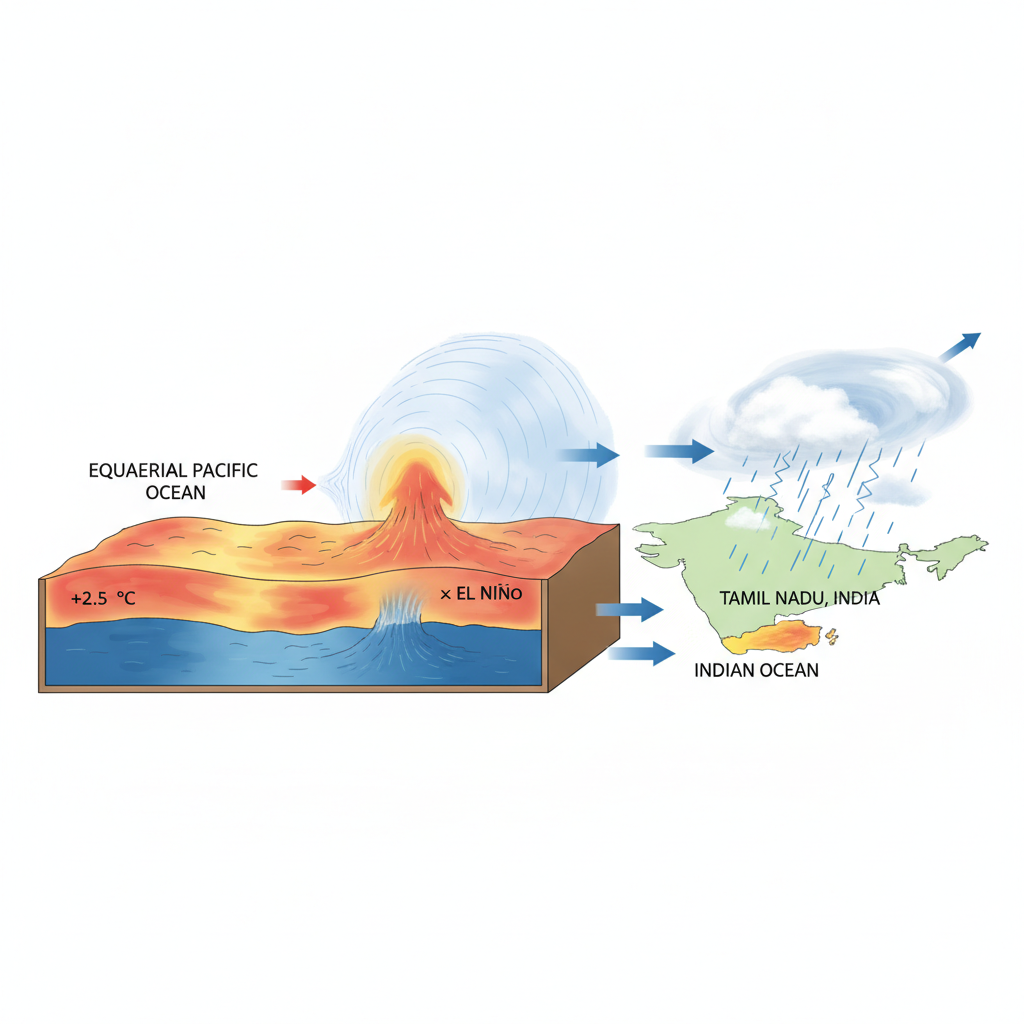
✎ El Niño is a climate phenomenon driven by abnormal warming in the central-eastern Pacific, disrupting monsoon patterns; its impact on Tamil Nadu’s Northeast Monsoon depends on interactions with the Indian Ocean Dipole and other…
Subject Relevance — Where This Topic Fits
- GS Paper I — Geography (Climate and Monsoon Systems) | GS Paper III — Disaster Management and Climate Change
- Prelims: El Niño-Southern Oscillation (ENSO), Northeast Monsoon, Indian Ocean Dipole (IOD), Niño 3.4 Index, IMD, WMO, Climate Anomalies, Drought-Prone Regions, Water Stress, Agricultural Yield Variability
- Essay: Climate Change and its Socio-Economic Impacts, Water Security: A Global Challenge
Quick Revision: El Niño is a climate phenomenon driven by abnormal warming in the central-eastern Pacific, disrupting monsoon patterns; its impact on Tamil Nadu’s Northeast Monsoon depends on interactions with the Indian Ocean Dipole and other regional climate drivers.
Why is this in the news?
The article highlights the intensifying El Niño conditions in 2026, with sea surface temperatures in the central-eastern equatorial Pacific exceeding +2.51°C, indicating a strong El Niño event. This phenomenon is critical for Tamil Nadu as it coincides with the northeast monsoon season, which is pivotal for the state’s water resources, agriculture, and overall socio-economic stability. The interaction between El Niño and other climate drivers like the Indian Ocean Dipole (IOD) will determine the severity of rainfall deficits and extreme weather events, necessitating proactive governance measures.
Background
- El Niño is a climate phenomenon characterised by the abnormal warming of sea surface temperatures in the central and eastern equatorial Pacific Ocean, disrupting global weather patterns.
- The Southwest Monsoon in India, which typically occurs from June to September, has already exhibited a rainfall deficit in 2026, partly attributed to El Niño conditions.
- The Northeast Monsoon, occurring from October to December, is crucial for Tamil Nadu, contributing approximately 48% of the state’s annual rainfall, particularly in coastal and southern districts.
- Tamil Nadu is highly vulnerable to climate variability, with recurring droughts and water scarcity issues exacerbating agricultural and urban water supply challenges.
- The World Meteorological Organisation (WMO) has warned that a very strong El Niño can significantly alter rainfall and temperature patterns, increasing the frequency of extreme weather events.
What is El Niño?
- El Niño is part of the El Niño-Southern Oscillation (ENSO) cycle, which includes the warm phase (El Niño), the cool phase (La Niña), and neutral conditions.
- The Niño 3.4 Index is the primary metric used to monitor El Niño, with values above +0.8°C indicating El Niño conditions.
- El Niño disrupts global atmospheric circulation, leading to altered jet streams and weather patterns, including reduced rainfall over Southeast Asia and Australia, and increased rainfall over parts of the Americas.
- In India, El Niño is historically associated with below-normal Southwest Monsoon rainfall, though its impact on the Northeast Monsoon is more variable and region-specific.
- The phenomenon is not a standalone driver; its effects are modulated by other climate systems such as the Indian Ocean Dipole (IOD), the Atlantic Multidecadal Oscillation, and the Pacific Decadal Oscillation.
- Strong El Niño events can amplify extreme weather events, including cyclones, heatwaves, and prolonged dry spells, posing significant risks to agriculture, water resources, and public health.
- The current El Niño event in 2026 is projected to persist until mid-2027, with potential peak intensities exceeding +3.0°C in the Niño 3.4 region, raising concerns about prolonged climate anomalies.
Key Features
| Feature | Significance |
|---|---|
| El Niño Phenomenon | A climate cycle characterised by abnormal warming of central-eastern equatorial Pacific Ocean, disrupting global weather patterns including monsoon systems. |
| Niño 3.4 Index | Standard metric measuring sea surface temperature anomalies in the central-eastern Pacific; threshold for El Niño is +0.8°C; current anomaly is +2.51°C, indicating a strong event. |
| Northeast Monsoon | Primary rainfall season for Tamil Nadu (October–December), critical for water resources, agriculture, and urban water supply. |
| Southwest Monsoon Retreat | Annual withdrawal phase (September–October) leaving rainfall deficits in parts of India, including Tamil Nadu, compounded by El Niño. |
| Indian Ocean Dipole (IOD) | Climate driver influencing monsoon variability; positive IOD can mitigate El Niño’s dry impact, while negative IOD exacerbates deficits. |
Why it Matters
Agricultural Impact
- Tamil Nadu’s agriculture, particularly rice and pulses, relies heavily on northeast monsoon rainfall; deficits can reduce crop yields and trigger price volatility.
- Irrigation systems, including tanks and canals, depend on monsoon recharge; prolonged deficits may exacerbate groundwater depletion.
- Livestock and dairy sectors face fodder shortages, increasing costs for farmers and impacting rural incomes.
Urban Water Security
- Chennai and other cities depend on northeast monsoon for reservoir replenishment; deficits risk water rationing and public health crises.
- Groundwater extraction may surge during deficits, accelerating depletion and increasing vulnerability to future droughts.
- Industrial and domestic water demand may strain supply systems, necessitating emergency measures like desalination or inter-basin transfers.
Economic Consequences
- Agricultural GDP contraction in Tamil Nadu could reduce state revenue and increase fiscal pressure on welfare schemes.
- Higher food prices due to crop failures may widen inflation, impacting household budgets and monetary policy decisions.
- Tourism and allied sectors (e.g., hospitality) may face revenue losses if monsoon deficits reduce attractiveness of coastal and hill destinations.
Climate Change Amplification
- El Niño events are intensifying under global warming, with 2023–2027 projected as the warmest five-year period on record.
- Extreme weather events (e.g., cyclones, heatwaves) linked to El Niño may compound monsoon deficits and infrastructure damage.
- Long-term adaptation strategies are needed to build resilience against recurring climate anomalies.
Challenges
1. Water Scarcity and Drought
- Prolonged monsoon deficits may lead to severe drought conditions, affecting 60% of Tamil Nadu’s districts reliant on rain-fed agriculture.
- Depletion of groundwater aquifers in districts like Coimbatore and Tiruchirappalli may become irreversible without stringent conservation measures.
UPSC Link: GS3: Drought Management and Water Conservation
2. Agricultural Production Decline
- Rice and pulses, key crops in Tamil Nadu, face yield reductions due to delayed or deficient northeast monsoon rainfall.
- Increased pest attacks (e.g., brown plant hopper in rice) are likely in water-stressed conditions, further lowering productivity.
UPSC Link: GS3: Food Security and Agricultural Practices
3. Urban Water Crisis
- Chennai’s reservoirs (e.g., Poondi, Cholavaram) may not reach full capacity, necessitating emergency measures like cloud seeding or water imports.
- Industrial shutdowns due to water shortages could disrupt supply chains and employment in sectors like automobile and textiles.
UPSC Link: GS2: Urban Governance and Infrastructure
4. Public Health Risks
- Water-borne diseases (e.g., cholera, diarrhoea) may surge due to poor water quality and inadequate sanitation during water shortages.
- Heatwaves coinciding with monsoon deficits could exacerbate health risks, particularly for vulnerable populations (elderly, children).
UPSC Link: GS2: Health and Sanitation Policies
5. Climate Migration and Social Unrest
- Rural-to-urban migration may increase as farmers seek alternative livelihoods, straining urban infrastructure and social services.
- Competition for limited water resources could lead to conflicts between agricultural, industrial, and domestic users.
UPSC Link: GS1: Climate Change and Human Migration
Challenges — UPSC Perspective
| Issue | Concern |
|---|---|
| Groundwater Depletion | Accelerated extraction during monsoon deficits may lead to permanent loss of aquifers, threatening long-term water security. |
| Crop Failure | Delayed or deficient northeast monsoon may reduce yields of staple crops, increasing food inflation and rural distress. |
| Reservoir Shortages | Urban water supply systems in Tamil Nadu may face critical shortages, necessitating emergency interventions. |
| Public Health Emergencies | Water scarcity may exacerbate outbreaks of water-borne diseases and heat-related illnesses. |
| Economic Slowdown | Agricultural and industrial sectors may face revenue losses, impacting state GDP and employment rates. |
| Climate-Induced Migration | Rural populations may migrate to cities, increasing pressure on urban resources and social cohesion. |
Way Forward
- Enhance real-time monitoring of El Niño and IOD indices through collaboration with international agencies (e.g., WMO, NOAA) for accurate forecasting.
- Implement drought-proofing measures in agriculture, including crop diversification, water-efficient irrigation (e.g., drip irrigation), and insurance schemes for farmers.
- Strengthen urban water management by augmenting reservoir capacities, promoting rainwater harvesting, and investing in wastewater recycling infrastructure.
- Develop contingency plans for Chennai and other cities, including inter-basin water transfers, desalination plants, and emergency rationing protocols.
- Promote community-based water conservation initiatives (e.g., revival of traditional water bodies, afforestation) to enhance local resilience.
- Integrate climate adaptation into state planning, including heat-action plans, cyclone preparedness, and early warning systems for extreme weather.
- Foster public-private partnerships for climate-resilient infrastructure (e.g., smart water grids, renewable energy-powered desalination).
UPSC Value Addition
Keywords for Mains Answer-Writing
El Niño Southern Oscillation (ENSO) · Northeast Monsoon · Southwest Monsoon · Tamil Nadu rainfall variability · Indian Ocean Dipole (IOD) · Climate change and monsoon patterns · Sea Surface Temperature anomalies · El Niño 3.4 index · Extreme weather events · Climate resilience and disaster preparedness · Monsoon forecasting models · South Peninsular India · Global warming and Pacific Ocean · Weather disruption mechanisms
Concept Flow
El Niño intensifies → Central-eastern Pacific Ocean warming (+2.51°C anomaly) → Disrupts Walker Circulation → Weakens Indian Southwest Monsoon → Leaves rainfall deficits in Tamil Nadu. → El Niño persists → Influences Northeast Monsoon dynamics → Tamil Nadu’s rainfall pattern altered → Critical for agriculture, urban water supply, and groundwater recharge. → Indian Ocean Dipole (IOD) interaction → Positive IOD may mitigate El Niño’s dry impact → Negative IOD exacerbates deficits → Tamil Nadu’s vulnerability increases. → Global warming amplifies El Niño → 2023–2027 projected as warmest five-year period → Extreme weather events (cyclones, heatwaves) compound monsoon deficits. → Monsoon deficits → Reduced reservoir levels → Urban water crisis in Chennai and other cities → Public health risks and economic slowdown. → Agricultural yield decline → Rural distress and food inflation → Increased migration to urban areas → Social and economic challenges. → Policy response → Drought management, water conservation, and climate adaptation → Long-term resilience building in Tamil Nadu.
Prelims Practice Questions
Q1. Consider the following statements regarding El Niño and its impact on the Indian monsoon:
1. El Niño is characterised by the warming of sea surface temperatures in the central and eastern equatorial Pacific Ocean.
2. A strong El Niño generally favours a wetter northeast monsoon over southern Peninsular India.
3. The Niño 3.4 index measures sea surface temperature anomalies in the western equatorial Pacific Ocean.
4. El Niño conditions typically persist for 2 to 7 years.
How many of the above statements are correct?
- Only one
- Only two
- Only three
- All
Answer: Only three — Statements 1 and 2 are correct. Statement 3 is incorrect as the Niño 3.4 index measures anomalies in the central-eastern equatorial Pacific. Statement 4 is correct as the typical cycle of El Niño occurrence is between two and seven years.
Q2. Assertion (A): The northeast monsoon in Tamil Nadu is influenced by multiple climate drivers, including El Niño and the Indian Ocean Dipole.
Reason (R): The Indian Ocean Dipole can either amplify or mitigate the effects of El Niño on regional rainfall patterns.
Options:
A. Both A and R are true, and R is the correct explanation of A.
B. Both A and R are true, but R is not the correct explanation of A.
C. A is true, but R is false.
D. A is false, but R is true.
- A
- B
- C
- D
Answer: B — Both the assertion and reason are true. The northeast monsoon in Tamil Nadu is indeed influenced by multiple climate drivers, including El Niño and the Indian Ocean Dipole. The IOD can either amplify or mitigate the effects of El Niño, making R a correct explanation of A.
Q3. Match the following climate phenomena with their respective descriptions:
Column I
1. El Niño
2. Indian Ocean Dipole (IOD)
3. Southwest Monsoon
4. Northeast Monsoon
Column II
A. Seasonal wind reversal bringing heavy rainfall to southern Peninsular India (October–December).
B. Warming of sea surface temperatures in the central-eastern equatorial Pacific Ocean.
C. Seasonal wind system bringing rainfall to most of India (June–September).
D. Anomalous cooling or warming of sea surface temperatures in the western and eastern Indian Ocean.
Options:
1. 1-B, 2-D, 3-C, 4-A
2. 1-A, 2-B, 3-D, 4-C
3. 1-C, 2-D, 3-A, 4-B
4. 1-D, 2-A, 3-B, 4-C
- 1
- 2
- 3
- 4
Answer: 1 — The correct match is: 1-B (El Niño), 2-D (IOD), 3-C (Southwest Monsoon), 4-A (Northeast Monsoon).
Mains Practice Question
✍ El Niño conditions are expected to persist until mid-2027, with potential implications for the northeast monsoon in Tamil Nadu. Critically analyse the interplay between El Niño, the Indian Ocean Dipole, and other climate drivers in determining rainfall variability over southern Peninsular India. Also, examine the role of monsoon forecasting models in mitigating the adverse impacts of such climate phenomena on agricultural and water resource management. (15 Marks)
Approach: MODEL-ANSWER SKELETON:
1. **Introduction (2 marks)**: Define El Niño and its global significance, including the Niño 3.4 index and its threshold (+0.8°C). Briefly outline the northeast monsoon’s importance for Tamil Nadu (October–December rainfall, ~40–50% of annual rainfall).
2. **El Niño and Monsoon Dynamics (4 marks)**:
– Explain the mechanism: El Niño-induced weakening of the Walker Circulation, leading to suppressed convection over the Indian Ocean and reduced southwest monsoon rainfall.
– Contrast with northeast monsoon: Strong El Niño often correlates with enhanced northeast monsoon rainfall over southern Peninsular India due to altered wind patterns (e.g., 2015 case study).
– Highlight variability: Emphasise that El Niño alone does not determine outcomes; other drivers like the Indian Ocean Dipole (IOD) can amplify or mitigate effects.
3. **Indian Ocean Dipole (IOD) and Other Drivers (3 marks)**:
– Define IOD (positive/negative phases) and its role in modulating rainfall over Tamil Nadu.
– Discuss the interplay: E.g., positive IOD can offset El Niño’s negative impact on southwest monsoon but may exacerbate northeast monsoon variability.
– Mention other factors: Atlantic Niño, Madden-Julian Oscillation (MJO), and global warming trends.
4. **Forecasting Models and Mitigation (4 marks)**:
– Name key models: IMD’s Extended Range Forecast System (ERFS), dynamical models (e.g., NCMRWF’s GFS, ECMWF), and statistical models (e.g., regression-based).
– Discuss their role: Early warnings for agricultural planning (e.g., sowing schedules, water storage), disaster preparedness (e.g., flood/drought alerts).
– Limitations: Model biases, data gaps, and the challenge of predicting IOD-El Niño interactions.
5. **Policy and Institutional Framework (2 marks)**:
– Reference India’s National Monsoon Mission and its outcomes.
– Highlight state-level initiatives: Tamil Nadu’s Water Resources Department’s drought management plans, crop insurance schemes (e.g., PMFBY).
6. **Conclusion (1 mark)**: Summarise the need for multi-hazard risk assessment, integrating climate science with policy, and building resilience in vulnerable regions like Tamil Nadu.
Source: The Hindu
Tamil Nadu PCS (TNPSC) — State PCS Practice
Prelims: Which of the following is a primary concern for Tamil Nadu during a strong El Niño event affecting the northeast monsoon?
- A. Excessive rainfall leading to floods in delta regions
- B. Delayed or deficit northeast monsoon rainfall causing water scarcity
- C. Increased cyclonic activity in the Bay of Bengal
- D. Rise in temperatures leading to heatwaves in coastal areas
Answer: B. Delayed or deficit northeast monsoon rainfall causing water scarcity — A strong El Niño typically weakens the northeast monsoon, leading to delayed or deficit rainfall, which increases the risk of water scarcity in Tamil Nadu.
Mains: Discuss the socio-economic impacts of a deficit northeast monsoon in Tamil Nadu, highlighting the challenges faced by agriculture, water resources, and livelihoods. Suggest measures to mitigate these impacts.
Generated by AanyaAi for educational purpose.
Related guides on our sites
- Current affairs for upsc 2026
- How to prepare for GS paper 1 for UPSC CSE mains exam
- Best UPSC coaching for IFOS exam
- Best geography optional coaching

- बिहार सरकार का बड़ा कदम: 25 हजार परिवारों को सौर ऊर्जा सहायता, 534 प्रखंडों में सोलर मार्ट खोले जाएंगे - September 23, 2026
- Bihar Launches Mega Solar Scheme: 25,000 Families to Benefit, 534 Solar Marts - September 23, 2026
- सुपर एल नीनो से भारत में 15,800 अतिरिक्त गर्मी से मौतें: जानिए पूरा मामला - September 23, 2026

No Comments