


23 Sep RBI Auction Results: Key Cuts in 91/182/364-Day T-Bill Yields Explained for UPSC
✎ Treasury Bills are zero-coupon government securities issued at a discount to face value, with yields determined by auction cut-off prices and reflecting short-term interest rate expectations.
Subject Relevance — Where This Topic Fits
- GS Paper III — Indian Economy: Money and Banking, Government Budgeting, Fiscal Policy
- Prelims: Treasury Bills (T-Bills), Yield to Maturity (YTM), Primary Market Auctions, Public Debt Management, Fiscal Deficit, Monetary Policy Transmission
- Essay: The Role of Government Securities in Fiscal Sustainability, Monetary Policy and Economic Stability: A Balancing Act
Quick Revision: Treasury Bills are zero-coupon government securities issued at a discount to face value, with yields determined by auction cut-off prices and reflecting short-term interest rate expectations.
Why is this in the news?
The Reserve Bank of India (RBI) conducted auctions for 91-day, 182-day, and 364-day Treasury Bills (T-Bills) on 23 September 2026, with the cut-off prices and implicit yields indicating market expectations regarding short-term interest rates, liquidity conditions, and the government’s borrowing strategy. These results are significant for understanding the dynamics of public debt management, the transmission of monetary policy, and the broader macroeconomic environment in India.
Background
- Treasury Bills are short-term government securities issued by the Government of India to meet its immediate cash requirements and manage the fiscal deficit.
- The RBI conducts auctions for T-Bills on behalf of the Government of India as part of the Public Debt Management (PDM) framework.
- T-Bills are issued at a discount to their face value and redeemed at par, with the difference representing the implicit yield, which reflects market interest rates.
- The notified face values for the 91-day, 182-day, and 364-day T-Bills were ₹9,000 crore, ₹8,000 crore, and ₹7,000 crore respectively, indicating the government’s borrowing requirements for short-term liquidity management.
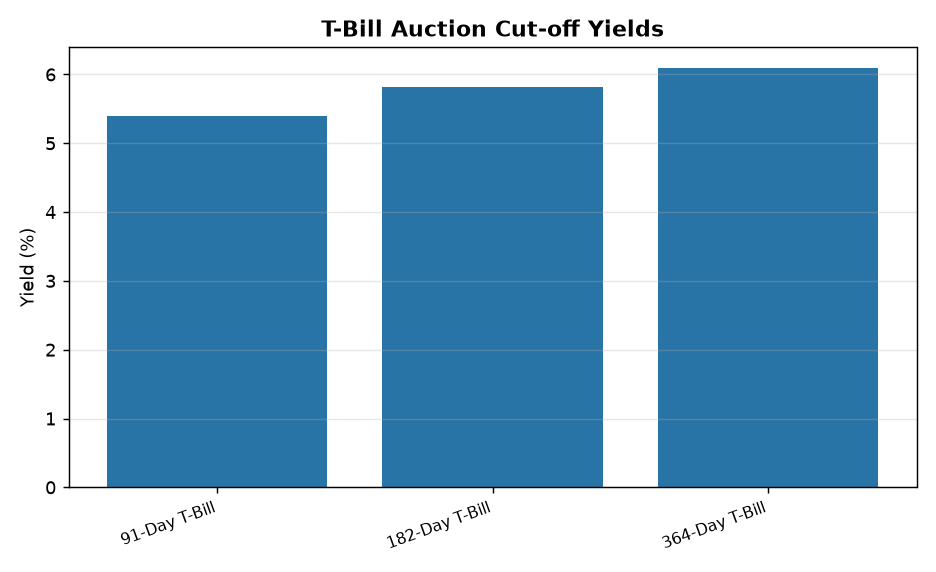
- The cut-off yields (5.3900% for 91-day, 5.8196% for 182-day, and 6.0895% for 364-day T-Bills) suggest a rising yield curve, which may reflect expectations of tighter liquidity conditions or higher inflationary pressures in the near term.
What are Treasury Bills (T-Bills)?
- Treasury Bills are short-term money market instruments issued by the Government of India to meet its short-term funding requirements and manage liquidity.
- They are issued at a discount to their face value and redeemed at par upon maturity, with the difference representing the implicit yield, which is equivalent to the interest rate on the bill.
- T-Bills are issued in three tenors: 91 days, 182 days, and 364 days, catering to different liquidity and investment horizons.
- They are considered risk-free securities as they are backed by the sovereign guarantee of the Government of India, making them attractive to institutional investors, banks, and other financial entities.
- The RBI conducts auctions for T-Bills on behalf of the Government of India, determining the cut-off prices and yields based on market demand and liquidity conditions.
- T-Bills play a crucial role in the Public Debt Management (PDM) framework, helping the government finance its fiscal deficit without resorting to long-term borrowing.
- They are also used as a benchmark for pricing other short-term debt instruments and for assessing market expectations regarding interest rates and inflation.
- The secondary market for T-Bills is highly liquid, enabling investors to trade them before maturity, which enhances their appeal as an investment instrument.
Key Features
| Feature | Significance |
|---|---|
| Tenor of Treasury Bills (T-Bills) | T-Bills are short-term government securities with maturities of 91 days, 182 days, and 364 days, used to manage the Union Government’s cash flow and fiscal deficit. |
| Cut-off Price and Implicit Yield | The cut-off price determines the yield at which the government borrows; higher yields indicate tighter liquidity or higher inflation expectations in the economy. |
| Total Face Value Notified | The notified amount (₹9,000 Crore for 91-day, ₹8,000 Crore for 182-day, ₹7,000 Crore for 364-day) reflects the government’s borrowing requirement for the week. |
| Acceptance of Full Notified Amount | The full notified amount was accepted across all tenors, indicating robust demand from market participants, including banks, mutual funds, and non-banking financial companies (NBFCs). |
| Yield Curve Dynamics | The upward-sloping yield curve (5.39% for 91-day, 5.82% for 182-day, 6.09% for 364-day) reflects term premiums and market expectations of future interest rate movements. |
Why it Matters
Monetary Policy Transmission
- The auction results serve as a benchmark for short-term interest rates, influencing the cost of funds for banks and financial institutions.
- Higher yields on longer-tenor T-Bills may signal expectations of tighter monetary policy or inflationary pressures, affecting lending rates across the economy.
- The yield curve provides insights into market sentiment regarding liquidity conditions and the Reserve Bank of India’s (RBI) policy stance.
Fiscal Management
- T-Bills are a key instrument for the Union Government to finance its fiscal deficit without resorting to long-term borrowings, which carry higher interest costs.
- The acceptance of the full notified amount indicates strong investor confidence in sovereign paper, reducing the risk of fiscal slippages.
- The auction results help the government align its borrowing calendar with liquidity conditions in the banking system.
Investor Sentiment and Market Liquidity
- The robust demand for T-Bills reflects their status as a risk-free asset, attracting institutional investors such as banks and mutual funds.
- Yield differentials across tenors provide arbitrage opportunities, influencing portfolio allocations and liquidity in the money market.
- The auction results are closely monitored by foreign portfolio investors (FPIs) for indications of India’s macroeconomic stability and policy direction.
Impact on Banking and Financial Sector
- Banks use T-Bills as part of their Statutory Liquidity Ratio (SLR) requirements, making them a critical component of liquidity management.
- Higher yields on T-Bills may reduce the attractiveness of other short-term instruments, such as commercial paper, altering the funding landscape for corporates.
- The auction results influence the pricing of short-term loans, including working capital and trade finance, impacting the real sector.
Challenges
1. Liquidity Management Challenges
- Balancing the government’s borrowing requirements with the need to maintain adequate liquidity in the banking system remains a persistent challenge.
- Excessive reliance on short-term borrowings (like T-Bills) can expose the government to rollover risks, especially in volatile market conditions.
- The RBI must ensure that the auction process does not disrupt the broader financial markets or crowd out private sector credit.
UPSC Link: Economic Survey: Fiscal Deficit and Government Borrowing
2. Interest Rate Volatility and Inflation Expectations
- Persistent inflation or expectations of tighter monetary policy can lead to higher yields, increasing the cost of government borrowing.
- Volatility in global financial markets, such as shifts in US Federal Reserve policy, can transmit to domestic T-Bill yields, complicating domestic monetary management.
- The RBI must calibrate its liquidity operations to prevent excessive volatility in short-term interest rates.
UPSC Link: Monetary Policy Framework: Inflation Targeting
3. Investor Concentration and Market Depth
- Over-reliance on a narrow set of institutional investors (e.g., banks, mutual funds) can reduce market depth and increase the risk of liquidity shocks.
- Encouraging participation from a broader investor base, including retail investors and foreign portfolio investors, remains a challenge.
- The RBI may need to introduce structural reforms to deepen the T-Bill market, such as enhancing secondary market liquidity.
UPSC Link: Financial Market Development: Money Market Instruments
4. Fiscal-Monetary Policy Coordination
- The government’s borrowing program must be aligned with the RBI’s monetary policy objectives to avoid conflicting signals in the financial markets.
- Excessive government borrowing can crowd out private investment, particularly if it leads to higher interest rates across the yield curve.
- The RBI’s open market operations (OMOs) must complement the government’s borrowing calendar to maintain stability in the financial system.
UPSC Link: Fiscal-Monetary Nexus and Policy Coordination
Challenges — UPSC Perspective
| Issue | Concern |
|---|---|
| Rollover Risk | Short-term borrowings like T-Bills expose the government to the risk of refinancing at higher costs if market conditions deteriorate. |
| Liquidity Mismatch | The government’s cash flow needs may not always align with the availability of liquidity in the banking system, leading to operational challenges. |
| Market Volatility | Sudden shifts in investor sentiment or global financial conditions can lead to sharp movements in T-Bill yields, disrupting the borrowing program. |
| Investor Base Concentration | Over-reliance on a few institutional investors can reduce market resilience and increase the risk of liquidity crunches during stress periods. |
| Fiscal-Monetary Divergence | If the government’s borrowing program conflicts with the RBI’s monetary policy stance, it can lead to distortions in the financial markets. |
| Inflation-Uncertainty Link | Uncertainty around inflation trends can make it difficult for the RBI to calibrate liquidity operations, affecting T-Bill yields and borrowing costs. |
Way Forward
- The RBI should continue to enhance transparency in the T-Bill auction process to ensure broad-based participation and reduce volatility.
- Encourage diversification of the investor base by introducing retail-friendly T-Bill products or enhancing secondary market liquidity.
- Strengthen coordination between fiscal and monetary authorities to align the government’s borrowing calendar with the RBI’s liquidity management objectives.
- Monitor global financial conditions closely to pre-empt spillover effects on domestic T-Bill yields and adjust policy responses accordingly.
- Explore structural reforms in the money market, such as introducing new tenors or instruments, to deepen the T-Bill market and reduce reliance on short-term borrowings.
- Conduct periodic reviews of the T-Bill auction framework to ensure it remains aligned with evolving market dynamics and policy objectives.
- Enhance communication strategies to provide clear guidance on the government’s borrowing program and the RBI’s liquidity management stance.
- Assess the feasibility of introducing inflation-linked T-Bills to hedge against inflation risks and reduce uncertainty in borrowing costs.
UPSC Value Addition
Keywords for Mains Answer-Writing
Treasury Bills · T-Bills · Money Market Instruments · Yield to Maturity · Cut-off Price · Implicit Yield · Reserve Bank of India · Fiscal Policy · Monetary Policy · Government Securities · Public Debt Management · Liquidity Management · Yield Curve · Risk-Free Rate · Market Determinants of Interest Rates · Debt Instruments
Concept Flow
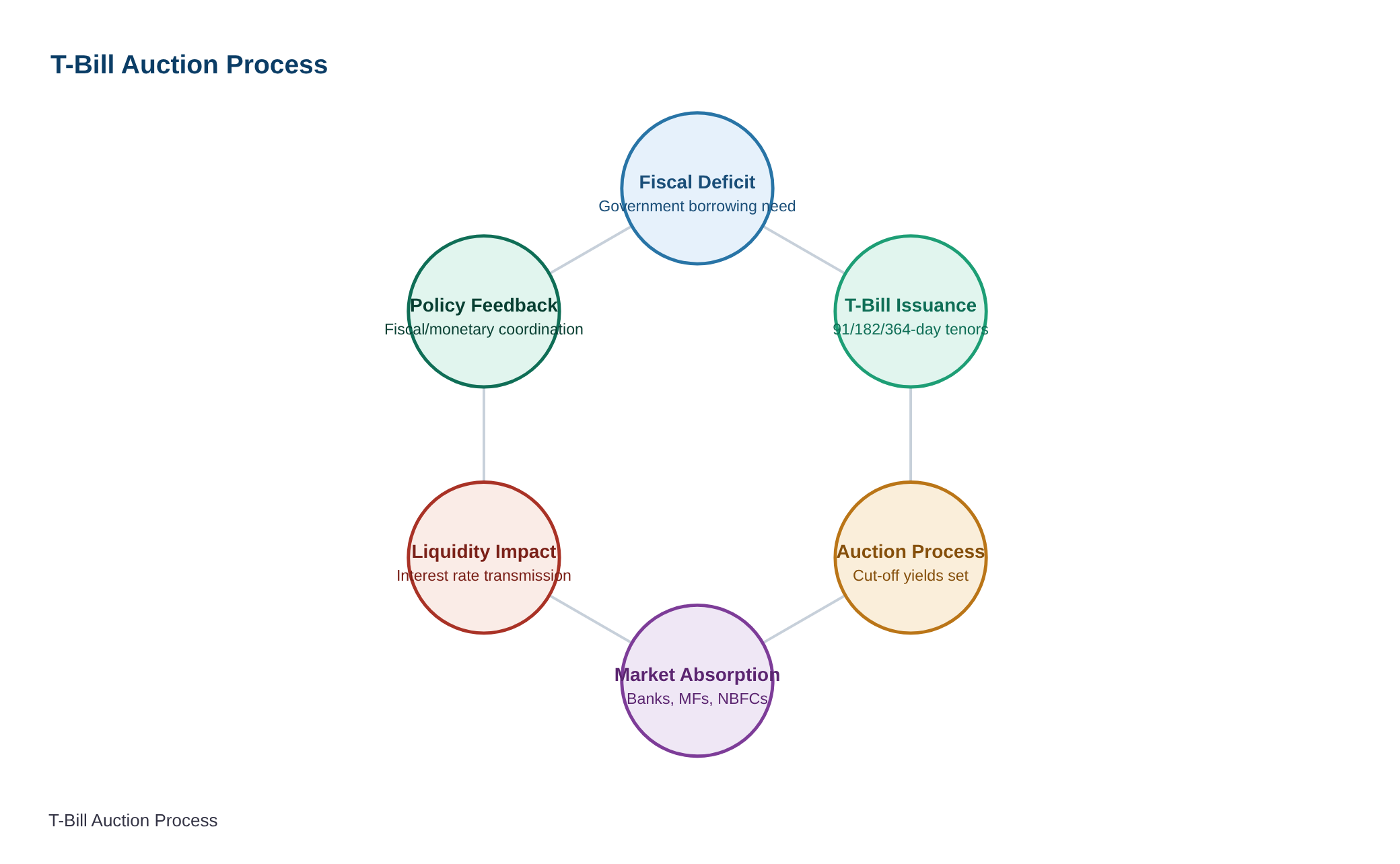
Government’s fiscal deficit → Requirement for short-term borrowings → Issuance of T-Bills with 91/182/364-day tenors → Auction process to determine cut-off yields → Market absorption of T-Bills by banks, mutual funds, and NBFCs → Impact on liquidity conditions and interest rates → Transmission to broader economy via lending rates and investment decisions → Feedback loop to fiscal and monetary policy coordination.
Prelims Practice Questions
Q1. Consider the following statements regarding Treasury Bills (T-Bills) in India: 1. T-Bills are issued by the Government of India to meet short-term financial requirements. 2. T-Bills are issued at a discount and redeemed at face value. 3. The yield on T-Bills is determined by the Reserve Bank of India (RBI) and remains fixed throughout their tenure. 4. T-Bills are money market instruments and are part of the public debt of India. How many of the above statements are correct?
- Only one
- Only two
- Only three
- All four
Answer: Only three — Statements 1, 2, and 4 are correct. T-Bills are issued by the Government of India to meet short-term fiscal needs, are issued at a discount and redeemed at face value, and form part of the public debt. Statement 3 is incorrect because the yield on T-Bills is market-determined, not fixed by the RBI.
Q2. Assertion (A): The cut-off price of a Treasury Bill is the price at which the bid is accepted in an auction. Reason (R): The cut-off price is determined based on the bids received and the notified amount to be raised.
- Both A and R are true, and R is the correct explanation of A.
- Both A and R are true, but R is not the correct explanation of A.
- A is true but R is false.
- A is false but R is true.
Answer: Both A and R are true, and R is the correct explanation of A. — Both the assertion and reason are true. The cut-off price in a T-Bill auction is indeed the price at which bids are accepted, and it is determined based on the bids received and the total notified amount to be raised.
Q3. Match the following types of Treasury Bills with their respective tenures:
Column I
1. 91-Day T-Bill
2. 182-Day T-Bill
3. 364-Day T-Bill
Column II
A. 6 months
B. 1 year
C. 3 months
- {‘1-C, 2-A, 3-B’: 0}
- {‘1-B, 2-C, 3-A’: 1}
- {‘1-A, 2-B, 3-C’: 2}
- {‘1-C, 2-B, 3-A’: 3}
Answer: {‘1-C, 2-A, 3-B’: 0} — The correct match is: 91-Day T-Bill (3 months), 182-Day T-Bill (6 months), and 364-Day T-Bill (1 year).
Mains Practice Question
✍ The yield on Treasury Bills (T-Bills) is a critical indicator of market expectations regarding interest rates and inflation. In this context, critically examine the role of T-Bills in India’s public debt management and monetary policy framework. Also, discuss the implications of rising implicit yields on T-Bills for fiscal sustainability and investor confidence. (15 Marks)
Approach: MODEL-ANSWER SKELETON:
1. **Introduction to T-Bills**: Define Treasury Bills as short-term government securities issued at a discount and redeemed at face value, with tenures of 91 days, 182 days, and 364 days. Highlight their role as money market instruments and their significance in public debt management.
2. **Public Debt Management**: Explain how T-Bills are used by the Government of India to meet short-term fiscal deficits. Discuss the role of the Reserve Bank of India (RBI) in auctioning T-Bills and managing the public debt. Reference the statutory framework under the Public Debt Act, 1944, and the RBI’s role as the debt manager.
3. **Monetary Policy Framework**: Analyze the relationship between T-Bill yields and monetary policy. Explain how T-Bill yields reflect market expectations of interest rates and inflation. Discuss the transmission mechanism of monetary policy through T-Bills, including their impact on liquidity management and the yield curve.
4. **Implicit Yields and Market Signals**: Examine the significance of implicit yields (YTM) on T-Bills as a market-determined signal. Use the provided data (e.g., 5.39% for 91-Day T-Bills, 5.82% for 182-Day T-Bills, and 6.09% for 364-Day T-Bills) to illustrate the yield curve and its implications for investor confidence and fiscal sustainability.
5. **Fiscal Sustainability**: Discuss the implications of rising implicit yields on fiscal sustainability. Explain how higher yields increase the cost of borrowing for the government, potentially leading to higher fiscal deficits. Reference the FRBM Act, 2003, and the government’s fiscal consolidation targets.
6. **Investor Confidence**: Analyze how rising T-Bill yields may impact investor confidence in government securities. Discuss the role of foreign institutional investors (FIIs) and domestic institutional investors in the T-Bill market. Highlight the importance of maintaining investor confidence for stable public debt management.
7. **Conclusion**: Summarize the critical role of T-Bills in public debt management and monetary policy. Emphasize the need for a balanced approach to manage implicit yields while ensuring fiscal sustainability and investor confidence.
Source: RBI
Generated by AanyaAi for educational purpose.
Related guides on our sites
- Best PSIR optional coaching for upsc
- Best economics optional coaching for upsc
- Best PSIR optional teacher for upsc
- Best teacher of PSIR optional for upsc

- बिहार सरकार का बड़ा फैसला: कारोबार शुरू करने में होगी आसानी, जानिए कैसे मिलेगा फायदा - September 23, 2026
- Bihar Launches Single Window Portal for 62 Business Services: UPSC & PCS Guide - September 23, 2026
- ग्रीनलैंड समझौता: अमेरिका को मिले अतिरिक्त रक्षा क्षेत्र, जानिए पूरा मामला - September 23, 2026

No Comments