


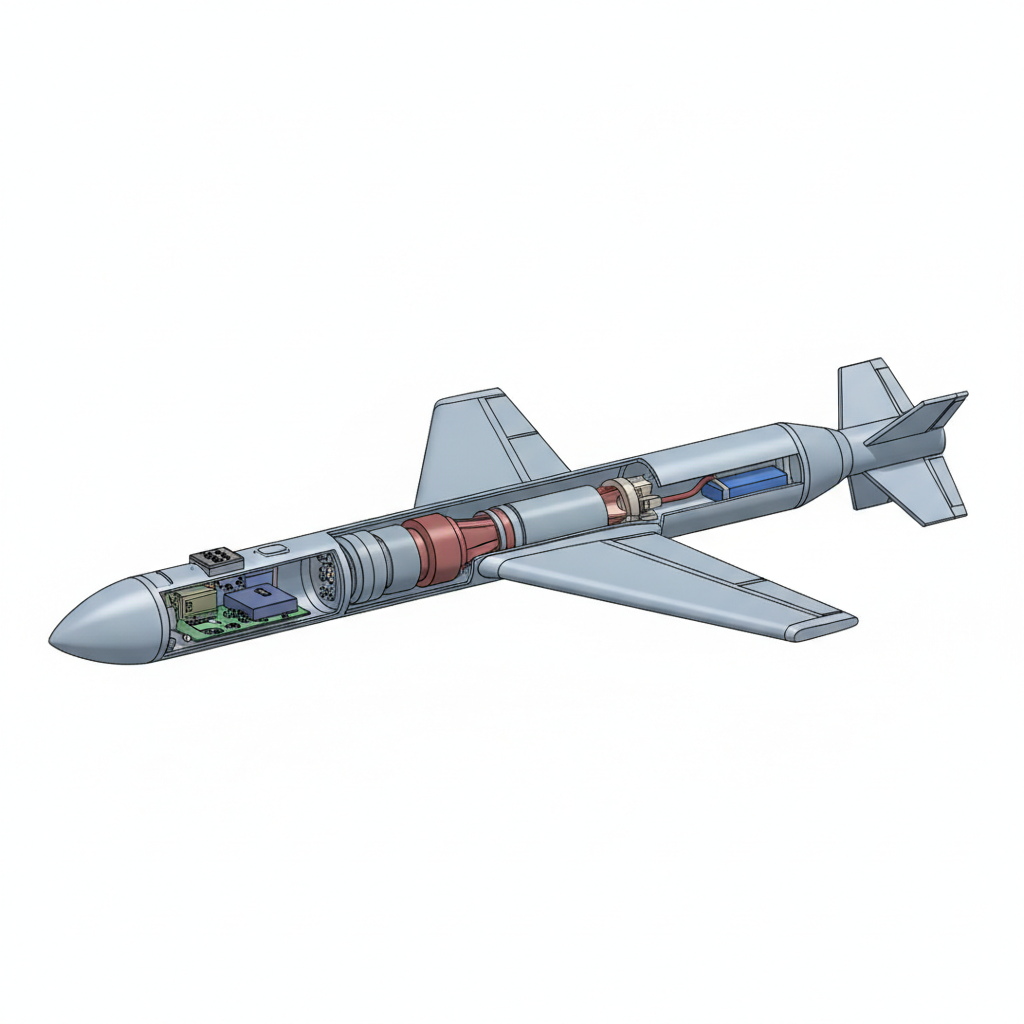
23 Sep UPSC Exam Alert: Defence Ministry signs ₹811 Crore SAT-SAAW deal for IAF
✎ SAT-SAAW is a long-range, precision-guided glide bomb developed indigenously by DRDO for air-to-ground strikes on enemy airfields, enhancing the IAF’s operational capabilities and reducing import dependence under the 'Atmanirbhar…
Subject Relevance — Where This Topic Fits
- GS Paper III — Security Challenges and Their Management in Border Areas; Linkages of Organised Crime with Terrorism | GS Paper III — Defence Technology and Indigenous Development
- Prelims: SAT-SAAW, Defence Research and Development Organisation (DRDO), India’s Defence Industrial Base, Make in India, Defence Procurement Procedure (DPP), Air-to-Ground Precision Munitions, Stand-off Range Weapons, Defence Acquisition Council (DAC)
- Essay: The Imperative of Indigenous Defence Technologies for National Security, Self-Reliance in Defence: Balancing Strategic Autonomy and Global Partnerships
Quick Revision: SAT-SAAW is a long-range, precision-guided glide bomb developed indigenously by DRDO for air-to-ground strikes on enemy airfields, enhancing the IAF’s operational capabilities and reducing import dependence under the ‘Atmanirbhar Bharat’ initiative.
Why is this in the news?
The Ministry of Defence (MoD) signed a ₹810.79 crore contract with Bharat Dynamics Limited (BDL) on 23 September 2026 for the procurement of 160 Satellite Smart Anti-Airfield Weapons (SAT-SAAW) for the Indian Air Force (IAF). This acquisition, under the ‘Buy (Indian-IDDM)’ category, marks a significant stride in India’s defence indigenisation efforts, aligning with the ‘Atmanirbhar Bharat’ initiative and enhancing the IAF’s operational capabilities through the integration of a long-range, precision-guided glide bomb system.
Background
- The Indian Air Force (IAF) has historically relied on imported air-to-ground munitions, which poses logistical and operational vulnerabilities during conflicts.
- The Defence Research and Development Organisation (DRDO) has been mandated to develop indigenous defence technologies to reduce import dependence and bolster self-reliance under the ‘Atmanirbhar Bharat’ initiative.
- India’s defence industrial base has evolved to include public sector undertakings (PSUs) like BDL and DRDO, alongside private sector participation, to enhance indigenous production capabilities.
- The SAT-SAAW project exemplifies the integration of advanced aerospace technologies, including guidance systems, warhead design, and fuzing mechanisms, within India’s defence R&D ecosystem.
- The contract aligns with the Defence Acquisition Council (DAC) guidelines, which aim to streamline procurement processes while promoting indigenous innovation.
What is the Satellite Smart Anti-Airfield Weapon (SAT-SAAW)?
- SAT-SAAW is a precision-guided glide bomb designed for air-to-ground strike missions, specifically targeting enemy airfields and associated infrastructure.
- It is developed indigenously by the Defence Research and Development Organisation (DRDO) under the ‘Atmanirbhar Bharat’ initiative, ensuring strategic autonomy in defence technology.
- The weapon system is capable of being launched from multiple IAF platforms, including the Jaguar, Hawk, and Sukhoi-30MKI aircraft, enhancing operational flexibility.
- SAT-SAAW operates with a long stand-off range, enabling strikes on enemy airfields without entering hostile airspace, thereby minimising risks to friendly aircraft.
- The system incorporates advanced guidance mechanisms, including satellite-aided navigation and inertial measurement units, for high-precision targeting.
- With 60% indigenous content, SAT-SAAW reduces import dependency and strengthens India’s defence industrial base, particularly in critical sub-systems like fuzing and warhead design.
- The weapon’s deployment is scheduled for 2027-28 and 2028-29, following rigorous testing and integration with IAF platforms.
- SAT-SAAW enhances the IAF’s operational readiness by providing a credible deterrent against adversarial air capabilities, thereby contributing to India’s overall defence preparedness.
Key Features
| Feature | Significance |
|---|---|
| Indigenous Design & Development | Demonstrates India’s capability in designing and developing advanced precision-guided munitions entirely within the country, reducing reliance on foreign defence imports. |
| 60% Indigenous Content | Enhances self-reliance in defence manufacturing while adhering to the ‘Make in India’ initiative, fostering domestic industrial growth. |
| Glide Bomb Technology | Provides long stand-off range capability, enabling precision strikes on enemy airfields without exposing aircraft to anti-aircraft defences. |
| Compatibility with Multiple Platforms | Can be launched from indigenous and foreign-origin platforms such as Jaguar, Hawk, and Su-30MKI, enhancing operational flexibility. |
| Phased Supply (2027-28 to 2028-29) | Ensures systematic induction into the Indian Air Force (IAF), allowing for gradual integration and training of personnel. |
| Supporting Indigenous Sub-Systems | Includes Initial Measurement Unit, Long Impact Delay Fuse, and Twin Store Carrier, furthering the indigenous defence ecosystem. |
Why it Matters
Strategic Defence Capability
- Enhances the IAF’s operational reach by enabling precision strikes on critical enemy infrastructure, such as airfields, from standoff distances.
- Reduces vulnerability of Indian aircraft during offensive operations by minimising exposure to ground-based air defence systems.
- Strengthens India’s deterrence posture by demonstrating indigenous capability to develop and deploy advanced precision-guided munitions.
Economic Implications
- Promotes indigenous defence manufacturing, reducing import dependency and contributing to the ‘Atmanirbhar Bharat’ initiative.
- Supports the growth of domestic defence industries, particularly in the aerospace and precision-guided munitions sectors.
- Generates employment and technological spill-over effects in allied industries such as electronics, materials science, and systems integration.
Technological Advancement
- Highlights India’s progress in developing complex aerospace technologies, including guidance systems, aerodynamics, and materials engineering.
- Demonstrates integration of indigenous sub-systems with advanced weapon platforms, showcasing India’s systems engineering capabilities.
- Provides a foundation for future indigenous development of similar precision-guided munitions for other branches of the armed forces.
Operational Readiness
- Enhances the IAF’s ability to conduct sustained operations without logistical or technological bottlenecks.
- Improves interoperability with existing platforms, ensuring seamless integration into the IAF’s operational doctrine.
- Supports the IAF’s modernisation goals by providing a cost-effective alternative to imported precision-guided munitions.
Challenges
1. Technology Maturation & Reliability
- Ensuring consistent performance of the SAT-SAAW across varied operational conditions, including extreme weather and electronic warfare environments.
- Validating the long-term reliability of indigenous sub-systems to meet the stringent operational standards of the IAF.
UPSC Link: GS3: Science and Technology
2. Indigenisation of Critical Components
- Achieving higher indigenous content (beyond 60%) in future iterations to further reduce import dependence.
- Developing domestic capabilities for advanced materials, electronics, and propulsion systems required for next-generation munitions.
UPSC Link: GS3: Defence Manufacturing
3. Supply Chain & Production Scalability
- Ensuring uninterrupted supply of raw materials and components to meet production timelines for 160 units.
- Scaling up manufacturing infrastructure to accommodate larger orders or modifications based on operational feedback.
UPSC Link: GS3: Industrial Policy
4. Integration with Existing Platforms
- Ensuring seamless integration of SAT-SAAW with diverse aircraft platforms, including legacy systems like Jaguar and Hawk.
- Addressing compatibility issues with avionics, weapons control systems, and pilot interfaces during integration.
UPSC Link: GS3: Defence Procurement
5. Cost Management & Budgetary Constraints
- Balancing the cost of indigenous development with the need for affordable munitions to ensure affordability for the IAF.
- Avoiding cost overruns during production and deployment phases to maintain fiscal discipline in defence procurement.
UPSC Link: GS3: Defence Budget
Challenges — UPSC Perspective
| Issue | Concern |
|---|---|
| Technology Readiness | Need for rigorous testing to ensure reliability in diverse operational scenarios. |
| Indigenous Content Targets | Limited availability of certain high-precision components domestically may hinder full indigenisation. |
| Production Timelines | Risk of delays in supply chain or manufacturing processes affecting delivery schedules. |
| Platform Compatibility | Ensuring SAT-SAAW integrates seamlessly with all designated aircraft platforms. |
| Cost Efficiency | Maintaining affordability while investing in advanced indigenous technologies. |
| Maintenance & Support | Establishing robust maintenance, repair, and overhaul (MRO) infrastructure for long-term operational readiness. |
Way Forward
- Accelerate indigenous development of critical sub-systems to achieve higher self-reliance in defence manufacturing.
- Establish dedicated testing and validation facilities to ensure SAT-SAAW meets IAF’s operational standards.
- Invest in upskilling the workforce in precision-guided munitions technology and related aerospace engineering domains.
- Develop a phased induction plan for SAT-SAAW, including pilot training and operational trials to validate performance.
- Strengthen public-private partnerships to scale up production and reduce lead times for future orders.
- Enhance domestic R&D in guidance systems, materials science, and propulsion to support next-generation munitions.
- Integrate SAT-SAAW into the IAF’s operational doctrine through joint exercises and war-gaming scenarios.
- Monitor global advancements in precision-guided munitions to identify opportunities for technology upgrades or collaborations.
UPSC Value Addition
Keywords for Mains Answer-Writing
SAT-SAAW · Defence Research and Development Organisation (DRDO) · Make in India in defence · Indian Air Force (IAF) modernisation · Indigenously Designed, Developed and Manufactured (IDDM) category · Defence Procurement Procedure (DPP) · Stand-off precision-guided munitions · Atmanirbhar Bharat in defence · Defence exports and self-reliance · Strategic defence autonomy
Concept Flow
Requirement for precision-guided munitions to enhance IAF’s operational capability and deterrence posture → Initiation of indigenous development of SAT-SAAW by DRDO under ‘Make in India’ initiative → Collaboration with Bharat Dynamics Limited (BDL) for manufacturing and procurement → Signing of ₹811 crore contract for 160 SAT-SAAW units with phased delivery (2027-28 to 2028-29) → Integration of SAT-SAAW into IAF platforms (Jaguar, Hawk, Su-30MKI) and operational deployment → Enhancement of India’s defence self-reliance and reduction in import dependency → Strengthening of India’s strategic defence capabilities and operational readiness
Prelims Practice Questions
Q1. Consider the following statements regarding the SAT-SAAW (Satellite Smart Anti-Airfield Weapon) recently inducted into the Indian Air Force:
1. SAT-SAAW is a precision-guided glide bomb designed to neutralise enemy airfields from stand-off ranges.
2. It has been developed by the Defence Research and Development Organisation (DRDO) under the Make in India initiative.
3. SAT-SAAW can be launched only from the Tejas aircraft.
4. The weapon system includes 60% indigenous content as per the contract signed with Bharat Dynamics Limited (BDL).
How many of the above statements are correct?
- Only one
- Only two
- Only three
- All four
Answer: Only three — Statements 1, 2, and 4 are correct. Statement 3 is incorrect as SAT-SAAW can be launched from platforms such as Jaguar, Hawk, and Sukhoi-30MKI, in addition to Tejas.
Q2. Assertion (A): The procurement of SAT-SAAW falls under the ‘Buy (Indian-IDDM)’ category of the Defence Procurement Procedure (DPP).
Reason (R): The IDDM category mandates that the equipment must be indigenously designed, developed, and manufactured with at least 50% indigenous content.
In the context of the above two statements, which one of the following is correct?
- Both A and R are true, and R is the correct explanation of A.
- Both A and R are true, but R is not the correct explanation of A.
- A is true, but R is false.
- A is false, but R is true.
Answer: Both A and R are true, and R is the correct explanation of A. — Both the Assertion (A) and Reason (R) are true. The IDDM category under DPP-2020 requires indigenously designed, developed, and manufactured equipment with at least 50% indigenous content, which aligns with the procurement of SAT-SAAW.
Q3. Match the following columns related to India’s defence indigenisation initiatives:
Column I
A. SAT-SAAW
B. INS Vikrant
C. Tejas Mk1A
D. Akash NG
Column II
1. Indigenous Aircraft Carrier
2. Beyond Visual Range Air-to-Air Missile
3. Satellite Smart Anti-Airfield Weapon
4. Indigenous Light Combat Aircraft (LCA)
Answer: ? — A-3 (SAT-SAAW is a precision-guided glide bomb), B-1 (INS Vikrant is an Indigenous Aircraft Carrier), C-4 (Tejas Mk1A is an Indigenous Light Combat Aircraft), D-2 (Akash NG is a Beyond Visual Range Air-to-Air Missile).
Mains Practice Question
✍ The induction of the SAT-SAAW (Satellite Smart Anti-Airfield Weapon) into the Indian Air Force represents a significant stride in India’s pursuit of strategic defence autonomy. Critically examine the role of indigenous defence technologies in enhancing India’s operational preparedness and self-reliance in the defence sector. Also, analyse the challenges in achieving complete self-reliance in defence manufacturing. (15 Marks)
Approach: MODEL-ANSWER SKELETON:
1. **Introduction (2 marks)**
– Define strategic defence autonomy and its significance for India.
– Contextualise SAT-SAAW as a symbol of India’s indigenisation efforts under ‘Atmanirbhar Bharat’ and the DPP-2020’s IDDM category.
2. **Role of Indigenous Defence Technologies (6 marks)**
– **Operational Preparedness**:
– SAT-SAAW as a stand-off precision-guided munition enhances IAF’s capability to neutralise enemy airfields without exposing aircraft to anti-aircraft defences.
– Integration with platforms like Jaguar, Hawk, Sukhoi-30MKI, and Tejas demonstrates platform-agnostic deployment.
– **Strategic Autonomy**:
– Reduces dependence on foreign suppliers, mitigating risks of supply chain disruptions (e.g., post-2022 global defence market shifts).
– Aligns with the ‘Make in India’ initiative and DPP-2020’s emphasis on indigenous design, development, and manufacturing (IDDM).
– **Economic and Industrial Benefits**:
– Boosts domestic defence manufacturing ecosystem (e.g., Bharat Dynamics Limited, DRDO labs).
– Potential for defence exports (e.g., BrahMos, Akash missiles) and foreign exchange earnings.
– **Technological Spin-offs**:
– Development of sub-systems (e.g., Initial Measurement Unit, Long Impact Delay Fuse) fosters innovation in precision guidance, materials science, and aerodynamics.
3. **Challenges in Achieving Complete Self-Reliance (5 marks)**
– **Technological Gaps**:
– Dependence on critical components (e.g., seekers, avionics) from foreign sources due to limited domestic capabilities in niche technologies.
– SAT-SAAW’s 60% indigenous content highlights the need to increase this threshold to 80-90% for true self-reliance.
– **Manufacturing and Supply Chain Constraints**:
– Limited production capacity of public sector undertakings (e.g., BDL, HAL) to meet large-scale demands.
– Delays in procurement processes under DPP due to bureaucratic hurdles and multiple approval layers.
– **R&D Investment and Human Capital**:
– Insufficient allocation of GDP to defence R&D (~0.6% vs. global average of 2-3%).
– Brain drain and lack of specialised talent in advanced aerospace and defence technologies.
– **Policy and Regulatory Hurdles**:
– Complexity in technology transfer agreements with foreign partners for dual-use technologies.
– Inconsistent implementation of DPP provisions (e.g., offset clauses, indigenisation timelines).
4. **Way Forward (2 marks)**
– **Enhancing R&D Ecosystem**:
– Increase funding for DRDO and private sector R&D (e.g., via iDEX, Make-II schemes).
– Collaborate with academic institutions (IITs, IISc) for fundamental research in propulsion, materials, and guidance systems.
– **Streamlining Procurement**:
– Simplify DPP procedures to expedite procurement of indigenous systems.
– Promote public-private partnerships (PPP) for large-scale manufacturing (e.g., Tata Advanced Systems, Mahindra Defence).
– **Skill Development**:
– Establish dedicated defence technology institutes (e.g., akin to the National Defence Academy for technical training).
– Incentivise STEM education with a focus on aerospace and defence engineering.
– **Export Promotion**:
– Leverage SAT-SAAW and similar systems as exportable defence products to friendly nations (e.g., ASEAN, Africa).
– Participate in global defence exhibitions (e.g., DefExpo, Aero India) to showcase indigenous capabilities.
**Balanced View**:
– Acknowledge progress (e.g., INS Vikrant, Tejas, Akash missiles) while highlighting systemic gaps that necessitate urgent reforms.
Source: PIB (Press Information Bureau)
Generated by AanyaAi for educational purpose.
Related guides on our sites
- Current affairs for upsc 2026
- How to prepare for GS paper 1 for UPSC CSE mains exam
- Best UPSC coaching for IFOS exam
- Best mentorship programme for upsc

- महाराष्ट्र में त्योहार जुलूसों पर बॉम्बे हाईकोर्ट का बड़ा फैसला: पटाखे, लेजर और संगीत पर रोक - September 24, 2026
- Bombay HC Bans Firecrackers, Music in Maharashtra Processions: Key UPSC Analysis - September 24, 2026
- तमिलनाडु में महिला कर्मचारियों के लिए सवैतनिक माहवारी अवकाश नीति पर HC का आदेश - September 24, 2026

No Comments