


24 Sep Madras HC Ruling: Resigned MLAs Can Recontest in By-Elections
 Public Interest LitigationElection Commission of IndiaLegislative domainConstitutional separation of power
✎ The resignation-recontest phenomenon is not prohibited by existing electoral laws, and the judiciary cannot direct the Election Commission or Parliament to impose restrictions; electoral reforms in this regard must be legislated…
Subject Relevance — Where This Topic Fits
- GS Paper II — Polity and Governance — Constitutional and Statutory Provisions | GS Paper II — Polity and Governance — Role of Judiciary and Election Commission
- Prelims: Anti-defection law (Tenth Schedule), Election Commission of India (ECI), By-elections, Madras High Court, Public Interest Litigation (PIL), Constitutional provisions on disqualification of legislators
- Essay: Ethics in electoral politics: Resignation and recontest as a strategic tool, Role of judiciary in electoral governance: Balancing judicial restraint and public interest
Quick Revision: The resignation-recontest phenomenon is not prohibited by existing electoral laws, and the judiciary cannot direct the Election Commission or Parliament to impose restrictions; electoral reforms in this regard must be legislated by Parliament.
Why is this in the news?
The Madras High Court, on 24 September 2026, dismissed a Public Interest Litigation (PIL) seeking to prevent legislators from resigning and recontesting in by-elections from the same constituencies. The petitioner had argued for a cooling-off period or financial disincentives to curb such practices, but the court ruled that the matter falls within the legislative domain of Parliament. The judgment underscores the constitutional separation of powers and the limited role of the judiciary in electoral governance, while also highlighting the Election Commission of India’s (ECI) procedural constraints in addressing the underlying issue.
Background
- The practice of legislators resigning their seats to trigger by-elections and subsequently recontesting from the same constituency has been a recurring issue in Indian electoral politics, particularly in states like Tamil Nadu.
- The Anti-Defection Law (Tenth Schedule of the Constitution) was introduced to curb political defections but does not explicitly address the resignation-recontest phenomenon.
- The Election Commission of India (ECI) is constitutionally mandated to conduct free and fair elections but lacks statutory authority to impose conditions on resigned legislators contesting by-elections.
- The PIL in question sought to restrain the conduct of by-elections in Madurantakam and Dharapuram constituencies until the main plea was resolved, reflecting concerns over public expenditure and voter perceptions.
- The court’s observation that Parliament must legislate on the issue aligns with the constitutional principle of legislative supremacy in electoral matters.
- The ECI, in its affidavit, clarified that it cannot investigate the motives behind resignations or impose financial penalties on resigned legislators.
What is the resignation-recontest phenomenon in electoral governance?
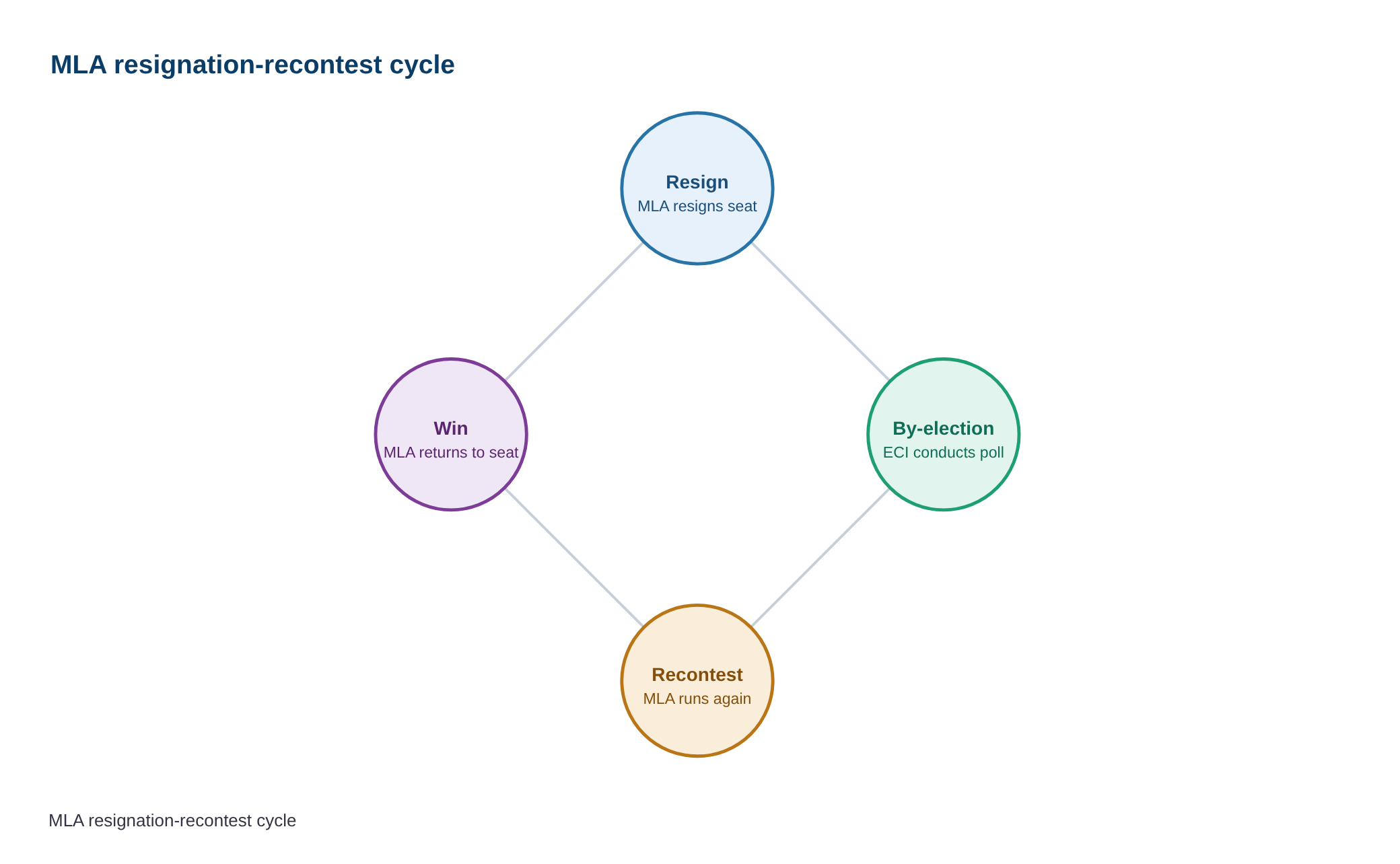
- The resignation-recontest phenomenon refers to a legislator resigning from their seat to trigger a by-election, often to join another political party, and then contesting the by-election to reclaim the seat.
- This practice is not explicitly prohibited under the Constitution or the Representation of the People Act, 1951, though it may be seen as a circumvention of democratic processes.
- The Anti-Defection Law (Tenth Schedule) addresses defection after election but does not directly regulate resignations or by-elections triggered by such resignations.
- The Election Commission of India (ECI) is responsible for conducting by-elections but cannot impose conditions on resigned legislators, such as a cooling-off period or financial penalties, as these fall outside its statutory mandate.
- The judiciary’s role is limited to interpreting existing laws and ensuring their constitutional validity; it cannot direct the ECI or Parliament to introduce new electoral norms unless such norms are unconstitutional.
- Concerns raised about this practice include the wastage of public funds on by-elections, potential voter disillusionment, and the circumvention of democratic accountability.
- The Madras High Court’s judgment reinforces the principle of judicial restraint, emphasizing that electoral reforms must originate from Parliament rather than the judiciary.
- This issue intersects with broader debates on electoral integrity, transparency, and the need for legislative reforms to address loopholes in the electoral process.
Key Features
| Feature | Significance |
|---|---|
| Public Interest Litigation (PIL) seeking restraint on bypolls | Highlights the judicial scrutiny of electoral processes and the role of courts in addressing systemic electoral concerns. |
| Madras High Court’s dismissal of PIL | Reinforces the principle of judicial restraint in matters governed by parliamentary legislation, particularly electoral laws. |
| Election Commission of India’s (ECI) role in byelections | Demonstrates the ECI’s constitutional mandate to conduct free and fair elections, independent of the reasons for vacancies. |
| Resignation and recontestation of MLAs | Raises questions about the ethical and procedural implications of MLAs resigning to contest byelections, including potential misuse of public funds. |
| Judicial observation on parliamentary jurisdiction | Emphasizes the separation of powers, noting that electoral reforms must originate from Parliament rather than the judiciary. |
Why it Matters
Constitutional and Electoral Governance
- The judgment underscores the constitutional framework governing byelections, where vacancies arise due to resignations, disqualifications, or other causes, as per Article 172 and the Representation of the People Act, 1951.
- It reaffirms the ECI’s autonomy in conducting elections without delving into the motives behind resignations, a principle rooted in the independence of the electoral process.
- The case highlights the tension between judicial activism and legislative primacy in electoral governance, particularly in matters not explicitly barred by law.
Fiscal and Administrative Implications
- The PIL raised concerns about the financial burden on public exchequer due to frequent byelections caused by strategic resignations, a recurring issue in Indian electoral politics.
- The court’s refusal to mandate a ‘cooling-off period’ or impose byelection expenses on resigned MLAs reflects the absence of statutory provisions addressing such scenarios.
- This case may prompt legislative discussions on electoral reforms to mitigate the misuse of resignation as a political strategy, particularly in the context of anti-defection laws.
Judicial Philosophy and Separation of Powers
- The judgment exemplifies judicial restraint, deferring to Parliament for electoral reforms rather than overstepping into legislative or executive domains.
- It reinforces the principle that courts cannot legislate or prescribe remedies where the law is silent, a cornerstone of constitutional governance.
- The observation that ‘it is for Parliament to take a call’ aligns with the doctrine of judicial deference in matters of policy and legislation.
Challenges
1. Judicial Overreach vs. Legislative Primacy
- The court’s refusal to intervene in electoral processes where no statutory bar exists raises questions about the limits of judicial activism in governance.
- This challenge is exacerbated by the recurring issue of MLAs resigning to contest byelections, which may undermine public trust in electoral integrity.
- The lack of a cooling-off period or penalties for such resignations creates a legal vacuum that may require parliamentary intervention.
UPSC Link: Constitutional Framework – Separation of Powers
2. Fiscal Burden of Frequent Byelections
- Strategic resignations leading to byelections impose significant financial costs on the exchequer, diverting resources from developmental priorities.
- The absence of mechanisms to penalize such resignations or mandate reimbursement of byelection expenses exacerbates the issue.
- This challenge intersects with broader debates on electoral reforms and the need for transparency in political processes.
UPSC Link: Government Budgeting – Public Expenditure
3. Ethical and Procedural Concerns in Resignations
- Resignations followed by recontestation from the same constituency raise ethical questions about the integrity of the electoral process and the representation of voters.
- The ECI’s inability to probe the reasons for resignations limits its capacity to address systemic issues in electoral behavior.
- This challenge is compounded by the lack of statutory provisions to regulate such resignations, leaving a gap in electoral governance.
UPSC Link: Representation of People Act, 1951 – Electoral Offences
4. Judicial Restraint and Constitutional Limits
- The judgment highlights the judiciary’s reluctance to intervene in matters where the law is silent, even when faced with systemic electoral concerns.
- This approach may delay necessary reforms, as Parliament has not yet addressed the issue of strategic resignations and byelections.
- The challenge lies in balancing judicial restraint with the need to uphold electoral integrity and public trust in democratic processes.
UPSC Link: Judicial Review – Constitutional Limits
Challenges — UPSC Perspective
| Issue | Concern |
|---|---|
| Strategic resignations by MLAs | Undermines electoral integrity and imposes financial burden on public exchequer due to frequent byelections. |
| Absence of statutory provisions for cooling-off periods | Creates a legal vacuum that allows MLAs to resign and recontest without consequences, eroding public trust. |
| ECI’s limited role in probing resignation reasons | Prevents the ECI from addressing systemic issues in electoral behavior, leaving gaps in governance. |
| Judicial restraint in electoral matters | Delays necessary reforms as courts defer to Parliament, potentially perpetuating systemic electoral concerns. |
| Potential misuse of byelections for political gains | Raises questions about the ethical implications of resignations and recontestations, impacting voter confidence. |
Way Forward
- Parliament may consider amending the Representation of the People Act, 1951, to introduce a cooling-off period for MLAs resigning to contest byelections, ensuring electoral integrity.
- The ECI could explore guidelines to address the financial burden of byelections caused by strategic resignations, such as mandating partial reimbursement of expenses.
- Judicial forums may develop a consistent approach to PILs involving electoral processes, balancing judicial activism with constitutional limits.
- Political parties could adopt internal codes of conduct to discourage MLAs from resigning solely to contest byelections, promoting ethical governance.
- Civil society and electoral watchdogs may advocate for greater transparency in the reasons for MLA resignations, fostering accountability.
- Academic and policy research should focus on the systemic impact of byelections on electoral governance, informing future legislative and administrative reforms.
- Constitutional bodies like the Law Commission of India could examine the feasibility of electoral reforms to address strategic resignations and their consequences.
UPSC Value Addition
Keywords for Mains Answer-Writing
Anti-defection law · resignation of legislators · byelections · Election Commission of India · Parliamentary sovereignty · constitutional provisions · Madras High Court · public interest litigation · cooling-off period · defection · electoral reforms · representation of the people · constitutional morality · judicial restraint · legislative assembly · by-election expenses · political ethics · constitutional governance
Constitutional & Policy Linkages
- Article 172 – Duration of State Legislatures
- Article 324 – Superintendence, direction and control of elections by the Election Commission
- Article 191 – Disqualifications for membership of State Legislatures
Concept Flow
Resignation of MLAs due to political realignment or other reasons → Vacancy in Assembly constituencies triggers byelections as per constitutional and statutory provisions → Public Interest Litigation (PIL) filed to restrain byelections or impose conditions on resigned MLAs → Madras High Court dismisses PIL, citing lack of statutory bar and deferring to Parliament for reforms → ECI conducts byelections independently, without probing resignation motives → Potential legislative or administrative reforms to address systemic concerns arising from strategic resignations
Prelims Practice Questions
Q1. Consider the following statements regarding the resignation of legislators in India: 1. The Election Commission of India (ECI) can investigate the reasons for an MLA’s resignation. 2. The Constitution of India does not impose any statutory bar on an MLA resigning and contesting a byelection from the same constituency. 3. The Madras High Court in 2026 held that it is for Parliament to decide on the issue of cooling-off periods for resigned MLAs. How many of the above statements are correct?
- Only one
- Only two
- All three
- None
Answer: All three — Statement 1 is incorrect because the ECI cannot probe the reasons for an MLA’s resignation; its role is limited to conducting free and fair elections. Statements 2 and 3 are correct as there is no constitutional bar on resigned MLAs contesting byelections, and the Madras High Court explicitly stated that Parliament must address such issues.
Q2. Assertion (A): The Election Commission of India can mandate that resigned MLAs bear the entire expenses of a byelection caused by their resignation. Reason (R): The ECI has the authority to regulate byelection expenses under the Representation of the People Act, 1951.
- Both A and R are true, and R is the correct explanation of A
- Both A and R are true, but R is not the correct explanation of A
- A is true, but R is false
- A is false, but R is true
Answer: A is false, but R is true — Assertion (A) is false because the ECI has no power to mandate that resigned MLAs bear byelection expenses; this is not provided under the Representation of the People Act, 1951. Reason (R) is true as the ECI does regulate byelection expenses, but it does not extend to compelling resigned MLAs to bear the costs.
Q3. Match the following provisions with their respective constitutional/statutory contexts: 1. Article 191(2) of the Constitution of India 2. The Tenth Schedule of the Constitution of India 3. Section 151A of the Representation of the People Act, 1951 4. Article 324 of the Constitution of India
- 1-A, 2-B, 3-C, 4-D; 1-B, 2-A, 3-D, 4-C; 1-C, 2-D, 3-A, 4-B; 1-D, 2-C, 3-B, 4-A
- A. Disqualification on grounds of defection B. Vacancy in Legislative Assemblies and byelections C. Election Commission’s powers and functions D. Disqualification for being chosen as a member of a House
Answer: 1-A, 2-B, 3-C, 4-D; 1-B, 2-A, 3-D, 4-C; 1-C, 2-D, 3-A, 4-B; 1-D, 2-C, 3-B, 4-A — 1 matches with D (Article 191(2) deals with disqualification for membership of a House). 2 matches with A (The Tenth Schedule contains provisions for disqualification on grounds of defection). 3 matches with B (Section 151A mandates byelections for vacancies in Legislative Assemblies). 4 matches with C (Article 324 vests the ECI with powers and functions related to elections).
Mains Practice Question
✍ Critically examine the constitutional and legal framework governing the resignation of legislators and their subsequent recontesting in byelections in India. Also assess the judicial response to public interest litigations seeking electoral reforms in this context. (15 Marks)
Approach: MODEL-ANSWER SKELETON:
1. **Constitutional Framework**:
– Article 190 (resignation of members) and Article 191 (disqualifications) of the Constitution of India.
– The absence of a constitutional bar on resigned legislators contesting byelections; reliance on parliamentary sovereignty.
– Role of the Election Commission of India (ECI) under Article 324: powers limited to conducting elections, not regulating motivations for resignation.
2. **Legal Provisions and Statutory Gaps**:
– Representation of the People Act, 1951: Sections 151A (byelections) and lack of provisions for cooling-off periods or expense liability.
– Anti-defection law (Tenth Schedule): Focuses on post-election defection, not pre-election resignations aimed at recontestation.
– Judicial restraint: Courts defer to Parliament on policy matters (Madras High Court, 2026; reference to *Kihoto Hollohan v. Zachillhu*, 1992).
3. **Judicial Response and PILs**:
– Madras High Court’s dismissal of PIL seeking cooling-off periods or expense liability (2026): emphasis on parliamentary prerogative.
– Earlier judicial observations on the ethical implications of resigned MLAs contesting byelections (e.g., *Krishnamurthy v. Union of India*, 2014).
– Contrast with judicial activism in other electoral reforms (e.g., *Public Interest Foundation v. Union of India*, 2019 on criminalisation of politics).
4. **Balancing Electoral Integrity and Parliamentary Sovereignty**:
– Arguments for reform: Waste of public funds, erosion of voter trust, and circumvention of anti-defection norms.
– Arguments against judicial intervention: Separation of powers, legislative supremacy in electoral matters, and lack of statutory basis for restrictions.
– Role of the Law Commission of India (e.g., 255th Report on Electoral Reforms) and parliamentary committees.
5. **Conclusion**:
– Need for legislative action to address ethical concerns without undermining constitutional governance.
– Suggested reforms: Statutory cooling-off periods, expense liability for resigned MLAs, or enhanced transparency in resignation reasons.
Source: The Hindu
Generated by AanyaAi for educational purpose.
Related guides on our sites
- Best PSIR optional coaching for upsc
- Best Law optional coaching for upsc
- Best PSIR optional teacher for upsc
- Best teacher of PSIR optional for upsc

- Madras HC Ruling: Resigned MLAs Can Recontest in By-Elections - September 24, 2026
- विदेश मंत्री जयशंकर की यूरोप के चार विदेश मंत्रियों से द्विपक्षीय वार्ता, भारत-ईयू एफटीए पर चर्चा - September 24, 2026
- मद्रास उच्च न्यायालय ने अनामलाई के खिलाफ मामले को रद्द किया: राजनीतिक टिप्पणियों पर न्यायिक फैसला - September 24, 2026

No Comments