


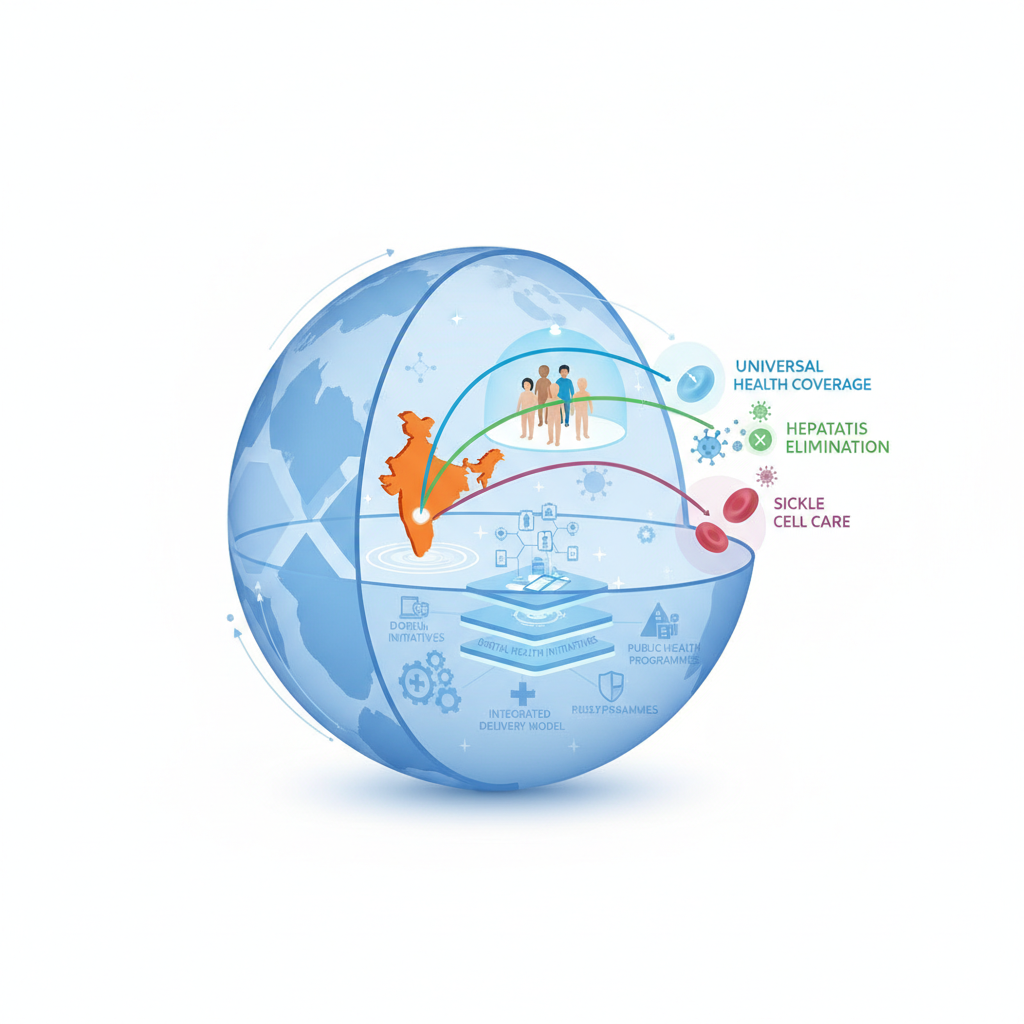
24 Sep UNGA81: India Highlights Progress on Universal Health Coverage, Hepatitis & Sickle Cell Care
✎ India’s UNGA 81 interventions underscore its integrated approach to UHC through Ayushman Arogya Mandir, AB-PMJAY, and e-Sanjeevani, while advancing hepatitis elimination and SCD care under global health frameworks.
Subject Relevance — Where This Topic Fits
- GS Paper II — International Relations | GS Paper II — Global Groupings and Agreements | GS Paper III — Health, Education, Human Resources
- Prelims: Universal Health Coverage (UHC), Ayushman Arogya Mandir, AB-PMJAY, e-Sanjeevani, Unique Health ID, Hepatitis elimination, Sickle Cell Disease (SCD), Telemedicine, Digital Health Ecosystem
- Essay: Universal Health Coverage as a Global Public Good, Technology-Driven Healthcare Transformation in India
Quick Revision: India’s UNGA 81 interventions underscore its integrated approach to UHC through Ayushman Arogya Mandir, AB-PMJAY, and e-Sanjeevani, while advancing hepatitis elimination and SCD care under global health frameworks.
Why is this in the news?
During the 81st session of the United Nations General Assembly (UNGA 81) in New York, India highlighted its progress in advancing Universal Health Coverage (UHC), eliminating hepatitis, and strengthening sickle cell disease (SCD) care. The Union Health Secretary underscored India’s integrated health delivery model, digital health initiatives, and public health programmes, positioning the country as a global leader in equitable and affordable healthcare solutions.
Background
- The 81st UNGA session convened in September 2026, focusing on global health priorities, including UHC, infectious disease elimination, and non-communicable disease management.
- India’s participation in UNGA 81 aligns with its commitment to the Sustainable Development Goals (SDGs), particularly SDG 3 (Good Health and Well-being), which calls for achieving UHC and reducing premature mortality from non-communicable diseases.
- Universal Health Coverage (UHC) is a global health priority endorsed by the World Health Organization (WHO), aiming to ensure all individuals receive quality health services without financial hardship.
- Hepatitis B and C are major public health challenges, with WHO targeting elimination by 2030 through vaccination, screening, and treatment.
- Sickle Cell Disease (SCD) is a genetic blood disorder disproportionately affecting marginalised communities, requiring lifelong care and early diagnosis.
- India’s health reforms, including Ayushman Bharat initiatives, reflect a shift from curative to preventive and promotive healthcare, integrating primary, secondary, and tertiary care.
Key Initiatives Highlighted by India at UNGA 81
- Ayushman Arogya Mandir (AAM): A network of over 1.8 lakh wellness centres providing comprehensive primary healthcare, including maternal and child health, non-communicable disease screening, mental health services, geriatric care, and palliative care. These centres serve as the first point of contact for preventive, promotive, and curative services.
- Ayushman Bharat Pradhan Mantri Jan Arogya Yojana (AB-PMJAY): A publicly funded health insurance scheme offering financial protection against catastrophic health expenditures for hospitalisation and critical care.
- e-Sanjeevani: A telemedicine platform facilitating 49.7 crore consultations, bridging geographical barriers and ensuring access to specialist care in remote and underserved areas.
- Digital Health Ecosystem: India’s Unique Health ID (Ayushman Bharat Health Account) for more than 90 crore unique health IDs, interoperable digital registries of health facilities and professionals for seamless health data exchange and continuity of care.
- Hepatitis Elimination: India’s progress towards the WHO 2030 target includes vaccination drives, screening programmes, and public awareness campaigns to reduce hepatitis B and C transmission and improve treatment access.
- Sickle Cell Disease (SCD) Care: India launched the ‘OneSickleCell Global Partnership’ to promote equitable and accessible SCD care, aligning with the goal of eliminating SCD by 2047 through early diagnosis, genetic counselling, and comprehensive management.
- Integrated Continuum of Care: India’s health model links primary care (AAM) with secondary and tertiary care through referral systems, ensuring a seamless journey from prevention to treatment, including specialised interventions.
- Financial Protection in Healthcare: Initiatives like the ‘Free Drug and Diagnostic Service’ and ‘Pradhan Mantri National Dialysis Programme’ reduce out-of-pocket expenditures for vulnerable populations, particularly for chronic diseases.
Key Features
| Feature | Significance |
|---|---|
| Ayushman Arogya Mandirs (1.8 lakh+) | Primary healthcare expansion to community level with integrated services including preventive, promotive, curative, and palliative care. |
| Ayushman Bharat PM-JAY | Financial protection for vulnerable populations through publicly funded health insurance covering secondary and tertiary care. |
| Unique Health ID (90+ crore) | Enables interoperable digital health records (ABHA) for seamless continuity of care and reduced duplication. |
| e-Sanjeevani (49.7+ crore tele-consultations) | Geographical barrier removal via telemedicine, including AI-enabled diagnostics and mobile medical units. |
| Free Drug & Diagnostic Services Initiative | Reduces out-of-pocket expenditure for essential medicines and diagnostics, enhancing affordability. |
Why it Matters
Public Health Governance
- Demonstrates India’s scalable model of integrating primary, secondary, and tertiary care through a continuum-of-care approach.
- Highlights the role of digital public infrastructure in achieving Universal Health Coverage (UHC) and reducing inequities.
- Showcases India’s leadership in global health diplomacy by aligning domestic progress with international commitments.
Economic Efficiency
- Financial risk protection via AB-PMJAY reduces catastrophic health expenditures, particularly for low-income groups.
- Preventive and promotive healthcare reduces long-term burden on tertiary care systems.
- Digital health records (ABHA) improve resource allocation and reduce administrative inefficiencies.
Social Inclusion
- Ayushman Arogya Mandirs bring healthcare to underserved rural and tribal populations.
- Focus on non-communicable diseases, mental health, and geriatric care addresses demographic transitions.
- Telemedicine bridges urban-rural divides, ensuring equitable access to specialist consultations.
Challenges
1. Universal Health Coverage Implementation Gaps
- Ensuring last-mile delivery of services in remote and conflict-affected regions.
- Maintaining quality standards across 1.8 lakh+ Ayushman Arogya Mandirs.
- Balancing cost-effectiveness with comprehensive service coverage under AB-PMJAY.
UPSC Link: GS2: Health Governance
2. Digital Health Infrastructure Bottlenecks
- Digital divide may exclude marginalised groups from ABHA and telemedicine benefits.
- Data privacy and cybersecurity risks in a large-scale digital health ecosystem.
- Interoperability challenges between state-level health systems and national platforms.
UPSC Link: GS3: Science & Tech
3. Hepatitis Elimination Roadmap
- Achieving the 2030 elimination target requires scaling up vaccination, diagnostics, and treatment.
- Addressing stigma and misinformation among high-risk populations.
- Ensuring equitable access to hepatitis B and C care in low-resource settings.
UPSC Link: GS2: Health Policies
4. Sickle Cell Disease (SCD) Care Challenges
- Genetic screening and early diagnosis require robust primary healthcare integration.
- High treatment costs and limited access to hydroxyurea and blood transfusions in rural areas.
- Need for a multi-sectoral approach involving nutrition, education, and social welfare.
UPSC Link: GS2: Health & Human Development
Challenges — UPSC Perspective
| Issue | Concern |
|---|---|
| Workforce Shortages | Insufficient trained healthcare professionals, especially in primary care and rural areas. |
| Supply Chain Disruptions | Dependence on imported pharmaceuticals and medical devices for chronic disease management. |
| Monitoring & Evaluation | Lack of real-time data systems to track progress and outcomes in UHC initiatives. |
| Policy Coordination | Fragmented implementation across states due to varying administrative capacities. |
Government Initiatives — Must-Memorise for Prelims
- Ayushman Arogya Mandirs (AAM)
- Free Drug & Diagnostic Services Initiative
- Pradhan Mantri National Dialysis Programme
- e-Sanjeevani Telemedicine Platform
- Ayushman Bharat Health Account (ABHA)
- OneSickle Cell Disease (OneSCD) Global Partnership
Way Forward
- Strengthen state-level implementation frameworks for Ayushman Arogya Mandirs to ensure uniform quality standards.
- Expand digital health literacy campaigns to bridge the divide in ABHA adoption.
- Integrate hepatitis elimination strategies into existing primary healthcare programs like Ayushman Arogya Mandirs.
- Scale up SCD screening and care through school health programmes and Anganwadi centres.
- Enhance public-private partnerships for telemedicine infrastructure in remote regions.
- Develop a national digital health workforce training programme to address skill gaps.
- Establish a robust monitoring system for UHC indicators using ABHA-linked data.
- Promote research and innovation in low-cost diagnostics for hepatitis and SCD.
UPSC Value Addition
Keywords for Mains Answer-Writing
Universal Health Coverage (UHC) · Ayushman Arogya Mandirs · Ayushman Bharat Pradhan Mantri Jan Arogya Yojana (AB-PMJAY) · e-Sanjeevani · Unique Health ID · Digital Health Ecosystem · Hepatitis elimination · Sickle Cell Disease (SCD) · Primary Health Care · Healthcare financing · Public health infrastructure · Telemedicine · ABHA-enabled health records · Integrated continuum of care · Non-communicable diseases (NCDs) · Palliative care · Financial protection in healthcare · Sustainable Development Goals (SDGs) target 3.8 · WHO Global Health Sector Strategy on Viral Hepatitis · OneSickle Cell Disease (OneSCD) Global Partnership
Constitutional & Policy Linkages
- Article 47 (DPSP) – Duty of State to improve public health
- Article 21 (Right to Life) – Implicit right to health as part of dignified life
Concept Flow
Universal Health Coverage (UHC) commitment → Establishment of Ayushman Arogya Mandirs for primary care → Integration with AB-PMJAY for financial protection → Digital health adoption (ABHA, e-Sanjeevani) → Achievement of 90+ crore Unique Health IDs → Global advocacy at UNGA81 → Hepatitis elimination target (2030) → National Viral Hepatitis Control Programme → Integration with Ayushman Arogya Mandirs for screening and treatment → Progress review at UNGA81 → Sickle Cell Disease burden → High prevalence in tribal populations → Need for genetic screening → Launch of OneSCD Global Partnership at UNGA81 → Target of elimination by 2047 → Digital public infrastructure (DPI) → ABHA as foundational layer → Interoperability with e-Sanjeevani and AB-PMJAY → Scalability and global replication potential → Primary healthcare strengthening → Ayushman Arogya Mandirs as hubs → Referral linkages to secondary/tertiary care → Reduction in out-of-pocket expenditure → Sustainable UHC model
Prelims Practice Questions
Q1. Consider the following statements regarding India’s healthcare initiatives as highlighted during the 81st UNGA:
1. Ayushman Arogya Mandirs are designed to provide comprehensive primary healthcare services at the community level.
2. The Ayushman Bharat Pradhan Mantri Jan Arogya Yojana (AB-PMJAY) provides financial protection to vulnerable sections against catastrophic health expenditures.
3. The Unique Health ID (Ayushman Bharat Health Account – ABHA) is mandatory for all Indian citizens to access healthcare services.
How many of the above statements are correct?
- Only one
- Only two
- All three
- None
Answer: Only two — Statement 1 and 2 are correct as Ayushman Arogya Mandirs provide comprehensive primary healthcare and AB-PMJAY offers financial protection. Statement 3 is incorrect because ABHA is not mandatory but voluntary for citizens to access healthcare services.
Q2. Assertion (A): The Ayushman Bharat Digital Mission aims to create a seamless digital health ecosystem in India.
Reason (R): The Unique Health ID (ABHA) enables interoperability of health records across healthcare providers and facilities.
In the context of the above two statements, which one of the following is correct?
- Both A and R are true, and R is the correct explanation of A
- Both A and R are true, but R is not the correct explanation of A
- A is true, but R is false
- A is false, but R is true
Answer: Both A and R are true, and R is the correct explanation of A — Both A and R are true. The Ayushman Bharat Digital Mission indeed aims to create a digital health ecosystem, and the Unique Health ID (ABHA) is a key enabler for interoperability of health records across providers.
Q3. Match the following healthcare initiatives with their respective objectives:
Column I (Initiative)
A. Ayushman Arogya Mandirs
B. AB-PMJAY
C. e-Sanjeevani
D. ABHA-enabled health records
Column II (Objective)
1. Providing telemedicine services to bridge geographical barriers
2. Creating a unique digital identity for citizens to access health records
3. Delivering comprehensive primary healthcare at the community level
4. Offering financial protection against catastrophic health expenditures
Select the correct match:
- A-3, B-4, C-1, D-2
- A-1, B-2, C-3, D-4
- A-4, B-3, C-2, D-1
- A-2, B-1, C-4, D-3
Answer: A-3, B-4, C-1, D-2 — The correct match is: A-3 (Ayushman Arogya Mandirs deliver comprehensive primary healthcare), B-4 (AB-PMJAY offers financial protection), C-1 (e-Sanjeevani provides telemedicine services), D-2 (ABHA-enabled health records create a unique digital identity).
Mains Practice Question
✍ India’s healthcare system has been increasingly leveraging digital public infrastructure to advance Universal Health Coverage (UHC). In this context, critically examine the role of Ayushman Arogya Mandirs, AB-PMJAY, and the Ayushman Bharat Digital Mission in achieving UHC. Also, analyse the challenges in ensuring equitable access to healthcare services across diverse geographies and socio-economic groups in India. (15 Marks)
Approach: MODEL-ANSWER SKELETON:
1. **Introduction (2 marks)**
– Define Universal Health Coverage (UHC) as per WHO: ensuring all individuals receive the health services they need without financial hardship (SDG target 3.8).
– Contextualise India’s commitment to UHC through initiatives like Ayushman Arogya Mandirs, AB-PMJAY, and the Ayushman Bharat Digital Mission.
2. **Ayushman Arogya Mandirs (3 marks)**
– Explain the concept: Comprehensive primary healthcare centres at the community level, integrating preventive, promotive, curative, and palliative care.
– Highlight their role in strengthening primary healthcare (PHC) as the foundation of UHC (as per Alma-Ata Declaration and India’s National Health Policy 2017).
– Mention services provided: Reproductive and child health, NCD screening, mental health, geriatric care, and palliative care.
3. **Ayushman Bharat Pradhan Mantri Jan Arogya Yojana (AB-PMJAY) (3 marks)**
– Define AB-PMJAY: World’s largest health insurance scheme providing financial protection to vulnerable sections against catastrophic health expenditures.
– Explain its design: Coverage of up to ₹5 lakh per family per year for secondary and tertiary care, covering over 12 crore families.
– Discuss its impact: Reduction in out-of-pocket expenditure (OOP) and improved access to healthcare for the poor (cite NSSO data or similar reports).
4. **Ayushman Bharat Digital Mission (ABDM) (3 marks)**
– Explain ABDM: Creation of a digital health ecosystem with Unique Health ID (ABHA), Health Facility Registry (HFR), and Healthcare Professional Registry (HPR).
– Highlight the role of ABHA: Enables interoperability of health records across providers, facilitating continuity of care.
– Discuss telemedicine (e-Sanjeevani): Over 49.7 crore tele-consultations, bridging geographical barriers and improving access in remote areas.
5. **Challenges in achieving equitable access (3 marks)**
– **Geographical barriers**: Rural-urban divide, hilly and tribal areas lacking infrastructure.
– **Socio-economic disparities**: Low awareness, digital divide, and affordability issues among marginalised groups.
– **Systemic challenges**: Fragmented healthcare delivery, shortage of skilled workforce, and regulatory gaps in digital health.
– **Data privacy concerns**: Need for robust data protection frameworks (mention Digital Information Security in Healthcare Act – DISHA or proposed Digital Personal Data Protection Act).
6. **Conclusion (1 mark)**
– Reiterate that while these initiatives are transformative, addressing systemic challenges and ensuring inclusive implementation are critical for achieving UHC in India.
– Emphasise the need for multi-stakeholder collaboration (government, private sector, civil society) and continued investment in digital public infrastructure.
Source: PIB (Press Information Bureau)
Generated by AanyaAi for educational purpose.
Related guides on our sites
- Anthropology VS PSIR
- Best PSIR optional coaching
- Best PSIR optional coaching online
- Best PSIR optional teacher

- दिव्यांगजन विभाग का विशेष अभियान 6.0 : लंबित मामलों से मुक्ति और स्वच्छ कार्यालयों की ओर - September 24, 2026
- DEPwD Launches Special Campaign 6.0 for Swachh Governance & Pending Cases - September 24, 2026
- यूएनजीए81 में भारत: यूनिवर्सल हेल्थ कवरेज और हेपेटाइटिस उन्मूलन की उपलब्धियां - September 24, 2026

No Comments