


25 Sep Odisha releases Rs 14.34 cr under Gyanodaya scheme for higher education
✎ The Gyanodaya Scheme in Odisha exemplifies a state-led governance model for inclusive higher education, utilising the SAMS platform for transparent and phased disbursement of financial assistance to eligible institutions, thereby…
Subject Relevance — Where This Topic Fits
- GS Paper II — Governance, Administration and Challenges — e.g., Public Sector Undertakings, State Public Finance | GS Paper III — Issues relating to Development and Management of Social Sector/Services relating to Education
- Prelims: Gyanodaya Scheme, Student Academic Management System (SAMS), Direct Benefit Transfer (DBT), State Public Finance, Higher Education Financing, Government-aided private institutions
- Essay: Role of State Governments in Ensuring Inclusive Education: A Case Study of Odisha’s Gyanodaya Scheme, Public Policy and Financial Inclusion: Bridging Gaps in Higher Education Accessibility
Quick Revision: The Gyanodaya Scheme in Odisha exemplifies a state-led governance model for inclusive higher education, utilising the SAMS platform for transparent and phased disbursement of financial assistance to eligible institutions, thereby reducing financial barriers for students from marginalised backgrounds.
Why is this in the news?
The Odisha government’s release of ₹14.34 crore under the ‘Gyanodaya Shiksha Ru Samruddhi’ (KG to PG Free Education) scheme represents a significant step in the phased disbursement of funds for the academic year 2026–27, aimed at reducing financial barriers in higher education. This initiative is notable for its structured implementation through the Student Academic Management System (SAMS) and its focus on direct benefit transfer to eligible institutions, aligning with broader national objectives of inclusive education and financial accessibility in the social sector.
Background
- The ‘Gyanodaya’ scheme is part of Odisha’s broader policy framework to enhance access to higher education by mitigating financial constraints faced by students from economically disadvantaged backgrounds.
- Higher education financing in India is a shared responsibility between the Union and State governments, with States playing a pivotal role in implementing targeted schemes for local needs.
- The Student Academic Management System (SAMS) is an Odisha-specific digital platform designed to streamline the disbursement of scholarships and financial assistance, ensuring transparency and reducing leakages in fund distribution.
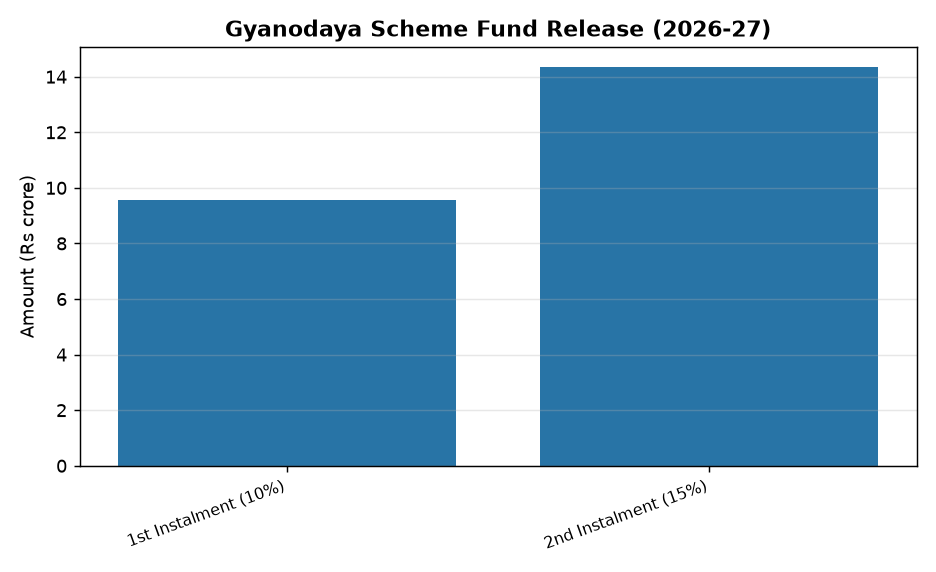
- The phased release of funds (10% in the first instalment and 15% in the second) reflects a governance approach to ensure sustainable implementation and prevent fund mismanagement.
What is the Gyanodaya Scheme?
- The ‘Gyanodaya Shiksha Ru Samruddhi’ (KG to PG Free Education) scheme is a state-funded initiative launched by the Odisha government to provide free education from kindergarten to postgraduate levels for eligible students.
- Under the scheme, eligible students enrolled in regular undergraduate (UG) and postgraduate (PG) programmes in state public universities, government colleges, and government-aided private colleges are required to pay only the prescribed examination fee, with tuition and other academic fees waived.
- The scheme is implemented through the Student Academic Management System (SAMS), a digital platform that facilitates the application, verification, and disbursement of financial assistance to institutions and students.
- Financial assistance is disbursed in phased instalments to ensure systematic utilisation and prevent fund mismanagement, with the latest release of ₹14.34 crore accounting for 15% of the approved assistance for the academic session 2026–27.
- The scheme underscores the role of state governments in addressing regional disparities in educational access and quality, particularly in states with significant tribal and rural populations.
- The financial outlay and phased disbursement reflect a governance model that prioritises accountability, transparency, and the efficient utilisation of public funds in the social sector.
Key Features
| Feature | Significance |
|---|---|
| Phased disbursement of funds | Ensures systematic allocation of financial resources, preventing sudden fiscal shocks to institutions and maintaining budgetary discipline. |
| Student Academic Management System (SAMS) | Digitizes fund disbursement, reduces leakages, and enhances transparency in the distribution of educational subsidies. |
| Coverage of UG and PG programmes | Extends financial support to a broad spectrum of higher education, aligning with the goal of inclusive access to tertiary education. |
| Examination fee exemption | Reduces direct financial burden on students, particularly those from economically weaker sections, thereby promoting equity in higher education. |
| State-funded free education initiative | Demonstrates a commitment to reducing out-of-pocket expenses for students, fostering a more accessible higher education ecosystem. |
Why it Matters
Economic Implications
- Mitigates financial barriers to higher education, potentially increasing the enrolment ratio and human capital formation in Odisha.
- Reduces the long-term debt burden on students, particularly those from marginalised communities, thereby improving socio-economic mobility.
- Stimulates demand for educational infrastructure, creating indirect employment opportunities in the education sector.
Educational Impact
- Enhances the Gross Enrolment Ratio (GER) in higher education by removing financial disincentives for students.
- Promotes equity by prioritising economically disadvantaged groups, aligning with the principles of social justice in education.
- Encourages institutional accountability through the SAMS platform, which tracks fund utilisation and student beneficiaries.
Governance and Transparency
- Demonstrates the efficacy of digital governance in public welfare schemes, reducing administrative delays and corruption risks.
- Sets a precedent for other states to adopt similar phased disbursement models for educational subsidies.
- Strengthens the role of the Higher Education Department in monitoring and evaluating the implementation of welfare schemes.
Challenges
1. Implementation Bottlenecks
- Ensuring timely disbursement of funds to all eligible institutions, particularly in remote or underserved regions.
- Preventing delays in the SAMS platform due to technical glitches or data entry errors.
- Monitoring the actual utilisation of funds to ensure they are not diverted for unintended purposes.
UPSC Link: GS2: Centre-State relations
2. Equity and Inclusion Gaps
- Identifying and including all eligible students, especially those from Scheduled Castes, Scheduled Tribes, and Other Backward Classes.
- Addressing regional disparities in higher education access between urban and rural areas.
- Ensuring that the scheme does not inadvertently exclude students due to administrative or procedural barriers.
UPSC Link: GS1: Social empowerment
3. Financial Sustainability
- Balancing the fiscal burden of the scheme with other developmental priorities in the state budget.
- Ensuring that the scheme remains viable in the long term without compromising the quality of education.
- Exploring alternative funding mechanisms, such as public-private partnerships, to sustain the initiative.
UPSC Link: GS3: Fiscal policy
4. Quality Assurance
- Maintaining academic standards in institutions receiving funds, particularly in government-aided private colleges.
- Ensuring that the exemption of examination fees does not lead to a decline in institutional accountability or performance metrics.
- Monitoring the impact of the scheme on learning outcomes and employability of graduates.
UPSC Link: GS2: Education policy
Challenges — UPSC Perspective
| Issue | Concern |
|---|---|
| Timely disbursement | Risk of delays in fund release due to bureaucratic or technical hurdles. |
| Data accuracy in SAMS | Potential errors in student eligibility data leading to incorrect fund allocation. |
| Regional disparities | Uneven distribution of benefits across districts, exacerbating urban-rural divides. |
| Institutional compliance | Possibility of funds being misused or not utilised for intended purposes by recipient institutions. |
| Monitoring and evaluation | Lack of robust mechanisms to assess the scheme’s impact on student outcomes and institutional performance. |
| Sustainability | Long-term financial viability of the scheme amid competing state priorities and economic constraints. |
Government Initiatives — Must-Memorise for Prelims
- Gyanodaya Shiksha Ru Samruddhi (KG to PG Free Education)
- Student Academic Management System (SAMS)
Way Forward
- Strengthen the SAMS platform with real-time monitoring and grievance redressal mechanisms to ensure transparency and accountability.
- Conduct periodic audits of fund utilisation by institutions to prevent misuse and ensure compliance with scheme guidelines.
- Expand outreach programmes to sensitise eligible students, particularly in tribal and remote areas, about the scheme’s benefits.
- Integrate the scheme with other higher education initiatives, such as skill development programmes, to enhance employability outcomes.
- Develop a robust evaluation framework to measure the scheme’s impact on enrolment rates, dropout rates, and academic performance.
- Explore public-private partnerships to supplement state funding and ensure the scheme’s long-term sustainability.
- Collaborate with the Union Ministry of Education to align the scheme with national higher education policies and standards.
- Establish a dedicated helpline or portal for students to report issues related to fund disbursement or eligibility.
UPSC Value Addition
Keywords for Mains Answer-Writing
Gyanodaya Shiksha Ru Samruddhi scheme · Odisha higher education funding · Student Academic Management System (SAMS) · free education in state institutions · phased disbursement of funds · public-private partnership in education · State Higher Education Department · examination fee waiver · UG and PG programme funding · education equity and access · state-sponsored scholarship schemes · digital governance in education administration
Concept Flow
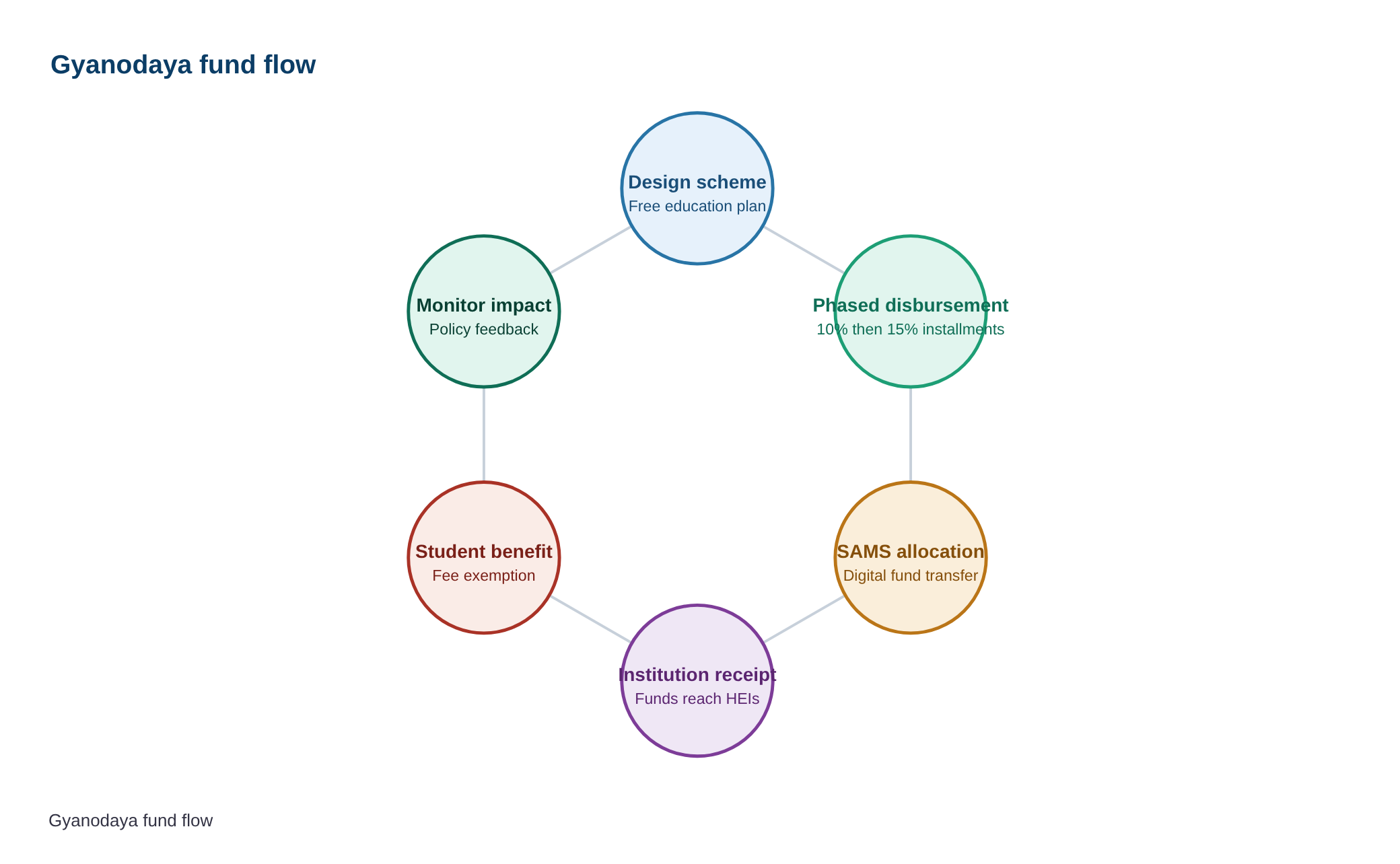
State recognises the need to reduce financial barriers in higher education → Designs ‘Gyanodaya’ scheme to provide free education (examination fee exemption) → Phased disbursement of funds via SAMS to ensure systematic allocation → Institutions receive funds and implement the scheme → Students benefit from reduced financial burden → Monitoring and evaluation of scheme impact → Feedback loop informs policy adjustments and future disbursements
Prelims Practice Questions
Q1. Consider the following statements regarding the ‘Gyanodaya Shiksha Ru Samruddhi’ scheme in Odisha:
1. The scheme provides full tuition fee waiver to eligible students enrolled in regular UG and PG programmes.
2. Funds are disbursed in phased instalments through the Student Academic Management System (SAMS).
3. Only government-run higher education institutions are eligible under the scheme.
4. Students are required to pay only the prescribed examination fee.
How many of the above statements are correct?
- Only one
- Only two
- Only three
- All four
Answer: Only three — Statements 2 and 4 are correct. Statement 1 is incorrect as the scheme covers only examination fees, not full tuition fees. Statement 3 is incorrect as the scheme includes government-aided private colleges as well.
Q2. Assertion (A): The ‘Gyanodaya Shiksha Ru Samruddhi’ scheme in Odisha aims to eliminate financial barriers to higher education.
Reason (R): The scheme mandates that eligible students pay only the examination fee, with all other academic expenses covered by the state government.
- Both A and R are true, and R is the correct explanation of A.
- Both A and R are true, but R is not the correct explanation of A.
- A is true but R is false.
- A is false but R is true.
Answer: Both A and R are true, but R is not the correct explanation of A. — Both the assertion and reason are true. The scheme’s design to waive examination fees and cover other academic costs directly supports its objective of removing financial barriers to higher education.
Q3. Match the following columns related to educational schemes in India:
Column I
A. Gyanodaya Shiksha Ru Samruddhi
B. Samagra Shiksha Abhiyan
C. Mid-Day Meal Scheme
D. Beti Bachao Beti Padhao
Column II
1. Higher education funding in Odisha
2. Universalisation of elementary education
3. Nutritional support for school children
4. Gender equality in education
- A-1, B-2, C-3, D-4; A-2, B-1, C-3, D-4; A-4, B-2, C-1, D-3; A-3, B-4, C-2, D-1
- answer_letter_combo_indexes_in_full_text_only_1
- explain_using_full_text_only
- format_match
Answer: A-1, B-2, C-3, D-4; A-2, B-1, C-3, D-4; A-4, B-2, C-1, D-3; A-3, B-4, C-2, D-1 — A-1 (Gyanodaya Shiksha Ru Samruddhi is Odisha’s higher education scheme), B-2 (Samagra Shiksha Abhiyan is a centrally sponsored scheme for universalising elementary education), C-3 (Mid-Day Meal Scheme provides nutritional support to school children), D-4 (Beti Bachao Beti Padhao promotes gender equality in education).
Mains Practice Question
✍ The phased disbursement of funds under the ‘Gyanodaya Shiksha Ru Samruddhi’ scheme exemplifies the state’s commitment to ensuring equitable access to higher education. Critically examine the significance of such phased funding mechanisms in public policy for educational equity. Also, assess the role of digital governance tools like the Student Academic Management System (SAMS) in enhancing the efficiency and transparency of fund disbursement. (15 Marks)
Approach: MODEL-ANSWER SKELETON:
1. **Introduction (2 Marks)**
– Define the ‘Gyanodaya Shiksha Ru Samruddhi’ scheme and its core objective of reducing financial barriers to higher education.
– Briefly state the phased disbursement mechanism and its alignment with the scheme’s goals.
2. **Significance of Phased Funding in Public Policy (5 Marks)**
– **Resource Optimisation**: Explain how phased disbursement ensures judicious utilisation of funds, prevents misuse, and aligns with fiscal prudence (reference: Public Financial Management System principles).
– **Accountability and Monitoring**: Discuss how phased releases enable periodic evaluation of institutional performance and student outreach (reference: Comptroller and Auditor General of India’s role in financial audits).
– **Inclusivity and Equity**: Argue that phased funding can prioritise marginalised groups by targeting disbursements based on need assessment (reference: NITI Aayog’s Aspirational Districts Programme).
– **Stakeholder Confidence**: Highlight how predictable funding cycles build trust among educational institutions and students.
3. **Role of Digital Governance (SAMS) (5 Marks)**
– **Efficiency**: Explain how SAMS automates fund disbursement, reduces human error, and accelerates processing (reference: e-Governance initiatives like Direct Benefit Transfer).
– **Transparency**: Discuss how digital platforms enable real-time tracking of fund utilisation, reducing leakages and corruption (reference: Supreme Court’s observations on transparency in public expenditure in *Vineet Narain v. Union of India*).
– **Data-Driven Decision Making**: Highlight how SAMS generates granular data on student demographics, institutional capacity, and fund utilisation, aiding evidence-based policymaking.
– **Challenges**: Acknowledge potential digital divide, data privacy concerns, and institutional capacity constraints in adopting such systems.
4. **Conclusion (3 Marks)**
– Summarise the dual benefits of phased funding and digital governance in advancing educational equity.
– Offer a balanced view: While phased funding and digital tools enhance efficiency, their success depends on robust institutional capacity and continuous monitoring.
– Conclude with a forward-looking statement on scaling such mechanisms nationally, referencing the National Education Policy 2020’s emphasis on digital infrastructure in education.
Source: orissapost.com
Odisha PCS (OPSC (OAS)) — State PCS Practice
Prelims: Under the ‘Gyanodaya’ scheme of the Odisha government, how much financial assistance has been released to higher education institutions in the current fiscal year?
- Rs 14.34 crore
- Rs 12.50 crore
- Rs 10.75 crore
- Rs 15.00 crore
Answer: Rs 14.34 crore — The Odisha government released Rs 14.34 crore under the ‘Gyanodaya’ scheme to support higher education institutions.
Mains: Discuss the objectives and significance of the Odisha government’s ‘Gyanodaya’ scheme for higher education institutions. Highlight its potential impact on Odisha’s educational landscape.
Generated by AanyaAi for educational purpose.
Related guides on our sites
- Anthropology VS PSIR
- Best PSIR optional coaching
- Best PSIR optional coaching online
- Best PSIR optional teacher

- PM Modi Praises Youth-Led Nasha Mukt Yuva Abhiyan Momentum - September 27, 2026
- राजनाथ सिंह का बड़ा बयान: भारत किसी की ज़मीन कब्ज़ा नहीं करेगा, लेकिन सुरक्षा पर होगा कठोर - September 27, 2026
- Exercise Tarang Shakti 2026: India’s Mega Multi-Nation Air Power Showcase - September 27, 2026

No Comments