


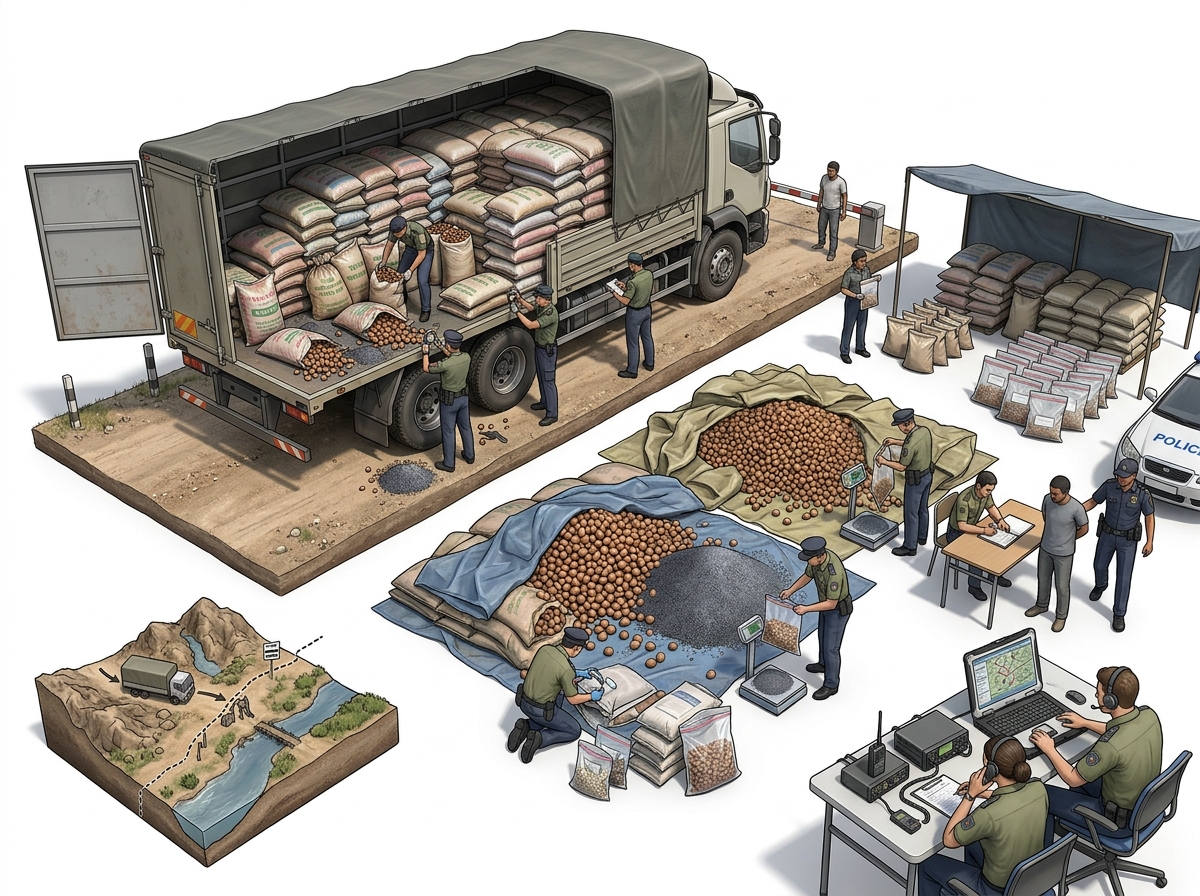
26 Sep DRI seizes ₹20.31 crore smuggled betel nut & poppy seeds in Assam-Mizoram
✎ The Directorate of Revenue Intelligence (DRI) is India’s premier anti-smuggling agency under the Department of Revenue, mandated to investigate and prosecute economic offences, including narcotics trafficking, under the Customs…
Subject Relevance — Where This Topic Fits
- GS Paper III — Security: Border Management, Smuggling, and Narcotics Control | GS Paper III — Role of Enforcement Agencies in Economic Offences
- Prelims: Narcotic Drugs and Psychotropic Substances Act, 1985, Customs Act, 1962, Directorate of Revenue Intelligence (DRI), Foreign Trade Policy (ITC HS), India-Myanmar border, Narcotics Commissioner, Gwalior, Assam Rifles
- Essay: The role of intelligence agencies in safeguarding national security and economic sovereignty, Regional cooperation in combating transnational crime: Lessons from India’s North-East
Quick Revision: The Directorate of Revenue Intelligence (DRI) is India’s premier anti-smuggling agency under the Department of Revenue, mandated to investigate and prosecute economic offences, including narcotics trafficking, under the Customs Act, 1962.
Why is this in the news?
On 23–24 September 2026, the Directorate of Revenue Intelligence (DRI), in coordinated operations with Assam Rifles and state police forces, intercepted and seized approximately ₹20.31 crore worth of foreign-origin betel nut (1,25,680 kg) and poppy seeds (41,697 kg) along the India-Myanmar border in Mizoram and Assam. Four individuals were arrested in connection with the illegal transportation of poppy seeds, marking one of the largest seizures of smuggled betel nut in the North-Eastern region. The seizures highlight the persistent challenge of cross-border smuggling and the operational efficacy of intelligence-driven enforcement in sensitive border zones.
Background
- The India-Myanmar border, spanning approximately 1,643 km, is a porous frontier with challenging terrain, making it susceptible to illicit trade in narcotics, wildlife parts, and restricted agricultural commodities.
- Poppy seeds (Papaver somniferum) are classified as restricted items under India’s Foreign Trade Policy (ITC HS classification).
- The Customs Act, 1962, provides the legal framework for interdiction, seizure, and prosecution in cases of smuggling of controlled substances.
- The Narcotics Commissioner, headquartered in Gwalior, is the nodal authority for regulating the import of poppy seeds, mandating registration of import contracts and sourcing from approved countries.
- The Directorate of Revenue Intelligence (DRI), under the Department of Revenue, Ministry of Finance, is the apex intelligence and investigative agency tasked with combating smuggling, commercial fraud, and economic offences.
- Assam Rifles, a central paramilitary force, plays a critical role in border security and counter-insurgency operations along the India-Myanmar border, often collaborating with DRI in interdiction operations.
What is the Directorate of Revenue Intelligence (DRI) and its role in combating smuggling?
- The Directorate of Revenue Intelligence (DRI) is the apex intelligence and investigative agency under the Department of Revenue, Ministry of Finance, Government of India, established in 1957.
- DRI’s primary mandate includes gathering intelligence, conducting investigations, and initiating prosecutions against smuggling syndicates involved in narcotics, gold, wildlife, counterfeit currency, and restricted goods.
- The agency operates through a network of 15 zones and 35 sub-zones across India, with specialised units for narcotics, gold, commercial fraud, and cyber-enabled economic offences.
- DRI works in close coordination with Central Board of Indirect Taxes and Customs (CBIC), Narcotics Control Bureau (NCB), Enforcement Directorate (ED), state police forces, and central paramilitary forces like Assam Rifles.
- The legal framework governing DRI’s operations includes the Customs Act, 1962, and the Foreign Trade Policy.
- DRI’s intelligence-led operations often involve undercover surveillance, electronic monitoring, and coordination with international agencies such as the World Customs Organization (WCO) and Interpol.
- The agency also plays a key role in capacity-building for customs and border security personnel, including training in detection techniques and legal procedures.
- Recent high-profile seizures, such as the 2026 betel nut and poppy seed busts, underscore DRI’s evolving role in addressing emerging threats in cross-border trade and narcotics trafficking.
Key Features
| Feature | Significance |
|---|---|
| Scale of seizure (₹20.31 crore, 1.67 lakh kg) | Largest interdiction of smuggled areca nut in North-East; demonstrates operational efficacy of DRI in high-risk border zones. |
| Geographical spread (Assam & Mizoram) | Targets two contiguous states sharing the porous India-Myanmar border, highlighting the need for multi-agency coordination. |
| Commodities seized (areca nut & poppy seeds) | Areca nut is a restricted agricultural product under ITC-HS; poppy seeds are narcotic precursors requiring strict import controls. |
| Multi-agency operation (DRI, Assam Rifles, State Police) | Shows institutional synergy in counter-smuggling; leverages paramilitary and local law enforcement for rapid response. |
| Legal framework invoked (Customs Act, 1962) | Demonstrates application of existing statutory powers for interdiction and asset forfeiture in cross-border crimes. |
Why it Matters
Border Security & National Integrity
- The India-Myanmar border, notified as a ‘Free Movement Regime’ zone, remains vulnerable to illicit trade due to its 1,643 km length and porous terrain.
- Smuggling of agricultural and narcotic commodities undermines India’s phytosanitary and narcotics control regimes, posing risks to public health and food safety.
- Large-scale seizures reflect the persistence of transnational criminal networks exploiting weak border controls in the North-East.
- The operation aligns with the government’s ‘Act East Policy’ by strengthening border management and countering illicit flows from Myanmar.
Economic & Revenue Implications
- The estimated market value of seized goods (₹20.31 crore) represents potential revenue loss to the exchequer if such consignments entered domestic trade.
- Illicit trade distorts agricultural markets, suppresses prices of domestically produced areca nut, and funds organised crime.
- Customs revenue from legitimate trade is protected when interdiction prevents undervaluation and misdeclaration of imports.
- The operation underscores the economic cost of smuggling to legitimate farmers and traders in North-East India.
Narcotics Control & Public Health
- Poppy seeds, though not narcotic in raw form, are listed under the Narcotic Drugs and Psychotropic Substances (NDPS) Act as a controlled precursor.
- Their illegal import bypasses mandatory registration with the Narcotics Commissioner, Mumbai, contravening the Foreign Trade Policy (ITC-HS).
- Unregulated entry of poppy seeds can facilitate diversion for illicit opium production, posing a dual threat to law enforcement and public health.
- The seizure demonstrates proactive enforcement under the NDPS framework to prevent precursor diversion.
Institutional Capacity & Inter-Agency Coordination
- The operation exemplifies the DRI’s role as the apex intelligence and investigation agency for cross-border smuggling under the Ministry of Finance.
- Collaboration with Assam Rifles (a central paramilitary force) and state police highlights the necessity of integrated border management.
- Real-time intelligence sharing and joint raids reduce response time and improve seizure outcomes in remote border areas.
- The case underscores the need for sustained capacity-building in forensic analysis and financial intelligence to trace smuggling networks.
Challenges
1. Porous Border Infrastructure
- The India-Myanmar border lacks physical barriers over large stretches, enabling low-risk smuggling of low-weight, high-value commodities.
- Topographical challenges (dense forests, hilly terrain) limit surveillance and increase response time for interdiction teams.
- Limited manpower and technological gaps in border guarding forces (e.g., Assam Rifles) hinder 24/7 monitoring.
UPSC Link: GS III: Border Management
2. Regulatory Gaps in Agricultural Trade
- Areca nut is classified as a restricted item under the Foreign Trade Policy, but enforcement of import bans is inconsistent due to overlapping jurisdictions.
- Lack of harmonised phytosanitary standards with Myanmar complicates interdiction of substandard or contaminated consignments.
- Weak traceability systems for agricultural imports allow misdeclaration of origin and quantity.
UPSC Link: GS III: Food Processing & Supply Chain
3. Narcotics Precursor Control
- Poppy seeds are dual-use commodities; their legal trade (e.g., for oil extraction) requires strict licensing but is vulnerable to diversion.
- India’s import regime for poppy seeds lacks real-time digital verification with source countries, enabling fraudulent documentation.
- Low conviction rates in NDPS cases due to prolonged legal processes reduce deterrence against precursor smuggling.
UPSC Link: GS II: Government Policies & Interventions
4. Intelligence-Led Operations Constraints
- Dependence on human intelligence (HUMINT) limits scalability; integration with signals intelligence (SIGINT) and financial intelligence (FININT) is nascent.
- Lack of a unified data-sharing platform between central agencies (DRI, NIA, ED) and state police hampers multi-jurisdictional investigations.
- Budgetary constraints in forensic labs delay chemical analysis of seized samples, prolonging case closure.
UPSC Link: GS III: Security Challenges
5. Community & Socio-Economic Factors
- Cross-border ethnic ties and informal trade networks in North-East India create social resistance to strict enforcement, fostering a culture of tolerance for smuggling.
- Poverty and limited livelihood alternatives in border districts push vulnerable populations into low-risk smuggling as a supplementary income source.
- Corruption in local administration and law enforcement at checkpoints facilitates collusion with smuggling syndicates.
UPSC Link: GS II: Social Sector & Governance
Challenges — UPSC Perspective
| Issue | Concern |
|---|---|
| Border fencing & surveillance | Inadequate physical barriers and technological gaps in monitoring enable smuggling of bulk commodities. |
| Phytosanitary standards | Absence of harmonised import norms with Myanmar risks entry of substandard agricultural products. |
| NDPS precursor controls | Weak licensing and verification systems for poppy seeds facilitate diversion for illicit opium production. |
| Multi-agency coordination | Fragmented data-sharing and jurisdictional overlaps delay interdiction and investigation. |
| Forensic capacity | Delays in chemical analysis of seized samples hinder timely prosecution. |
| Socio-economic drivers | Poverty and ethnic ties in border communities create resistance to enforcement efforts. |
Government Initiatives — Must-Memorise for Prelims
- Foreign Trade Policy (2023-28) – Restricted items list (ITC-HS)
Way Forward
- Strengthen border infrastructure with integrated surveillance (drones, sensors) along the India-Myanmar border under the Comprehensive Integrated Border Management System (CIBMS).
- Establish a real-time digital verification portal for agricultural and narcotic precursor imports, linking customs, Narcotics Commissioner, and source-country authorities.
- Expand DRI’s forensic and financial intelligence capabilities to trace smuggling networks and freeze assets under the Prevention of Money Laundering Act (PMLA).
- Conduct joint training programmes for border guarding forces (Assam Rifles, BSF) and state police on interdiction techniques and legal procedures.
- Launch community awareness campaigns in North-East border districts to reduce tolerance for smuggling and encourage reporting of suspicious activities.
- Harmonise phytosanitary standards with Myanmar and Bangladesh to prevent entry of substandard agricultural products through formal trade channels.
- Increase budgetary allocation for border guarding forces to address manpower shortages and technological gaps in high-risk zones.
- Enhance international cooperation with Myanmar under the ‘India-Myanmar Bilateral Agreement on Drug Control’ to share intelligence and conduct joint operations.
UPSC Value Addition
Keywords for Mains Answer-Writing
Border Security Force (BSF) · Directorate of Revenue Intelligence (DRI) · Customs Act, 1962 · Foreign Trade Policy (FTP) · Narcotics Control Bureau (NCB) · India-Myanmar border · Transnational crime · Illicit drug trafficking · Anti-smuggling operations · Central Armed Police Forces (CAPFs) · Regulated commodities · International trade compliance
Concept Flow
Cross-border ethnic trade networks → Exploitation of porous India-Myanmar border → Smuggling of restricted commodities (areca nut, poppy seeds) → Revenue loss & public health risks → DRI-led multi-agency interdiction → Seizure under Customs Act & NDPS → Legal proceedings & asset forfeiture → Strengthening of border controls & intelligence systems.
Prelims Practice Questions
Q1. Consider the following statements regarding the Directorate of Revenue Intelligence (DRI):
1. The DRI is a statutory body established under the Customs Act, 1962.
2. It functions under the administrative control of the Department of Revenue, Ministry of Finance.
3. The DRI is primarily responsible for investigating cases of smuggling and commercial frauds.
How many of the above statements are correct?
- Only one
- Only two
- All three
- None
Answer: All three — Statements 2 and 3 are correct. The DRI is a multi-functional agency under the Department of Revenue, Ministry of Finance, tasked with investigating smuggling, commercial frauds, and related economic offences. Statement 1 is incorrect as the DRI is not established under the Customs Act, 1962; it operates under the broader framework of customs and central excise laws.
Q2. Assertion (A): The Foreign Trade Policy (FTP) classifies poppy seeds (khus-khus) as a restricted commodity.
Reason (R): Poppy seeds are narcotic substances and their import is regulated under the Narcotic Drugs and Psychotropic Substances Act, 1985.
- Both A and R are true, and R is the correct explanation of A.
- Both A and R are true, but R is not the correct explanation of A.
- A is true, but R is false.
- A is false, but R is true.
Answer: A is true, but R is false. — Assertion (A) is true as the FTP classifies poppy seeds as a restricted commodity, requiring specific conditions for import. Reason (R) is also true but does not directly explain why the FTP classifies them as restricted; the regulation stems from trade policy and customs laws, not solely from the NDPS Act.
Q3. Match the following agencies with their primary functions:
Column I
A. Directorate of Revenue Intelligence (DRI)
B. Narcotics Control Bureau (NCB)
C. Border Security Force (BSF)
D. Central Bureau of Investigation (CBI)
Column II
1. Investigation of narcotics-related offences
2. Investigation of economic offences and smuggling
3. Border management and counter-infiltration duties
4. Investigation of corruption and special crimes
- A-2, B-1, C-3, D-4
- A-1, B-2, C-3, D-4
- A-4, B-1, C-2, D-3
- A-3, B-4, C-1, D-2
Answer: A-2, B-1, C-3, D-4 — The correct match is: A (DRI) – 2 (investigation of economic offences and smuggling), B (NCB) – 1 (narcotics-related offences), C (BSF) – 3 (border management), D (CBI) – 4 (investigation of corruption and special crimes).
Mains Practice Question
✍ The seizure of foreign-origin areca nut and poppy seeds along the India-Myanmar border underscores the challenges of transnational crime and illicit trade. Critically examine the institutional and legal framework governing the prevention of such smuggling in India. Also, analyse the role of the Directorate of Revenue Intelligence (DRI) in this context. (15 Marks)
Approach: MODEL-ANSWER SKELETON:
1. **Institutional Framework**:
– Role of DRI as the apex anti-smuggling agency under the Department of Revenue, Ministry of Finance.
– Coordination with Central Armed Police Forces (CAPFs) like Assam Rifles and state police forces.
– Involvement of Customs Department and Border Security Force (BSF) in border management.
– Role of Narcotics Control Bureau (NCB) for narcotic substances like poppy seeds.
2. **Legal Framework**:
– Customs Act, 1962: Powers of seizure, confiscation, and investigation.
– Foreign Trade Policy (FTP) and ITC-HS classification for regulated commodities.
– Narcotic Drugs and Psychotropic Substances (NDPS) Act, 1985 for narcotic substances.
– Provisions for arrest, prosecution, and penalties under relevant laws.
3. **Challenges**:
– Porous borders and difficult terrain of North-East India.
– Transnational criminal syndicates exploiting gaps in enforcement.
– Logistical and operational constraints in large-scale seizures.
– Coordination gaps among central and state agencies.
4. **DRI’s Role and Effectiveness**:
– Intelligence-led operations and inter-agency collaboration.
– Use of modern technology and forensic tools in investigations.
– Limitations: Resource constraints, jurisdictional overlaps, and delays in prosecution.
5. **Way Forward**:
– Strengthening border infrastructure and surveillance.
– Enhancing inter-agency coordination and intelligence-sharing mechanisms.
– Capacity-building for personnel and adoption of AI-driven analytics.
– Public awareness and community engagement in border areas.
Source: PIB (Press Information Bureau)
Assam PCS (APSC) — State PCS Practice
Prelims: Under the large-scale campaign against cross-border smuggling, the Directorate of Revenue Intelligence (DRI) recently seized goods worth ₹20.31 crore and 1.25 lakh kg in Assam and Mizoram. Which of the following is the primary objective of the DRI’s operation in this context?
- A. To curb illegal trade across the Assam-Mizoram border and protect state revenue
- B. To promote cross-border tourism between Assam and Mizoram
- C. To facilitate the movement of goods under the GST regime
- D. To enhance agricultural exports from Assam to Mizoram
Answer: A. To curb illegal trade across the Assam-Mizoram border and protect state revenue — The DRI’s operation targets illegal trade and smuggling across the Assam-Mizoram border to protect state revenue and curb cross-border crimes.
Mains: Discuss the socio-economic and security implications of cross-border smuggling in Assam, with a focus on the challenges posed by the Assam-Mizoram border. Suggest measures to strengthen border management and curb illegal trade in the region.
Generated by AanyaAi for educational purpose.
Related guides on our sites
- Anthropology VS PSIR
- Best PSIR optional coaching
- Best PSIR optional coaching online
- Best PSIR optional teacher

- Exercise Tarang Shakti 2026: India’s Mega Multi-Nation Air Power Showcase - September 27, 2026
- रबी अभियान 2026: राष्ट्रीय सम्मेलन में केंद्र-राज्य तालमेल पर होगा जोर - September 27, 2026
- Himachal CM Sukhu: All Doctor Vacancies to be Filled by March - September 27, 2026

No Comments