


26 Sep Indian Non-Profits Trail in Digital Maturity and AI Adoption: 2026 Report
✎ Digital maturity in non-profits is hindered by resource constraints, low AI governance, and underutilisation of existing digital tools, despite the sector’s critical role in achieving sustainable development goals.
Subject Relevance — Where This Topic Fits
- GS Paper II — Governance, Transparency and Accountability | GS Paper III — Science and Technology — Developments and their Applications and Effects in Everyday Life
- Prelims: Digital Public Infrastructure (DPI), Artificial Intelligence (AI), Non-Profit Organisations (NPOs), Data Governance, Digital Literacy, UN Sustainable Development Goals (SDGs), E-Governance
- Essay: The Role of Technology in Social Sector Transformation, Bridging the Digital Divide: Challenges and Strategies
Quick Revision: Digital maturity in non-profits is hindered by resource constraints, low AI governance, and underutilisation of existing digital tools, despite the sector’s critical role in achieving sustainable development goals.
Why is this in the news?
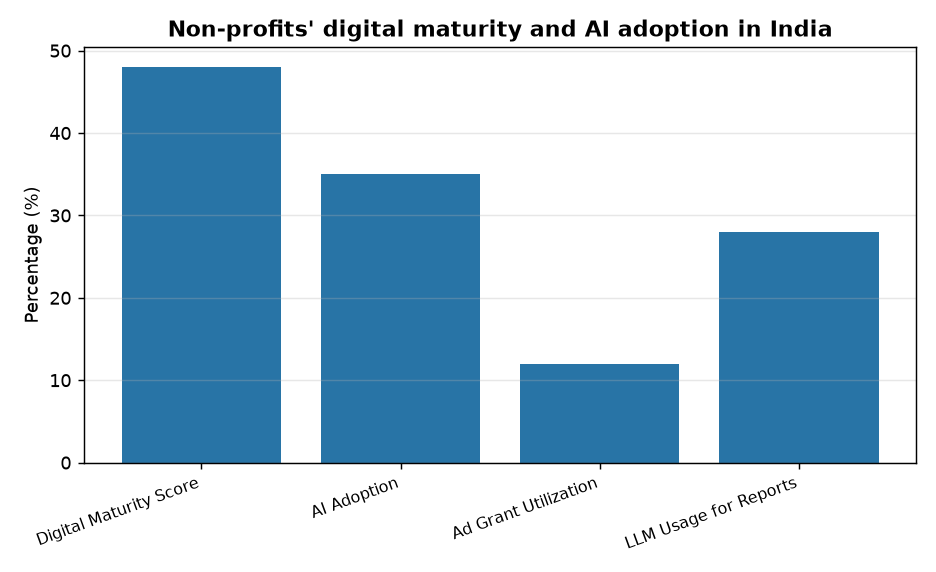
The ‘State of Nonprofits Digitization Report 2026’ by Digital for Nonprofits (D4NP) highlights the significant lag in digital maturity and AI adoption among Indian non-profit organisations, despite the sector’s growing interest in leveraging large language models (LLMs) for reports and marketing. The report underscores the underutilisation of existing digital tools, including free online advertising grants, and the limited safeguards for handling sensitive personal data, raising concerns about governance and operational efficiency in the non-profit ecosystem.
Background
- The global surge in Artificial Intelligence (AI) adoption has transformed workflows across industries, enabling automation, data analytics, and enhanced decision-making.
- India’s non-profit sector, comprising over 3.3 million registered organisations, plays a pivotal role in social welfare, education, healthcare, and environmental sustainability.
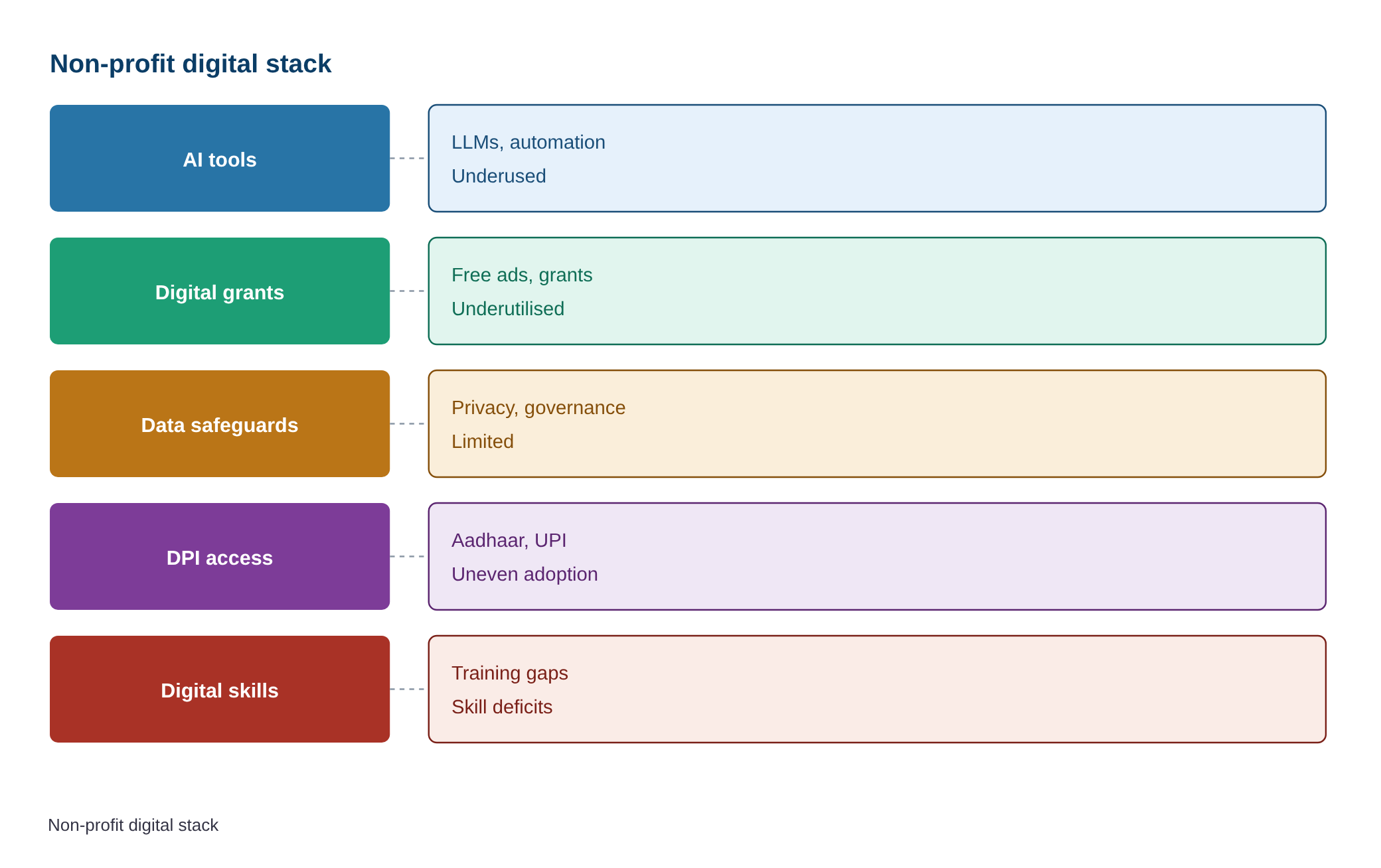
- Digital Public Infrastructure (DPI) initiatives in India, such as Aadhaar, UPI, and the India Stack, have accelerated digital inclusion but adoption remains uneven across sectors.
- The United Nations Sustainable Development Goals (SDGs) emphasise the need for digital inclusion and innovation in the social sector to achieve targets by 2030.
- Previous studies, such as those by Microsoft and NITI Aayog, have highlighted India’s leadership in AI adoption among startups and enterprises, contrasting with the lag in the non-profit sector.
- The Digital for Nonprofits (D4NP) report is an annual assessment tracking the digital maturity of non-profits, with the 2026 edition revealing persistent gaps in technological integration.
Digital Maturity and AI Adoption in the Non-Profit Sector
- Digital maturity refers to the extent to which an organisation leverages digital technologies to enhance efficiency, transparency, and impact. It encompasses infrastructure, skills, processes, and governance aligned with digital transformation.
- AI adoption in non-profits includes the use of Large Language Models (LLMs) for report generation, chatbots for stakeholder engagement, and data analytics for impact assessment. However, utilisation remains limited to basic applications.
- Key barriers to digital maturity include limited financial resources, low digital literacy among staff, lack of technical expertise, and insufficient governance frameworks for AI and data management.
- Non-profits face challenges in integrating AI due to concerns over data privacy, ethical considerations, and the need for robust cybersecurity measures to protect sensitive beneficiary information.
- The underutilisation of free online advertising grants represents a missed opportunity for non-profits to amplify their outreach and fundraising efforts.
- Organisations with corporate backgrounds, such as CRY (Child Rights and You), demonstrate higher digital maturity, suggesting that leadership and workforce composition influence technological adoption.
- AI tools can streamline routine tasks such as report writing, donor communication, and impact measurement, but their potential remains underrealised due to operational and strategic constraints.
Key Features
| Feature | Significance |
|---|---|
| Digital Maturity Index | Quantifies the technological readiness of non-profits across governance, operations, and outreach, serving as a benchmark for sectoral transformation. |
| Large Language Models (LLMs) | Enable automation of report generation, marketing content, and data analysis, reducing manual effort in non-profit workflows. |
| Free Online Advertising Grants | Provide non-profits with unutilised financial resources (e.g., $10,000 monthly grants) to enhance visibility and outreach, yet remain underleveraged. |
| AI Safeguards for Data Privacy | Critical for protecting sensitive personal data in AI-driven tools, with only 25% of non-profits implementing such measures. |
| Online Analytics Tools | Facilitate data-driven decision-making, with LLMs simplifying their adoption, yet underused by 75% of non-profits. |
Why it Matters
Governance and Institutional Efficiency
- Digital maturity in non-profits correlates with improved governance, transparency, and accountability, aligning with the principles of good administration under the Constitution of India.
- Adoption of AI tools can streamline compliance reporting, donor management, and project monitoring, reducing administrative bottlenecks in the sector.
- Underutilisation of free advertising grants reflects inefficiencies in resource mobilisation, impacting outreach and fundraising capabilities.
Economic and Operational Impact
- AI-driven automation reduces operational costs by minimising manual labour in routine tasks such as report writing and data entry.
- Enhanced digital capabilities can attract corporate partnerships and CSR funding, as businesses prioritise technologically advanced collaborators.
- Lack of digital maturity limits scalability, hindering non-profits from expanding their impact across geographies or beneficiary groups.
Societal and Developmental Implications
- Digital and AI adoption in non-profits can amplify their advocacy efforts, enabling data-backed policy engagement with governments and multilateral bodies.
- Improved outreach through digital tools can enhance grassroots awareness campaigns, particularly in education, health, and livelihood sectors.
- Underdeveloped digital ecosystems in non-profits may exacerbate digital divides, marginalising smaller organisations in resource-scarce regions.
Technological and Innovation Ecosystem
- The lag in digital maturity highlights a broader challenge in India’s non-profit sector, contrasting with the rapid AI adoption in private enterprises and startups.
- Opportunities exist for cross-sector collaborations, where tech-driven non-profits can mentor others, fostering a culture of innovation.
- The report underscores the need for sector-specific AI solutions tailored to the unique operational constraints of non-profits.
Challenges
1. Resource Constraints and Funding Gaps
- Limited financial resources impede investment in digital infrastructure, training, and AI tool acquisition for non-profits.
- Underutilisation of free advertising grants suggests a lack of awareness or capacity to leverage available digital resources.
- Dependence on donor funding often prioritises immediate project needs over long-term technological upgrades.
UPSC Link: GS2: Role of Civil Society in Governance
2. Skill Deficits and Capacity Building
- Workforce in non-profits often lacks technical expertise in AI, data analytics, and digital tools, hindering adoption.
- High turnover rates in the sector exacerbate skill gaps, as institutional knowledge is frequently lost.
- Training programmes for non-profit staff are scarce, with limited access to affordable, sector-specific upskilling initiatives.
UPSC Link: GS2: Government Policies and Interventions for Development
3. Regulatory and Ethical Concerns
- Only 25% of non-profits have safeguards for AI-driven data handling, raising concerns about privacy breaches and ethical use.
- Lack of standardised guidelines for AI adoption in the non-profit sector creates ambiguity in compliance and risk management.
- Data localisation and cross-border data transfer regulations may pose additional compliance burdens for digitally advanced non-profits.
UPSC Link: GS2: Important Aspects of Governance
4. Infrastructure and Digital Divide
- Poor internet connectivity and limited access to digital devices in rural and remote areas restrict non-profits’ ability to adopt digital tools.
- The digital divide disproportionately affects smaller non-profits, which lack the scale to invest in technology.
- Dependence on third-party platforms for digital operations introduces vulnerabilities related to data security and platform reliability.
UPSC Link: GS1: Social Empowerment
5. Cultural and Organisational Resistance
- Traditional operational models in non-profits often prioritise human-centric approaches, creating resistance to AI-driven automation.
- Leadership in non-profits may lack awareness of the strategic benefits of digital transformation, focusing instead on immediate project deliverables.
- Fear of job displacement among staff due to AI adoption can lead to internal resistance to technological change.
UPSC Link: GS2: Development Processes and the Development Industry
Challenges — UPSC Perspective
| Issue | Concern |
|---|---|
| Limited Financial Resources | Insufficient funds for digital infrastructure and AI tool acquisition. |
| Skill Deficits | Lack of technical expertise among non-profit staff in AI and data analytics. |
| Regulatory Ambiguity | Absence of clear guidelines for ethical AI use and data privacy. |
| Infrastructure Gaps | Poor internet connectivity and limited access to digital devices in rural areas. |
| Organisational Resistance | Cultural barriers and fear of job displacement hinder digital adoption. |
| Underutilised Resources | Free advertising grants remain unused due to lack of awareness or capacity. |
Way Forward
- Establish sector-specific digital maturity frameworks and benchmarks to guide non-profits in incremental technological upgrades.
- Develop public-private partnerships to provide subsidised or free AI tools, training programmes, and digital infrastructure to non-profits.
- Launch awareness campaigns to educate non-profits on the availability and utilisation of free advertising grants and other digital resources.
- Create certification programmes for AI and digital literacy tailored to the non-profit sector, in collaboration with educational institutions and tech firms.
- Formulate ethical guidelines for AI adoption in non-profits, addressing data privacy, transparency, and accountability concerns.
- Invest in rural digital infrastructure to bridge the digital divide, enabling non-profits in remote areas to adopt digital tools effectively.
- Encourage large non-profits with corporate backgrounds (e.g., CRY) to mentor smaller organisations in digital transformation journeys.
- Integrate digital literacy and AI training into CSR-funded projects, ensuring that technological upskilling is embedded in developmental initiatives.
UPSC Value Addition
Keywords for Mains Answer-Writing
Digital Public Infrastructure · Artificial Intelligence in Governance · Digital Maturity Index for Non-profits · Data Governance and Privacy · AI Ethics and Safeguards · E-governance for Civil Society Organisations · Large Language Models (LLMs) in Public Service Delivery · Digital Divide in Non-profit Sector · Government Grants for Digital Upskilling · Cybersecurity for Non-governmental Organisations · AI Adoption in Social Sector · Regulatory Framework for AI in India
Constitutional & Policy Linkages
- [‘Article 19(1)(a): Freedom of Speech and Expression’, ‘Digital advocacy tools enable non-profits to exercise their right to free expression and public engagement.’]
- [‘Article 21: Right to Life and Personal Liberty’, ‘Protection of personal data in AI tools is essential for safeguarding individual privacy and dignity.’]
- [‘Directive Principles of State Policy (Part IV): Articles 38, 39’, “Digital maturity in non-profits aligns with the state’s duty to promote welfare and reduce inequalities.”]
Concept Flow
Limited awareness of digital resources → Underutilisation of free advertising grants and AI tools → Low digital maturity scores in non-profits. → Resource constraints and skill deficits → Inability to invest in digital infrastructure → Perpetuation of traditional operational models. → Poor digital infrastructure in rural areas → Exclusion of smaller non-profits → Widening digital divide within the sector. → Lack of regulatory guidelines → Ethical concerns in AI adoption → Risk of data breaches and compliance failures. → Organisational resistance to change → Slow adoption of AI-driven workflows → Reduced operational efficiency and scalability. → Public-private partnerships → Access to subsidised AI tools and training → Incremental digital transformation in non-profits. → Sector-specific digital maturity frameworks → Standardised benchmarks → Improved governance and transparency in the non-profit ecosystem.
Prelims Practice Questions
Q1. Consider the following statements regarding the Digital Maturity Index for Non-profits in India as reported by the Digital for Nonprofits (D4NP) State of Nonprofits Digitization Report 2026:
1. The majority of Indian non-profits score below 50% on digital maturity.
2. Only one in four non-profits have safeguards for handling sensitive personal data when using AI tools.
3. The report highlights that most non-profits utilise the monthly $10,000 ad grants provided by online platforms.
How many of the above statements are correct?
- Only one
- Only two
- All three
- None
Answer: Only two — Statement 1 is correct as the report states non-profits scored below 50% on digital maturity. Statement 2 is correct as only roughly one in four non-profits had safeguards for AI tools’ handling of sensitive personal data. Statement 3 is incorrect as the report notes most organisations are not taking advantage of the monthly $10,000 ad grants.
Q2. Assertion (A): The Digital for Nonprofits (D4NP) report 2026 indicates that non-profits in India are rapidly adopting AI tools for complex workflows and data analytics.
Reason (R): The report attributes the lag in AI adoption among non-profits to the lack of corporate background among their staff members.
- Both A and R are true, and R is the correct explanation of A
- Both A and R are true, but R is not the correct explanation of A
- A is true, but R is false
- A is false, but R is true
Answer: ? — Assertion (A) is false as the report highlights that non-profits are lagging in adopting AI for complex workflows and data analytics. Reason (R) is true as the report attributes the lag to the lack of corporate background among staff, but it does not explain the assertion.
Q3. Match the following columns with respect to the findings of the Digital for Nonprofits (D4NP) State of Nonprofits Digitization Report 2026:
Column I (Finding) | Column II (Percentage/Status)
1. Non-profits scoring below 50% on digital maturity | A. Approximately 25%
2. Non-profits with safeguards for sensitive personal data | B. Less than 50%
3. Non-profits utilising online analytics tools | C. Roughly one in four
4. Non-profits using at least one AI tool daily | D. Majority (60%)
Choose the correct match:
- 1-B, 2-C, 3-A, 4-D
- 1-A, 2-B, 3-C, 4-D
- 1-C, 2-A, 3-B, 4-D
- 1-D, 2-C, 3-A, 4-B
Answer: 1-B, 2-C, 3-A, 4-D — 1 matches with B (non-profits scoring below 50% on digital maturity), 2 matches with C (roughly one in four non-profits have safeguards), 3 matches with A (approximately 25% use online analytics tools), and 4 matches with D (majority of 60% use at least one AI tool daily).
Mains Practice Question
✍ The Digital for Nonprofits (D4NP) State of Nonprofits Digitization Report 2026 highlights a significant digital maturity deficit among Indian non-profits, with scores below 50% and limited adoption of AI for complex workflows. Critically examine the implications of this digital lag for India’s social sector governance, with particular reference to data governance, ethical AI use, and the potential of Digital Public Infrastructure (DPI). Also, outline the constitutional and statutory provisions that may guide the regulation of AI in the social sector. (15 Marks)
Approach: MODEL-ANSWER SKELETON:
1. **Introduction (2 marks)**
– Define Digital Maturity Index and its relevance for non-profits in governance.
– State the key findings of the D4NP report (e.g., <50% digital maturity, underutilisation of AI tools, lack of safeguards for sensitive data).
2. **Implications for Social Sector Governance (5 marks)**
– **Data Governance**: Discuss risks of data breaches, lack of standardised data protocols, and erosion of trust in non-profits due to poor cybersecurity.
– **Ethical AI Use**: Highlight concerns over bias in AI tools, opacity in decision-making, and the absence of AI ethics frameworks in non-profits.
– **Digital Public Infrastructure (DPI)**: Argue how DPI (e.g., Aadhaar, DigiLocker, Unified Payments Interface) could bridge the digital divide but require capacity-building in non-profits.
– **Efficiency and Transparency**: Link digital lag to inefficiencies in service delivery, fundraising, and stakeholder engagement.
3. **Constitutional and Statutory Provisions (5 marks)**
– **Constitutional Provisions**: Art. 19(1)(a) (freedom of speech and expression) and Art. 21 (right to privacy) as foundational principles for data governance.
– **Statutory Framework**:
– Personal Data Protection Bill, 2019 (now Digital Personal Data Protection Act, 2023) – obligations for data fiduciaries.
– Information Technology Act, 2000 (Sections 43, 66, 67C) – cybersecurity and data localisation.
– Right to Information Act, 2005 – transparency in non-profit operations.
– **Regulatory Bodies**: Role of Data Protection Board of India (under DPDP Act) and MeitY’s AI ethics guidelines.
4. **Way Forward (3 marks)**
– Capacity-building initiatives (e.g., government-funded digital upskilling programmes for non-profits).
– Public-private partnerships (PPPs) to leverage corporate expertise in AI adoption.
– Adoption of open-source AI tools and low-code platforms to democratise access.
– Strengthening of internal governance mechanisms (e.g., data protection officers, AI ethics committees).
Balance of Views:
– Optimistic view: DPI and AI can democratise governance and enhance service delivery.
– Pessimistic view: Risks of surveillance, exclusion, and erosion of non-profit autonomy if AI is poorly regulated.
Source: The Hindu
Generated by AanyaAi for educational purpose.
Related guides on our sites
- Best economics services coaching
- Anthropology VS PSIR
- Best PSIR optional coaching
- Best PSIR optional coaching online

- गैर-लाभकारी संगठनों में डिजिटल परिपक्वता और एआई अपनाने में कमी: रिपोर्ट 2026 - September 26, 2026
- Indian Non-Profits Trail in Digital Maturity and AI Adoption: 2026 Report - September 26, 2026
- अमरावती अब कानून से आंध्र की राजधानी, तीन राजधानियों के याचिकाएँ निरर्थक - September 26, 2026

No Comments