


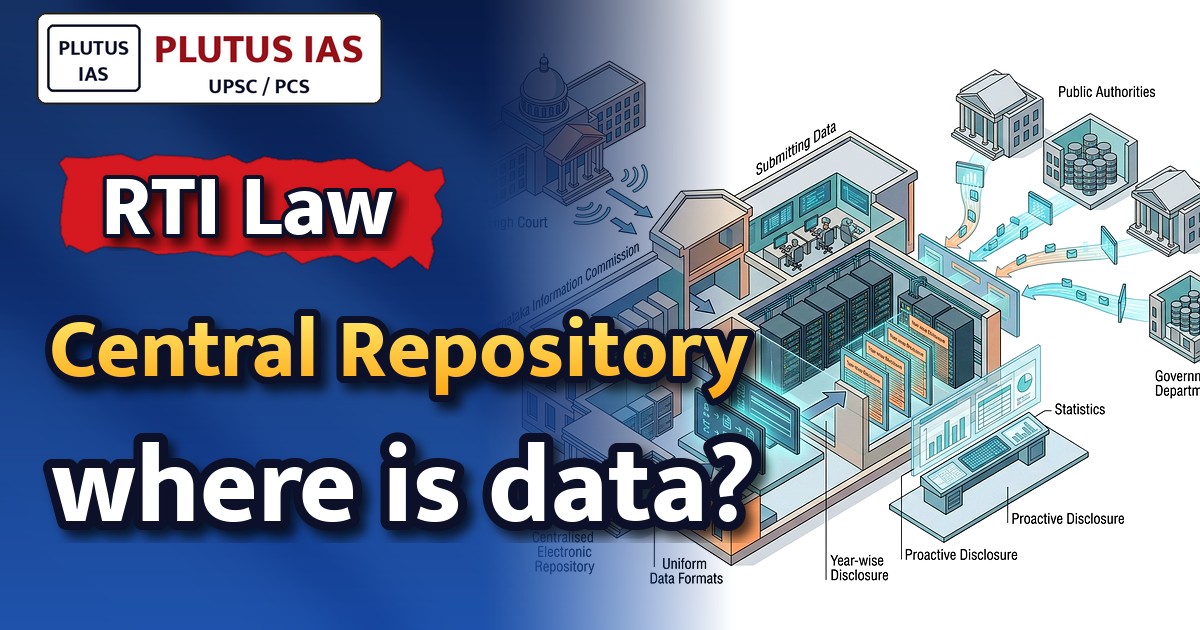
29 Sep Karnataka HC Orders Central RTI Disclosure Repository for State Authorities
✎ The Karnataka High Court has directed the Karnataka Information Commission to establish a centralised electronic repository for RTI disclosures, ensuring standardised, year-wise, and searchable data on applications, appeals…
Subject Relevance — Where This Topic Fits
- GS Paper II — Polity — Statutory, Regulatory and various quasi-judicial bodies | GS Paper III — Governance — e-governance- applications, models, successes, limitations, and potential; citizen charters, transparency and accountability
- Prelims: Right to Information (RTI) Act, 2005, Section 25 (monitoring and reporting), Section 20 (penalties on PIOs), Public Information Officer (PIO), Karnataka Information Commission (KIC), Proactive Disclosure, Centralised Electronic Repository, First and Second Appeals under RTI
- Essay: Transparency as a cornerstone of democratic governance, The role of the judiciary in strengthening institutional accountability
Quick Revision: The Karnataka High Court has directed the Karnataka Information Commission to establish a centralised electronic repository for RTI disclosures, ensuring standardised, year-wise, and searchable data on applications, appeals, penalties, and disciplinary actions, while strictly adhering to the exemptions under the RTI Act.
Why is this in the news?
The Karnataka High Court, in a significant order dated 29 September 2026, directed the Karnataka Information Commission (KIC) to establish a centralised electronic repository for RTI disclosures, prescribe a uniform data format, and ensure proactive, year-wise disclosure of RTI-related statistics by all public authorities. This judicial intervention underscores the persistent challenge of incomplete or fragmented RTI disclosures and seeks to institutionalise transparency through standardised, accessible, and searchable data management systems.
Background
- The Right to Information (RTI) Act, 2005, mandates proactive disclosure of information by public authorities under Section 4(1)(b) to facilitate citizen access without recourse to formal applications.
- Section 25 of the RTI Act requires the Central and State Information Commissions to monitor and report on the implementation of the Act, including the receipt, disposal, and rejection of RTI applications, appeals, and penalties imposed on Public Information Officers (PIOs).
- Despite statutory obligations, many public authorities in Karnataka and across India have maintained RTI-related data in disparate formats, leading to difficulties in aggregation, analysis, and public scrutiny.
- The petitioner, Ramesh Babu N., challenged the KIC’s refusal to provide granular data on penalties imposed and disciplinary actions recommended against PIOs, highlighting gaps in compliance reporting.
- The High Court’s directive aligns with the broader judicial trend of interpreting the RTI Act expansively to enhance transparency, as seen in landmark judgments such as *Namit Sharma v. Union of India* (2013) and *CBSE v. Aditya Bandopadhyay* (2011).
- The order reinforces the constitutional principle of transparency (Article 19(1)(a)) and the doctrine of public accountability, which are integral to the functioning of a participatory democracy.
What is a Centralised RTI Disclosure Repository?
- A centralised RTI disclosure repository is a digital platform maintained by the State Information Commission (in this case, the Karnataka Information Commission) that aggregates, standardises, and disseminates RTI-related data from all public authorities within the State.
- The repository is designed to function as a single-window interface for citizens, enabling them to access year-wise statistics on RTI applications received, disposed of, and rejected; first and second appeals; penalties imposed on PIOs under Section 20; and disciplinary actions recommended.
- The repository must adhere to a uniform data format prescribed by the KIC, ensuring consistency, comparability, and ease of retrieval across departments.
- The platform is required to be searchable, sortable, and retrievable electronically, eliminating the need for manual inspection of files and reducing administrative delays.
- The repository will also host information on the functioning of the KIC itself, including details of appeals, complaints, penalties, and recommendations, thereby enhancing the Commission’s transparency and accountability.
- The repository does not alter the existing exemptions under the RTI Act (Sections 8 and 9) and does not mandate disclosure of information that is otherwise protected from public access.
- The order emphasises the statutory mandate under Section 25 of the RTI Act, which requires public authorities to proactively disclose information and maintain records in a manner that facilitates public scrutiny.
- The repository is expected to function as a tool for evidence-based advocacy, enabling civil society, researchers, and citizens to assess the efficacy of RTI implementation and identify systemic bottlenecks.
Key Features
| Feature | Significance |
|---|---|
| Uniform format for RTI disclosures | Ensures consistency in data collection, maintenance, and disclosure by public authorities across Karnataka, facilitating comparability and ease of access for citizens. |
| Central electronic repository/index | Provides a single-window platform for citizens to locate RTI disclosures from all public authorities, eliminating the need for department-specific searches. |
| Year-wise categorisation of RTI data | Enables trend analysis of RTI applications, appeals, penalties, and disciplinary actions, supporting evidence-based governance and transparency audits. |
| Designation of nodal officers | Assigns responsibility for maintaining updated RTI records electronically, ensuring accountability and reducing manual errors in data compilation. |
| Proactive disclosure mandate on websites | Aligns with Section 4(1)(b) of the RTI Act, which requires public authorities to suo motu disclose information, enhancing preemptive transparency. |
Why it Matters
Governance and Transparency
- Strengthens the institutional framework of the RTI Act by enforcing structured data collection and disclosure, reducing opacity in public authority functioning.
- Enhances citizens’ ability to monitor compliance with RTI provisions, thereby improving accountability of Public Information Officers (PIOs) and appellate authorities.
- Facilitates data-driven oversight by the Karnataka Information Commission (KIC) and civil society, enabling identification of systemic delays or non-compliance in RTI processes.
Legal and Procedural
- Clarifies the scope of Section 25 (monitoring and reporting) of the RTI Act, which mandates public authorities to maintain and publish RTI-related data, ensuring legal compliance.
- Reinforces the role of the KIC as the nodal body for RTI implementation, with explicit directives to maintain a central repository and monitor compliance across departments.
- Upholds the principle of proactive disclosure under Section 4(1)(b) of the RTI Act, reducing the need for citizens to file RTI applications for routine information.
Technological and Administrative
- Promotes digital governance by mandating electronic maintenance and retrieval of RTI data, aligning with the broader push for e-governance in India.
- Reduces administrative burden on citizens by centralising RTI disclosures, thereby improving the efficiency of information dissemination.
- Encourages standardisation in RTI record-keeping, which can serve as a model for other states to emulate, fostering inter-state consistency in transparency practices.
Challenges
1. Data Standardisation and Quality
- Risk of inconsistent data formats across public authorities despite uniform guidelines, leading to challenges in aggregation and analysis.
- Potential delays in updating the central repository due to bureaucratic inertia or lack of dedicated personnel in smaller departments.
- Ensuring the accuracy and completeness of year-wise data, particularly in departments with high RTI application volumes or complex information structures.
UPSC Link: GS-II: Transparency & Accountability in Governance
2. Digital Divide and Accessibility
- Limited digital literacy among citizens, especially in rural areas, may hinder effective utilisation of the central repository.
- Dependence on internet connectivity and digital infrastructure could exclude marginalised communities from accessing RTI disclosures.
- Need for multilingual support in the repository to cater to linguistic diversity in Karnataka.
UPSC Link: GS-II: E-Governance & Digital Divide
3. Balancing Transparency and Exemptions
- Ensuring that proactive disclosure does not inadvertently expose sensitive information exempt under Sections 8 and 9 of the RTI Act.
- Risk of over-classification of information as exempt, undermining the purpose of the central repository.
- Need for clear guidelines on what constitutes exempt information to prevent misuse of confidentiality provisions.
UPSC Link: GS-II: RTI Act – Exemptions and Limitations
4. Institutional Capacity and Enforcement
- Limited capacity of the Karnataka Information Commission to monitor compliance across all public authorities, particularly in remote or understaffed departments.
- Lack of penalties for non-compliance with proactive disclosure requirements under Section 25 of the RTI Act, reducing deterrence.
- Need for periodic audits and third-party evaluations to assess the effectiveness of the central repository and data quality.
UPSC Link: GS-II: Role of Information Commissions
Challenges — UPSC Perspective
| Issue | Concern |
|---|---|
| Data consistency across departments | Inconsistent formats may lead to aggregation errors, undermining the repository’s utility. |
| Digital infrastructure gaps | Poor internet connectivity in rural areas may limit access to the central repository. |
| Exempt information classification | Overuse of exemptions could dilute the repository’s transparency benefits. |
| Monitoring and enforcement | Weak oversight may result in non-compliance by public authorities. |
| Citizen awareness | Low digital literacy could prevent effective utilisation of the repository. |
Way Forward
- The Karnataka Information Commission should conduct capacity-building workshops for public authorities on standardised data formats and electronic record-keeping.
- Develop a phased rollout plan for the central repository, prioritising departments with high RTI application volumes to ensure early impact.
- Introduce a grievance redressal mechanism for citizens to report discrepancies or delays in RTI disclosures on the repository.
- Collaborate with civil society organisations to conduct periodic audits of the repository’s data quality and accessibility.
- Strengthen digital infrastructure in rural areas through partnerships with local governments and telecom providers.
- Publish a citizen-friendly guide on navigating the central repository, including multilingual support where feasible.
- Establish a feedback loop between the KIC and public authorities to address systemic challenges in data maintenance.
- Explore the integration of the Karnataka repository with national RTI portals to facilitate inter-state data sharing and benchmarking.
UPSC Value Addition
Keywords for Mains Answer-Writing
Right to Information Act, 2005 · Karnataka Information Commission · RTI disclosure repository · proactive disclosure under RTI · Section 25 of RTI Act · Section 20 of RTI Act · uniform format for RTI disclosures · electronic repository for RTI data · Public Information Officers (PIOs) · RTI compliance monitoring · judicial directions on RTI implementation · RTI Act exemptions
Constitutional & Policy Linkages
- Article 19(1)(a) – Freedom of Speech and Expression (includes right to seek information)
- Article 21 – Right to Life and Personal Liberty (interpreted to include right to information)
- Article 32 – Writs for enforcement of fundamental rights (including RTI-related remedies)
Concept Flow
Public Authority receives RTI application → PIO processes request (Section 5-7, RTI Act) → Data on applications, appeals, penalties recorded (Section 25, RTI Act) → Information Commission monitors compliance (Section 12, RTI Act) → High Court directs uniform format and central repository → Public Authorities upload data electronically → Citizens access repository for transparency → Data-driven oversight and accountability.
Prelims Practice Questions
Q1. Consider the following statements regarding the Right to Information (RTI) Act, 2005:
1. Section 25 of the RTI Act mandates monitoring and reporting by public authorities.
2. Section 20 empowers the Information Commission to impose penalties on Public Information Officers (PIOs) for non-compliance.
3. The RTI Act does not require public authorities to maintain records electronically.
How many of the above statements are correct?
- Only one
- Only two
- All three
- None
Answer: Only two — Statement 1 and 2 are correct. Statement 3 is incorrect as the RTI Act, as interpreted by the Karnataka High Court, mandates electronic maintenance of records for search, sorting, and retrieval.
Q2. Assertion (A): The Karnataka High Court directed the Karnataka Information Commission to create a central RTI disclosure repository.
Reason (R): The court aimed to ensure uniform collection, maintenance, and disclosure of information by public authorities under the RTI Act.
(a) Both A and R are true, and R is the correct explanation of A
(b) Both A and R are true, but R is not the correct explanation of A
(c) A is true, but R is false
(d) A is false, but R is true
- (a)
- (b)
- (c)
- (d)
Answer: (a) — Both A and R are true, and R correctly explains A as the directive was issued to standardise RTI disclosures and improve accessibility.
Q3. Match the following provisions of the Right to Information (RTI) Act, 2005 with their respective functions:
Column I (Provision)
A. Section 20
B. Section 25
C. Section 4(1)(b)
D. Section 6(1)
Column II (Function)
1. Mandates proactive disclosure of information by public authorities
2. Empowers Information Commissions to impose penalties on PIOs for non-compliance
3. Specifies the procedure for filing RTI applications
4. Requires public authorities to monitor and report RTI compliance
Select the correct match:
- A-2, B-4, C-1, D-3
- A-1, B-2, C-3, D-4
- A-3, B-1, C-2, D-4
- A-4, B-3, C-1, D-2
Answer: A-2, B-4, C-1, D-3 — Section 20 empowers penalties (A-2); Section 25 mandates monitoring and reporting (B-4); Section 4(1)(b) requires proactive disclosure (C-1); Section 6(1) specifies the procedure for filing RTI applications (D-3).
Mains Practice Question
✍ The Karnataka High Court has directed the Karnataka Information Commission to create a central RTI disclosure repository and prescribe a uniform format for RTI disclosures. In this context, critically examine the significance of proactive disclosure under the Right to Information Act, 2005, and evaluate the role of Information Commissions in ensuring compliance. Also, discuss the challenges in implementing such a centralised repository. (15 Marks)
Approach: MODEL-ANSWER SKELETON:
1. **Proactive disclosure under RTI Act**: Define proactive disclosure (Section 4(1)(b)) and its objectives—transparency, accountability, and reduction in RTI applications. Cite the rationale: to empower citizens with information without the need for formal requests.
2. **Role of Information Commissions**: Explain their constitutional/statutory mandate (Section 12, 18, 20 of RTI Act) to oversee compliance, adjudicate appeals, and impose penalties. Highlight the Karnataka High Court’s directive as a judicial intervention to strengthen this role.
3. **Uniform format and central repository**: Discuss the court’s direction for a uniform format (year-wise data on RTI applications, appeals, penalties) and a central electronic repository. Link to Section 25 (monitoring and reporting) and the need for standardised, searchable data.
4. **Challenges in implementation**:
– **Data fragmentation**: Public authorities’ reluctance to maintain updated records.
– **Resource constraints**: Limited capacity of Information Commissions to enforce compliance uniformly.
– **Exemptions and confidentiality**: Balancing proactive disclosure with exemptions under Section 8 and 9 of the RTI Act.
– **Digital divide**: Ensuring accessibility for citizens lacking digital literacy.
5. **Comparative perspective**: Reference similar initiatives (e.g., Central RTI Portal) and their limitations. Conclude with the need for institutional capacity-building, periodic audits, and citizen awareness campaigns to realise the repository’s potential.
Source: The Hindu
Karnataka PCS (KPSC) — State PCS Practice
Prelims: Which of the following is the primary directive given by the Karnataka High Court to the Karnataka Information Commission regarding the RTI Act?
- To establish a central RTI disclosure repository for proactive disclosures
- To reduce the number of RTI applications received annually
- To mandate digital RTI applications only
- To restrict RTI access to government employees only
Answer: To establish a central RTI disclosure repository for proactive disclosures — The Karnataka High Court directed the Karnataka Information Commission to create a central RTI disclosure repository to ensure proactive disclosures under the RTI Act.
Mains: Discuss the significance of the Karnataka High Court’s directive to the Karnataka Information Commission for creating a central RTI disclosure repository. How can this initiative enhance transparency and accountability in governance in Karnataka?
Generated by AanyaAi for educational purpose.
Related guides on our sites
- Anthropology VS PSIR
- Best PSIR optional coaching
- Best PSIR optional coaching online
- Best PSIR optional teacher

- जम्मू-कश्मीर: अनुच्छेद 370 से राज्यत्व तक का संवैधानिक सफर - September 30, 2026
- Supreme Court to Hear Plea Against CEC’s Suspension & SIR Validity - September 30, 2026
- पश्चिम बंगाल में परिवहन सुधार: AI सिग्नलिंग, ट्राम पुनरुद्धार और जल टैक्सी की योजना - September 30, 2026

No Comments