


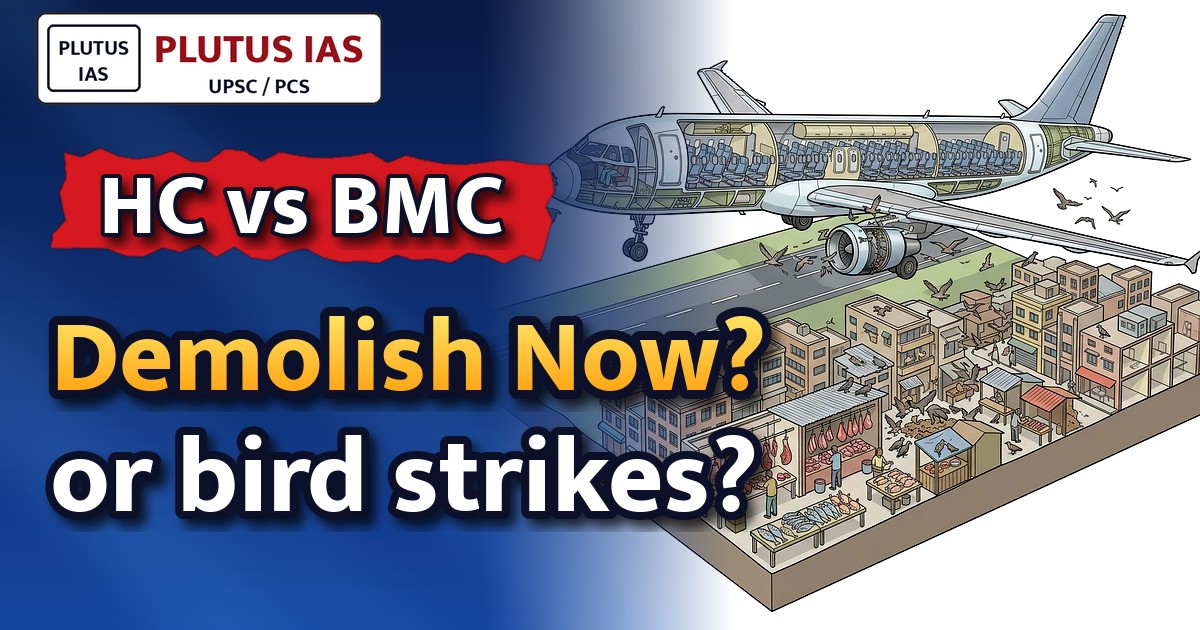
30 Sep Bombay HC to BMC: Demolish illegal meat shops near Mumbai Airport
✎ The Bombay High Court’s directive to the BMC underscores the necessity of permanent, multi-agency solutions to eliminate illegal meat shops near airports, aligning with the Aircraft Rules, 1937, and public health statutes to…
Subject Relevance — Where This Topic Fits
- GS Paper II — Governance, Constitution, Polity, Social Justice and International Relations | GS Paper III — Environment, Disaster Management and Security
- Prelims: Bird strike hazard, Aircraft Rules 1937, Brihanmumbai Municipal Corporation (BMC), Bombay High Court, Chhatrapati Shivaji Maharaj International Airport (CSMIA), Municipal Solid Waste (Management and Handling) Rules 2000, Public Health (Prevention, Control and Management of Zoonoses) Rules 2020
- Essay: The judiciary as an enforcer of public safety and environmental governance, Balancing urban livelihoods with aviation safety and environmental protection
Quick Revision: The Bombay High Court’s directive to the BMC underscores the necessity of permanent, multi-agency solutions to eliminate illegal meat shops near airports, aligning with the Aircraft Rules, 1937, and public health statutes to mitigate bird strike hazards and ensure aviation safety.
Why is this in the news?
The Bombay High Court has recently directed the Brihanmumbai Municipal Corporation (BMC) to submit a comprehensive scheme to permanently prevent illegal meat, poultry, and fish shops from operating within a 10-kilometre radius of the Chhatrapati Shivaji Maharaj International Airport (CSMIA) in Mumbai. The court’s intervention stems from persistent enforcement failures and the continued operation of unauthorised establishments, which pose a severe bird strike hazard to aircraft and violate multiple regulatory frameworks, including the Aircraft Rules, 1937, and public health statutes.
Background
- The Chhatrapati Shivaji Maharaj International Airport (CSMIA) in Mumbai is one of India’s busiest aviation hubs, handling over 40 million passengers annually and serving as a critical node in the national and international air transport network.
- Bird strikes pose a significant safety risk to aircraft operations, with the potential to cause engine failure, structural damage, and loss of life. The Federal Aviation Administration (FAA) and International Civil Aviation Organization (ICAO) classify bird strike hazards as a Tier-1 safety concern.
- Illegal meat shops, particularly those engaged in unauthorised slaughtering and poultry processing, attract predatory birds such as crows and kites, exacerbating the bird strike hazard near airports.
- The Bombay High Court has, in prior orders, directed the BMC and other authorities to enforce existing regulations, including the Aircraft Rules, 1937, to mitigate this hazard.
- Despite enforcement drives, unauthorised shops have continued to operate on days when drives are not conducted, indicating systemic gaps in regulatory compliance and enforcement mechanisms.
- The court’s observation that shops could be demolished like road encroachments underscores the need for robust and permanent solutions rather than ad hoc enforcement actions.
What are the regulatory and governance dimensions of this issue?
- The Aircraft Rules, 1937, framed under the Aircraft Act, 1934, empower airport authorities to regulate activities within a 10-kilometre radius of airports to prevent hazards to air navigation, including bird strikes.
- The BMC, as the municipal authority, is constitutionally obligated under the 74th Constitutional Amendment Act, 1992, to ensure public health, sanitation, and environmental protection in its jurisdiction.
- Enforcement challenges include dense urban settlements, lack of adequate policing during drives, and the transient nature of unauthorised operations, which necessitate a multi-agency and permanent solution.
- Judicial directives in such cases often serve as a catalyst for inter-agency coordination, as seen in the court’s suggestion to involve senior police authorities for protection of civic officers during enforcement.
- The case highlights the intersection of aviation safety, urban governance, and environmental regulation, requiring a holistic approach that balances livelihood concerns with public safety imperatives.
Key Features
| Feature | Significance |
|---|---|
| Bombay High Court directive to BMC | Mandates a comprehensive scheme to prevent illegal meat shops within 10 km of CSMIA to mitigate bird-strike hazards and ensure compliance with Aircraft Rules |
| 10-kilometre radius restriction | Aligns with international aviation safety norms to reduce risk of bird strikes near airports, a critical operational requirement for flight safety |
| Enforcement drives by BMC | Aims to identify and dismantle unauthorised meat, poultry, and fish shops, though challenges persist due to reopening on non-drive days |
| Court’s observation on demolition | Highlights the civic body’s powers to remove encroachments and unauthorised structures, reinforcing the need for decisive action |
| Proposal for police protection | Addresses threats and intimidation faced by civic officials during enforcement, ensuring lawful duty execution in high-risk zones |
Why it Matters
Aviation Safety and Regulatory Compliance
- Illegal meat shops near airports attract predatory birds, increasing the risk of bird strikes that can compromise aircraft safety and lead to catastrophic incidents
- The Aircraft (Amendment) Act, 2020, and Aircraft Rules, 1937, mandate strict adherence to aviation safety protocols, including wildlife hazard management around aerodromes
- Compliance with international standards (e.g., ICAO Annex 14) requires proactive measures to mitigate bird hazards in airport vicinities
Urban Governance and Enforcement Challenges
- Highlights systemic gaps in municipal enforcement, particularly in dense urban slums where unauthorised commercial activities persist despite periodic drives
- Demonstrates the need for integrated enforcement mechanisms, including inter-agency coordination (BMC, MIAL, police) to address reopening of illegal shops
- Raises questions about the efficacy of ad-hoc enforcement versus long-term structural solutions (e.g., zoning regulations, licensing reforms)
Judicial Intervention in Urban Management
- Showcases the judiciary’s role in directing executive action to address public safety concerns, particularly in cases of persistent non-compliance
- Emphasises the court’s power to monitor and enforce compliance through periodic reviews and directives for additional safeguards (e.g., police protection)
- Underscores the balance between judicial activism and executive autonomy in urban governance
Environmental and Public Health Implications
- Unauthorised meat processing units often lack sanitary infrastructure, posing risks of zoonotic diseases and environmental pollution
- Improper waste disposal from such units contributes to vector-borne diseases and degradation of local ecosystems
- Regulation of such activities is essential for safeguarding public health in densely populated urban areas
Challenges
1. Enforcement Gaps and Reopening of Illegal Shops
- Civic authorities report that illegal shops reopen on non-drive days despite seizures of livestock and goods, indicating systemic enforcement failures
- Dense slums and informal settlements near airports complicate access for enforcement teams, exacerbating the problem
- Lack of real-time monitoring mechanisms hinders sustained compliance with court directives
UPSC Link: GS-II: Urban Local Bodies and their Functions
2. Threats to Civic Officials During Enforcement
- Court notes instances of intimidation or obstruction faced by BMC officials during raids, necessitating police protection
- Such threats undermine the rule of law and deter officials from executing their duties effectively
- Requires institutional safeguards, including legal protections and inter-agency coordination
UPSC Link: GS-II: Role of Civil Services in Governance
3. Balancing Aviation Safety with Informal Economies
- Displacement of informal meat vendors may lead to economic hardship for marginalised communities dependent on such livelihoods
- Need for alternative livelihood programmes or formalisation of micro-enterprises to align with safety regulations
- Requires a nuanced approach that addresses both safety imperatives and socio-economic realities
UPSC Link: GS-III: Inclusive Growth and Informal Sector
4. Regulatory Ambiguities in Urban Zoning
- Ambiguities in municipal zoning laws and licensing frameworks may enable the proliferation of illegal shops
- Lack of clarity on permissible commercial activities near airports exacerbates enforcement challenges
- Need for harmonised regulations and clear demarcation of restricted zones
UPSC Link: GS-II: Functions and Powers of Urban Local Governments
5. Judicial Overreach vs. Executive Autonomy
- Frequent judicial directives in urban governance may encroach upon the executive’s policymaking autonomy
- Raises questions about the appropriate role of the judiciary in monitoring day-to-day civic administration
- Requires mechanisms to ensure judicial interventions are proportionate and outcome-oriented
UPSC Link: GS-II: Judiciary and its Functions
Challenges — UPSC Perspective
| Issue | Concern |
|---|---|
| Reopening of illegal shops | Persistent operation of unauthorised meat shops despite enforcement drives |
| Threats to civic officials | Intimidation and obstruction during enforcement actions in high-risk zones |
| Regulatory ambiguities | Lack of clear zoning and licensing norms for commercial activities near airports |
| Socio-economic displacement | Potential livelihood loss for informal workers due to strict enforcement |
| Judicial monitoring fatigue | Risk of excessive judicial oversight undermining executive autonomy |
| Resource constraints | Limited personnel and infrastructure for sustained enforcement and monitoring |
Way Forward
- Formulate a **comprehensive enforcement scheme** with multi-agency coordination (BMC, MIAL, police) to ensure sustained closure of illegal shops
- Implement **real-time monitoring systems** (e.g., drones, CCTV, GIS mapping) to track reopening of unauthorised units
- Conduct **awareness campaigns** for vendors on legal compliance, alternative livelihoods, and public health risks
- Strengthen **municipal zoning regulations** to clearly demarcate restricted zones around airports and enforce penalties for violations
- Establish **fast-track adjudication mechanisms** for cases of illegal commercial activities to expedite legal action
- Develop **livelihood transition programmes** for displaced vendors, including skill training and microfinance support
- Enhance **police protection protocols** for civic officials during enforcement drives in high-risk areas
- Integrate **wildlife hazard management plans** into urban development frameworks to align with aviation safety norms
UPSC Value Addition
Keywords for Mains Answer-Writing
Bombay High Court directives · Brihanmumbai Municipal Corporation (BMC) · Chhatrapati Shivaji Maharaj International Airport · bird strike hazard · Aircraft Rules, 1937 · municipal governance and enforcement · illegal slaughterhouses · public health and aviation safety · judicial review of executive actions · constitutional obligations of local bodies
Constitutional & Policy Linkages
- [‘Article 243W’, ‘Empowers Municipalities to enforce regulations in matters of urban planning’]
- [‘Article 243P’, ‘Defines the functions of Municipalities, including public health and safety’]
- [‘Article 142’, ‘Enables Supreme Court/High Courts to issue directions for complete justice’]
Concept Flow
Illegal meat shops operate near CSMIA despite prior court orders → Bird strikes risk aviation safety → MIAL files petition seeking compliance → Bombay High Court directs BMC to submit a permanent prevention scheme → BMC reports enforcement actions but admits shops reopen on non-drive days → Court questions efficacy of periodic drives → Directs consideration of demolition or permanent removal → Court notes threats to civic officials → Proposes police protection during enforcement → Seeks comprehensive scheme from BMC within two weeks → Scheme must address zoning, licensing, and monitoring gaps → Requires multi-agency coordination (BMC, police, MIAL) → Final compliance to be reviewed by the court → Permanent solution hinges on structural reforms (zoning laws, livelihood alternatives) → Outcome will set precedent for urban governance and aviation safety enforcement
Prelims Practice Questions
Q1. Consider the following statements regarding the jurisdiction of the Bombay High Court over municipal matters in Maharashtra:
1. The Bombay High Court can issue directions to the Brihanmumbai Municipal Corporation (BMC) under Article 226 of the Constitution of India.
2. The Bombay High Court cannot direct the demolition of illegal structures under municipal laws.
3. The Bombay High Court can suo motu take cognisance of violations of municipal laws affecting public health and safety.
How many of the above statements are correct?
- Only one
- Only two
- All
- None
Answer: All — Statements 1 and 3 are correct. The Bombay High Court derives its jurisdiction under Article 226 to issue writs for enforcement of fundamental rights and other legal rights, including directing municipal authorities. Statement 2 is incorrect as the High Court can direct demolition of illegal structures under municipal laws when such structures pose hazards to public health and safety.
Q2. Assertion (A): The Bombay High Court directed the Brihanmumbai Municipal Corporation (BMC) to demolish illegal meat shops near the Chhatrapati Shivaji Maharaj International Airport.
Reason (R): The presence of illegal meat shops posed a severe bird strike hazard to aircraft operations.
In the context of the above statements, which of the following is correct?
- Both A and R are true, and R is the correct explanation of A.
- Both A and R are true, but R is not the correct explanation of A.
- A is true, but R is false.
- A is false, but R is true.
Answer: Both A and R are true, but R is not the correct explanation of A. — Both the assertion and reason are true. The Bombay High Court’s direction to demolish illegal meat shops was issued specifically to mitigate the bird strike hazard to aircraft operations, making R the correct explanation of A.
Q3. Match the following legal provisions with their respective purposes:
Column I (Legal Provision) | Column II (Purpose)
—————————|———————-
A. Article 226 of the Constitution of India | 1. Empowers the President to grant pardons
B. Aircraft Rules, 1937 | 2. Provides for judicial review by High Courts
C. Article 72 of the Constitution of India | 3. Regulates civil aviation and safety standards
D. Article 161 of the Constitution of India | 4. Empowers the Governor to grant pardons
- A-2, B-3, C-1, D-4
- A-1, B-2, C-3, D-4
- A-3, B-1, C-4, D-2
- A-4, B-3, C-2, D-1
Answer: A-2, B-3, C-1, D-4 — The correct match is: A (Article 226) – 2 (Judicial review by High Courts), B (Aircraft Rules, 1937) – 3 (Regulates civil aviation), C (Article 72) – 1 (Presidential pardons), D (Article 161) – 4 (Governor’s pardons).
Mains Practice Question
✍ The Bombay High Court has observed that illegal meat shops in the vicinity of the Chhatrapati Shivaji Maharaj International Airport pose a severe bird strike hazard, thereby endangering aviation safety. Critically examine the constitutional and statutory framework governing municipal governance and enforcement in India, with particular reference to the role of the judiciary in ensuring compliance. Also, analyse the challenges faced by municipal authorities in implementing such directives in densely populated urban areas. (15 Marks)
Approach: MODEL-ANSWER SKELETON:
1. **Constitutional Framework**:
– Article 243W of the Constitution (74th Amendment Act, 1992) empowers municipalities to perform functions related to public health, sanitation, and urban planning.
– Article 226 of the Constitution empowers the High Courts to issue writs, including directions to municipal authorities for enforcement of laws.
– The doctrine of judicial review ensures that executive actions, including those of municipal bodies, are subject to judicial scrutiny for compliance with constitutional and statutory obligations.
2. **Statutory Framework**:
– The Bombay Municipal Corporation Act, 1888, vests the BMC with powers to regulate and demolish illegal structures, including unauthorised slaughterhouses.
– The Aircraft Rules, 1937, and the Aircraft (Prevention of Bird Strikes) Guidelines, 2019, mandate the removal of activities that attract birds near airports to ensure aviation safety.
– The Environment (Protection) Act, 1986, and the Wildlife (Protection) Act, 1972, may also be invoked to address public health and ecological concerns.
3. **Judicial Role and Directives**:
– The Bombay High Court’s intervention underscores the judiciary’s role in ensuring that municipal authorities discharge their constitutional obligations effectively.
– The court’s direction to demolish illegal structures aligns with the principle of ‘polluter pays’ and the precautionary principle in environmental law.
– The court’s suggestion to provide police protection to civic officers highlights the need for institutional support to enforce compliance.
4. **Challenges in Implementation**:
– **Urban Density and Informal Settlements**: Densely populated slums and informal settlements in Mumbai pose logistical challenges to enforcement drives.
– **Revenue Loss and Livelihood Concerns**: Illegal meat shops often operate as sources of livelihood, leading to resistance from local communities.
– **Coordination Gaps**: Lack of coordination between municipal authorities, airport operators (MIAL), and state agencies can hinder enforcement.
– **Legal and Procedural Delays**: Protracted legal processes and appeals can delay demolitions and enforcement actions.
5. **Balancing Competing Interests**:
– The need to balance aviation safety, public health, and livelihood concerns requires a nuanced approach.
– Alternative measures, such as relocating illegal shops to designated areas or providing compensation to affected vendors, may be explored.
6. **Conclusion**:
– The judiciary plays a critical role in holding municipal authorities accountable for their constitutional and statutory obligations.
– Addressing implementation challenges requires a multi-stakeholder approach, including policy reforms, institutional strengthening, and community engagement.
Source: The Indian Express
Maharashtra PCS (MPSC) — State PCS Practice
Prelims: Which constitutional provision does the Bombay High Court likely invoke while directing the Mumbai civic body to demolish illegal meat shops in the city?
- Article 21 (Right to Life and Personal Liberty)
- Article 48 (Directive Principles of State Policy – Prohibition of cow slaughter)
- Article 243W (Powers, Authority, and Responsibilities of Municipalities)
- Article 300A (Right to Property)
Answer: Article 243W (Powers, Authority, and Responsibilities of Municipalities) — The Bombay High Court is likely invoking Article 243W, which empowers municipalities to regulate and enforce local laws, including demolition of illegal establishments, as part of urban governance.
Mains: Analyze the legal and administrative challenges faced by the Mumbai civic body in demolishing illegal meat shops, while balancing constitutional rights, municipal duties, and public health concerns. Suggest measures to ensure compliance with court directives in Maharashtra.
Generated by AanyaAi for educational purpose.
Related guides on our sites
- Anthropology VS PSIR
- Best PSIR optional coaching
- Best PSIR optional coaching online
- Best ias coaching in mumbai

- सुप्रीम कोर्ट का बड़ा फैसला: बंद निगमों के कर्मचारियों को मिलेगा एक लाख मुआवजा - September 30, 2026
- West Bengal’s Transport Roadmap: AI Signals, Tram Revival & River Links - September 30, 2026
- चुनाव आयोग ने पूरा हुआ राज्यों में विशेष गहन पुनरीक्षण तो फॉर्म 6 से हटाया SIR घोषणा पत्र - September 30, 2026

No Comments