


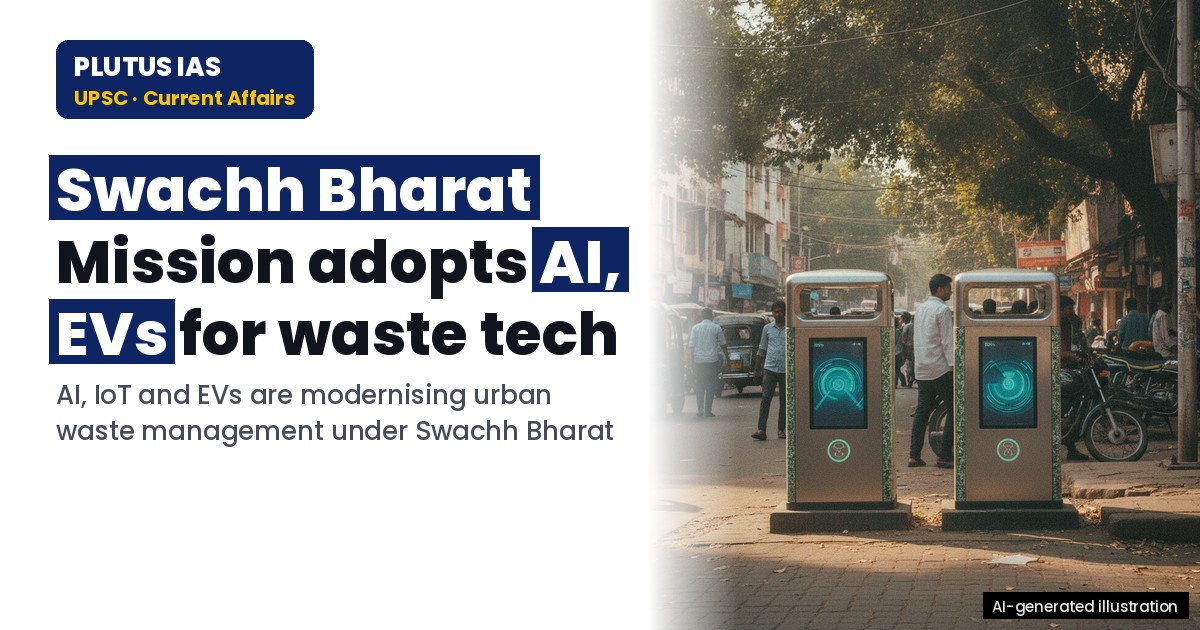
01 Oct AI & EVs: Tech Revolution in Swachh Bharat Mission
✎ Swachh Bharat Mission 2.0 leverages AI, IoT, EVs, and blockchain to transform urban sanitation through data-driven governance, real-time monitoring, and sustainable infrastructure.
Subject Relevance — Where This Topic Fits
- GS Paper II — Governance, Transparency and Accountability | GS Paper III — Science and Technology, Environment and Urbanisation | GS Paper IV — Ethics and Governance
- Prelims: Swachh Bharat Mission 2.0, Smart Cities Mission, AI in public service delivery, IoT-enabled waste management, Electric Vehicle (EV) fleets in municipal services, Plastic Waste Management Rules 2022, National Urban Sanitation Policy, Digital India initiatives
- Essay: The Role of Technology in Achieving Sustainable Development Goals, Urbanisation and Governance: Balancing Efficiency with Inclusivity
Quick Revision: Swachh Bharat Mission 2.0 leverages AI, IoT, EVs, and blockchain to transform urban sanitation through data-driven governance, real-time monitoring, and sustainable infrastructure.
Why is this in the news?
The Government of India’s Swachh Bharat Mission 2.0 (SBM 2.0) has catalysed the adoption of advanced technological solutions—artificial intelligence (AI), the Internet of Things (IoT), and electric vehicles (EVs)—to enhance urban sanitation systems. Recent initiatives under SBM 2.0 underscore the integration of these technologies to improve waste collection, processing, and public health outcomes. This shift reflects a broader governance strategy to modernise municipal services while aligning with global sustainability targets.
Background
- The Swachh Bharat Mission (SBM), launched in 2014, aimed to achieve universal sanitation coverage and eliminate open defecation by 2019. SBM 2.0, launched in 2020, expanded the mandate to include sustainable solid waste management, plastic waste reduction, and behaviour change communication.
- Urban India generates approximately 62 million tonnes of municipal solid waste annually, with only about 75–80% collected and a fraction processed scientifically, highlighting inefficiencies in traditional waste management systems.
- The Smart Cities Mission (2015), a complementary initiative, prioritises the use of technology to enhance urban governance, including sanitation infrastructure.
- The National Urban Sanitation Policy (2008) and its subsequent revisions emphasise the need for data-driven decision-making and citizen participation in sanitation management.
- Global commitments such as the Sustainable Development Goals (SDG 6 and 11) and the Paris Agreement on climate change necessitate innovative approaches to urban sanitation and waste management.
- India’s EV policy (2023–2030) and the Faster Adoption and Manufacturing of Hybrid and Electric Vehicles (FAME) scheme provide fiscal and regulatory support for electric fleets in municipal services.
Technological Innovations in Urban Sanitation: Mechanisms and Applications
- Artificial Intelligence (AI) and Machine Learning (ML): AI-driven systems analyse waste generation patterns, optimise collection routes, and predict overflow in bins using real-time data from IoT sensors. These tools enhance operational efficiency and reduce costs by minimising fuel consumption and labour requirements.
- Internet of Things (IoT): IoT-enabled smart bins equipped with sensors monitor fill levels, detect contamination, and trigger automated alerts for waste collection vehicles. This reduces manual inspection and ensures timely servicing, particularly in high-density urban areas.
- Electric Vehicles (EVs) in Waste Management: Municipal corporations are increasingly deploying EVs for waste collection and transportation to reduce carbon emissions and operational costs. Cities like Delhi, Bengaluru, and Ahmedabad have integrated EV fleets under SBM 2.0, aligning with India’s net-zero commitments.
- Blockchain for Traceability: Blockchain technology is being piloted to track the lifecycle of waste from generation to disposal, ensuring compliance with waste segregation norms and reducing illegal dumping. This enhances transparency and accountability in waste management supply chains.
- Geospatial Mapping and GIS: Geographic Information Systems (GIS) are used to map waste generation hotspots, plan infrastructure, and monitor progress. This spatial data aids in designing targeted interventions and resource allocation for sanitation projects.
- Automated Segregation and Processing: AI-powered robotic systems at waste processing plants segregate recyclables from non-recyclables with high precision, improving recovery rates and reducing landfill dependency. These systems are particularly effective in handling mixed waste streams.
- Citizen Engagement Platforms: Digital platforms and mobile applications, such as the Swachh Bharat Mission’s ‘Swachhata App’, enable citizens to report sanitation issues, track grievances, and participate in cleanliness drives. This fosters a sense of ownership and collective responsibility.
- Data Analytics for Policy Formulation: Aggregated data from sanitation systems is analysed to identify trends, assess policy impacts, and design evidence-based interventions. This supports adaptive governance and continuous improvement in urban sanitation.
Key Features
| Feature | Significance |
|---|---|
| Artificial Intelligence (AI) in Waste Management | Enhances predictive analytics for waste generation patterns, optimises collection routes, and improves segregation efficiency through real-time monitoring systems. |
| Electric Vehicles (EVs) for Waste Collection | Reduces carbon emissions in urban logistics, lowers operational costs for municipal corporations, and aligns with India’s commitment to climate-resilient urban infrastructure under SDG 11. |
| Smart Dustbins with IoT Integration | Facilitates automated waste level detection, triggers timely collection alerts, and supports data-driven decision-making for urban local bodies (ULBs). |
| AI-Powered Segregation Robots | Augments manual segregation processes, reduces human exposure to hazardous waste, and improves recycling rates through precision sorting. |
| Blockchain for Waste Traceability | Ensures transparent tracking of waste from generation to disposal, combats illegal dumping, and strengthens compliance with the Solid Waste Management Rules, 2016. |
| Geospatial Mapping for Landfill Management | Provides spatial data on landfill sites, monitors encroachments, and aids in the identification of suitable sites for new sanitary landfills. |
Why it Matters
Economic Impact
- Reduces municipal expenditure on waste management through operational efficiency gains from AI and IoT integration.
- Creates high-skilled employment opportunities in AI, robotics, and data analytics sectors linked to smart urban infrastructure.
- Lowers healthcare costs by mitigating vector-borne diseases associated with unmanaged urban waste.
Environmental Sustainability
- Minimises greenhouse gas emissions from waste decomposition through efficient segregation and recycling.
- Reduces landfill pressure by promoting circular economy principles in waste management.
- Supports India’s Nationally Determined Contributions (NDCs) under the Paris Agreement.
Urban Governance and Service Delivery
- Enhances transparency and accountability in waste management through digital tracking and public dashboards.
- Strengthens compliance with the Swachh Bharat Mission 2.0 and the Solid Waste Management Rules, 2016.
- Improves citizen participation via real-time feedback mechanisms and grievance redressal systems.
Technological Sovereignty
- Fosters indigenous development of AI and IoT solutions tailored to India’s urban waste challenges.
- Reduces dependence on imported waste management technologies, aligning with the ‘Atmanirbhar Bharat’ vision.
Challenges
1. High Initial Capital Investment
- Significant upfront costs for deploying AI, IoT, and EV infrastructure in municipal waste systems.
- Limited fiscal space in ULBs to finance large-scale technological upgrades without central or state subsidies.
UPSC Link: GS3: Infrastructure financing
2. Digital Divide and Skill Gaps
- Uneven access to digital infrastructure across urban and rural areas hinders uniform adoption of smart waste solutions.
- Shortage of skilled personnel in ULBs to operate, maintain, and troubleshoot advanced waste management technologies.
UPSC Link: GS2: E-governance challenges
3. Data Privacy and Security Concerns
- Risk of data breaches in IoT-enabled waste systems, particularly in geospatial and blockchain applications.
- Need for robust cybersecurity frameworks to protect citizen data collected through smart waste initiatives.
UPSC Link: GS3: Cybersecurity
4. Regulatory and Compliance Bottlenecks
- Fragmented regulatory landscape across states leads to inconsistent enforcement of waste management rules.
- Lack of standardised protocols for integrating AI and IoT solutions with existing municipal waste frameworks.
UPSC Link: GS2: Federalism
5. Public Acceptance and Behavioural Resistance
- Citizen apathy towards segregation at source undermines the efficacy of AI-driven waste systems.
- Resistance to adoption of new technologies due to lack of awareness and trust in automated systems.
UPSC Link: GS4: Ethics in governance
6. Logistical and Infrastructure Constraints
- Inadequate charging infrastructure for EVs in waste collection fleets limits scalability.
- Poor road conditions and traffic congestion in urban areas hinder efficient deployment of smart waste systems.
UPSC Link: GS3: Urban infrastructure
Challenges — UPSC Perspective
| Issue | Concern |
|---|---|
| Capital Expenditure | High upfront costs deter ULBs from adopting advanced technologies. |
| Digital Literacy | Low awareness among municipal staff and citizens impedes effective utilisation of smart systems. |
| Data Governance | Absence of clear data-sharing policies risks misuse of citizen information. |
| Interoperability | Lack of standardised APIs hinders integration of AI/IoT solutions across ULBs. |
| Public Participation | Low community engagement reduces the effectiveness of technology-driven waste initiatives. |
| Policy Coherence | Divergent state-level regulations create compliance challenges for national-level smart waste programmes. |
Government Initiatives — Must-Memorise for Prelims
- Swachh Bharat Mission 2.0 (Urban)
- Solid Waste Management Rules, 2016
- National Urban Digital Mission (NUDM)
- Fame India Scheme Phase II (for EV adoption in municipal fleets)
- Atal Mission for Rejuvenation and Urban Transformation (AMRUT) 2.0
Way Forward
- Establish a National Smart Waste Management Mission to coordinate AI/IoT adoption across ULBs with centralised funding and technical support.
- Develop a standardised framework for data governance, including cybersecurity protocols and citizen data protection measures.
- Launch capacity-building programmes for municipal staff to enhance digital literacy and operational skills in smart waste systems.
- Incentivise public-private partnerships (PPPs) for financing and deploying EV fleets and AI-driven waste segregation units in cities.
- Create a national dashboard for real-time monitoring of waste management metrics, linked to Swachh Bharat Mission 2.0 indicators.
- Promote R&D in indigenous AI and IoT solutions through grants and incubators under the Atal Innovation Mission.
- Enforce source segregation mandates with strict penalties and public awareness campaigns to improve behavioural compliance.
- Integrate geospatial mapping with urban planning to identify optimal locations for sanitary landfills and waste-to-energy plants.
UPSC Value Addition
Keywords for Mains Answer-Writing
Urban Swachhata Mission · Smart Cities Mission · Swachh Bharat Mission 2.0 · Artificial Intelligence in governance · Internet of Things (IoT) for waste management · E-vehicles in municipal services · Data-driven urban governance · Sustainable Development Goal 11 · Circular economy in waste management · Digital Public Infrastructure · Ministry of Housing and Urban Affairs · Swachhata Hi Seva 2026 · Smart Waste Management Systems · Urban Local Bodies (ULBs) · Technology-enabled public service delivery
Constitutional & Policy Linkages
- Article 48A: Directive Principle of State Policy on environmental protection and improvement.
- Article 51A(g): Fundamental Duty to protect and improve the natural environment.
Concept Flow
Urbanisation and population growth → Increased waste generation → Inefficient manual waste management → Introduction of AI/IoT/EV technologies → Optimisation of collection, segregation, and disposal → Reduction in landfill pressure and emissions → Compliance with SDG 11 and Swachh Bharat Mission 2.0 → Enhanced urban governance and citizen participation → Sustainable and resilient urban ecosystems.
Prelims Practice Questions
Q1. Consider the following statements regarding the Swachh Bharat Mission 2.0 (Urban):
1. It is implemented by the Ministry of Housing and Urban Affairs.
2. The mission includes a component for promoting the use of electric vehicles in waste collection.
3. The mission mandates the use of Artificial Intelligence for real-time monitoring of cleanliness.
4. The mission is aligned with Sustainable Development Goal 6 (Clean Water and Sanitation).
How many of the above statements are correct?
- Only one
- Only two
- Only three
- All four
Answer: Only three — Statements 1 and 2 are correct. Statement 3 is incorrect as AI is encouraged but not mandated for real-time monitoring. Statement 4 is incorrect as SDG 6 pertains to water and sanitation, whereas Swachh Bharat Mission 2.0 aligns with SDG 11 (Sustainable Cities and Communities).
Q2. Assertion (A): The Smart Cities Mission in India integrates digital technologies to enhance urban governance and service delivery.
Reason (R): The mission prioritises the use of electric vehicles for waste collection and public transport to reduce carbon emissions.
Options:
A. Both A and R are true, and R is the correct explanation of A.
B. Both A and R are true, but R is not the correct explanation of A.
C. A is true, but R is false.
D. A is false, but R is true.
Answer: ? — Both A and R are true. The Smart Cities Mission does integrate digital technologies for governance, and electric vehicles are prioritised for waste collection and public transport to reduce emissions. However, R is not the sole explanation for A, as the mission also includes other digital interventions.
Q3. Match the following initiatives with their respective ministries/departments:
Column I (Initiative) Column II (Ministry/Department)
1. Swachh Bharat Mission 2.0 A. Ministry of Electronics and Information Technology
2. Smart Cities Mission B. Ministry of Housing and Urban Affairs
3. Digital India Mission C. Ministry of Environment, Forest and Climate Change
4. National Clean Air Programme D. Ministry of Skill Development and Entrepreneurship
Options:
A. 1-B, 2-C, 3-A, 4-D
B. 1-B, 2-A, 3-D, 4-C
C. 1-C, 2-B, 3-A, 4-D
D. 1-B, 2-B, 3-A, 4-C
- A
- B
- C
- D
Answer: D — 1-B (Swachh Bharat Mission 2.0 is under Ministry of Housing and Urban Affairs), 2-B (Smart Cities Mission is also under Ministry of Housing and Urban Affairs), 3-A (Digital India Mission is under Ministry of Electronics and Information Technology), 4-C (National Clean Air Programme is under Ministry of Environment, Forest and Climate Change).
Mains Practice Question
✍ Critically examine the role of technology in transforming urban sanitation in India, with particular reference to the Swachh Bharat Mission 2.0 and the Smart Cities Mission. How far has the integration of Artificial Intelligence, Internet of Things (IoT), and electric vehicles in waste management systems contributed to achieving the objectives of these missions? (15 Marks)
Approach: MODEL-ANSWER SKELETON:
1. **Introduction (2 marks)**: Define urban sanitation and its significance in the context of Sustainable Development Goal 11 (Sustainable Cities and Communities). Briefly introduce the Swachh Bharat Mission 2.0 and the Smart Cities Mission as flagship programmes aimed at transforming urban governance through technology.
2. **Technological Interventions in Urban Sanitation (5 marks)**:
– **Artificial Intelligence (AI)**: Discuss AI-driven solutions for real-time monitoring of cleanliness, predictive analytics for waste generation, and automated segregation of waste. Cite examples such as AI-based surveillance systems in cities like Surat and Indore.
– **Internet of Things (IoT)**: Explain IoT-enabled smart bins, GPS-tracked waste collection vehicles, and IoT sensors for monitoring air quality and odour levels. Highlight the role of IoT in enhancing the efficiency of Urban Local Bodies (ULBs).
– **Electric Vehicles (EVs)**: Discuss the integration of electric vehicles in waste collection and public transport to reduce carbon emissions and improve air quality. Cite the use of EVs in cities like Bengaluru and Pune.
3. **Contribution to Mission Objectives (4 marks)**:
– **Swachh Bharat Mission 2.0**: Assess how these technologies have contributed to the mission’s goals of 100% door-to-door waste collection, scientific processing of waste, and reduction in open defecation. Discuss the role of technology in achieving the Open Defecation Free (ODF) + status.
– **Smart Cities Mission**: Evaluate how digital technologies have enhanced urban governance, citizen participation, and service delivery. Discuss the role of technology in creating ‘smart’ waste management systems that are efficient, transparent, and sustainable.
4. **Challenges and Limitations (3 marks)**:
– Highlight challenges such as high initial costs, digital divide, data privacy concerns, and the need for skilled manpower to operate and maintain these technologies.
– Discuss the issue of last-mile connectivity and the role of ULBs in ensuring equitable access to these technologies.
5. **Conclusion (1 mark)**: Summarise the transformative potential of technology in urban sanitation while acknowledging the need for a balanced approach that integrates technology with traditional methods and community participation.
Source: PIB (Press Information Bureau)
Generated by AanyaAi for educational purpose.
Related guides on our sites
- Anthropology VS PSIR
- Best PSIR optional coaching
- Best PSIR optional coaching online
- Best PSIR optional teacher

- AI & EVs: Tech Revolution in Swachh Bharat Mission - October 1, 2026
- स्विट्जरलैंड के राष्ट्रपति का भारत दौरा: प्रमुख समझौते और रिश्ते मजबूत - October 1, 2026
- Chhattisgarh’s Developed Gram Panchayat Scheme: Key for UPSC & State PCS - October 1, 2026

No Comments