


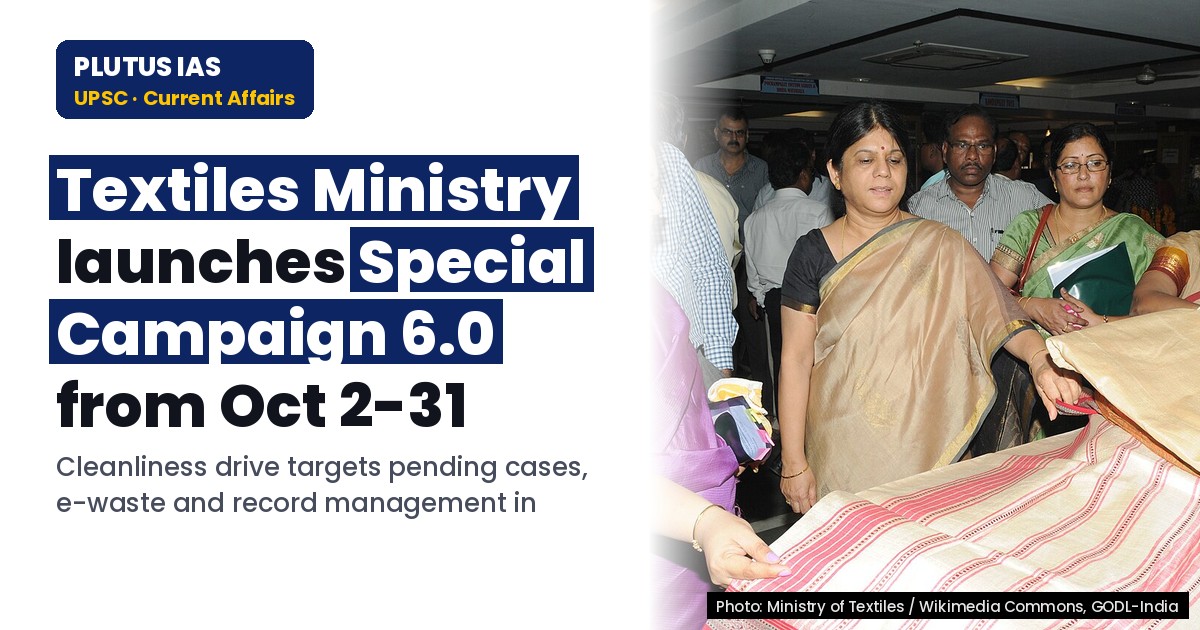
02 Oct वस्त्र मंत्रालय द्वारा विशेष अभियान-6.0: 2-31 अक्टूबर तक प्रमुख लक्ष्य
✎ Special Campaign 6.0 by the Ministry of Textiles (2–31 Oct 2026) focuses on sanitation, pending matter disposal, e-waste management, and record digitisation under India’s broader governance and environmental sustainability agenda.
Subject Relevance — Where This Topic Fits
- GS Paper II — Governance, Transparency and Accountability | GS Paper III — Environment and Sustainable Development
- Prelims: Special Campaign 6.0, E-waste Management, Citizen Grievances, Parliamentary Assurances, Digital Records Management, Swachh Bharat Mission
- Essay: Administrative Reforms and Governance Efficiency, Sustainable Development and Environmental Stewardship
Quick Revision: Special Campaign 6.0 by the Ministry of Textiles (2–31 Oct 2026) focuses on sanitation, pending matter disposal, e-waste management, and record digitisation under India’s broader governance and environmental sustainability agenda.
Why is this in the news?
The Ministry of Textiles has announced the conduct of Special Campaign 6.0 from 2 October to 31 October 2026 across its organisations, subordinate offices, and Public Sector Undertakings. The campaign prioritises sanitation enhancement, disposal of pending matters, efficient record management, and systematic collection, segregation, and disposal of e-waste, reflecting the government’s commitment to administrative efficiency and environmental sustainability.
Background
- Each campaign focuses on time-bound disposal of pending matters, reduction of physical files, and improvement in record management across ministries and departments.
- The Ministry of Textiles, through its subordinate offices and PSUs, manages a significant volume of administrative and operational records, necessitating robust record-keeping and disposal mechanisms.
What is Special Campaign 6.0?
- Special Campaign 6.0 is a month-long initiative launched by the Ministry of Textiles to enhance administrative efficiency, sanitation, and environmental sustainability within its organisational ecosystem.
- The campaign targets the disposal of pending grievances, appeals, parliamentary references, and assurances, ensuring timely resolution of citizen and parliamentary concerns.
- A key focus area is the systematic collection, segregation, and disposal of e-waste, including obsolete electronic and electrical equipment such as personal computers, CPUs, and peripherals.
- The campaign aims to reduce the accumulation of physical and digital records by identifying and disposing of redundant files, thereby improving record management practices.
- Targeted sanitation activities are planned across 240 identified locations within the ministry’s organisational framework to promote cleanliness and hygiene.
- The campaign encourages coordinated efforts among the ministry, its subordinate offices, and PSUs to achieve its objectives in a unified manner.
Key Features
| Feature | Significance |
|---|---|
| Duration: 2–31 October 2026 | Provides a fixed, time-bound framework for systematic implementation across all subordinate units, ensuring accountability and measurable outcomes. |
| Targets for grievance redressal (57 public complaints, 13 appeals, 55 MP references, 26 assurances) | Demonstrates adherence to citizen-centric governance and parliamentary accountability within the administrative purview of the Ministry. |
| Physical and e-file rationalisation (12,519 physical + 6,941 e-files) | Promotes efficient record management, reduces storage costs, and enhances transparency in administrative processes. |
| E-waste management (720 items: PCs, CPUs, peripherals) | Aligns with environmental sustainability goals and formalises the disposal of obsolete electronic assets under statutory guidelines. |
| Focused sanitation drives at 240 sites | Reinforces institutional commitment to workplace hygiene and public health standards within government premises. |
Why it Matters
Administrative Efficiency
- Systematic disposal of physical and digital records reduces bureaucratic backlog and enhances decision-making agility.
- Centralised tracking of grievances and parliamentary references ensures timely compliance with statutory and constitutional obligations.
- Standardised e-waste protocols streamline asset lifecycle management in government IT infrastructure.
Environmental Governance
- Formalised e-waste collection and disposal mitigates hazardous material leakage into landfills, supporting SDG 12 (Responsible Consumption and Production).
- Adherence to EPR (Extended Producer Responsibility) principles for e-waste, as outlined in the E-Waste (Management) Rules, 2022.
- Reduces carbon footprint of government operations through efficient resource utilisation and waste minimisation.
Public Accountability
- Transparent grievance redressal mechanisms strengthen citizen trust in government responsiveness.
- Parliamentary assurances and references are addressed within a fixed timeline, reinforcing constitutional governance.
- Public participation in sanitation drives enhances civic engagement in institutional cleanliness.
Fiscal Prudence
- Rationalisation of records reduces storage expenditures and optimises office space utilisation.
- Efficient e-waste management prevents financial liabilities from non-compliance with environmental regulations.
- Cost savings from asset lifecycle optimisation can be reinvested in core developmental programmes.
Institutional Synergy
- Unified implementation across subordinate offices and PSUs ensures uniform standards and shared best practices.
- Cross-departmental coordination fosters a culture of continuous improvement in administrative processes.
- Alignment with national missions such as Swachh Bharat Abhiyan and Digital India through tangible actions.
Challenges
1. Resource Constraints in E-Waste Disposal
- Limited authorised e-waste processing facilities may lead to delays in disposal for remote or underserved units.
- Ensuring certified dismantlers and recyclers are accessible across all geographic jurisdictions of the Ministry’s operations.
- Training staff in hazardous material handling to prevent occupational safety risks during collection and segregation.
UPSC Link: GS3: Environmental Pollution & Degradation
2. Digital Divide in Record Digitisation
- Incomplete digitisation of legacy records may hinder seamless transition to e-file systems.
- Resistance to change among staff accustomed to traditional filing methods could slow adoption rates.
- Cybersecurity risks associated with transitioning sensitive physical records to digital formats.
UPSC Link: GS2: Governance & e-Governance
3. Grievance Redressal Backlog
- Historical accumulation of unresolved complaints may require prioritisation frameworks to avoid overload.
- Ensuring inter-departmental coordination for complaints spanning multiple jurisdictions or agencies.
- Maintaining transparency in redressal timelines without compromising the quality of responses.
UPSC Link: GS2: Citizen Charter & Grievance Redressal
4. Sustainability of Sanitation Drives
- Ensuring long-term maintenance of cleanliness beyond the campaign period requires institutionalisation of habits.
- Balancing resource allocation for sanitation with other competing developmental priorities within budget constraints.
- Monitoring and evaluation mechanisms to assess the impact of sanitation activities on workplace health outcomes.
UPSC Link: GS2: Health & Sanitation
5. Stakeholder Engagement
- Coordinating with external agencies (e.g., municipal bodies, NGOs) for e-waste collection and disposal logistics.
- Public awareness campaigns to encourage voluntary participation in sanitation and e-waste segregation.
- Addressing scepticism or resistance from staff unions regarding additional workload during the campaign.
UPSC Link: GS4: Ethics & Human Interface
Challenges — UPSC Perspective
| Issue | Concern |
|---|---|
| Limited authorised e-waste processors | Potential delays in disposal and risk of unauthorised dumping. |
| Legacy record digitisation gaps | Hindrance to seamless transition to e-governance and increased storage costs. |
| Historical grievance backlog | Risk of incomplete redressal within campaign timelines, eroding public trust. |
| Staff resistance to digitisation | Slower adoption of e-files, undermining efficiency gains. |
| Inter-departmental coordination gaps | Fragmented implementation leading to inconsistent outcomes across units. |
| Sustainability of sanitation efforts | Risk of relapse into poor hygiene practices post-campaign conclusion. |
Way Forward
- Constitute cross-functional teams at each subordinate office to monitor progress against campaign milestones.
- Leverage GIS mapping to identify authorised e-waste processors and allocate disposal routes based on proximity.
- Launch mandatory training modules for staff on e-waste segregation, hazardous material handling, and digital record management.
- Implement a real-time dashboard for grievance redressal to track status, escalate bottlenecks, and ensure transparency.
- Partner with municipal corporations and NGOs to organise community sanitation drives and e-waste collection camps.
- Institutionalise quarterly audits of physical and e-files to prevent recurrence of accumulation and ensure compliance.
- Develop a rewards-and-recognition mechanism for units demonstrating exemplary performance in campaign objectives.
- Document best practices and lessons learned to inform future editions of the campaign across other ministries.
UPSC Value Addition
Keywords for Mains Answer-Writing
Special Campaign 6.0 · Ministry of Textiles · E-waste Management · Swachhata Abhiyan · Record Management · Government of India initiatives · Public Sector Undertakings · Parliamentary Assurances · Citizen Grievances · Sustainable Development Goals · Environmental Governance · Administrative Reforms · Digital Records · Electronic Waste Disposal · Institutional Efficiency
Constitutional & Policy Linkages
- {‘article’: ‘Article 51A(g)’, ‘note’: ‘Fundamental Duty to protect environment’}
- {‘article’: ‘Article 21’, ‘note’: ‘Right to clean environment’}
- {‘article’: ‘Article 48A’, ‘note’: ‘Directive Principle on environment protection’}
Concept Flow
Government operations generate physical records, e-files, and obsolete electronic assets. → Accumulation of these items leads to administrative inefficiency, storage costs, and environmental hazards. → Ministry launches Special Campaign 6.0 to rationalise records, dispose of e-waste, and improve sanitation. → Systematic identification, segregation, and disposal of records and e-waste enhance governance efficiency. → Transparent grievance redressal and parliamentary accountability reinforce public trust in institutions. → Environmentally responsible disposal of e-waste aligns with constitutional duties and SDGs. → Sustained institutionalisation of these practices ensures long-term administrative and environmental sustainability.
Prelims Practice Questions
Q1. Consider the following statements regarding Special Campaign 6.0 launched by the Ministry of Textiles:
1. The campaign aims to dispose of 12,519 physical files and 6,941 e-files.
2. It includes the systematic collection and disposal of 720 units of e-waste.
3. The campaign focuses exclusively on the disposal of personal computers and CPUs.
How many of the above statements are correct?
- Only one
- Only two
- All three
- None
Answer: Only two — Statement 1 is incorrect as the campaign aims to dispose of 12,519 physical files and 6,941 e-files to reduce record accumulation, not to dispose of them entirely. Statement 2 is correct as the campaign targets the disposal of 720 units of e-waste. Statement 3 is incorrect as the campaign includes a broader range of electronic and electrical equipment beyond personal computers and CPUs.
Q2. Assertion (A): Special Campaign 6.0 by the Ministry of Textiles includes the disposal of e-waste in accordance with environmentally responsible guidelines.
Reason (R): The campaign prioritizes the systematic collection, segregation, and disposal of e-waste to minimize environmental pollution.
Options:
A. Both A and R are true, and R is the correct explanation of A.
B. Both A and R are true, but R is not the correct explanation of A.
C. A is true, but R is false.
D. A is false, but R is true.
- A
- B
- C
- D
Answer: A — Both Assertion (A) and Reason (R) are true. The campaign explicitly aims to dispose of e-waste in an environmentally responsible manner, and Reason (R) correctly explains this objective.
Q3. Match the following objectives of Special Campaign 6.0 with their respective targets:
Column I (Objective) | Column II (Target)
———————|——————-
A. Disposal of physical files | 1. 240 sites
B. Disposal of e-files | 2. 12,519 files
C. E-waste disposal | 3. 6,941 files
D. Focused cleanliness activities | 4. 720 units
Options:
A. A-2, B-3, C-4, D-1
B. A-3, B-2, C-1, D-4
C. A-1, B-4, C-2, D-3
D. A-4, B-1, C-3, D-2
- A
- B
- C
- D
Answer: A — The correct matching is: A (Disposal of physical files) – 2 (12,519 files), B (Disposal of e-files) – 3 (6,941 files), C (E-waste disposal) – 4 (720 units), D (Focused cleanliness activities) – 1 (240 sites).
Mains Practice Question
✍ Critically examine the significance of Special Campaign 6.0 launched by the Ministry of Textiles in the context of administrative reforms and environmental governance in India. Also, analyse how such campaigns contribute to the realization of Sustainable Development Goals (SDGs). (15 Marks)
Approach: MODEL-ANSWER SKELETON:
1. Introduction (1 mark): Define Special Campaign 6.0 and its objectives as a governance initiative.
2. Administrative Reforms (4 marks):
– Discuss the campaign’s focus on record management (physical and e-files) and disposal of redundant records (12,519 physical files, 6,941 e-files).
– Highlight the disposal of 720 units of e-waste and the systematic segregation process.
– Mention the resolution of pending grievances (57), appeals (13), MP references (55), and parliamentary assurances (26) as indicators of administrative efficiency.
– Reference the identification of 240 sites for focused cleanliness activities.
3. Environmental Governance (4 marks):
– Explain the campaign’s alignment with the E-Waste (Management) Rules, 2022, and the National Environment Policy.
– Discuss the environmental benefits of systematic e-waste disposal, including reduction in landfill burden and pollution.
– Link the campaign to India’s commitments under SDG 12 (Responsible Consumption and Production) and SDG 13 (Climate Action).
4. Challenges and Limitations (3 marks):
– Acknowledge potential challenges such as resistance to change, logistical hurdles in e-waste disposal, and the need for continuous monitoring.
– Discuss the scalability of such campaigns across other ministries and the role of public awareness.
5. Conclusion (3 marks):
– Summarize the campaign’s role in enhancing institutional efficiency and environmental sustainability.
– Emphasize the need for long-term institutionalization of such initiatives to ensure sustained impact.
Source: PIB (Press Information Bureau)
Generated by AanyaAi for educational purpose.
Related guides on our sites
- Anthropology VS PSIR
- Best PSIR optional coaching
- Best PSIR optional coaching online
- Best PSIR optional teacher


No Comments