


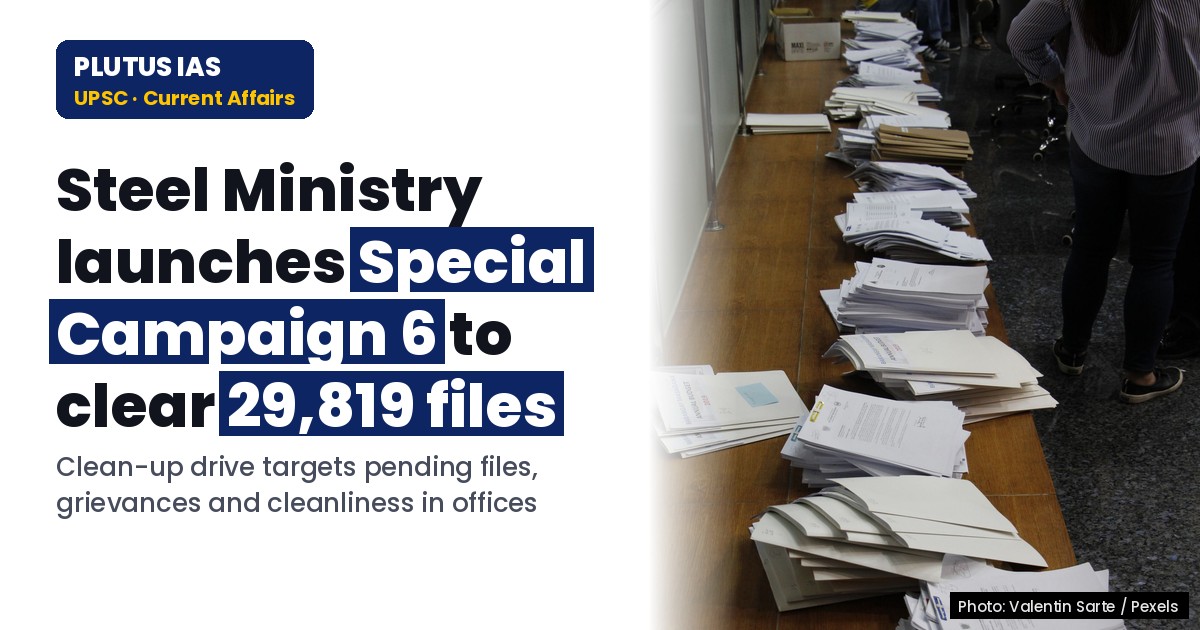
02 Oct Steel Ministry Launches Special Campaign 6 for Pending Cases
✎ SCDPM is a government-wide campaign to reduce pendency in files, grievances, and references through time-bound disposal, improved record management, and e-governance integration.
Subject Relevance — Where This Topic Fits
- GS Paper II — Governance, Transparency and Accountability | GS Paper III — Industrial Policy and Public Sector Enterprises
- Prelims: Special Campaign for Disposal of Pending Matters (SCDPM), Central Public Sector Enterprises (CPSEs), Ministry of Steel, E-governance initiatives, Record management in government, Citizen grievance redressal, Time-bound disposal of references
- Essay: The role of administrative reforms in enhancing governance efficiency, Technology and transparency in public service delivery
Quick Revision: SCDPM is a government-wide campaign to reduce pendency in files, grievances, and references through time-bound disposal, improved record management, and e-governance integration.
Why is this in the news?
The Ministry of Steel has initiated Special Campaign for Disposal of Pending Matters (SCDPM) 6, a time-bound governance initiative aimed at reducing the backlog of pending files, grievances, and references across its Central Public Sector Enterprises (CPSEs). Scheduled from 2 October to 31 October 2026, this campaign follows a preparatory phase and aligns with broader national efforts to improve administrative efficiency, transparency, and citizen-centric service delivery in the public sector.
Background
- The Union Government has been implementing Special Campaigns for Disposal of Pending Matters (SCDPM) since 2022 to address the accumulation of pending files and grievances in government ministries and departments.
- These campaigns are part of a broader governance reform agenda aimed at reducing pendency, improving record management, and enhancing the ease of doing business in the public sector.
- The Ministry of Steel, through its CPSEs such as SAIL, NMDC, and RINL, plays a pivotal role in India’s industrial ecosystem, particularly in the production and distribution of steel, a critical input for infrastructure and manufacturing sectors.
- Pending matters in government offices often include references from Members of Parliament, the Prime Minister’s Office, Cabinet Secretariat, state governments, and citizen grievances, which require timely resolution to ensure policy coherence and public accountability.
- E-governance initiatives, including digital record management and online grievance redressal systems, have been progressively integrated into government workflows to streamline processes and reduce delays.
What is the Special Campaign for Disposal of Pending Matters (SCDPM)?
- SCDPM is a government-wide initiative launched in 2022 to address the backlog of pending files, grievances, and references in ministries and departments through a time-bound, mission-mode approach.
- The campaign operates in phases, with a preparatory phase for capacity building, target setting, and resource allocation, followed by an implementation phase for actual disposal of pending matters.
- SCDPM 6, launched by the Ministry of Steel, is the sixth iteration of this campaign and focuses on reducing pendency in the steel sector, including CPSEs under the ministry.
- Key activities under SCDPM include the physical and digital disposal of files, resolution of citizen grievances, and improvement of record management and office cleanliness.
- The campaign emphasizes the disposal of references received from constitutional bodies such as the Parliament, Cabinet Secretariat, and state governments, ensuring policy coherence and inter-governmental coordination.
- The initiative leverages e-governance tools, such as digital file tracking systems and online grievance portals, to enhance efficiency and reduce delays in administrative processes.
- SCDPM also includes awareness campaigns to promote cleanliness, proper record-keeping, and efficient use of office space, fostering a culture of discipline and productivity in government offices.
Key Features
| Feature | Significance |
|---|---|
| Special Campaign for Disposal of Pending Matters (SCDPM) 6 | A time-bound, structured initiative to reduce pendency in the Ministry of Steel and its CPSEs, ensuring efficient governance and service delivery. |
| Preparation Phase (15–30 Sep 2026) | Involved setting targets, resource allocation, and groundwork for the implementation phase, aligning with the broader government mandate for pendency reduction. |
| Implementation Phase (2–31 Oct 2026) | Focuses on physical and digital file disposal, grievance redressal, and office cleanliness, directly addressing administrative efficiency. |
| Physical and E-File Disposal (20,763 + 9,056 files) | Systematic reduction of backlog to improve decision-making speed and transparency in public service delivery. |
| Grievance Redressal (37 pending complaints) | Ensures timely resolution of citizen grievances, enhancing public trust and accountability in governance. |
Why it Matters
Administrative Efficiency
- Reduces bureaucratic delays by systematically disposing of pending files and grievances, aligning with the government’s broader push for ‘Minimum Government, Maximum Governance’.
- Promotes digital transformation through e-file disposal, reducing reliance on physical records and improving accessibility.
- Enhances transparency by ensuring timely resolution of references from MPs, PMO, and state governments.
Public Service Delivery
- Improves citizen experience by reducing pendency in grievance redressal, a critical component of responsive governance.
- Facilitates faster decision-making in the steel sector, which is vital for industrial growth and economic stability.
- Encourages a culture of accountability and efficiency within government offices.
Policy and Governance
- Demonstrates the government’s commitment to reducing administrative backlog, a key aspect of governance reform.
- Aligns with the ‘Mission Karmayogi’ framework for civil service capacity-building and performance management.
- Supports the ‘Digital India’ initiative by prioritizing e-governance and paperless administration.
Economic Impact
- Timely disposal of pending matters in CPSEs (e.g., SAIL, NMDC) can accelerate project approvals, enhancing sectoral productivity.
- Reduces litigation risks and financial costs associated with prolonged pendency in public sector undertakings.
Challenges
1. Data Integrity and Tracking
- Ensuring accurate tracking of disposed files and grievances to prevent misreporting or duplication.
- Upsc_link
- https://www.upsc.gov.in/official-documentation
UPSC Link: https://www.upsc.gov.in/official-documentation
2. Resource Constraints
- Limited manpower and infrastructure in certain offices may hinder the pace of disposal activities.
- Upsc_link
- https://www.upsc.gov.in/official-documentation
UPSC Link: https://www.upsc.gov.in/official-documentation
3. Digital Divide and E-File Adoption
- Resistance to digital transformation in some offices may slow the disposal of e-files, especially in remote or under-resourced units.
- Upsc_link
- https://www.upsc.gov.in/official-documentation
UPSC Link: https://www.upsc.gov.in/official-documentation
4. Stakeholder Coordination
- Coordinating with multiple stakeholders (e.g., state governments, PMO, MPs) to resolve references efficiently.
- Upsc_link
- https://www.upsc.gov.in/official-documentation
UPSC Link: https://www.upsc.gov.in/official-documentation
5. Sustainability of Outcomes
- Ensuring that the gains from SCDPM 6 are sustained beyond the campaign period, preventing backlog accumulation.
- Upsc_link
- https://www.upsc.gov.in/official-documentation
UPSC Link: https://www.upsc.gov.in/official-documentation
Challenges — UPSC Perspective
| Issue | Concern |
|---|---|
| Physical File Disposal | Risk of loss or misplacement of physical records during large-scale disposal. |
| E-File Adoption | Potential gaps in digital literacy among staff may delay e-file processing. |
| Grievance Redressal | Complex grievances may require multi-departmental coordination, slowing resolution. |
| Stakeholder References | Delays in responses from external agencies (e.g., state governments) may hinder timely disposal. |
| Monitoring and Evaluation | Ensuring real-time tracking of progress to avoid superficial compliance. |
| Sustainability | Preventing recurrence of pendency post-campaign through institutionalized reforms. |
Way Forward
- Establish a robust monitoring mechanism with weekly reviews to track progress and address bottlenecks.
- Conduct capacity-building workshops for officials on digital file management and grievance redressal.
- Integrate AI-driven tools for automatic tracking of pending files and grievances to enhance efficiency.
- Strengthen inter-departmental coordination to resolve references from external stakeholders promptly.
- Develop a standardized template for file disposal and grievance redressal to ensure uniformity across offices.
- Incentivize offices with the highest disposal rates to foster a competitive environment for efficiency.
- Publish quarterly reports on pendency reduction to maintain transparency and public accountability.
- Incorporate feedback from citizens and stakeholders to identify systemic issues in governance.
UPSC Value Addition
Keywords for Mains Answer-Writing
Special Campaign for Disposal of Pending Matters (SCDPM) · Ministry of Steel · Central Public Sector Enterprises (CPSEs) · Pending cases disposal · E-governance in administration · Swachhata Abhiyan in offices · Record management in governance · Time-bound disposal of grievances · Administrative reforms · Public grievance redressal mechanism
Concept Flow
Pendency in government offices → Delays in decision-making and service delivery → Reduced public trust and economic inefficiency → Government launches SCDPM 6 → Structured campaign with targets for file disposal and grievance redressal → Improved administrative efficiency and transparency → Enhanced public service delivery and sectoral productivity → Sustainable governance reforms through institutionalized monitoring.
Prelims Practice Questions
Q1. Consider the following statements regarding the Special Campaign for Disposal of Pending Matters (SCDPM):
1. SCDPM is a centrally sponsored scheme aimed at reducing pending cases in government offices.
2. The campaign includes both physical and e-file disposal activities.
3. The Ministry of Steel and its CPSEs are participating in SCDPM 6 during October 2026.
4. The campaign focuses solely on the disposal of physical files and does not address e-files.
How many of the above statements are correct?
- Only one
- Only two
- Only three
- All
Answer: Only three — Statements 2 and 3 are correct. Statement 1 is incorrect as SCDPM is not a centrally sponsored scheme but a government-wide initiative. Statement 4 is incorrect as the campaign addresses both physical and e-files.
Q2. Assertion (A): The Special Campaign for Disposal of Pending Matters (SCDPM) is designed to improve administrative efficiency by reducing pendency in government offices.
Reason (R): The campaign includes activities such as swachhata drives, file disposal, and grievance redressal to create a cleaner and more efficient working environment.
In the context of the above two statements, which one of the following is correct?
- Both A and R are true, and R is the correct explanation of A.
- Both A and R are true, but R is not the correct explanation of A.
- A is true but R is false.
- A is false but R is true.
Answer: Both A and R are true, and R is the correct explanation of A. — Both A and R are true, and R correctly explains A. The campaign’s activities are aimed at improving administrative efficiency by addressing pendency through multiple measures.
Q3. Which of the following is NOT a focus area of the Special Campaign for Disposal of Pending Matters (SCDPM) 6 as per the Ministry of Steel’s recent initiative?
- Disposal of physical and e-files
- Redressal of public grievances
- Conducting swachhata activities in offices
- Imposing penalties on officers for delays
Answer: Imposing penalties on officers for delays — The campaign focuses on disposal of files, redressal of grievances, and swachhata activities. Imposing penalties on officers is not mentioned as a focus area.
Mains Practice Question
✍ The Special Campaign for Disposal of Pending Matters (SCDPM) is a government-wide initiative aimed at reducing pendency in administrative offices. Critically examine the objectives, implementation strategies, and potential challenges associated with SCDPM in the context of governance reforms. (15 Marks)
Approach: MODEL-ANSWER SKELETON:
1. **Introduction (2 Marks)**: Define SCDPM as a reform initiative under the Department of Administrative Reforms and Public Grievances (DARPG) to reduce pendency in government offices. Mention its alignment with the broader agenda of ‘Minimum Government, Maximum Governance’.
2. **Objectives of SCDPM (3 Marks)**:
– Time-bound disposal of pending physical and e-files.
– Redressal of public grievances to achieve zero pendency.
– Creation of a cleaner, more efficient, and transparent working environment through swachhata drives and record management.
– Ensuring accountability and reducing delays in decision-making.
3. **Implementation Strategies (4 Marks)**:
– **Phased Approach**: Preparation phase (target setting, capacity building) followed by implementation phase (execution of activities).
– **Multi-Stakeholder Participation**: Involvement of ministries, CPSEs, and public grievance redressal mechanisms.
– **Digital Integration**: Emphasis on e-file disposal and use of digital platforms for grievance redressal.
– **Monitoring and Review**: Regular reviews by senior officials to track progress and address bottlenecks.
4. **Potential Challenges (4 Marks)**:
– **Resource Constraints**: Limited manpower and infrastructure in some offices.
– **Resistance to Change**: Bureaucratic inertia and reluctance to adopt digital processes.
– **Data Management Issues**: Ensuring accuracy and completeness of digital records.
– **Sustainability**: Maintaining momentum post-campaign to prevent recurrence of pendency.
5. **Conclusion (2 Marks)**: Highlight the significance of SCDPM in improving governance efficiency and suggest measures such as capacity building, digital transformation, and institutionalizing best practices for long-term impact.
Source: PIB (Press Information Bureau)
Generated by AanyaAi for educational purpose.
Related guides on our sites
- Anthropology VS PSIR
- Best PSIR optional coaching
- Best PSIR optional coaching online
- Best PSIR optional teacher


No Comments