


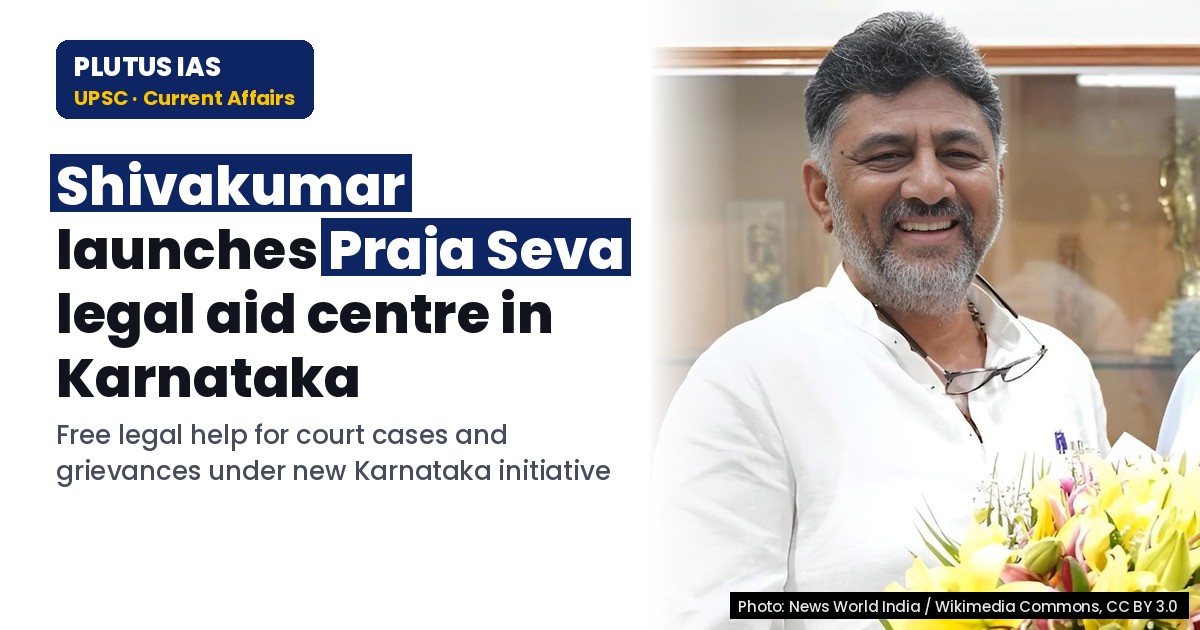
03 Oct Karnataka Launches Praja Seva Legal Aid Centre for Court Case Resolution
✎ The Praja Seva Legal Aid Centre in Karnataka exemplifies the integration of constitutional mandates (Legal Services Authorities Act, 1987) with administrative reforms to decentralise legal aid and grievance redressal, ensuring…
Subject Relevance — Where This Topic Fits
- GS Paper II — Governance, Administration and Challenges | GS Paper III — Issues relating to Development and Management of Social Sector/Services relating to Health, Education, Human Resources
- Prelims: Praja Seva Department, Legal Services Authorities Act, 1987, Legal Aid Clinics, Revenue Grievances, Pension Eligibility Criteria, Drought Relief Measures, Electoral Rolls Revision
- Essay: The Role of Governance in Addressing Citizen Grievances, Access to Justice and Social Equity
Quick Revision: The Praja Seva Legal Aid Centre in Karnataka exemplifies the integration of constitutional mandates (Legal Services Authorities Act, 1987) with administrative reforms to decentralise legal aid and grievance redressal, ensuring on-the-spot assistance for citizens while reducing pendency in disputes.
Why is this in the news?
The launch of a dedicated legal aid centre under Karnataka’s Praja Seva campaign marks a significant institutional intervention to enhance access to justice and expedite dispute resolution at the grassroots level. This initiative underscores the state government’s commitment to decentralised governance and citizen-centric service delivery, particularly in addressing legal and administrative grievances through on-the-spot assistance. The integration of legal aid representatives within public outreach programmes reflects a convergence of constitutional obligations under the Legal Services Authorities Act, 1987, with administrative reforms aimed at reducing pendency and improving governance outcomes.
Background
- The Legal Services Authorities Act, 1987, mandates the establishment of Legal Services Authorities at the national, state, and district levels to provide free legal aid to eligible individuals, ensuring access to justice under Articles 14, 15, and 21 of the Constitution.
- Public grievance redressal mechanisms, such as the Centralised Public Grievance Redress and Monitoring System (CPGRAMS) at the national level and state-specific portals like Karnataka’s ‘Seva Sindhu’, have been operationalised to streamline citizen complaints.
- Karnataka’s Praja Seva Department, launched on September 5, 2026, is a flagship governance initiative designed to decentralise administrative functions and resolve citizen grievances through direct outreach programmes, with over 620 programmes conducted and over 1 lakh applications received within a month.
- The National Legal Services Authority (NALSA) and State Legal Services Authorities (SLSA) function under the aegis of the Supreme Court and High Courts, respectively, to implement legal aid schemes, organise Lok Adalats, and conduct awareness programmes.
- Revenue, rural development, and urban development departments are among the most frequently grieved against due to overlapping land records, encroachment issues, and delayed clearances, necessitating on-site legal and administrative assistance.
What is the Praja Seva Legal Aid Centre?
- A dedicated legal aid centre established under Karnataka’s Praja Seva campaign to provide free legal assistance to citizens during public outreach programmes, ensuring on-the-spot guidance for legal grievances.
- The centre operates in tandem with government officials to address disputes related to revenue, rural development, urban development, and other administrative matters, leveraging the Legal Services Authorities Act, 1987.
- Legal aid representatives, including panel lawyers and paralegals, are deployed to assist citizens in drafting applications, filing petitions, and understanding legal rights, thereby reducing the burden on courts and expediting resolutions.
- The initiative aligns with the constitutional directive under Article 39A to provide free legal aid to the weaker sections of society, ensuring equity in access to justice.
- The Praja Seva Department functions as a nodal agency to receive, categorise, and prioritise grievances, with the Chief Minister personally reviewing the disposal of applications to ensure accountability and transparency.
- The model integrates administrative reforms with legal empowerment, enabling citizens to resolve disputes without recourse to prolonged litigation, particularly in cases involving land records, pension eligibility, and property disputes.
- The legal aid centre is part of a broader governance strategy to decentralise service delivery, moving beyond traditional complaint mechanisms to proactive, citizen-facing solutions.
- The initiative complements existing state-specific pension schemes by addressing legal barriers to entitlement delivery.
Key Features
| Feature | Significance |
|---|---|
| Praja Seva Legal Aid Centre | Provides free legal assistance to citizens during public outreach programmes, ensuring access to justice under Article 39A of the Constitution. |
| Praja Seva Department | Institutionalises a dedicated mechanism for grievance redressal and service delivery at the doorstep of citizens. |
| Revenue, Rural & Urban Development Focus | Addresses land, property, and infrastructure-related disputes, aligning with the Directive Principles of State Policy (DPSP) under Part IV. |
| Pension Eligibility Revision | Raises income threshold for pension eligibility from ₹32,000 to ₹1.20 lakh, expanding social security coverage for marginalised sections. |
| Drought Relief Measures | Includes ploughing assistance and tractor support under the Negilayogi scheme for 217 drought-affected taluks, ensuring agricultural resilience. |
UPSC Value Addition
Keywords for Mains Answer-Writing
Praja Seva initiative · Legal Services Authorities Act, 1987 · Access to Justice · Doorstep Governance · Gram Nyayalayas · Public Grievance Redressal · Legal Aid in India · Constitutional Right to Legal Aid · Article 39A of the Constitution · NITI Aayog’s Aspirational Districts Programme · Digital Governance Initiatives · Revenue Disputes Resolution · Pension Eligibility Criteria · Drought Relief Measures · Youth Empowerment Schemes
Prelims Practice Questions
Q1. Consider the following statements regarding the Legal Services Authorities Act, 1987:
1. It mandates the establishment of Lok Adalats at the district level.
2. The Act provides for free legal aid to weaker sections of society.
3. Gram Nyayalayas are established under this Act to adjudicate civil and criminal cases at the village level.
4. The Act empowers the Supreme Court to constitute a National Legal Services Authority (NALSA).
How many of the above statements are correct?
- Only one
- Only two
- Only three
- All four
Answer: All four — Statements 1, 2, and 4 are correct. Statement 3 is incorrect as Gram Nyayalayas are established under the Gram Nyayalayas Act, 2008, not the Legal Services Authorities Act, 1987.
Q2. Assertion (A): The Constitution of India guarantees the right to free legal aid under Article 39A.
Reason (R): Article 39A directs the State to ensure that the operation of the legal system promotes justice on a basis of equal opportunity.
Options:
A. Both A and R are true, and R is the correct explanation of A.
B. Both A and R are true, but R is not the correct explanation of A.
C. A is true, but R is false.
D. A is false, but R is true.
- A
- B
- C
- D
Answer: B — Both A and R are true. Article 39A explicitly guarantees the right to free legal aid, and the Reason correctly explains the constitutional basis for this right.
Q3. Match the following schemes with their respective objectives:
Column I (Scheme) | Column II (Objective)
— | —
1. Praja Seva (Karnataka) | A. Providing free legal aid and resolving grievances at the doorstep
2. NALSA | B. Ensuring justice on a basis of equal opportunity through legal aid
3. Gram Nyayalayas | C. Adjudicating civil and criminal cases at the village level
4. Aspirational Districts Programme | D. Transforming underdeveloped districts through focused interventions
Options:
A. 1-A, 2-B, 3-C, 4-D
B. 1-B, 2-A, 3-D, 4-C
C. 1-C, 2-D, 3-A, 4-B
D. 1-D, 2-C, 3-B, 4-A
- A
- B
- C
- D
Answer: A — The correct match is: 1-A (Praja Seva provides free legal aid and grievance redressal), 2-B (NALSA ensures equal opportunity in legal aid), 3-C (Gram Nyayalayas adjudicate at the village level), and 4-D (Aspirational Districts Programme focuses on underdeveloped districts).
Mains Practice Question
✍ The Praja Seva initiative in Karnataka exemplifies a modern approach to governance by integrating legal aid and grievance redressal at the grassroots level. Critically examine the constitutional and statutory framework that underpins such initiatives in India. Also, evaluate the challenges in ensuring effective access to justice through these mechanisms. (15 Marks)
Approach: MODEL-ANSWER SKELETON:
1. **Constitutional and Statutory Framework:**
– **Article 39A** of the Constitution: Directive Principle mandating free legal aid to ensure justice on an equal opportunity basis.
– **Legal Services Authorities Act, 1987**: Establishes National Legal Services Authority (NALSA), State Legal Services Authorities (SLSAs), and District Legal Services Authorities (DLSAs) to provide free legal aid.
– **Gram Nyayalayas Act, 2008**: Establishes village-level courts for speedy and affordable justice.
– **Doorstep Governance Models**: Initiatives like Praja Seva align with the principle of decentralised governance and participatory justice.
2. **Role of Praja Seva in Access to Justice:**
– Integration of legal aid representatives with government officials during outreach programmes.
– Focus on revenue, rural, and urban development disputes, addressing common grievances.
– Personal review mechanism by the Chief Minister to ensure accountability in grievance redressal.
3. **Challenges in Implementation:**
– **Awareness Gaps**: Limited awareness among marginalised communities about legal aid services.
– **Infrastructure Deficits**: Inadequate number of Gram Nyayalayas and DLSAs in remote areas.
– **Bureaucratic Delays**: Slow disposal of applications despite streamlined processes.
– **Resource Constraints**: Limited funding and human resources for legal aid services.
– **Digital Divide**: Exclusion of digitally illiterate populations from online legal aid platforms.
4. **Comparative Perspective:**
– **NITI Aayog’s Aspirational Districts Programme**: Focuses on holistic development but lacks a dedicated legal aid component.
– **State-Specific Models**: Examples like Telangana’s ‘Mee Seva’ and Odisha’s ‘Mo Sarkar’ highlight the need for tailored approaches.
5. **Way Forward:**
– Strengthening Gram Nyayalayas and DLSAs with adequate infrastructure and staff.
– Leveraging technology for digital legal aid platforms (e.g., e-Courts, tele-law services).
– Community-based legal literacy programmes to enhance awareness.
– Inter-departmental coordination to address systemic bottlenecks.
Balance of Views:
– Proponents argue that such initiatives democratise justice by bringing it closer to the people.
– Critics highlight persistent challenges in scalability, funding, and institutional capacity.
Source: The Hindu
Karnataka PCS (KPSC) — State PCS Practice
Prelims: Under which initiative did the Karnataka Chief Minister recently inaugurate a legal aid centre to help people resolve court cases?
- Praja Seva
- Nava Karnataka
- Karnataka One
- Arogya Karnataka
Answer: Praja Seva — The legal aid centre was inaugurated under the ‘Praja Seva’ initiative to provide accessible legal support to citizens.
Mains: Critically analyse the significance of the ‘Praja Seva’ initiative’s legal aid centre in Karnataka, highlighting its potential impact on judicial accessibility and socio-economic justice for the state’s marginalized communities.
Generated by AanyaAi for educational purpose.

- Karnataka Launches Praja Seva Legal Aid Centre for Court Case Resolution - October 3, 2026
- महाराष्ट्र में मानसून की असामयिक वापसी: 21 जिलों में बारिश की कमी - October 3, 2026
- Odisha launches new tourism portal to attract global investors - October 3, 2026

No Comments