


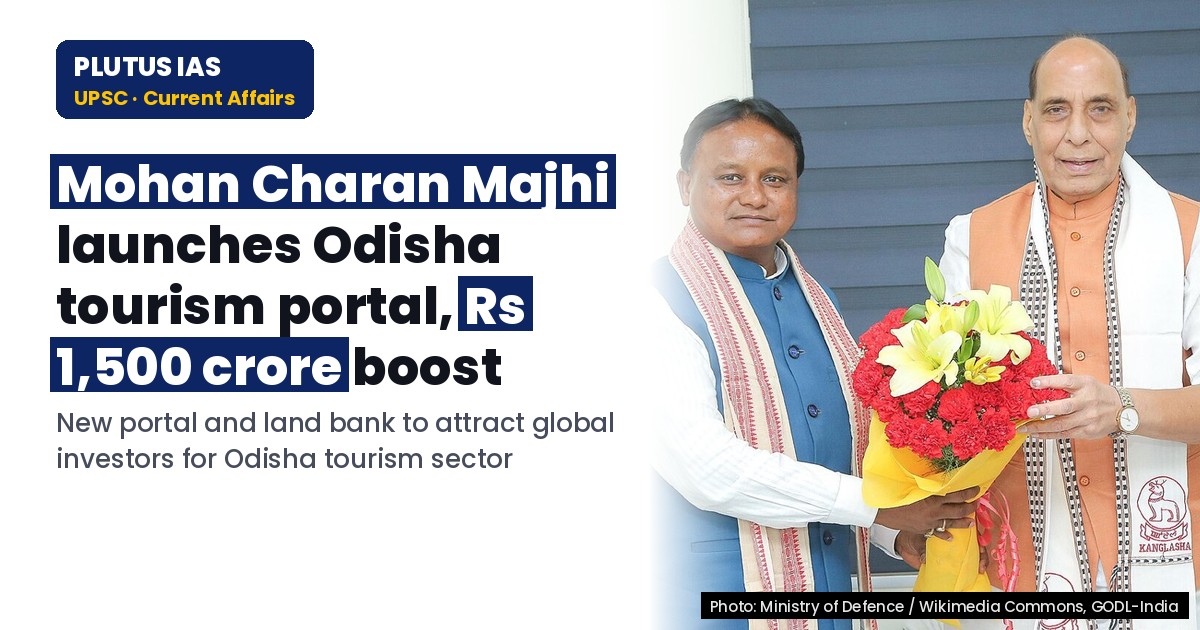
03 Oct Odisha launches new tourism portal to attract global investors
✎ The Odisha Tourism (Amendment) Policy, 2026, aims to transform Odisha into a global tourism hub by reducing regulatory barriers, increasing capital subsidies, and establishing a dedicated land bank for infrastructure development.
Subject Relevance — Where This Topic Fits
- GS Paper II — Government Policies and Interventions for Development in various sectors | GS Paper III — Infrastructure: Energy, Ports, Roads, Airports, Railways, Tourism
- Prelims: Tourism Policy, Public-Private Partnership (PPP), Land Bank Policy, Star Rating System for Hotels, Tourist Police, Deendayal Upadhyay Grameen Kaushalya Yojana (DUGKY), Atithi Devo Bhava, Swadesh Darshan Scheme, PRASAD Scheme
- Essay: The Role of Tourism in India’s Economic Development and Employment Generation, Balancing Economic Growth with Environmental and Cultural Preservation in Tourism
Quick Revision: The Odisha Tourism (Amendment) Policy, 2026, aims to transform Odisha into a global tourism hub by reducing regulatory barriers, increasing capital subsidies, and establishing a dedicated land bank for infrastructure development.
Why is this in the news?
The Government of Odisha has recently launched the ‘Odisha Tourism Investment Incentive Management System’ and a dedicated ‘Odisha Tourism Portal’ to streamline investment facilitation and promote the state as a global tourism destination. This initiative is accompanied by the ‘Odisha Tourism (Amendment) Policy, 2026’, which introduces regulatory relaxations, enhanced capital subsidies, and a dedicated land bank to accelerate infrastructure development in the tourism sector. The reforms aim to position tourism as a key pillar of economic progress and employment generation in Odisha.
Background
- Odisha possesses a 575-kilometre coastline, rich cultural heritage, architectural marvels such as the Jagannath Temple and Konark Sun Temple, and unique ecosystems like Bhitarkanika mangrove forests and Chilika Lake, which collectively form a strong foundation for tourism development.
- The state’s tourism sector has historically been underutilised despite its immense potential, with infrastructure and regulatory bottlenecks limiting growth and investment.
- The Government of India’s ‘Swadesh Darshan’ and ‘PRASAD’ schemes aim to develop theme-based and pilgrimage tourism circuits, respectively, providing a national framework for state-level tourism development.
- Odisha’s ‘Developed Odisha’ vision seeks to leverage its natural, cultural, and historical assets to drive economic growth, with tourism identified as a critical sector for job creation and sustainable development.
- The COVID-19 pandemic underscored the need for resilient and sustainable tourism models, prompting states to adopt innovative policies to revive and expand the sector.
- Odisha’s tourism policy reforms align with global trends in tourism governance, including the adoption of digital platforms for investment facilitation and the emphasis on safety and destination management.
What is the Odisha Tourism (Amendment) Policy, 2026?
- The Odisha Tourism (Amendment) Policy, 2026, is a legislative framework introduced to reform and streamline the state’s tourism sector by reducing regulatory barriers and enhancing incentives for investors.
- The policy introduces a ‘minimum room requirement’ reduction for star hotels from 50 to 10, thereby lowering the entry threshold for new hotel projects and encouraging smaller-scale investments in hospitality infrastructure.
- Capital subsidy limits have been significantly increased from ₹20 crore to ₹120 crore, providing greater financial support for tourism infrastructure development, including hotels, resorts, and recreational facilities.
- A dedicated land bank spanning 5,500 acres has been established to facilitate the allocation of land for tourism projects, reducing delays in land acquisition and project implementation.
- The policy mandates the deployment of Tourist Police and Destination Managers at 29 major tourist sites to enhance safety and visitor experience, aligning with global best practices in tourism governance.
- The ‘Odisha Tourism Investment Incentive Management System’ and the new ‘Odisha Tourism Portal’ have been launched as digital tools to streamline investment applications, project tracking, and approvals, improving ease of doing business in the sector.
- The policy emphasises sustainable tourism by promoting eco-friendly practices, cultural preservation, and community engagement, ensuring that tourism growth does not compromise environmental or social integrity.
- The reforms are designed to align with Odisha’s ‘Developed Odisha’ vision, positioning tourism as a key driver of economic growth, employment generation, and skill development in the state.
Key Features
| Feature | Significance |
|---|---|
| Odisha Tourism Investment Incentive Management System | A digital platform designed to streamline investor onboarding, regulatory clearances, and post-investment facilitation for tourism projects in Odisha. |
| Odisha Tourism Portal | A dedicated web portal providing real-time information on tourism policies, land availability, incentives, and project approvals to attract domestic and international investors. |
| Odisha Tourism (Amendment) Policy, 2026 | A revised policy framework that liberalises regulations for the hotel industry, enhances capital subsidies, and reduces bureaucratic hurdles to accelerate tourism infrastructure development. |
| Dedicated Land Bank (5,500 acres) | A pre-identified repository of land parcels earmarked for tourism projects, ensuring faster land acquisition and reducing project gestation periods. |
| Tourist Police and Destination Managers | Specialised security and management personnel deployed at 29 major tourist sites to enhance safety, visitor experience, and emergency response mechanisms. |
| Beach Lifeguard Initiative (1,000 lifeguards) | A coastal safety programme to mitigate drowning risks and improve emergency response along Odisha’s 575-km coastline, a critical component for sustainable beach tourism. |
Why it Matters
Economic Development
- Positioning tourism as a key pillar of Odisha’s economic growth, aligning with the state’s ‘Developed Odisha’ vision to diversify revenue streams beyond traditional sectors like mining and agriculture.
- Creation of employment opportunities across hospitality, construction, and allied services, with a focus on skill development and local entrepreneurship.
- Attraction of foreign direct investment (FDI) and domestic capital in high-impact projects such as resorts, eco-tourism hubs, and cultural heritage conservation.
- Enhanced revenue generation through tourism taxes, user fees, and multiplier effects in allied sectors like transport, handicrafts, and food processing.
Infrastructure Development
- Accelerated development of world-class tourism infrastructure, including hotels, resorts, and recreational facilities, to meet global standards and attract high-spending tourists.
- Improved connectivity and accessibility through targeted investments in roads, airports, and digital infrastructure to integrate remote and coastal destinations.
- Establishment of a land bank to reduce delays in land acquisition, a critical bottleneck in large-scale infrastructure projects.
- Integration of safety and sustainability measures, such as lifeguard stations and Tourist Police, to ensure long-term viability of tourism destinations.
Cultural and Natural Heritage Preservation
- Promotion of Odisha’s UNESCO-recognised heritage sites (e.g., Konark Sun Temple, Puri Jagannath Temple) as global tourist attractions, fostering pride and cultural continuity.
- Support for eco-tourism initiatives in biodiverse regions like Bhitarkanika mangroves and Chilika Lake, balancing conservation with economic benefits.
- Leveraging Odisha’s rich intangible cultural heritage (e.g., handlooms, classical dance) to create niche tourism experiences, such as craft trails and cultural festivals.
- Emphasis on ‘authentic tourism’—preserving local traditions without commodification—ensuring that cultural experiences remain rooted in their original context.
Governance and Policy Innovation
- Introduction of a digital governance framework (Odisha Tourism Investment Incentive Management System) to reduce red tape and improve transparency in investor facilitation.
- Adoption of outcome-based policies, such as reduced minimum room requirements for star hotels (from 50 to 10) and enhanced capital subsidies (Rs 20 crore to Rs 120 crore), to attract diverse investors.
- Creation of a dedicated budget (Rs 1,500 crore for 2026–31) to fund tourism infrastructure, signalling long-term commitment and fiscal prioritisation.
- Institutionalisation of safety protocols (Tourist Police, lifeguards) as part of a broader ‘tourism safety ecosystem’, addressing a critical deterrent for international visitors.
Challenges
1. Seasonality and Demand Fluctuations
- Tourism demand in Odisha is highly seasonal, with peaks during festivals (e.g., Rath Yatra) and winter months, leading to underutilisation of infrastructure during off-seasons.
- Risk of over-reliance on a narrow set of attractions (e.g., Puri, Konark), which may lead to congestion and environmental degradation in peak periods.
- Need for diversification of tourism products (e.g., adventure, wellness, MICE) to spread demand and reduce pressure on iconic sites.
UPSC Link: GS-III: Sustainable Tourism & Seasonality Management
2. Environmental Sustainability
- Coastal and mangrove ecosystems (e.g., Chilika Lake, Bhitarkanika) are vulnerable to over-tourism, pollution, and climate change impacts, necessitating strict carrying capacity norms.
- Balancing infrastructure development with ecological conservation, particularly in fragile zones like wetlands and marine protected areas.
- Addressing plastic waste and marine litter along beaches, which can deter tourists and harm biodiversity.
- Ensuring that eco-tourism initiatives do not lead to displacement of local communities or degradation of natural habitats.
UPSC Link: GS-III: Ecotourism & Environmental Governance
3. Infrastructure Bottlenecks
- Inadequate last-mile connectivity to remote destinations (e.g., Simlipal, Hirakud) limits accessibility and deters investment in peripheral areas.
- Shortage of skilled manpower in hospitality and tourism services, requiring targeted vocational training programmes.
- Dependence on road transport for tourist mobility, with limited integration of rail, air, and waterways to enhance connectivity.
- High capital costs for projects in coastal and hilly regions due to terrain constraints and regulatory hurdles.
UPSC Link: GS-III: Infrastructure Development & Logistics
4. Investor Confidence and Regulatory Stability
- Perception of bureaucratic delays or policy reversals may deter long-term investors, despite the new digital facilitation mechanisms.
- Need for transparent land acquisition processes to avoid disputes and ensure fair compensation for landowners.
- Ensuring consistency in policy implementation across multiple departments (e.g., forest, revenue, tourism) to avoid project delays.
- Addressing concerns of micro, small, and medium enterprises (MSMEs) in tourism, who may lack the capital to leverage new incentives.
UPSC Link: GS-III: Ease of Doing Business & Regulatory Reforms
5. Cultural Heritage Management
- Risk of commercialisation eroding the authenticity of cultural experiences, particularly in heritage sites with religious significance (e.g., Jagannath Temple).
- Need for conservation of intangible heritage (e.g., Odissi dance, Pattachitra art) to ensure cultural tourism remains rooted in tradition.
- Balancing public access to heritage sites with preservation requirements to prevent structural damage from over-tourism.
- Ensuring equitable benefit-sharing with local communities, particularly artisans and performers, to prevent exploitation.
UPSC Link: GS-I: Cultural Heritage & Sustainable Tourism
Challenges — UPSC Perspective
| Issue | Concern |
|---|---|
| Seasonality of Tourism | Underutilisation of infrastructure during off-seasons, leading to economic inefficiencies and revenue shortfalls. |
| Environmental Degradation | Risk of pollution, habitat loss, and biodiversity decline in coastal and wetland ecosystems due to unregulated tourism growth. |
| Last-Mile Connectivity | Poor road and transport links to remote tourist destinations hinder accessibility and deter investment. |
| Land Acquisition Delays | Protracted processes for land procurement, despite the creation of a dedicated land bank, may slow project execution. |
| Skill Gaps in Workforce | Shortage of trained hospitality professionals, particularly in niche segments like eco-tourism and adventure tourism. |
| Policy Consistency | Potential for policy reversals or bureaucratic hurdles to undermine investor confidence in the long term. |
Government Initiatives — Must-Memorise for Prelims
- Odisha Tourism (Amendment) Policy, 2026
- Odisha Tourism Investment Incentive Management System
- Odisha Tourism Portal
Way Forward
- Formulate a State Tourism Development Plan (STDP) with short-, medium-, and long-term milestones, aligned with the ‘Developed Odisha’ vision and Sustainable Development Goals (SDGs).
- Expand the land bank by identifying additional parcels in high-potential zones (e.g., Gopalpur, Chandipur) and streamlining land-use clearances through single-window approvals.
- Launch skill development programmes in partnership with hospitality institutes (e.g., Indian Institute of Tourism and Travel Management) to address manpower shortages in tourism services.
- Develop niche tourism products such as adventure tourism (e.g., trekking in Eastern Ghats), wellness tourism (e.g., Ayurveda centres), and MICE (Meetings, Incentives, Conferences, Exhibitions) to diversify demand.
- Strengthen coastal zone management plans to balance tourism growth with marine conservation, including stricter enforcement of the Coastal Regulation Zone (CRZ) norms.
- Enhance digital infrastructure by integrating the Odisha Tourism Portal with national tourism platforms (e.g., Incredible India) and global booking systems to improve visibility and accessibility.
- Establish a Tourism Regulatory Authority to monitor compliance with environmental and cultural heritage norms, ensuring sustainable development.
- Promote public-private partnerships (PPPs) for large-scale projects (e.g., luxury resorts, convention centres) to leverage private sector expertise and capital.
UPSC Value Addition
Keywords for Mains Answer-Writing
Tourism policy · State-level economic reforms · Ease of Doing Business in states · Tourism infrastructure development · Land bank policy · Capital subsidy for hospitality sector · Tourist safety and policing · Coastal tourism management · Cultural heritage preservation · Public-Private Partnership (PPP) in tourism · Sustainable tourism governance · Sub-national fiscal incentives · Investment facilitation mechanisms · Developed Odisha Vision 2036 · Destination management organisations (DMOs) · Tourism police deployment
Concept Flow
Odisha’s rich natural and cultural assets → Recognition of tourism as an economic growth driver → Formulation of Odisha Tourism (Amendment) Policy, 2026 → Launch of Odisha Tourism Portal and Investment Incentive Management System → Attraction of domestic and global investors → Development of tourism infrastructure (hotels, resorts, eco-parks) → Creation of employment and skill development opportunities → Enhancement of state revenue through tourism taxes and allied sectors → Sustainable tourism practices and conservation of heritage sites.
Prelims Practice Questions
Q1. Consider the following statements regarding the ‘Odisha Tourism (Amendment) Policy, 2026’:
1. It reduces the minimum room requirement for star hotels from 50 to 10.
2. It increases the capital subsidy limit from Rs 20 crore to Rs 120 crore.
3. It mandates the deployment of Tourist Police at all 29 major tourist sites in the state.
How many of the above statements are correct?
- Only one
- Only two
- All three
- None
Answer: Only two — Statement 1 and 2 are directly mentioned in the policy amendments. Statement 3 is incorrect as the deployment of Tourist Police is specified only for 29 major sites, not all sites.
Q2. Assertion (A): The Odisha Tourism Investment Incentive Management System is designed to facilitate single-window clearance for tourism projects.
Reason (R): The system aims to reduce regulatory delays and enhance investor confidence in the state’s tourism sector.
Options:
A. Both A and R are true, and R is the correct explanation of A.
B. Both A and R are true, but R is NOT the correct explanation of A.
C. A is true, but R is false.
D. A is false, but R is true.
Answer: ? — The assertion is true as the system is explicitly launched to streamline approvals. The reason correctly explains the purpose of the system in reducing regulatory hurdles for investors.
Q3. Match the following initiatives launched by the Odisha government with their respective objectives:
Column I (Initiative) | Column II (Objective)
———————————————-|————————————————
A. Odisha Tourism Portal | 1. Facilitates single-window clearance for tourism projects
B. Land Bank Policy | 2. Provides a digital platform for tourism promotion
C. Odisha Tourism Investment Incentive Management System | 3. Allocates designated land parcels for tourism infrastructure
D. Tourist Police Deployment | 4. Ensures safety and security at tourist sites
Options:
A B C D
1 3 2 4
2 3 1 4
4 2 3 1
3 1 4 2
Answer: ? — A matches with 2 (digital platform for promotion), B with 3 (land allocation), C with 1 (single-window clearance), and D with 4 (safety and security).
Mains Practice Question
✍ ‘Tourism can act as a catalyst for economic diversification and job creation in a state.’ Critically examine the initiatives launched by the Odisha government to transform its tourism sector into a key pillar of economic progress. Also, analyse the challenges that may impede the realisation of these objectives. (15 Marks)
Approach: MODEL-ANSWER SKELETON:
1. **Introduction (2 marks)**: Define tourism as an economic sector and its potential for job creation and economic diversification. Briefly introduce Odisha’s tourism potential (coastline, heritage, cultural traditions).
2. **Odisha’s Initiatives (5 marks)**:
– **Policy Reforms**: Odisha Tourism (Amendment) Policy, 2026 (capital subsidy increase, room requirement reduction, land bank policy).
– **Institutional Mechanisms**: Odisha Tourism Investment Incentive Management System (single-window clearance), Odisha Tourism Portal (digital facilitation).
– **Infrastructure Development**: Budget allocation (Rs 1,500 crore), land bank (5,500 acres), Tourist Police and Destination Managers at 29 sites.
– **Sustainability and Safety**: Emphasis on eco-tourism, lifeguards on beaches, and cultural preservation.
3. **Challenges (5 marks)**:
– **Regulatory and Bureaucratic Hurdles**: Despite reforms, implementation delays may persist.
– **Environmental Concerns**: Coastal and heritage site degradation due to unregulated tourism.
– **Skill Gaps**: Need for trained workforce in hospitality and tourism management.
– **Seasonality**: Dependence on weather and festivals may limit year-round employment.
– **Competition**: Other states with similar attractions may dilute Odisha’s market share.
4. **Conclusion (3 marks)**: Balanced view — Odisha’s initiatives are a step in the right direction but require sustained effort, stakeholder coordination, and adaptive governance to overcome challenges. Highlight the role of PPPs and community participation in ensuring inclusive growth.
Source: orissapost.com
Odisha PCS (OPSC (OAS)) — State PCS Practice
Prelims: Which of the following is a key feature of Odisha’s newly launched tourism portal aimed at attracting global investors?
- A. Integration with the ‘Mo Sarkar’ citizen feedback system
- B. Real-time tracking of wildlife census data
- C. AI-powered chatbot for personalized travel recommendations
- D. Blockchain-based land record verification for tourism projects
Answer: C. AI-powered chatbot for personalized travel recommendations — The newly launched tourism portal by Odisha includes an AI-powered chatbot to enhance visitor experience and investor engagement.
Mains: Discuss the significance of Odisha’s new tourism portal in the context of the state’s economic diversification strategy. Highlight at least two specific features of the portal and their potential impact on the tourism sector.
Generated by AanyaAi for educational purpose.
Related guides on our sites
- Anthropology VS PSIR
- Best PSIR optional coaching
- Best PSIR optional coaching online
- Best PSIR optional teacher


No Comments