


05 Oct JEE Advanced 2026: Women’s Record Success & General Category Decline
✎ The JEE Advanced 2026 results highlight a 23.4% success rate for female candidates—an all-time high.
Subject Relevance — Where This Topic Fits
- GS Paper II — Social Justice and Empowerment (Gender and Education) | GS Paper III — Science and Technology (Institutions and Policies)
- Prelims: JEE Advanced, IITs, reservation policy, gender parity in STEM, affirmative action, NTA, MHRD, National Education Policy 2020
- Essay: Gender Equality in Education: Progress and Challenges, Science and Technology as Catalysts for National Development
Quick Revision: The JEE Advanced 2026 results highlight a 23.4% success rate for female candidates—an all-time high.
Why is this in the news?
The Joint Entrance Examination (Advanced) 2026 results reveal a historic milestone with over 10,000 female candidates qualifying for the first time, alongside a notable decline in the success rate of the General Category. This dual trend underscores the evolving dynamics of India’s premier engineering entrance examination, reflecting both policy interventions and structural challenges in higher education access and equity.
Background
- The JEE Advanced is the final stage of the IIT admissions process, conducted annually by one of the IITs on a rotational basis; in 2026, IIT Roorkee was the organizing institute.
- Since 2018, the IITs have implemented a policy of creating additional seats exclusively for female candidates to address gender imbalance in engineering education.
- The examination is open to candidates who qualify JEE Main and is considered one of the most competitive entrance tests globally, with participation exceeding 200,000 annually.
- Reservations for Scheduled Castes (SC), Scheduled Tribes (ST), and Other Backward Classes (OBC) have been in place since the inception of the IITs, with the percentage of reserved seats increasing over time.
- The National Education Policy (NEP) 2020 emphasizes equitable access to higher education and promotes gender inclusion in STEM fields.
- The success rate in JEE Advanced is influenced by factors such as the difficulty level of the examination, preparation strategies, and socio-economic background of candidates.
What is JEE Advanced and its significance in the Indian education system?
- JEE Advanced is the second stage of the Joint Entrance Examination, conducted for admission to undergraduate engineering, architecture, and science programs in the Indian Institutes of Technology (IITs), Indian Institute of Science (IISc), and other premier institutions.
- It is designed to assess a candidate’s comprehension, analytical ability, and problem-solving skills in physics, chemistry, and mathematics.
- The examination is held annually, typically in May, and is open only to candidates who have qualified JEE Main.
- Admission to IITs is based solely on JEE Advanced ranks, making it one of the most competitive examinations in India.
- The examination pattern includes two compulsory papers, each of three hours duration, with multiple-choice and numerical-answer type questions.
- Performance in JEE Advanced determines eligibility for admission to 23 IITs, IISc Bangalore, and other participating institutes.
- The examination is conducted in a computer-based test (CBT) mode across multiple cities in India and abroad.
- The syllabus is aligned with Class 11 and 12 NCERT curriculum, but questions are designed to test higher-order thinking and application of concepts.
Key Features
| Feature | Significance |
|---|---|
| Female candidates qualifying JEE Advanced 2026 crossed 10,000 mark for the first time in six years | Demonstrates narrowing gender disparity in STEM education and highlights policy interventions such as reserved seats and outreach programmes. |
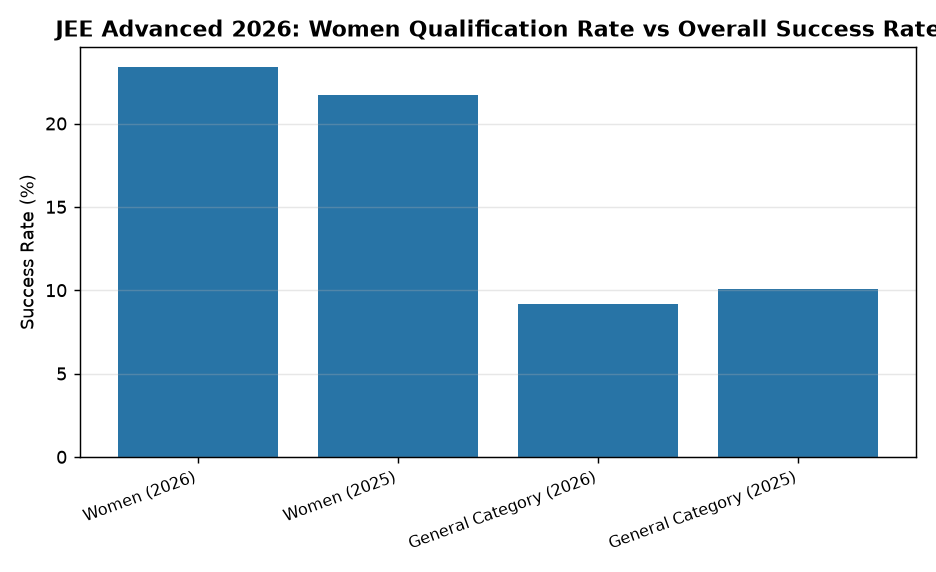
| Success rate for female candidates increased to 23.4% from 21.7% in 2025 | Reflects systemic improvements in examination preparation, mentorship, and inclusive pedagogy within coaching ecosystems. |
| Additional 3,814 seats reserved exclusively for female candidates in JEE Advanced 2026 | Institutional commitment to gender parity in technical education, addressing historical underrepresentation in engineering disciplines. |
| Scheduled Caste (SC) and Scheduled Tribe (ST) candidates’ success rates rose by 9.8% and 8.1% respectively | Indicates progress in inclusive education policies and targeted support mechanisms for marginalised communities. |
| General category success rate declined despite overall increase in qualified candidates | Suggests competitive pressure due to expanded participation and potential need for curriculum alignment with examination rigour. |
Why it Matters
Educational Equity
- Enhanced female participation in JEE Advanced underscores the effectiveness of reservation policies and outreach initiatives in STEM education.
- Rising success rates among SC and ST candidates indicate progress in addressing socio-economic barriers to technical education.
- Institutional mechanisms such as reserved seats and mentorship programmes contribute to equitable access to premier engineering institutions.
Institutional Governance
- The role of IITs, particularly IIT Roorkee as the conducting body, in implementing inclusive examination policies.
- Joint Implementation Committee’s reporting framework ensures transparency and accountability in outcome analysis.
- Policy-driven seat allocation mechanisms reflect a commitment to diversity in higher technical education.
Socio-Economic Impact
- Increased representation of women and marginalised groups in engineering institutions can drive innovation and workforce diversity.
- Higher technical education participation correlates with improved socio-economic mobility and reduced gender disparities in STEM careers.
- Policy interventions in examination design and support systems contribute to broader educational equity goals.
Challenges
1. Declining General Category Success Rate
- Competitive pressure intensified due to expanded participation across all categories.
- Potential misalignment between school-level curriculum and JEE Advanced examination standards.
- Need for standardised preparation resources to bridge performance gaps across socio-economic groups.
UPSC Link: UPSC GS Paper 2: Education Policy
2. Regional Disparities in Preparation Access
- Unequal distribution of quality coaching infrastructure across states affects candidate performance.
- Digital divide exacerbates disparities in access to online learning resources and mock tests.
- Policy interventions required to decentralise coaching support and mentorship programmes.
UPSC Link: UPSC GS Paper 1: Regional Development
3. Sustainability of Inclusive Policies
- Ensuring long-term effectiveness of reservation policies without compromising meritocratic standards.
- Balancing quantitative inclusion with qualitative outcomes in technical education.
- Monitoring and evaluation mechanisms to assess the impact of policy interventions over time.
UPSC Link: UPSC GS Paper 4: Ethics in Governance
4. Examination Rigour vs. Curriculum Alignment
- Discrepancy between school syllabus and JEE Advanced syllabus creates preparation challenges.
- Need for curriculum reforms to align with competitive examination standards.
- Teacher training programmes to enhance pedagogical approaches for competitive exams.
UPSC Link: UPSC GS Paper 3: Science & Technology
5. Psychological and Social Barriers
- Persistent gender stereotypes in STEM fields may deter female candidates despite policy support.
- Caste-based biases in educational institutions can impact performance and retention.
- Mental health support systems required to address examination stress and societal pressures.
UPSC Link: UPSC GS Paper 4: Human Values
Challenges — UPSC Perspective
| Issue | Concern |
|---|---|
| Declining general category success rate | Competitive pressure and curriculum misalignment |
| Regional disparities in coaching access | Digital divide and infrastructure gaps |
| Sustainability of inclusive policies | Balancing meritocracy with equity |
| Examination rigour vs. school curriculum | Need for alignment and teacher training |
| Psychological barriers in STEM | Gender and caste biases affecting performance |
Way Forward
- Strengthen regional coaching hubs through public-private partnerships to reduce disparities in preparation access.
- Expand digital infrastructure in rural and semi-urban areas to democratise access to online learning resources.
- Enhance teacher training programmes to align school curriculum with competitive examination standards.
- Establish mental health and mentorship programmes for female and marginalised candidates to address psychological barriers.
- Review and refine reservation policies to ensure long-term sustainability without compromising meritocratic outcomes.
- Promote industry-academia collaborations to create scholarships and internships for underrepresented groups in engineering.
- Develop standardised preparation materials and mock tests accessible across socio-economic strata.
- Monitor and evaluate the impact of inclusive policies through longitudinal studies to inform future interventions.
UPSC Value Addition
Keywords for Mains Answer-Writing
JEE Advanced 2026 · women in STEM education · gender parity in engineering admissions · reservation policy in higher education · General Category success rate decline · Scheduled Castes and Scheduled Tribes performance in JEE Advanced · IIT admissions policy · educational equity · meritocracy vs affirmative action · National Testing Agency (NTA) · Joint Implementation Committee (JIC) for JEE Advanced · inclusive education policies · socio-economic barriers in higher education
Concept Flow
Policy interventions (reserved seats, outreach programmes) → Increased participation of women and marginalised groups → Enhanced success rates → Institutional commitment to diversity → Long-term socio-economic benefits → Need for sustained policy evaluation → Refinement of inclusive measures
Prelims Practice Questions
Q1. Consider the following statements regarding the JEE Advanced 2026 examination:
1. The success rate of women candidates in JEE Advanced 2026 was 23.4%, the highest in six years.
2. The number of women candidates who qualified JEE Advanced 2026 exceeded 10,000 for the first time.
3. The success rate of Scheduled Tribe (ST) candidates in JEE Advanced 2026 increased by 8.1 percentage points compared to the previous year.
How many of the above statements are correct?
- Only one
- Only two
- All three
- None
Answer: All three — Statements 1 and 2 are correct. Statement 3 is incorrect as the success rate of ST candidates increased by 8.1 percentage points, but the base figure is not provided in the question. The success rate increase is a factual claim from the report.
Q2. Assertion (A): The success rate of General Category candidates in JEE Advanced 2026 declined compared to the previous year.
Reason (R): The increase in reserved category candidates’ success rates led to a relative decline in the General Category’s success rate due to fixed seat allocation policies.
In the context of the above statements, which of the following is correct?
- Both A and R are true, and R is the correct explanation of A.
- Both A and R are true, but R is not the correct explanation of A.
- A is true, but R is false.
- A is false, but R is true.
Answer: Both A and R are true, but R is not the correct explanation of A. — Both the assertion and reason are true. The reason correctly explains the assertion: fixed seat allocation policies mean that an increase in reserved category candidates’ success rates can lead to a relative decline in the General Category’s success rate.
Mains Practice Question
✍ The success rate of women candidates in JEE Advanced 2026 reached a six-year high, with over 10,000 women qualifying for the first time. However, the success rate for the General Category declined. In this context, critically examine the role of reservation policies and inclusive education measures in promoting gender and social parity in higher education. Also, analyse the implications of such trends for the principle of meritocracy in competitive examinations. (15 Marks)
Approach: MODEL-ANSWER SKELETON:
1. **Introduction (2 marks)**
– Briefly define JEE Advanced and its significance in engineering admissions.
– State the key findings from JEE Advanced 2026: women’s success rate (23.4%), first-time crossing of 10,000 women qualifiers, and decline in General Category success rate.
2. **Reservation Policies and Inclusive Education Measures (4 marks)**
– Explain the reservation policy for women in JEE Advanced: 3,814 seats reserved exclusively for women, including additional seats.
– Discuss the broader framework of reservation for Scheduled Castes (SC) and Scheduled Tribes (ST) in higher education (e.g., Article 15(4) and 16(4) of the Constitution, National Commission for Scheduled Castes and Tribes).
– Highlight the role of inclusive education measures such as coaching schemes, fee waivers, and mentorship programs for underrepresented groups.
– Cite the Joint Implementation Committee (JIC) report for JEE Advanced 2026 as evidence of policy impact.
3. **Promoting Gender and Social Parity (4 marks)**
– Analyse how reservation policies and inclusive measures contribute to gender parity in STEM education (reference to global best practices, e.g., STEM initiatives in the United States or European Union).
– Discuss the socio-economic barriers faced by women and marginalised communities in accessing quality education and competitive examinations.
– Reference the success rates of SC and ST candidates in JEE Advanced 2026 (increase of 9.8% and 8.1% respectively) as indicators of policy effectiveness.
– Critically evaluate whether these measures address structural inequalities or merely provide temporary relief.
4. **Meritocracy vs. Affirmative Action (3 marks)**
– Define meritocracy in the context of competitive examinations like JEE Advanced.
– Discuss the debate surrounding reservation policies: do they dilute merit or create a level playing field?
– Reference academic literature (e.g., Amartya Sen’s work on capabilities, or debates in the context of the Mandal Commission recommendations).
– Analyse the decline in General Category success rate: is it a result of reservation policies, increased competition, or other factors such as coaching disparities?
5. **Conclusion (2 marks)**
– Summarise the findings and their implications for higher education policy.
– Argue for a balanced approach that combines meritocratic principles with affirmative action to ensure both excellence and equity in education.
Source: amarujala.com
Generated by AanyaAi for educational purpose.
Related guides on our sites
- Current affairs for upsc 2026
- Best PSIR optional coaching for upsc
- Best economics optional coaching for upsc
- Best PSIR optional teacher for upsc

- आठवां वेतन आयोग: एक साल का सफर, 6 महीने में तय होगा भविष्य - November 9, 2026
- 8th Pay Commission: One Year On, Salary Hike & Fitment Factor Update - November 9, 2026
- तमिलनाडु में शराब की बोतल वापसी योजना पर क्लबों की चुनौती - November 9, 2026

No Comments