


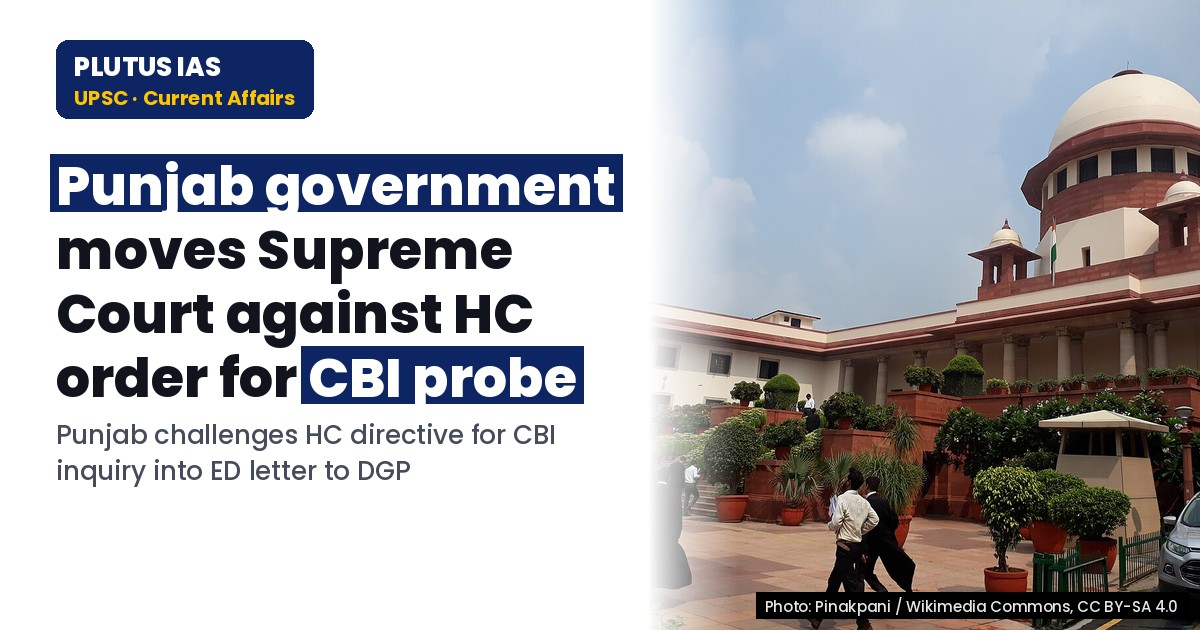
06 Oct Punjab Govt Challenges High Court Order on CBI Probe in SC
✎ The CBI can investigate a matter in a state only with the state’s consent or under a court order, and the Supreme Court’s decision in this case will clarify the interplay between judicial review, federalism, and investigative…
Subject Relevance — Where This Topic Fits
- GS Paper II — Functions and Responsibilities of the Union and the States, Issues and Challenges Pertaining to the Federal Structure | GS Paper II — Separation of Powers between various organs, Dispute Redressal Mechanisms and Institutions | GS Paper III — Role of External State and Non-State Actors in Creating Challenges to Internal Security
- Prelims: Central Bureau of Investigation (CBI), Enforcement Directorate (ED), Punjab & Haryana High Court, Supreme Court of India, Doctrine of Federalism, Judicial Review, Concurrent List (Union-State Relations), Public Interest Litigation (PIL)
- Essay: Federalism in India: Balancing Autonomy and Accountability, Judicial Activism and the Limits of Judicial Review
Quick Revision: The CBI can investigate a matter in a state only with the state’s consent or under a court order, and the Supreme Court’s decision in this case will clarify the interplay between judicial review, federalism, and investigative autonomy.
Why is this in the news?
The Punjab Government has approached the Supreme Court challenging a Punjab & Haryana High Court order directing the Central Bureau of Investigation (CBI) to investigate allegations related to transfers and postings of government officials, allegedly linked to the Chief Minister’s Office (CMO). The High Court’s directive followed a Public Interest Litigation (PIL) invoking the Enforcement Directorate’s (ED) letter to the Director General of Police (DGP), Punjab, seeking registration of a criminal case against certain officials. The Punjab Government contends that the probe is politically motivated and seeks to invoke constitutional safeguards to prevent federal encroachment.
Background
- The Enforcement Directorate (ED) forwarded a letter to the DGP, Punjab, alleging interference in administrative decisions, transfers, and tender processes by officials linked to the CMO.
- The Punjab Police did not register a First Information Report (FIR) based on the ED’s letter, prompting a PIL in the Punjab & Haryana High Court seeking a court-monitored investigation.
- The High Court, in its order, directed the CBI to file an investigation report within two months, citing the need for an independent probe free from local influence.
- The Punjab Government has challenged this order before the Supreme Court, arguing that the CBI’s involvement infringes upon the state’s administrative autonomy and is politically motivated.
- The case raises questions about the balance between federalism, judicial oversight, and the autonomy of state agencies in investigating alleged administrative irregularities.
- The Supreme Court’s stance on the matter will have implications for the constitutional division of powers between the Union and the States, particularly in matters of law and order.
What is the Legal and Constitutional Framework Governing CBI Investigations?
- The Central Bureau of Investigation (CBI) is a premier investigating agency in India, established under the Delhi Special Police Establishment Act, 1946, and operates under the administrative control of the Union Government.
- The CBI’s jurisdiction is primarily limited to Union Territories and cases involving Union Government employees or matters of national importance, as per the DSPE Act.
- For investigations within states, the CBI can take up a case only with the consent of the state government, as mandated under Section 6 of the DSPE Act, unless the Supreme Court or High Court orders a transfer of investigation.
- Judicial review of such orders is permissible under Article 226 of the Constitution (for High Courts) and Article 32 (for the Supreme Court), ensuring constitutional checks on executive actions.
- The doctrine of federalism in India, as envisaged in the Seventh Schedule, delineates the legislative and executive powers between the Union and the States, with law and order being a state subject under the State List.
- The Supreme Court, in landmark judgments such as *State of West Bengal v. Committee for Protection of Democratic Rights* (2010), has upheld the CBI’s role as an investigating agency but emphasized the need for state consent unless overridden by judicial orders.
- Public Interest Litigations (PILs) can be filed under Articles 32 and 226 to seek judicial intervention in matters of public concern, including alleged administrative malfeasance.
- The Enforcement Directorate (ED) functions under the Department of Revenue, Ministry of Finance, and investigates offenses under the Prevention of Money Laundering Act, 2002, and the Foreign Exchange Management Act, 1999.
- The ED’s letter to the DGP, Punjab, does not ipso facto confer jurisdiction on the CBI; the matter must pass legal scrutiny to ensure compliance with constitutional and statutory provisions.
Key Features
| Feature | Significance |
|---|---|
| Punjab Government’s Supreme Court Petition | Challenges the Punjab & Haryana High Court’s directive for a CBI probe into allegations involving state officials, asserting political motivation behind the case. |
| Enforcement Directorate (ED) Letter to DGP | Forms the basis of the allegations, citing interference in transfers, postings, tender processes, and alleged misuse of official documents by state officials. |
| High Court Order for CBI Investigation | Directs the Central Bureau of Investigation to investigate the matter independently, citing lack of impartiality in state agencies. |
| Allegations of Administrative Interference | Involves claims of undue influence over government transfers, postings, and tender processes by officials linked to the Chief Minister’s Office. |
| Election Timing Context | The legal proceedings coincide with the electoral cycle in Punjab, raising questions about the timing and potential politicisation of the investigation. |
Why it Matters
Institutional Integrity and Autonomy
- The case underscores the tension between state agencies and central investigative bodies, particularly where allegations of administrative interference are involved.
- Highlights the judiciary’s role in ensuring impartial investigations when state institutions may lack credibility due to perceived conflicts of interest.
- Raises questions about the independence of state vigilance bodies in politically sensitive cases.
Federalism and Centre-State Relations
- Examines the constitutional balance between state sovereignty and the Centre’s authority to direct investigations through central agencies like the CBI.
- Illustrates the procedural complexities when state governments challenge central investigative mandates in the Supreme Court.
Judicial Oversight of Investigations
- Demonstrates the judiciary’s power to transfer sensitive cases to central agencies for fair investigation, especially in cases involving high-ranking officials.
- Reinforces the principle that investigations must be insulated from local political pressures to ensure objectivity.
Challenges
1. Politicisation of Investigations
- Risk of allegations being framed or exaggerated during election periods, potentially undermining public trust in institutions.
- Challenge of distinguishing genuine administrative irregularities from politically motivated accusations.
UPSC Link: GS-II: Judiciary, Federalism
2. Autonomy of State Vigilance Institutions
- State vigilance bodies may face credibility deficits when investigating cases involving high-ranking officials or the ruling dispensation.
- Need for institutional safeguards to ensure impartiality in such investigations.
UPSC Link: GS-II: State Institutions
3. Centre-State Coordination in Investigations
- Potential friction between state governments and central agencies over jurisdiction and investigative mandates.
- Legal complexities in determining when central agencies can intervene in state-administered matters.
UPSC Link: GS-II: Centre-State Relations
4. Judicial Discretion in Case Transfers
- Balancing the need for fair investigations with the principle of judicial restraint in transferring cases.
- Ensuring that transfers to central agencies do not erode the autonomy of state judiciaries.
UPSC Link: GS-II: Judiciary
Challenges — UPSC Perspective
| Issue | Concern |
|---|---|
| Perceived Politicisation of Allegations | Risk of investigations being influenced by electoral politics, leading to partisan narratives. |
| Lack of Impartiality in State Agencies | State vigilance bodies may lack credibility when investigating cases involving ruling party officials. |
| Jurisdictional Conflicts | Tension between state and central agencies over investigative authority and autonomy. |
| Judicial Overreach vs. Restraint | Debate over the judiciary’s role in transferring cases to central agencies without undermining state institutions. |
| Public Trust in Institutions | Erosion of confidence in administrative and investigative bodies due to perceived bias or interference. |
Way Forward
- Clarify the procedural criteria for transferring cases from state to central agencies, ensuring judicial consistency.
- Strengthen institutional safeguards within state vigilance bodies to enhance their autonomy and credibility.
- Establish transparent guidelines for the judiciary to balance impartiality with the need for fair investigations.
- Enhance inter-agency coordination between the CBI, ED, and state police to avoid jurisdictional conflicts.
- Promote public awareness campaigns to distinguish between genuine administrative irregularities and politically motivated allegations.
- Encourage the adoption of digital evidence management systems to ensure the integrity of investigative processes.
- Review the electoral code of conduct to prevent the politicisation of investigations during election periods.
UPSC Value Addition
Keywords for Mains Answer-Writing
Central Bureau of Investigation · Enforcement Directorate · Federalism · Judicial Review · Probe into Administrative Interference · State Autonomy · Constitutional Governance · Supreme Court of India · Punjab Government · High Court Orders · Central Agencies · Separation of Powers · Judicial Activism · Public Interest Litigation · Federal Structure of India · Constitutional Morality · Rule of Law · Administrative Accountability · Judicial Independence
Constitutional & Policy Linkages
- {‘Article 136’: ‘Special Leave Petition jurisdiction of the Supreme Court.’}
- {‘Article 256’: ‘Centre’s power to issue directions to states.’}
- {‘Article 257’: ‘Cooperation between the Union and states in certain matters.’}
Concept Flow
Allegations of administrative interference by state officials -> ED initiates inquiry and issues letter to DGP -> State police fail to register FIR -> High Court directs CBI investigation -> State government challenges High Court order in Supreme Court -> Supreme Court examines the case for political motivation -> Judiciary balances institutional autonomy and federalism.
Prelims Practice Questions
Q1. Consider the following statements regarding the Central Bureau of Investigation (CBI):
1. The CBI is a statutory body established under the Delhi Special Police Establishment Act, 1946.
2. The CBI derives its investigative powers from the Union Government and cannot suo motu take up cases without the consent of the state government.
3. The CBI is exempt from the Right to Information Act, 2005, under Section 24 of the Act.
How many of the above statements are correct?
- Only one
- Only two
- All three
- None
Answer: All three — Statements 1 and 3 are correct. Statement 2 is incorrect because the CBI can take up cases suo motu in certain circumstances, such as in matters of national importance or when directed by the Supreme Court or High Courts.
Q2. Assertion (A): The Enforcement Directorate (ED) is a specialized financial investigation agency under the Department of Revenue, Ministry of Finance.
Reason (R): The ED enforces the provisions of the Prevention of Money Laundering Act, 2002, and the Foreign Exchange Management Act, 1999.
- Both A and R are true, and R is the correct explanation of A.
- Both A and R are true, but R is not the correct explanation of A.
- A is true but R is false.
- A is false but R is true.
Answer: Both A and R are true, but R is not the correct explanation of A. — Both the Assertion and Reason are correct, and the Reason correctly explains the Assertion. The ED is indeed a specialized agency under the Department of Revenue, and its primary mandate includes enforcing the PMLA and FEMA.
Q3. Match the following constitutional provisions with their respective functions:
Column I (Provision)
A. Article 32
B. Article 136
C. Article 226
D. Article 142
Column II (Function)
1. Power of the Supreme Court to issue writs for enforcement of Fundamental Rights
2. Power of the Supreme Court to grant special leave to appeal from any court or tribunal
3. Power of the High Courts to issue writs for enforcement of Fundamental Rights and other purposes
4. Power of the Supreme Court to pass any order necessary for doing complete justice in any cause or matter
Answer: ? —
Mains Practice Question
✍ The Supreme Court of India has recently declined to entertain an urgent hearing sought by the Punjab Government against a High Court order directing a CBI probe into alleged administrative interference by state officials. Critically examine the constitutional and institutional dimensions of this judicial intervention in the context of federalism and separation of powers. (15 Marks)
Approach: MODEL-ANSWER SKELETON:
1. **Introduction (2 marks)**: Brief context of the case—Punjab Government’s challenge to the High Court order directing a CBI probe into alleged administrative interference by state officials (CM’s OSD and associates). Mention the constitutional provisions involved: Articles 131 (original jurisdiction of Supreme Court), 136 (special leave petition), and 256-257 (cooperative federalism).
2. **Judicial Review and Federalism (4 marks)**:
– Role of the Supreme Court under Article 136 as a guardian of constitutional morality and rule of law.
– Federal balance: Can the Supreme Court direct a CBI probe against state officials without the state’s consent? Reference to the Supreme Court’s stance in *State of West Bengal v. Committee for Protection of Democratic Rights* (2010) and *K. Veeraswami v. Union of India* (1991).
– The doctrine of ‘judicial federalism’ and the need for judicial restraint in matters of state autonomy.
3. **Separation of Powers and Institutional Integrity (4 marks)**:
– Distinction between the investigative roles of state police, state vigilance agencies, and central agencies like the CBI.
– The CBI’s legal framework: Derivation of powers under the Delhi Special Police Establishment Act, 1946, and its relationship with state governments.
– Judicial activism vs. judicial overreach: Can the judiciary direct a probe by a central agency into state affairs without undermining the federal structure? Reference to *Common Cause v. Union of India* (2017) and *S.P. Gupta v. Union of India* (1981).
4. **Constitutional Morality and Rule of Law (3 marks)**:
– The principle of ‘constitutional morality’ as enunciated by Dr. B.R. Ambedkar and its application in judicial review.
– How does the judiciary balance the need for accountability with respect for federalism?
– The role of the judiciary in ensuring administrative accountability without encroaching upon the executive’s domain.
5. **Conclusion (2 marks)**:
– Summarize the need for a nuanced approach where judicial intervention is warranted in cases of grave administrative malfeasance but does not erode the federal fabric.
– Suggest that such matters may be better addressed through inter-governmental consultations or constitutional mechanisms like the Inter-State Council rather than judicial directives.
Source: amarujala.com
Punjab PCS (PPSC) — State PCS Practice
Prelims: Recently, the Punjab Government approached the Supreme Court against the CBI’s investigation into a matter, alleging it was politically motivated. Which of the following best describes the Punjab Government’s stance in this case?
- The Punjab Government sought an immediate stay on the CBI’s investigation, claiming it was politically motivated and lacked legal basis.
- The Punjab Government requested the CBI to expand the scope of the investigation to include more political figures.
- The Punjab Government demanded the transfer of the case to the Punjab Police for a fair investigation.
- The Punjab Government filed a PIL in the Punjab and Haryana High Court to challenge the CBI’s jurisdiction.
Answer: The Punjab Government sought an immediate stay on the CBI’s investigation, claiming it was politically motivated and lacked legal basis. — The Punjab Government approached the Supreme Court alleging the CBI’s investigation was politically motivated and sought immediate hearing, which was rejected by the apex court.
Mains: Critically analyze the constitutional and legal implications of the Punjab Government’s decision to challenge the CBI’s investigation in the Supreme Court. Discuss the balance between federal autonomy and central investigative agencies’ powers, with specific reference to Punjab’s concerns.
Generated by AanyaAi for educational purpose.
Related guides on our sites
- Anthropology VS PSIR
- Best PSIR optional coaching
- Best PSIR optional coaching online
- Best PSIR optional teacher


No Comments