


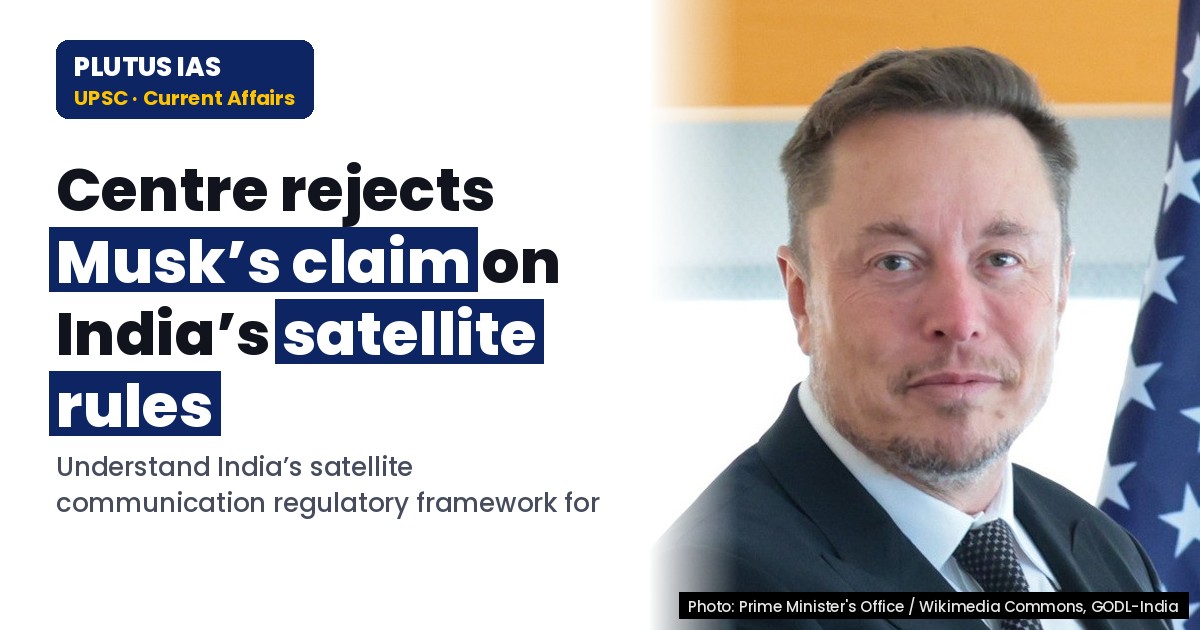
08 Oct Centre Rejects Musk’s Claim on India’s Satellite Rules: UPSC Exam Focus
✎ India’s satellite communication regulatory framework is governed by the Department of Telecommunications under a non-discriminatory licensing regime, with mandatory security clearances and spectrum assignment as key stages in the…
Subject Relevance — Where This Topic Fits
- GS Paper II — Governance, Constitution and Polity (Regulatory Authorities) | GS Paper III — Science and Technology (Space Technology, Telecommunication) and Economic Development (Digital Infrastructure)
- Prelims: Telecommunication Regulatory Authority of India (TRAI), Department of Telecommunications (DoT), Global Mobile Personal Communication by Satellite (GMPCS), Non-Geostationary Orbit (NGSO), Satellite Spectrum Assignment, Security Clearance for Telecom Licences
- Essay: The interplay between technological sovereignty and global innovation in India’s digital economy, Balancing national security imperatives with the imperatives of digital inclusion and innovation
Quick Revision: India’s satellite communication regulatory framework is governed by the Department of Telecommunications under a non-discriminatory licensing regime, with mandatory security clearances and spectrum assignment as key stages in the authorisation process.
Why is this in the news?
The Government of India has publicly refuted claims by Elon Musk, CEO of SpaceX, alleging discriminatory treatment in the issuance of satellite communication licences, specifically concerning Starlink’s operations in India. The Ministry of Communications clarified that the regulatory framework governing satellite communication services in India is non-discriminatory, transparent, and grounded in statutory compliance, including security assessments. This development underscores the importance of India’s evolving satellite communication policy in the context of global space-based internet services and domestic regulatory sovereignty.
Background
- India’s satellite communication policy has evolved to accommodate global players while ensuring compliance with national security requirements, particularly in light of increasing reliance on space-based internet services for digital inclusion.
- The Telecom Regulatory Authority of India (TRAI) periodically issues recommendations on satellite communication, which inform the DoT’s regulatory framework.
- Global Mobile Personal Communication by Satellite (GMPCS) licences are granted to entities operating NGSO-based satellite systems, enabling them to provide communication services in India.
- Security clearances are a mandatory component of the licence issuance process, aimed at safeguarding national security and user data integrity.
- The DoT’s framework aligns with India’s broader digital infrastructure goals, including the BharatNet initiative and the Digital India programme, while ensuring adherence to international obligations.
What is Satellite Communication Regulation in India?
- Licensing Framework: The DoT issues licences for satellite communication services under the Global Mobile Personal Communication by Satellite (GMPCS) category, which permits entities to operate NGSO-based satellite systems in India.
- Non-Discriminatory Principles: The regulatory framework is designed to be transparent, fair, and non-discriminatory, ensuring equitable treatment of all applicants, including international entities like SpaceX’s Starlink.
- Security Compliance: All licence applicants must undergo a security clearance process to demonstrate compliance with national security requirements, including data protection and user safety protocols.
- Spectrum Assignment: After securing a licence and completing security clearances, entities may apply for spectrum assignment, which is essential for operationalising satellite communication services.
- Statutory Basis: The regulatory framework is grounded in the Indian Telegraph Act, 1885, the Telecom Regulatory Authority of India (TRAI) Act, 1997, and the Unified Licensing regime, which collectively govern telecommunication services in India.
- Global Standards Alignment: India’s satellite communication regulations are aligned with international best practices, including those set by the International Telecommunication Union (ITU), while incorporating domestic security imperatives.
- Digital Inclusion Focus: The framework supports India’s broader digital inclusion goals by facilitating the expansion of satellite-based internet services, particularly in remote and underserved regions.
Key Features
| Feature | Significance |
|---|---|
| Non-discriminatory authorisation framework | Ensures equitable access to satellite communication services for all operators, preventing monopolistic practices and fostering competition. |
| Security compliance as a licence condition | Mandates adherence to national security protocols, safeguarding user data and critical infrastructure from potential threats. |
| Phased regulatory process | Includes security assessment before spectrum assignment, ensuring systematic and transparent evaluation of applicants. |
| Global Mobile Personal Communication by Satellite (GMPCS) licences | Facilitates provision of satellite-based telecommunication services in India, aligning with international best practices. |
| Equal regulatory stage for all licensees | Demonstrates fairness in the application of rules, countering claims of selective or biased enforcement. |
Why it Matters
Economic
- Encourages foreign direct investment in India’s satellite communication sector by maintaining a predictable and transparent regulatory environment.
- Promotes indigenous innovation and entrepreneurship in satellite-based services, reducing reliance on imports.
- Supports the growth of India’s digital economy by expanding high-speed internet access to underserved and remote regions.
Strategic
- Enhances India’s strategic autonomy in satellite communication by diversifying service providers beyond traditional oligopolies.
- Strengthens national security by ensuring that all satellite communication operators comply with stringent security protocols.
- Aligns with India’s space policy objectives of self-reliance and global leadership in space-based technologies.
Regulatory
- Demonstrates the government’s commitment to a rules-based governance model in emerging technology sectors.
- Sets a precedent for the regulation of other advanced technologies, such as 5G and 6G networks.
- Reinforces the role of the Ministry of Communications as a neutral arbiter in telecom policy, ensuring fairness and transparency.
Challenges
1. Security and Sovereignty Concerns
- Balancing the need for rapid deployment of satellite communication services with stringent security assessments.
- Preventing misuse of satellite networks for espionage, cyber threats, or illegal activities while ensuring operational efficiency.
- Addressing concerns of foreign entities regarding data localisation and sovereignty over satellite-based services.
UPSC Link: GS Paper 3: Security challenges
Challenges — UPSC Perspective
| Issue | Concern |
|---|---|
| Security compliance delays | Prolonged security assessments may hinder the timely rollout of satellite services, affecting market competitiveness. |
| Monopolistic tendencies in telecom sector | Risk of existing players leveraging regulatory hurdles to stifle competition from new entrants like Starlink. |
| Spectrum scarcity | Limited availability of spectrum for satellite communication may constrain the expansion of services. |
| Regulatory fragmentation | Inconsistencies in the application of rules across states or sectors could undermine investor confidence. |
| Technological lag | Delays in adopting global standards may place India at a disadvantage in the rapidly evolving satellite communication market. |
| Public-private partnership challenges | Coordinating between government agencies, private operators, and international stakeholders to ensure seamless service delivery. |
Way Forward
- Conclude security assessments for all licensed satellite communication operators in a time-bound manner to expedite spectrum allocation.
- Enhance transparency in the licensing and regulatory process by publishing clear timelines and criteria for approvals.
- Strengthen collaboration between the Ministry of Communications, Department of Space, and security agencies to streamline compliance procedures.
- Promote public-private partnerships to accelerate the deployment of satellite-based internet in rural and remote areas.
- Develop a national satellite communication policy to provide a long-term roadmap for the sector’s growth and regulation.
- Encourage indigenous R&D in satellite technologies to reduce dependency on foreign providers and enhance self-reliance.
- Establish a grievance redressal mechanism for operators facing undue delays or regulatory ambiguities.
- Align India’s satellite communication regulations with international standards to attract global investments and foster innovation.
UPSC Value Addition
Keywords for Mains Answer-Writing
Satellite Communication Policy · Telecommunication Licensing Framework · Global Mobile Personal Communication by Satellite (GMPCS) · Non-Geosynchronous Orbit (NGSO) satellite services · Telecom Security Regulations · Spectrum Assignment Process · Telecom Regulatory Authority of India (TRAI) · Wireless Planning & Coordination Wing (WPC) · National Security Implications of Satellite Communication · Telecom Licensing Policy · Regulatory Fairness in Telecommunication · Satellite Internet Services in India · Telecom Authorisation Framework · Security Clearance in Telecom Licensing
Concept Flow
Elon Musk’s claim of discriminatory practices in satellite communication licensing → Government’s rebuttal citing non-discriminatory regulatory framework → Ministry of Communications’ statement on fair and transparent licensing process → Security compliance as a prerequisite for spectrum assignment → Phased regulatory process for all licensees → Equal regulatory stage for all applicants → Conclusion: India’s regulatory environment is neutral and security-focused, countering claims of bias.
Prelims Practice Questions
Q1. Consider the following statements regarding the regulatory framework for satellite communication services in India:
1. The Telecom Regulatory Authority of India (TRAI) is the sole authority for granting telecom licences for satellite communication services.
2. Global Mobile Personal Communication by Satellite (GMPCS) services are permitted under the non-geosynchronous satellite orbit-based framework.
3. Licence applicants must undergo a security clearance process before spectrum assignment.
4. The Wireless Planning & Coordination Wing (WPC) is responsible for the technical and operational aspects of satellite communication licensing.
How many of the above statements are correct?
- Only one
- Only two
- Only three
- All four
Answer: Only three — Statements 2 and 3 are correct. Statement 1 is incorrect as the Ministry of Communications, through the WPC, plays a key role in licensing. Statement 4 is incorrect as the WPC handles spectrum assignment and coordination, not licensing authority.
Q2. Assertion (A): The Government of India requires all satellite communication service providers to comply with security conditions as part of their licensing terms.
Reason (R): This is to ensure that services meet national security requirements and protect user data.
In the context of the above two statements, which of the following is correct?
- Both A and R are true, and R is the correct explanation of A.
- Both A and R are true, but R is NOT the correct explanation of A.
- A is true but R is false.
- A is false but R is true.
Answer: Both A and R are true, and R is the correct explanation of A. — Both the assertion and reason are true. The security compliance requirement is explicitly stated in the licensing framework to safeguard national security and user data, making R the correct explanation of A.
Q3. Match the following entities with their respective roles in India’s satellite communication regulatory framework:
Column I (Entity) | Column II (Role)
——————|——————
A. Ministry of Communications | 1. Technical and operational coordination for spectrum assignment
B. Telecom Regulatory Authority of India (TRAI) | 2. Policy formulation and licensing oversight
C. Wireless Planning & Coordination Wing (WPC) | 3. Advisory role on tariffs and service standards
D. Department of Telecommunications (DoT) | 4. Implementation of telecom policies and licences
Select the correct match:
- A-2, B-3, C-1, D-4
- A-4, B-1, C-2, D-3
- A-1, B-4, C-3, D-2
- A-3, B-2, C-4, D-1
Answer: A-2, B-3, C-1, D-4 — The correct matches are: A-2 (Ministry of Communications oversees policy and licensing), B-3 (TRAI advises on tariffs and service standards), C-1 (WPC handles technical and operational coordination), and D-4 (DoT implements telecom policies and licences).
Mains Practice Question
✍ Critically examine the regulatory framework governing satellite communication services in India, with particular reference to the licensing and security clearance processes. How does this framework balance the objectives of promoting innovation and ensuring national security? (15 Marks)
Approach: MODEL-ANSWER SKELETON:
1. **Introduction (2 marks)**: Define satellite communication services and their significance in India’s digital ecosystem. Mention the role of the Ministry of Communications, DoT, TRAI, and WPC in regulation.
2. **Licensing Framework (4 marks)**:
– Explain the Global Mobile Personal Communication by Satellite (GMPCS) framework under the non-geosynchronous orbit (NGSO) regime.
– Highlight the role of the Wireless Planning & Coordination Wing (WPC) in spectrum assignment and technical coordination.
– Reference the Telecom Regulatory Authority of India’s (TRAI) advisory role on tariffs and service standards.
3. **Security Clearance Process (4 marks)**:
– Detail the security conditions imposed on licence applicants (e.g., compliance with the Indian Telegraph Act, 1885, and the Information Technology Act, 2000).
– Explain the role of security agencies (e.g., Intelligence Bureau, Defence Research and Development Organisation) in the clearance process.
– Cite the rationale: protection of national security, user data privacy, and prevention of misuse (e.g., espionage, cyber threats).
4. **Balancing Innovation and Security (3 marks)**:
– Discuss how the framework promotes innovation by allowing multiple players (e.g., Starlink, OneWeb, Jio Satellite) under a non-discriminatory regime.
– Acknowledge challenges: delays in clearance, perceived opacity, and the need for a transparent and time-bound process.
– Reference international best practices (e.g., ITU guidelines, US FCC’s licensing model) for comparative insights.
5. **Conclusion (2 marks)**: Summarise the effectiveness of the framework in achieving its dual objectives. Suggest measures to enhance transparency and efficiency (e.g., digital clearance portals, timelines for security assessments).
**Key Statutory/Institutional References**:
– Telecom Regulatory Authority of India Act, 1997
– Indian Telegraph Act, 1885 (Sections 4, 5, and 6)
– Information Technology Act, 2000 (Sections 67C, 69)
– National Cyber Security Policy, 2013
– Recent TRAI recommendations on satellite communication (e.g., 2023 consultation papers on NGSO services).
Source: orissapost.com
Generated by AanyaAi for educational purpose.
Related guides on our sites
- How to prepare for GS paper 1 for UPSC CSE mains exam
- Best UPSC coaching for IFOS exam
- Best mentorship programme for upsc
- UPSC+BA degree

- Centre Rejects Musk’s Claim on India’s Satellite Rules: UPSC Exam Focus - October 8, 2026
- भारत पुनः द्विपक्षीय निवेश संधियों पर हस्ताक्षर क्यों कर रहा है? 2016 के पुनर्प्रारंभ के बाद क्या बदला? - October 8, 2026
- India’s Satellite Communication Policy: Fair & Non-Discriminatory Framework - October 8, 2026

No Comments