


07 Oct Odisha Finance Dept Bans New Outsourcing Posts: Key Policy Changes Explained
✎ The Odisha government’s new outsourcing policy replaces manpower-based engagement with man-hours, phases out existing outsourcing posts, and caps contract periods at three years to enhance transparency, accountability, and…
Subject Relevance — Where This Topic Fits
- GS Paper II — Governance, Transparency and Accountability | GS Paper III — Public Administration and Good Governance | GS Paper III — Government Budgeting and Financial Management
- Prelims: outsourcing, man-hours vs manpower, service-level agreements, tender process, outsourced employees, Labour Commissioner, RFP, contract period, identity cards, phasing out of posts
- Essay: The role of administrative reforms in enhancing governance efficiency: A case study of outsourcing policy changes, Balancing cost-efficiency and employee welfare in public service delivery
Quick Revision: The Odisha government’s new outsourcing policy replaces manpower-based engagement with man-hours, phases out existing outsourcing posts, and caps contract periods at three years to enhance transparency, accountability, and cost-efficiency in public service delivery.
Why is this in the news?
The Odisha Finance Department has recently introduced a policy reform aimed at redefining the engagement of outsourced employees in government departments by shifting from a manpower-based to a man-hours-based measurement system. This policy also prohibits the creation of new outsourcing posts and mandates the phasing out of existing ones, triggering concerns among outsourced employees and raising questions about transparency in the outsourcing ecosystem.
Background
- The Government of Odisha has historically engaged outsourced employees through service providers to meet temporary operational needs, particularly in non-core functions such as cleaning, security, and maintenance.
- The absence of a consolidated database on the number of outsourced employees across departments and districts has led to accountability gaps, as highlighted during the Monsoon Session of the Odisha Legislative Assembly.
- Chief Minister Mohan Charan Majhi has acknowledged that outsourced personnel are engaged through tender processes but are not classified as government employees, resulting in no official record-keeping of their employment details.
- The new policy is part of broader administrative reforms aimed at improving financial discipline, transparency, and efficiency in public expenditure management.
- The policy aligns with the broader principle of ‘minimum government, maximum governance’ by reducing dependency on outsourced manpower and promoting cost-effective, outcome-based service delivery.
What is the Odisha Government’s Outsourcing Policy Reform?
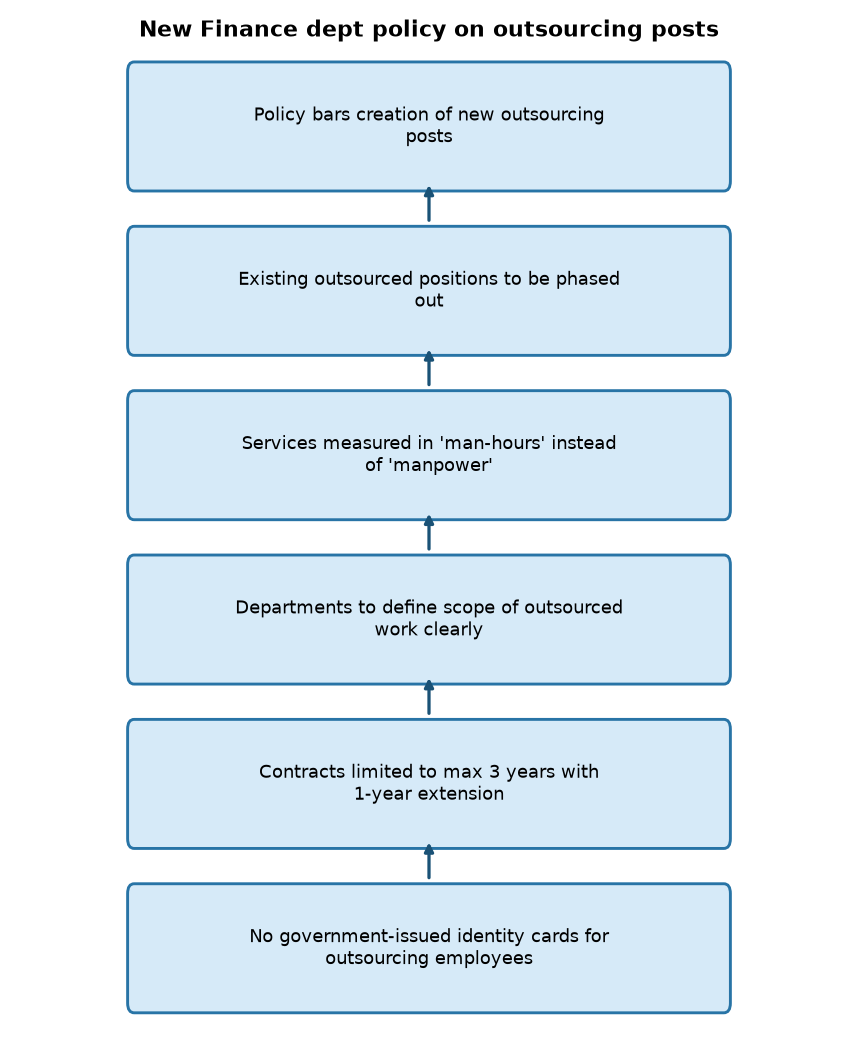
- The policy introduces a shift from ‘manpower’ to ‘man-hours’ as the metric for engaging outsourced employees, ensuring that services are procured based on measurable work output rather than headcount.
- The creation of new outsourcing posts has been barred, and existing posts are to be phased out, signalling a long-term reduction in reliance on outsourced manpower in government departments.
- Departments are required to enter into comprehensive service agreements with service providers, clearly defining the scope of work, deliverables, and performance metrics to ensure accountability.
- The contract period for outsourcing services is capped at three years, with a two-year initial term and a possible one-year extension based on performance evaluation, to prevent long-term dependency on temporary staff.
- Tender processes must be initiated well in advance to ensure seamless transition between service providers, avoiding disruptions in service delivery.
- Outsourcing employees will not be issued government identity cards; instead, service providers may issue identity cards to their employees, reinforcing the distinction between government staff and contractual workers.
- The policy mandates that Requests for Proposals (RFPs) for outsourced services must include detailed specifications such as total area, number of rooms, and number of officers to enable accurate assessment of service requirements by bidders.
- The reform aims to address financial inefficiencies by ensuring that government funds are allocated based on actual service delivery rather than the number of employees engaged.
UPSC Value Addition
Keywords for Mains Answer-Writing
Outsourcing in government · Manpower vs man-hours policy · Government outsourcing contracts · Public procurement reforms · Temporary employment in bureaucracy · Service-level agreements in governance · Regulation of outsourcing agencies · Government accountability in outsourcing · Outsourced workforce data management · Government-Non-Government Employee Interface · Public financial management · Government outsourcing policy framework · Contractual employment in administration
Prelims Practice Questions
Q1. Consider the following statements regarding the new Finance department policy on outsourcing in government departments:
1. The policy mandates that outsourced employees be measured in terms of ‘man-hours’ rather than ‘manpower’.
2. The policy prohibits the creation of new outsourcing posts in government departments.
3. The contract period for outsourcing services can be extended up to five years without any restrictions.
Which of the above statements are correct?
- Only one
- Only two
- Only three
- None
Answer: Only two — Statement 1 is correct: The policy explicitly replaces ‘manpower’ with ‘man-hours’ for measuring outsourced services. Statement 2 is correct: The policy bars the creation of new outsourcing posts. Statement 3 is incorrect: The contract period is limited to two years with a possible one-year extension, not exceeding three years in total.
Q2. Assertion (A): The new policy requires government departments to enter into comprehensive service agreements with outsourcing agencies to prevent future claims for regularisation.
Reason (R): The policy aims to clarify the scope of outsourced work and define measurable parameters to ensure transparency and accountability in public procurement.
- Both A and R are true, and R is the correct explanation of A
- Both A and R are true, but R is not the correct explanation of A
- A is true, but R is false
- A is false, but R is true
Answer: Both A and R are true, and R is the correct explanation of A — Assertion (A) is true as the policy directs departments to enter into comprehensive service agreements to prevent claims for regularisation. Reason (R) is also true and correctly explains the rationale behind the assertion, as the agreements define the scope of work and measurable parameters.
Q3. Match the following provisions of the new outsourcing policy with their respective descriptions:
Column I (Provision)
A. Measurement of services
B. Contract duration
C. Identity cards for outsourced employees
D. Tender process
Column II (Description)
1. Limited to two years, extendable by one year
2. Based on ‘man-hours’ instead of ‘manpower’
3. Procuring entity will not issue identity cards
4. Tenders must be invited in advance to select a new agency before contract expiry
- {‘A’: ‘2’, ‘B’: ‘1’, ‘C’: ‘3’, ‘D’: ‘4’}
- {‘A’: ‘1’, ‘B’: ‘2’, ‘C’: ‘4’, ‘D’: ‘3’}
- {‘A’: ‘3’, ‘B’: ‘4’, ‘C’: ‘2’, ‘D’: ‘1’}
- {‘A’: ‘4’, ‘B’: ‘3’, ‘C’: ‘1’, ‘D’: ‘2’}
Answer: {‘A’: ‘2’, ‘B’: ‘1’, ‘C’: ‘3’, ‘D’: ‘4’} — A-2: Services are measured in ‘man-hours’. B-1: Contract duration is limited to two years with a one-year extension. C-3: Procuring entities will not issue identity cards to outsourced employees. D-4: Tenders must be invited in advance to select a new agency before the existing contract expires.
Mains Practice Question
✍ Critically examine the rationale behind the Odisha government’s policy shift from ‘manpower’ to ‘man-hours’ in outsourcing government services. Also, analyse the implications of this policy on administrative efficiency, transparency, and the rights of outsourced employees. (15 Marks)
Approach: MODEL-ANSWER SKELETON:
1. **Rationale for the Policy Shift (4 marks)**
– **Cost Efficiency**: Explanation of how ‘man-hours’ measurement aligns with actual service delivery, reducing fiscal burden and preventing overstaffing.
– **Accountability and Transparency**: Emphasis on measurable outputs (e.g., area cleaned, hours worked) to enhance monitoring and reduce opacity in outsourcing.
– **Prevention of Regularisation Claims**: Reference to the directive to enter into comprehensive service agreements to mitigate future demands for permanent employment.
– **Regulatory Framework**: Link to the Public Procurement (Preference to Make in India) Order, 2017, and the General Financial Rules (GFR), 2017, which mandate competitive bidding and defined scopes in government contracts.
2. **Administrative Efficiency (3 marks)**
– **Flexibility in Workforce Management**: Discussion on how ‘man-hours’ allows departments to scale services up or down based on real-time needs.
– **Reduction in Bureaucratic Burden**: Streamlining of procurement processes by limiting contract durations and mandating advance tenders.
– **Data Management**: Addressing the lack of consolidated data on outsourced employees as highlighted in the Assembly session.
3. **Transparency Enhancements (3 marks)**
– **Defined Scope of Work**: Explanation of how specifying parameters (e.g., area, rooms, officers) in Requests for Proposal (RFPs) improves clarity and reduces disputes.
– **Competitive Bidding**: Emphasis on the requirement to invite tenders in advance, ensuring fair competition and value for money.
– **Service-Level Agreements (SLAs)**: Role of SLAs in setting measurable benchmarks for service delivery and performance evaluation.
4. **Implications for Outsourced Employees (3 marks)**
– **Job Security Concerns**: Analysis of how the policy may lead to job insecurity due to non-regularisation and short-term contracts.
– **Lack of Government Identity**: Discussion on the absence of government-issued identity cards and its impact on employee rights and social security.
– **Workload and Compensation**: Potential for increased workload without commensurate compensation, given the ‘man-hours’ measurement.
5. **Balanced View and Conclusion (2 marks)**
– **Pros and Cons Synthesis**: Summarise the policy’s benefits in terms of fiscal discipline and administrative efficiency versus its drawbacks in terms of employee welfare and job security.
– **Recommendations**: Suggest measures such as social security coverage for outsourced employees, periodic reviews of contracts, and grievance redressal mechanisms to mitigate adverse effects.
Source: orissapost.com
Generated by AanyaAi for educational purpose.
Related guides on our sites
- Current affairs for upsc 2026
- Best PSIR optional coaching for upsc
- Best PSIR optional teacher for upsc
- Best teacher of PSIR optional for upsc

- IndIAI Mission Strengthens AI Talent Ecosystem at NIT Andhra Pradesh - October 7, 2026
- स्वच्छता ही सेवा 2026: पंचायतों में सफाई अभियान की मुख्य बातें - October 7, 2026
- RBI Repo Rate Hike to 5.5%: Impact on UPSC & State PCS Economy Syllabus - October 7, 2026

No Comments