


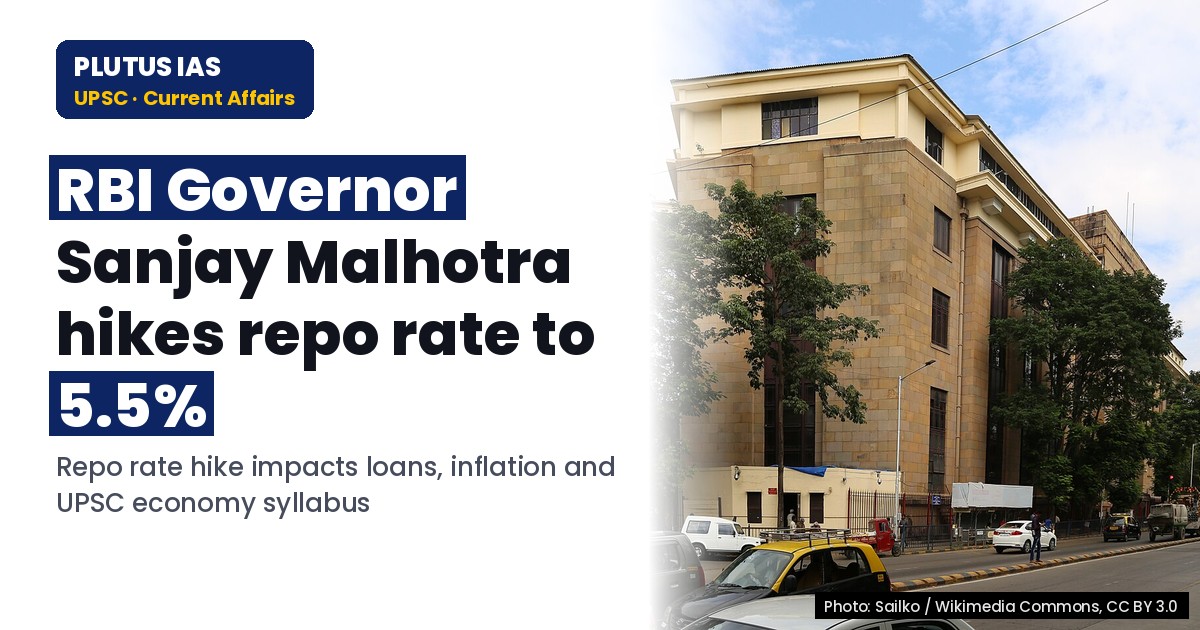
07 Oct RBI Repo Rate Hike to 5.5%: Impact on UPSC & State PCS Economy Syllabus
✎ The repo rate is the benchmark interest rate at which the RBI lends to commercial banks, and its adjustment by the Monetary Policy Committee (MPC) is a primary tool to manage inflation and growth in line with the RBI’s…
Subject Relevance — Where This Topic Fits
- GS Paper III — Indian Economy: Issues relating to planning, resource mobilisation, growth, development and employment | GS Paper III — Effects of liberalisation on the economy, changes in industrial policy and their effects on industrial growth
- Prelims: Repo rate, Monetary Policy Committee (MPC), Inflation targeting, Basis points, Calibrated tightening, Retail inflation, Liquidity adjustment facility, Bank rate, Statutory Liquidity Ratio (SLR), Cash Reserve Ratio (CRR)
- Essay: Macroeconomic stability and the role of central banks in emerging economies, The trade-off between growth and inflation: A case study of monetary policy in India
Quick Revision: The repo rate is the benchmark interest rate at which the RBI lends to commercial banks, and its adjustment by the Monetary Policy Committee (MPC) is a primary tool to manage inflation and growth in line with the RBI’s inflation-targeting mandate.
Why is this in the news?
The Reserve Bank of India (RBI) has raised the repo rate by 25 basis points to 5.5% and shifted its monetary policy stance to ‘calibrated tightening’, marking a reversal from the prolonged accommodative phase. This decision, taken by the Monetary Policy Committee (MPC) in October 2026, reflects concerns over elevated retail inflation (4.82% in August 2026) and external sector vulnerabilities, including geopolitical tensions in West Asia and synchronized monetary tightening by major central banks such as the US Federal Reserve and the European Central Bank.
Background
- India adopted an inflation-targeting framework under the Reserve Bank of India Act, 1934, with a target of 4% (±2%) for retail inflation, to anchor price stability and anchor inflation expectations.
- The RBI’s monetary policy stance—ranging from accommodative to neutral to calibrated tightening—guides market expectations and influences borrowing costs across the economy.
- Global commodity prices, particularly crude oil, have exhibited volatility due to geopolitical developments in West Asia, contributing to imported inflationary pressures in India.
- The synchronised monetary tightening by advanced economy central banks (e.g., US Fed, ECB) has implications for capital flows, exchange rates, and domestic liquidity conditions in emerging markets like India.
What is the Repo Rate and the Monetary Policy Stance?
- The repo rate is the interest rate at which the RBI provides short-term liquidity to commercial banks under the liquidity adjustment facility (LAF), typically for a period of one to fourteen days.
- It is a key instrument of the RBI’s monetary policy, influencing the cost of credit in the economy and thereby affecting consumption, investment, and inflation dynamics.
- The Monetary Policy Committee (MPC), constituted under the RBI Act, 1934, is responsible for determining the policy repo rate with the primary objective of maintaining price stability while supporting growth.
- The MPC consists of six members—three from the RBI (including the Governor) and three external members appointed by the Central Government—ensuring a balanced and independent decision-making process.
- The RBI’s monetary policy stance—‘accommodative’, ‘neutral’, or ‘calibrated tightening’—signals the future trajectory of interest rates and guides market expectations regarding liquidity and credit conditions.
- A stance of ‘calibrated tightening’ indicates that while the RBI may not immediately raise rates further, it retains the flexibility to do so if inflationary pressures persist, thereby signalling a cautious approach to policy normalization.
- The transmission of the repo rate to the broader economy occurs through the banking system, affecting lending and deposit rates, which in turn influence household consumption, business investment, and aggregate demand.
- The RBI also uses other tools such as the Cash Reserve Ratio (CRR) and Statutory Liquidity Ratio (SLR) to manage liquidity and ensure financial stability, complementing the repo rate adjustments.
Key Features
| Feature | Significance |
|---|---|
| Repo Rate Increase (25 basis points to 5.5%) | Directly influences borrowing costs for households, businesses, and governments, impacting consumption, investment, and inflation dynamics. |
| Monetary Policy Stance Change to ‘Calibrated Tightening’ | Signals a cautious approach to monetary policy, indicating a higher likelihood of further rate hikes if inflationary pressures persist, while avoiding abrupt tightening. |
| Unanimous Decision by Monetary Policy Committee (MPC) | Demonstrates alignment among MPC members on the need for monetary tightening, enhancing credibility and predictability of policy actions. |
| Retail Inflation Rise (4.82% in August 2026) | Provides empirical justification for the rate hike, as inflation exceeds the RBI’s target range, necessitating preemptive policy measures. |
| Global Synchronised Monetary Tightening (US Fed, ECB) | Highlights the influence of external macroeconomic conditions on domestic policy decisions, particularly through capital flows and commodity price channels. |
Why it Matters
Macroeconomic Stability
- The repo rate hike is a critical tool for the RBI to anchor inflation expectations within the target range of 4±2%, as mandated by the Flexible Inflation Targeting Framework under the RBI Act, 1934.
- By shifting to ‘calibrated tightening,’ the RBI balances the dual objectives of controlling inflation and supporting growth, avoiding the extremes of aggressive tightening or prolonged accommodation.
- The decision reflects a proactive stance in response to persistent inflationary pressures, which could otherwise erode purchasing power and disrupt fiscal consolidation efforts.
Impact on Financial Markets
- Bond yields are likely to rise in response to the hawkish policy shift, increasing the cost of government borrowing and affecting fiscal deficit projections.
- Equity markets may experience short-term volatility as higher borrowing costs reduce corporate profitability and discount rates for future cash flows.
- The banking sector’s net interest margins could benefit from higher lending rates, though non-performing assets (NPAs) may rise if economic growth slows.
Household and Corporate Borrowing
- Existing borrowers with floating-rate loans (e.g., home loans, vehicle loans) will face higher equated monthly instalments (EMIs), reducing disposable income and discretionary spending.
- New borrowers, particularly in the housing and automobile sectors, may defer purchases, potentially dampening demand in interest-sensitive industries.
- Corporate debt servicing costs will increase, particularly for leveraged firms, which could constrain capital expenditure and hiring plans.
Global Spillovers and External Sector
- The synchronised tightening by major central banks (US Fed, ECB) reflects a global shift toward restrictive monetary policy, which could strengthen the Indian rupee but also reduce capital inflows to emerging markets.
- Rising global interest rates may exacerbate India’s current account deficit (CAD) by increasing the cost of external commercial borrowings (ECBs) and portfolio outflows.
- Commodity prices, particularly crude oil, remain a key risk factor, as geopolitical tensions in West Asia could further fuel inflationary pressures.
Challenges
1. Inflation Management Within Target Range
- Persistent inflationary pressures, driven by supply-side constraints or geopolitical shocks, could undermine the RBI’s ability to maintain inflation within the 4±2% band.
- Food inflation, a key contributor to retail inflation, remains vulnerable to monsoon variability and global agricultural commodity prices.
- Second-round effects—such as wage-price spirals—could entrench inflation, necessitating sustained monetary tightening.
UPSC Link: GS-III: Indian Economy – Inflation and its control
2. Growth-Inflation Trade-off
- Excessive monetary tightening risks stifling economic growth, particularly in sectors reliant on credit (e.g., real estate, MSMEs, and export-oriented industries).
- A slowdown in private consumption and investment could widen the output gap, complicating the RBI’s inflation-targeting mandate.
- Fiscal-monetary coordination becomes critical to avoid conflicting policy signals (e.g., expansionary fiscal stance amid monetary tightening).
UPSC Link: GS-III: Indian Economy – Growth and Development
3. External Sector Vulnerabilities
- A stronger US dollar and rising global interest rates could lead to capital outflows from India, putting pressure on the rupee and foreign exchange reserves.
- A widening current account deficit (CAD) could exacerbate external sector imbalances, particularly if export growth remains sluggish.
- Resilience to global shocks requires robust forex reserves and prudent external debt management.
UPSC Link: GS-III: Indian Economy – Balance of Payments
4. Financial Sector Stability
- Higher interest rates may increase the risk of defaults in the corporate and retail loan segments, particularly for highly leveraged borrowers.
- Banks may face asset-liability mismatches if deposit rates rise faster than lending rates, compressing net interest margins.
- Regulatory oversight must ensure that financial institutions maintain adequate capital buffers to withstand stress scenarios.
UPSC Link: GS-III: Indian Economy – Banking and Financial Institutions
5. Policy Communication and Credibility
- The RBI must clearly communicate its policy stance to anchor market expectations and avoid misinterpretation of its ‘calibrated tightening’ approach.
- Inconsistent policy signals could lead to market volatility and undermine the credibility of the monetary policy framework.
- Transparency in forward guidance is essential to manage inflation expectations and guide market participants.
UPSC Link: GS-III: Indian Economy – Monetary Policy
Challenges — UPSC Perspective
| Issue | Concern |
|---|---|
| Supply-side Inflation | Persistent price pressures from supply chain disruptions, geopolitical conflicts, or agricultural bottlenecks. |
| Fiscal-Monetary Policy Divergence | Risk of conflicting objectives if fiscal policy remains expansionary while monetary policy tightens. |
| Capital Flow Volatility | Potential outflows due to global monetary tightening, impacting forex reserves and rupee stability. |
| Debt Servicing Burden | Increased borrowing costs for governments, corporations, and households, raising default risks. |
| Sectoral Impact on MSMEs | Higher credit costs could disproportionately affect small businesses, which are critical for employment generation. |
| Global Commodity Price Shocks | Spillovers from West Asia tensions or supply chain disruptions could reignite inflationary pressures. |
Way Forward
- Monitor inflation dynamics closely, with a focus on food and fuel price trends, to assess the need for further policy adjustments.
- Enhance coordination between fiscal and monetary authorities to ensure policy coherence and avoid conflicting signals.
- Strengthen forex reserves and diversify export markets to mitigate external sector vulnerabilities arising from global monetary tightening.
- Improve liquidity management in the banking system to ensure that credit flows to productive sectors are not constrained.
- Accelerate structural reforms (e.g., ease of doing business, labour market flexibility) to boost long-term growth potential and reduce reliance on monetary stimulus.
- Enhance transparency in monetary policy communication to anchor inflation expectations and reduce market volatility.
- Conduct stress tests for financial institutions to assess resilience to higher interest rates and potential defaults.
- Leverage digital public infrastructure to improve credit delivery to underserved sectors, such as MSMEs and agriculture.
UPSC Value Addition
Keywords for Mains Answer-Writing
Monetary Policy Committee · repo rate · calibrated tightening · inflation targeting · RBI Act 1934 · inflation dynamics · transmission mechanism · cost of credit · liquidity adjustment facility · GDP growth-inflation trade-off · autonomy of central bank · Union Budget 2026-27 · global monetary policy convergence · West Asia crisis · spillover effects on emerging markets · household debt burden · corporate profitability · financial stability · inflation expectations · MPC composition and voting
Concept Flow
Rising retail inflation (4.82% in August 2026) → Exceeds RBI’s target range (4±2%) → Inflationary pressures persist → MPC assesses risks → Decision to hike repo rate by 25 bps to 5.5% → Shift in stance to ‘calibrated tightening’ → Higher borrowing costs for households and businesses → Potential slowdown in consumption and investment → Impact on GDP growth and inflation trajectory → Need for vigilant monitoring of global and domestic macroeconomic conditions.
Prelims Practice Questions
Q1. Consider the following statements regarding the Monetary Policy Committee (MPC) of the Reserve Bank of India (RBI):
1. The MPC is constituted under the provisions of the RBI Act, 1934.
2. The MPC consists of six members, including three external members appointed by the Government of India.
3. The Governor of the RBI is the ex-officio Chairperson of the MPC.
4. The MPC meets at least four times in a financial year.
How many of the above statements are correct?
- Only one
- Only two
- Only three
- All four
Answer: All four — Statements 1, 2, and 3 are correct. The MPC is constituted under Section 45ZB of the RBI Act, 1934, and consists of six members—three from the RBI (including the Governor as Chairperson) and three external members nominated by the Government of India. Statement 4 is incorrect; the MPC meets at least six times in a financial year.
Q2. Assertion (A): The Reserve Bank of India (RBI) raised the repo rate by 25 basis points to 5.5% in October 2026 to curb rising inflation.
Reason (R): The RBI’s decision was influenced by the West Asia crisis and the need to align with global monetary policy trends, including actions by the US Federal Reserve and the European Central Bank.
Options:
A. Both A and R are true, and R is the correct explanation of A.
B. Both A and R are true, but R is not the correct explanation of A.
C. A is true, but R is false.
D. A is false, but R is true.
Answer: ? — Both the assertion (A) and the reason (R) are true. The RBI’s decision to raise the repo rate was indeed aimed at curbing inflation, which had risen to 4.82% in August 2026. The reason (R) correctly identifies the external factors, including the West Asia crisis and global monetary policy actions, that influenced the RBI’s decision.
Q3. Match the following terms related to monetary policy with their correct descriptions:
Column I
A. Repo Rate
B. Reverse Repo Rate
C. Marginal Standing Facility (MSF)
D. Standing Deposit Facility (SDF)
Column II
1. The rate at which the RBI borrows funds overnight from commercial banks.
2. The rate at which the RBI lends funds overnight to commercial banks against government securities.
3. The rate at which the RBI borrows funds overnight from commercial banks against government securities.
4. The rate at which the RBI absorbs liquidity from commercial banks without collateral.
Options:
A B C D
1. 2 3 1 4
2. 2 1 3 4
3. 1 2 3 4
4. 3 2 1 4
Answer: ? — A-2: Repo Rate is the rate at which the RBI lends funds overnight to commercial banks against government securities. B-1: Reverse Repo Rate is the rate at which the RBI borrows funds overnight from commercial banks. C-3: Marginal Standing Facility (MSF) is the rate at which the RBI lends funds overnight to commercial banks against government securities but at a higher rate than the repo rate. D-4: Standing Deposit Facility (SDF) is the rate at which the RBI absorbs liquidity from commercial banks without collateral.
Mains Practice Question
✍ The Reserve Bank of India (RBI), in its October 2026 bi-monthly monetary policy review, raised the repo rate by 25 basis points to 5.5% and shifted its monetary policy stance to ‘calibrated tightening’. Critically analyse the rationale behind this decision and its implications for inflation, economic growth, and financial stability in India. (15 Marks)
Approach: MODEL-ANSWER SKELETON:
1. **Rationale for the Decision**:
– Inflation dynamics: Cite the rise in retail inflation to 4.82% in August 2026 and the role of the West Asia crisis in driving oil prices.
– Alignment with global trends: Reference the rate hikes by the US Federal Reserve and the European Central Bank to counter inflation.
– Inflation targeting framework: Explain the RBI’s mandate under the RBI Act, 1934, to maintain price stability while supporting growth.
– MPC’s role: Highlight the unanimous decision by the MPC and the shift from a ‘neutral’ to ‘calibrated tightening’ stance.
2. **Implications for Inflation**:
– Transmission mechanism: Discuss how higher repo rates affect borrowing costs, aggregate demand, and inflation expectations.
– Impact on households: Explain the burden on household debt (e.g., EMIs for home loans and vehicle loans) and its distributional effects.
– Corporate sector: Analyse the impact on corporate profitability, investment decisions, and employment.
3. **Implications for Economic Growth**:
– GDP growth-inflation trade-off: Discuss the potential slowdown in economic activity due to higher borrowing costs.
– Sectoral impact: Highlight sectors sensitive to interest rates (e.g., real estate, automobiles, and MSMEs).
– Fiscal space: Examine the constraints on government spending due to higher interest payments on debt.
4. **Financial Stability**:
– Banking sector: Assess the impact on bank profitability (net interest margins) and asset quality.
– Non-banking financial companies (NBFCs): Discuss the liquidity challenges for NBFCs and their role in credit intermediation.
– Capital flows: Analyse the impact on foreign portfolio investments and the rupee’s exchange rate.
5. **Critique and Counterarguments**:
– Delayed action: Discuss whether the RBI acted too late to curb inflation.
– Growth concerns: Present arguments for prioritising growth over inflation control in the current economic context.
– Alternative tools: Evaluate the effectiveness of other monetary tools (e.g., open market operations, statutory liquidity ratio) in managing inflation.
6. **Conclusion**:
– Summarise the RBI’s balancing act between inflation control and growth support.
– Highlight the need for coordinated fiscal-monetary policies to address structural inflation drivers (e.g., supply-side constraints, global commodity prices).
Source: orissapost.com
Generated by AanyaAi for educational purpose.
Related guides on our sites
- UPSC EPFO syllabus
- Best economics optional coaching for upsc
- Best economics optional teacher for upsc
- Gs Paper 1 Syllabus

- IndIAI Mission Strengthens AI Talent Ecosystem at NIT Andhra Pradesh - October 7, 2026
- स्वच्छता ही सेवा 2026: पंचायतों में सफाई अभियान की मुख्य बातें - October 7, 2026
- RBI Repo Rate Hike to 5.5%: Impact on UPSC & State PCS Economy Syllabus - October 7, 2026

No Comments