


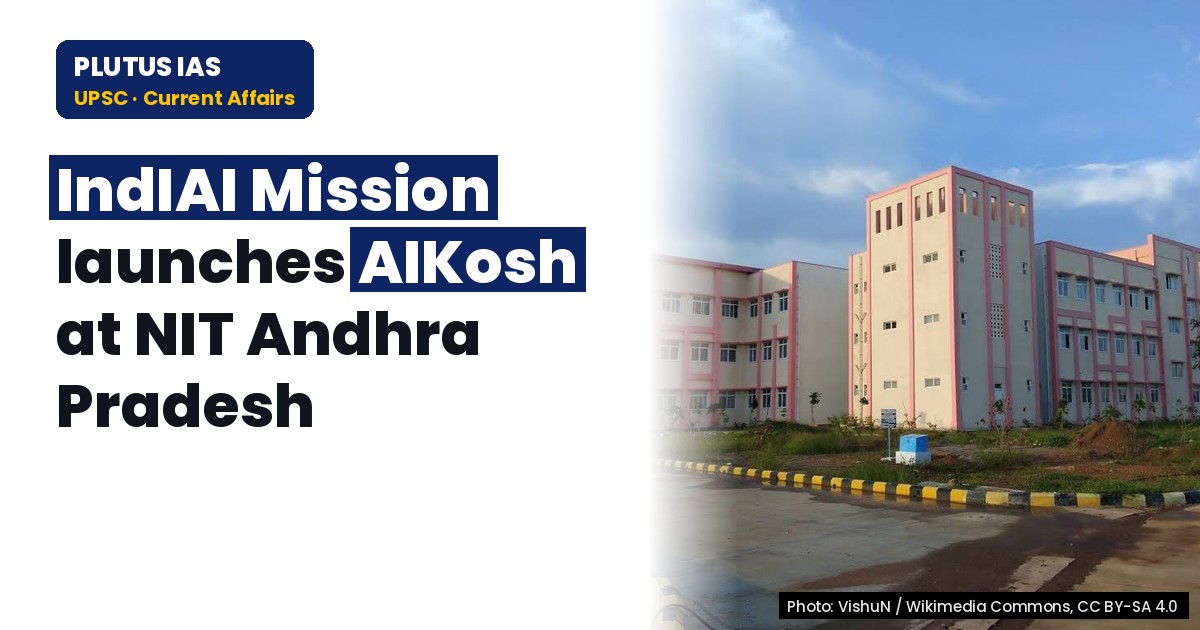
07 Oct IndIAI Mission Strengthens AI Talent Ecosystem at NIT Andhra Pradesh
✎ AI-Kosh UEP is a government initiative under the IndiaAI Mission to democratise AI education, integrate academic institutions into India’s AI ecosystem, and foster innovation through access to datasets, models, and toolkits.
Subject Relevance — Where This Topic Fits
- GS Paper II — Governance, Administration and Challenges (Digital Governance and AI Policy) | GS Paper III — Science and Technology (Emerging Technologies and Innovation)
- Prelims: AI-Kosh, IndiaAI Mission, NIT Andhra Pradesh, AI talent ecosystem, National AI Portal, AI literacy, Digital Public Infrastructure, Responsible AI, AI for Social Good, AI governance
- Essay: Role of Technology in Transforming Governance and Society, Bridging the Digital Divide: Inclusive Innovation for National Development
Quick Revision: AI-Kosh UEP is a government initiative under the IndiaAI Mission to democratise AI education, integrate academic institutions into India’s AI ecosystem, and foster innovation through access to datasets, models, and toolkits.
Why is this in the news?
The IndiaAI Mission, under the Ministry of Electronics and Information Technology (MeitY), Government of India, organised the AI-Kosh University Engagement Programme (UEP) at the National Institute of Technology (NIT), Andhra Pradesh, on 5 October 2026. This initiative is part of a broader strategy to democratise access to AI resources, enhance AI literacy, and integrate academic institutions into India’s national AI ecosystem. The programme aligns with the IndiaAI Mission’s vision to position India as a global leader in AI by fostering innovation, indigenous capabilities, and inclusive growth in the field.
Background
- The IndiaAI Mission was approved by the Government of India in March 2024 as a multi-stakeholder initiative to accelerate India’s AI capabilities while ensuring responsible and equitable development.
- AI-Kosh serves as the integrated data platform under the IndiaAI Mission, providing access to high-quality datasets, AI models, toolkits, benchmarks, and other critical resources to support research and AI applications.
- The mission aims to bridge the gap between AI innovation and societal needs by promoting indigenous AI capabilities and ensuring that AI benefits reach all sections of society.
- Academic institutions play a pivotal role in nurturing AI talent and fostering research ecosystems, making university engagement programmes essential for scaling India’s AI workforce.
- The collaboration between IndiaAI Mission and NIT Andhra Pradesh reflects the government’s focus on decentralising AI education and fostering grassroots innovation in tier-II and tier-III cities.
- The programme is part of a broader national effort to align AI development with the principles of ‘Viksit Bharat’ (Developed India) and the Digital India initiative.
What is the AI-Kosh University Engagement Programme (UEP)?
- The AI-Kosh UEP is a flagship initiative of the IndiaAI Mission designed to integrate academic institutions into India’s national AI ecosystem by providing access to AI resources, tools, and expertise.
- The programme aims to enhance AI literacy among students, encourage practical engagement with AI technologies, and foster innovation through hands-on learning and research.
- AI-Kosh, as the integrated data platform of the IndiaAI Mission, offers datasets, AI models, and development toolkits (such as AI-Kosh MCP and AI-Kosh SDK) to simplify access to AI resources for both developers and non-developers.
- The AI-Kosh MCP enables users to search datasets and AI models using natural language, reducing technical barriers and democratising AI adoption.
- The UEP includes expert sessions, live demonstrations, and practical activities to familiarise students with AI-Kosh and broader IndiaAI initiatives, including opportunities for institutional contributions to datasets.
- Students are encouraged to contribute to existing datasets, develop AI applications for social impact, and participate in the AI-Kosh open-source community, fostering a culture of collaboration and innovation.
- The programme aligns with the IndiaAI Mission’s goal of ensuring that AI benefits are accessible to all, particularly in underserved regions and institutions.
- The NIT Andhra Pradesh event engaged over 160 students, demonstrating the scalability of the programme and its potential for replication across other academic institutions.
Key Features
| Feature | Significance |
|---|---|
| AI-KOSH Unified Data Platform | Acts as India’s integrated repository for high-quality datasets, AI models, toolkits, and benchmarks, enabling research and application development across sectors. |
| AI-KOSH University Engagement Programme (UEP) | Facilitates direct exposure of students to national AI resources through expert sessions, live demonstrations, and hands-on activities, fostering practical learning. |
| AI-KOSH MCP (Model Context Protocol) | Enables users to discover datasets and AI models via natural language queries, reducing technical barriers for non-developers. |
| AI-KOSH SDK (Software Development Kit) | Provides developers with tools to integrate and deploy AI models, accelerating innovation in applied AI solutions. |
| Institutional Profile on AI-KOSH | Allows academic institutions to contribute datasets, enrich existing resources, and develop proof-of-concepts for public-interest use cases. |
Why it Matters
Economic and Innovation
- Strengthens India’s indigenous AI capabilities by democratising access to high-quality datasets and models, reducing reliance on proprietary foreign tools.
- Enhances the employability of Indian graduates by equipping them with skills aligned to global AI standards through hands-on exposure.
- Supports the growth of a self-reliant AI ecosystem, contributing to India’s ambition to become a global leader in responsible AI innovation.
Educational and Human Capital
- Bridges the AI literacy gap in higher education by integrating AI-KOSH into academic curricula, ensuring equitable access across institutions.
- Encourages interdisciplinary collaboration among students, fostering innovation in domains such as healthcare, agriculture, and governance.
- Creates a talent pipeline for India’s AI workforce by nurturing early-stage researchers and developers through structured engagement programmes.
Governance and Policy
- Operationalises the IndiaAI Mission’s vision of democratising AI by embedding resource-sharing mechanisms within the national digital public infrastructure.
- Aligns with the National Education Policy (NEP) 2020 by promoting experiential learning and industry-academia partnerships in emerging technologies.
- Supports the implementation of the National AI Strategy by providing a scalable platform for AI adoption in public services and governance.
Strategic Autonomy
- Reduces dependence on foreign AI platforms by promoting the use of indigenous datasets and models, enhancing data sovereignty.
- Facilitates the development of domain-specific AI solutions tailored to India’s socio-economic challenges, such as healthcare diagnostics and agricultural productivity.
Challenges
1. Digital Divide in AI Access
- Ensuring equitable access to AI-KOSH resources across tier-2 and tier-3 institutions, where digital infrastructure may be limited.
- Addressing disparities in internet connectivity and computational resources that hinder participation from rural and remote areas.
UPSC Link: GS3: Digital Divide & Inclusive Growth
2. Data Privacy and Security
- Mitigating risks associated with the aggregation and sharing of sensitive datasets on public platforms, requiring robust anonymisation and encryption protocols.
- Ensuring compliance with the Digital Personal Data Protection Act, 2023, while facilitating open access to datasets for research purposes.
UPSC Link: GS3: Data Governance & Cybersecurity
3. Skill Gap and Capacity Building
- Bridging the gap between academic training and industry requirements in AI, necessitating continuous upskilling and curriculum reforms.
- Addressing the shortage of qualified faculty in AI-related disciplines through targeted training programmes and industry collaborations.
UPSC Link: GS2: Education & Skill Development
4. Interoperability with Global Standards
- Ensuring compatibility of AI-KOSH with international AI frameworks and benchmarks to facilitate global collaboration and knowledge exchange.
- Harmonising data standards and model formats to avoid fragmentation in the AI ecosystem.
UPSC Link: GS3: Global Standards & Technology
5. Sustainable Funding and Maintenance
- Securing long-term funding for the maintenance, scaling, and continuous updating of AI-KOSH to keep pace with technological advancements.
- Developing a sustainable business model for the platform that balances open access with revenue generation for operational sustainability.
UPSC Link: GS3: Public Expenditure & Fiscal Policy
Challenges — UPSC Perspective
| Issue | Concern |
|---|---|
| Infrastructure Gaps | Limited digital infrastructure in rural institutions hinders participation in AI-KOSH programmes. |
| Data Governance | Lack of standardised protocols for data sharing may lead to privacy breaches or misuse. |
| Curriculum Misalignment | Traditional academic curricula often lag behind industry needs in AI and emerging technologies. |
| Talent Retention | Risk of brain drain as skilled AI professionals may migrate to global firms due to better opportunities. |
| Ethical AI Use | Need for clear guidelines on responsible AI development to prevent biases and misuse in applications. |
Government Initiatives — Must-Memorise for Prelims
- IndiaAI Mission
Way Forward
- Expand the AI-KOSH University Engagement Programme to cover more NITs, IITs, and state universities, ensuring pan-India participation.
- Develop tiered access models on AI-KOSH to accommodate institutions with varying digital infrastructure, including offline modules for remote areas.
- Establish a national AI literacy certification programme in collaboration with AI-KOSH to standardise skill development across institutions.
- Create a dedicated fund under the IndiaAI Mission for the maintenance and scaling of AI-KOSH, ensuring long-term sustainability.
- Strengthen data governance frameworks by integrating anonymisation tools and compliance modules directly into AI-KOSH.
- Foster industry-academia partnerships to align AI-KOSH resources with market demands, enhancing employability of graduates.
- Launch a mentorship programme where AI professionals guide student-led projects on AI-KOSH, bridging the skill gap.
- Promote open-source contributions by recognising and incentivising outstanding student projects, fostering innovation and ownership.
UPSC Value Addition
Keywords for Mains Answer-Writing
Artificial Intelligence (AI), IndiaAI Mission, AI-Kosh platform, National AI Ecosystem, AI literacy, AI resource democratisation, AI academic collaboration, AI talent ecosystem, AI innovation, AI governance, AI data platforms, AI toolkits, AI model repositories, AI integration in education, AI research and development (R&D), AI policy framework
Concept Flow
IndiaAI Mission’s vision of democratising AI → Establishment of AI-KOSH as a unified national platform → Integration with academic institutions via University Engagement Programme → Hands-on exposure of students to AI resources → Development of practical AI applications → Contribution to India’s AI-led innovation ecosystem.
Prelims Practice Questions
Q1. Consider the following statements regarding the IndiaAI Mission and the AI-Kosh platform:
1. The IndiaAI Mission was approved by the Government of India in March 2024.
2. AI-Kosh serves as an integrated data platform providing high-quality datasets, AI models, toolkits, and benchmarks.
3. The AI-Kosh University Engagement Programme (UEP) aims to enhance AI literacy and democratise access to AI resources among students.
4. AI-Kosh exclusively supports proprietary AI models and does not provide open-source resources.
How many of the above statements are correct?
- Only one
- Only two
- Only three
- All four
Answer: Only three — Statements 1, 2, and 3 are correct. Statement 4 is incorrect as AI-Kosh provides both open-source and proprietary resources, including datasets, models, and toolkits.
Q2. Assertion (A): The IndiaAI Mission aims to position India as a global leader in Artificial Intelligence by fostering innovation and indigenous AI capabilities.
Reason (R): The AI-Kosh platform facilitates access to national AI resources, enabling research and development in AI applications.
(a) Both A and R are true, and R is the correct explanation of A.
(b) Both A and R are true, but R is not the correct explanation of A.
(c) A is true, but R is false.
(d) A is false, but R is true.
- (a)
- (b)
- (c)
- (d)
Answer: (a) — Both the Assertion (A) and Reason (R) are true. The IndiaAI Mission indeed aims to make India a global leader in AI, and AI-Kosh acts as a critical enabler by providing accessible AI resources for research and development.
Q3. Match the following initiatives with their respective objectives under the IndiaAI Mission:
Column I (Initiative) | Column II (Objective)
———————————————–|—————————————-
A. AI-Kosh Platform | 1. Democratising AI literacy and access to resources
B. IndiaAI Mission | 2. Strengthening indigenous AI capabilities and innovation
C. AI-Kosh University Engagement Programme (UEP)| 3. Providing an integrated national AI data and resource platform
D. National AI Ecosystem | 4. Fostering collaboration between academia and industry
Options:
1. A-3, B-2, C-1, D-4
2. A-1, B-3, C-2, D-4
3. A-2, B-1, C-3, D-4
4. A-4, B-2, C-1, D-3
- 1
- 2
- 3
- 4
Answer: 1 — Correct matching: A-3 (AI-Kosh Platform provides an integrated national AI data and resource platform), B-2 (IndiaAI Mission aims to strengthen indigenous AI capabilities and innovation), C-1 (AI-Kosh UEP aims to democratise AI literacy and access), D-4 (National AI Ecosystem fosters collaboration between academia and industry).
Mains Practice Question
✍ The AI-Kosh platform, as part of the IndiaAI Mission, seeks to democratise access to Artificial Intelligence resources in India. Critically examine the significance of this initiative in bridging the AI literacy gap and fostering innovation within the academic ecosystem. Also, discuss the potential challenges in its implementation and scalability. (15 Marks)
Approach: 1. Introduction: Define AI-Kosh and its role within the IndiaAI Mission. Mention the broader objective of democratising AI access and fostering innovation.
2. Significance of AI-Kosh:
– Democratisation of AI resources: Highlight how AI-Kosh provides high-quality datasets, AI models, toolkits, and benchmarks to students and researchers, reducing barriers to entry.
– Academic collaboration: Explain how the University Engagement Programme (UEP) integrates academic institutions like NIT Andhra Pradesh, enabling practical exposure and skill development.
– Indigenous AI capabilities: Discuss how AI-Kosh supports the development of homegrown AI solutions, aligning with the IndiaAI Mission’s goal of reducing dependence on foreign AI technologies.
– Alignment with national priorities: Link the initiative to broader national objectives such as the National AI Strategy, Digital India, and Make in India.
3. Challenges in Implementation and Scalability:
– Digital divide: Address issues of unequal access to technology and internet connectivity across regions and socio-economic groups.
– Data privacy and security: Discuss concerns related to the handling of sensitive datasets and compliance with data protection frameworks like the Digital Personal Data Protection Act, 2023.
– Skill gaps: Highlight the need for continuous upskilling of faculty and students to effectively utilise AI-Kosh resources.
– Institutional readiness: Examine challenges in integrating AI-Kosh into existing academic curricula and research frameworks.
– Sustainability: Discuss the long-term funding, maintenance, and updating of AI-Kosh to ensure relevance and effectiveness.
4. Comparative Perspective (Optional for higher marks):
– Contrast AI-Kosh with similar global initiatives (e.g., EU’s AI-on-Demand platform, US’s National AI Research Resource).
5. Conclusion: Summarise the transformative potential of AI-Kosh while acknowledging the challenges. Emphasise the need for a multi-stakeholder approach involving government, academia, and industry to ensure its success.
Source: PIB (Press Information Bureau)
Andhra Pradesh PCS (APPSC) — State PCS Practice
Prelims: Under the IndiaAI Mission, the ‘AIKoSH University Partnership Program’ was recently launched at which institution in Andhra Pradesh to strengthen India’s AI talent ecosystem?
- A. Indian Institute of Technology (IIT) Tirupati
- B. National Institute of Technology (NIT) Andhra Pradesh
- C. Andhra University, Visakhapatnam
- D. Indian Institute of Science Education and Research (IISER) Tirupati
Answer: B. National Institute of Technology (NIT) Andhra Pradesh — The AIKoSH University Partnership Program was launched at the National Institute of Technology (NIT) Andhra Pradesh under the IndiaAI Mission to enhance AI talent development.
Mains: Discuss the significance of the AIKoSH University Partnership Program launched under the IndiaAI Mission in Andhra Pradesh. How does this initiative align with the broader objectives of the IndiaAI Mission, and what impact can it have on the state’s technological and economic landscape?
Generated by AanyaAi for educational purpose.
Related guides on our sites
- Anthropology VS PSIR
- Best PSIR optional coaching
- Best PSIR optional coaching online
- Best PSIR optional teacher

- IndIAI Mission Strengthens AI Talent Ecosystem at NIT Andhra Pradesh - October 7, 2026
- स्वच्छता ही सेवा 2026: पंचायतों में सफाई अभियान की मुख्य बातें - October 7, 2026
- RBI Repo Rate Hike to 5.5%: Impact on UPSC & State PCS Economy Syllabus - October 7, 2026

No Comments