


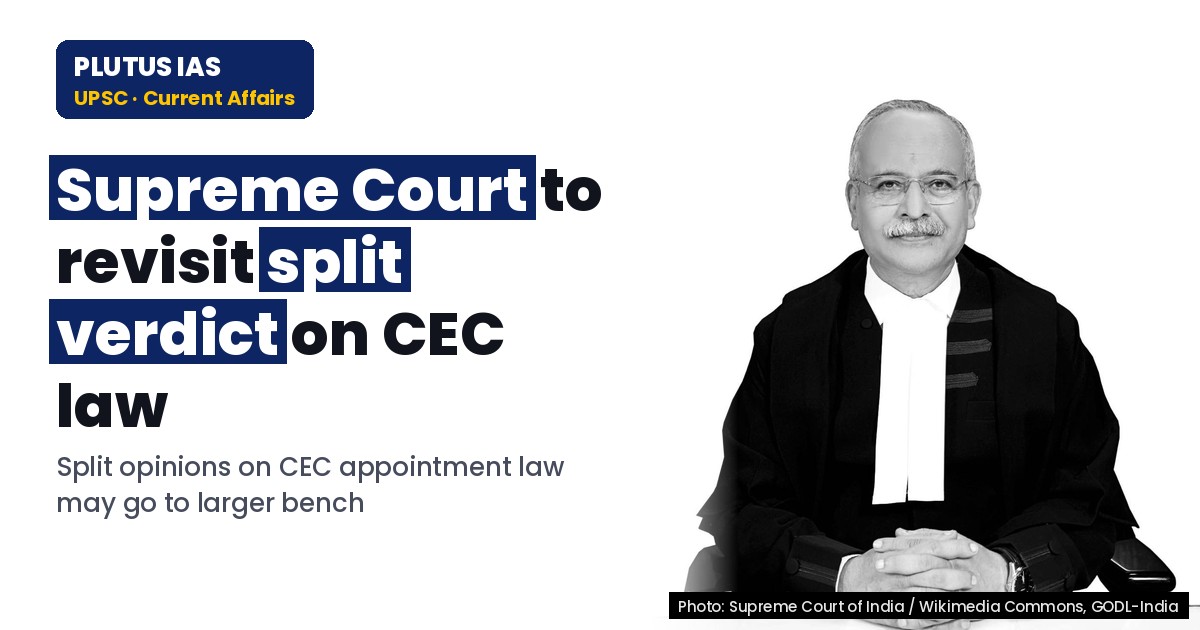
07 Oct Supreme Court to Review Split Verdict on CEC Appointment Law
✎ The appointment of the Chief Election Commissioner and Election Commissioners is governed by Article 324(2) of the Constitution, and any legislative amendment to this process is subject to judicial review to ensure adherence to…
Subject Relevance — Where This Topic Fits
- GS Paper II — Polity and Governance: Constitutional and Statutory Bodies | GS Paper II — Fundamental Rights and Judicial Review
- Prelims: Election Commission of India (ECI), Chief Election Commissioner (CEC), Article 324, Constitution (104th Amendment) Act 2023, Judicial Review, Split Verdict, Constitution Bench, Curative Petition, Article 145(5), Article 324(2), Collegium System, Judicial Independence, Separation of Powers
- Essay: The Role of Independent Constitutional Institutions in Democratic Governance, Judicial Review and the Balance of Powers in India
Quick Revision: The appointment of the Chief Election Commissioner and Election Commissioners is governed by Article 324(2) of the Constitution, and any legislative amendment to this process is subject to judicial review to ensure adherence to constitutional principles of independence and separation of powers.
Why is this in the news?
The Supreme Court of India is currently examining a plea seeking the recall of a recent split verdict delivered by a two-judge bench on the constitutional validity of the 2023 law governing the appointment process of the Chief Election Commissioner (CEC) and Election Commissioners (ECs). The split verdict, delivered on September 23, 2026, has raised critical questions regarding the referral of the matter to a larger Constitution Bench, thereby necessitating judicial clarity on the interpretation of Article 324(2) and the role of the Chief Justice of India (CJI) in the appointment process.
Background
- The Election Commission of India (ECI) is a constitutional body established under Article 324 of the Constitution, responsible for the superintendence, direction, and control of the electoral process in India.
- The appointment process of the CEC and ECs has historically been governed by executive discretion, with the President of India making appointments based on the advice of the Council of Ministers.
- The amendment was challenged in the Supreme Court on grounds of violating the principles of independence of the judiciary and the separation of powers, as enshrined in the Constitution.
- A two-judge bench of the Supreme Court delivered a split verdict on September 23, 2026, with one judge declining the Centre’s request for a reference to a larger Constitution Bench, while the other favoured such a reference due to the complexity of the issues involved.
- The recall plea seeks to address the legal uncertainty arising from the split verdict, which has implications for the autonomy and impartiality of the ECI.
What is the Appointment Process of the Election Commission of India?
- The Election Commission of India (ECI) is a constitutional body established under Article 324 of the Constitution, tasked with overseeing the conduct of elections in India.
- The ECI consists of the Chief Election Commissioner (CEC) and Election Commissioners (ECs), whose appointments are made by the President of India on the advice of the Council of Ministers, as per the constitutional framework.
- The independence of the ECI is a cornerstone of free and fair elections, and any legislative or executive action that undermines this independence is subject to judicial review under Article 136 and Article 226 of the Constitution.
- The Supreme Court’s role in interpreting the constitutional provisions governing the ECI is pivotal in ensuring that the appointment process adheres to the principles of fairness, transparency, and separation of powers.
- The recall plea and the curative petition filed in the Supreme Court highlight the ongoing judicial scrutiny of the appointment process, reflecting the judiciary’s responsibility to safeguard constitutional values.
- The split verdict underscores the complexity of balancing executive authority with judicial oversight in matters concerning constitutional bodies.
- The outcome of the Supreme Court’s examination of the recall plea will have far-reaching implications for the autonomy of the ECI and the integrity of the electoral process in India.
Key Features
| Feature | Significance |
|---|---|
| Split Verdict in Supreme Court | A two-judge bench of the Supreme Court delivered divergent opinions on the referral of challenges to the 2023 law governing the appointment of the Chief Election Commissioner (CEC) and Election Commissioners (ECs) to a larger Constitution bench, necessitating resolution of the judicial impasse. |
| Recall Application Mechanism | The Supreme Court has agreed to examine a plea seeking recall of the split verdict, highlighting the procedural recourse available within the judicial system to address judicial inconsistencies or errors in judgment. |
| Role of the Chief Justice of India (CJI) | The administrative authority of the CJI in constituting an appropriate bench for authoritative adjudication underscores the institutional mechanism to resolve judicial disagreements and ensure coherence in constitutional interpretation. |
| Curative Petition as Parallel Remedy | The existence of a curative petition alongside the recall application illustrates the layered judicial remedies available to litigants, emphasizing the hierarchy of legal recourse in constitutional matters. |
| Judicial Independence and Collegium System | The case indirectly touches upon the broader principle of judicial independence, particularly in the context of appointments to constitutional bodies, and the balance between judicial and executive roles in governance. |
Why it Matters
Constitutional Governance
- The case underscores the constitutional framework governing the appointment of key electoral authorities, particularly the CEC and ECs, whose independence is critical for free and fair elections.
- A split verdict in the Supreme Court highlights the need for clarity in constitutional interpretation, especially in matters affecting the independence of constitutional bodies.
- The resolution of this case will have implications for the balance of powers between the judiciary and the executive in matters of constitutional appointments.
- The case reinforces the principle that constitutional bodies must function independently to uphold democratic principles and electoral integrity.
- The judicial process itself, including mechanisms like recall applications and curative petitions, demonstrates the robustness of constitutional governance in addressing judicial inconsistencies.
Electoral Integrity
- The appointment process of the CEC and ECs is pivotal to maintaining the credibility and neutrality of the Election Commission of India (ECI), which is the guardian of electoral democracy.
- Any ambiguity in the legal framework governing these appointments can undermine public trust in the electoral process and the independence of the ECI.
- The case reflects broader concerns about the autonomy of electoral institutions and their ability to function without undue influence from other branches of government.
- A definitive judicial ruling on this matter will strengthen the institutional framework necessary for conducting free, fair, and transparent elections.
- The outcome may influence future reforms aimed at enhancing the transparency and accountability of electoral appointments.
Judicial Precedent and Consistency
- A split verdict in the Supreme Court necessitates resolution to avoid conflicting judicial interpretations, which can create legal uncertainty and undermine the predictability of constitutional law.
- The case highlights the importance of larger benches in resolving complex constitutional questions, particularly those involving the interpretation of fundamental principles.
- The judicial process of recalling or reviewing a split verdict ensures that constitutional law evolves in a coherent and consistent manner.
- The resolution of this case will set a precedent for future disputes involving the appointment of constitutional authorities, ensuring uniformity in judicial reasoning.
- The case also underscores the role of the CJI in maintaining judicial coherence and resolving disagreements among benches.
Challenges
1. Judicial Impasse Due to Split Verdict
- A split verdict in the Supreme Court creates legal uncertainty and delays resolution of critical constitutional questions.
- The divergence in judicial opinions necessitates intervention by a larger bench, which may prolong the adjudication process.
- The administrative burden on the CJI to constitute an appropriate bench adds to the complexity of resolving the impasse.
- The lack of immediate clarity in the law governing CEC and EC appointments may affect public perception of judicial efficiency.
- The case highlights the challenges of balancing judicial independence with the need for timely and coherent adjudication.
UPSC Link: GS-II: Judiciary – Independence, Structure, and Functions
2. Ensuring Independence of Constitutional Bodies
- The appointment process of the CEC and ECs must balance executive prerogative with judicial and institutional independence to prevent undue influence.
- The exclusion of the CJI from the selection panel in the 2023 law raises questions about the autonomy of the Election Commission of India (ECI).
- The case reflects broader concerns about the independence of constitutional bodies and their ability to function without external interference.
- Ensuring the independence of the ECI is critical for maintaining public trust in the electoral process and democratic governance.
- The resolution of this case may influence future reforms aimed at enhancing the transparency and accountability of electoral appointments.
UPSC Link: GS-II: Constitutional Bodies – Independence and Accountability
3. Legal Recourse and Judicial Remedies
- The existence of multiple judicial remedies, such as recall applications and curative petitions, highlights the complexity of addressing judicial inconsistencies.
- The interplay between these remedies raises questions about their effectiveness and the hierarchy of legal recourse in constitutional matters.
- The case underscores the need for clear procedural guidelines to streamline the resolution of split verdicts and other judicial disagreements.
- The judicial process must balance the principles of finality and correctness to ensure justice is served without undue delay.
- The resolution of this case may provide clarity on the scope and applicability of recall applications and curative petitions in constitutional adjudication.
UPSC Link: GS-II: Judiciary – Judicial Review and Writs
4. Public Trust and Perception of Judicial Efficiency
- A prolonged resolution of the split verdict may erode public confidence in the judiciary’s ability to deliver timely and coherent judgments.
- The case highlights the importance of transparency and communication in judicial processes to maintain public trust.
- The perception of judicial efficiency is critical for the legitimacy of the judiciary as an institution of governance.
- The resolution of this case will have implications for how the judiciary is perceived in matters of constitutional governance and electoral integrity.
- Ensuring public trust in the judiciary is essential for upholding the rule of law and democratic principles.
UPSC Link: GS-II: Judiciary – Role and Importance
Challenges — UPSC Perspective
| Issue | Concern |
|---|---|
| Split Verdict in Supreme Court | Creates legal uncertainty and delays resolution of constitutional questions regarding CEC and EC appointments. |
| Exclusion of CJI from Selection Panel | Raises questions about the independence of the Election Commission of India and the balance of powers between the judiciary and executive. |
| Multiple Judicial Remedies | Highlights the complexity of addressing judicial inconsistencies and the need for clear procedural guidelines. |
| Public Trust in Judiciary | A prolonged resolution may erode confidence in the judiciary’s ability to deliver timely and coherent judgments. |
| Administrative Burden on CJI | The need to constitute an appropriate bench adds to the complexity of resolving the judicial impasse. |
| Legal Precedent and Consistency | The case underscores the importance of larger benches in resolving complex constitutional questions to ensure uniformity in judicial reasoning. |
Way Forward
- The Supreme Court must constitute a larger Constitution bench to resolve the split verdict and provide a definitive ruling on the appointment process of the CEC and ECs.
- Parliament and the government may consider legislative reforms to clarify the appointment process, ensuring it balances executive prerogative with judicial and institutional independence.
- The Election Commission of India (ECI) should proactively engage with stakeholders to address concerns about the independence of the CEC and ECs, reinforcing public trust in the electoral process.
- Judicial reforms may be explored to streamline the resolution of split verdicts, including clearer guidelines for recall applications and curative petitions.
- Civil society and legal experts should monitor the case closely, providing inputs to ensure that the resolution aligns with constitutional principles and democratic values.
- The resolution of this case should be communicated transparently to the public, highlighting the judiciary’s commitment to upholding constitutional governance and electoral integrity.
- Future reforms may focus on enhancing the transparency and accountability of the appointment process for constitutional bodies, ensuring their independence and credibility.
- The judiciary and the executive must collaborate to establish a robust framework for appointments to constitutional bodies, balancing institutional autonomy with democratic accountability.
UPSC Value Addition
Keywords for Mains Answer-Writing
Constitutional Appointments · Chief Election Commissioner · Election Commissioners · Article 324 · Article 243K · Constitution Bench · Judicial Review · Split Verdict · Recall of Judgment · Election Commission of India · Appointment Procedure · Judicial Independence · Doctrine of Separation of Powers · Constitutional Morality · Judicial Activism · Electoral Reforms · Supreme Court of India · Constitutional Provisions on Elections
Constitutional & Policy Linkages
- {‘Article 324’: ‘Constitutional provisions governing the Election Commission of India and its independence.’}
- {‘Article 329’: ‘Bar on interference in electoral matters by courts.’}
- {‘Article 142’: ‘Power of the Supreme Court to do complete justice.’}
- {‘Article 50’: ‘Separation of judiciary from executive.’}
Concept Flow
Constitutional Provision (Article 324) → Appointment of CEC and ECs → 2023 Law Excluding CJI from Selection Panel → Challenges to the Law → Split Verdict in Supreme Court → Recall Application Filed → CJI Constitutes Larger Bench → Resolution of Judicial Impasse → Clarity in Constitutional Interpretation → Strengthening of Electoral Integrity → Judicial Independence → Balance of Powers (Executive vs. Judiciary) → Public Trust in Electoral Institutions → Need for Transparent and Accountable Appointment Process → Legislative and Judicial Reforms → Split Verdict → Legal Uncertainty → Multiple Judicial Remedies (Recall, Curative) → Procedural Complexity → Resolution by Larger Bench → Precedent Setting → Consistency in Constitutional Law → Appointment Process of CEC/ECs → Independence of ECI → Electoral Integrity → Democratic Governance → Public Confidence in Institutions → Judicial Process → Administrative Role of CJI → Constitution of Appropriate Bench → Authoritative Adjudication → Resolution of Constitutional Questions
Prelims Practice Questions
Q1. Consider the following statements regarding the appointment of the Chief Election Commissioner (CEC) and Election Commissioners (ECs) in India:
1. The Chief Justice of India (CJI) is constitutionally mandated to be part of the selection committee for the appointment of the CEC and ECs.
2. The Election Commission of India (ECI) is a constitutional body under Article 324 of the Constitution.
3. The tenure and service conditions of the CEC and ECs are determined by the Parliament.
How many of the above statements are correct?
- Only one
- Only two
- All three
- None
Answer: Only two — Statement 1 is incorrect: The CJI is not constitutionally mandated to be part of the selection committee; the 2023 law excludes the CJI from the panel. Statement 2 is correct: The ECI is a constitutional body under Article 324. Statement 3 is correct: The Parliament determines the tenure and service conditions of the CEC and ECs under Article 324(5).
Q2. Assertion (A): The Supreme Court of India has the power to recall its own judgments under Article 142 of the Constitution.
Reason (R): The power under Article 142 is absolute and can be exercised to do complete justice in any cause or matter pending before it.
Options:
A. Both A and R are true, and R is the correct explanation of A.
B. Both A and R are true, but R is NOT the correct explanation of A.
C. A is true, but R is false.
D. A is false, but R is true.
Answer: ? — Assertion (A) is true: The Supreme Court can recall its judgments under Article 142 to ensure complete justice. Reason (R) is also true and correctly explains A, as Article 142 empowers the Court to pass any order necessary for doing complete justice.
Q3. Match the following constitutional provisions with their respective subjects:
Column I (Constitutional Provision)
A. Article 324
B. Article 243K
C. Article 142
D. Article 74
Column II (Subject)
1. Appointment of the Election Commission of India
2. Appointment of the Chief Election Commissioner and Election Commissioners
3. Power of the Supreme Court to do complete justice
4. Role and functions of the Council of Ministers
Options:
A B C D
1 2 3 4
2 1 4 3
3 4 1 2
4 3 2 1
Answer: ? — A. Article 324: Appointment of the Election Commission of India.
B. Article 243K: Appointment of the Chief Election Commissioner and Election Commissioners.
C. Article 142: Power of the Supreme Court to do complete justice.
D. Article 74: Role and functions of the Council of Ministers.
Mains Practice Question
✍ The Supreme Court’s split verdict on the constitutional validity of the 2023 law governing the appointment of the Chief Election Commissioner (CEC) and Election Commissioners has reignited debates on judicial independence, separation of powers, and the integrity of electoral institutions. Critically examine the constitutional framework governing the appointment of the CEC and ECs, and analyse the implications of the Supreme Court’s intervention in this matter. (15 Marks)
Approach: MODEL-ANSWER SKELETON:
1. **Constitutional Framework** (5 points):
– Article 324(2) of the Constitution establishes the Election Commission of India (ECI) as a multi-member body.
– Article 324(5) empowers Parliament to determine the tenure, service conditions, and removal process of the CEC and ECs.
– The original constitutional scheme did not specify the appointment process; it was left to Parliament.
– The 2023 law (Conduct of Elections (Amendment) Act, 2023) introduced a three-member committee for appointments, excluding the Chief Justice of India (CJI).
– Contrast with Article 243K (73rd and 74th Amendments), which specifies a similar committee for State Election Commissions.
2. **Judicial Review and Split Verdict** (5 points):
– The Supreme Court’s split verdict (Justices Dipankar Datta and Satish Chandra Sharma) reflects differing judicial interpretations of the balance between legislative competence and judicial oversight.
– Justice Datta’s opinion: The 2023 law is valid as Parliament has the competence to legislate on electoral matters under Entry 72 of the Union List.
– Justice Sharma’s opinion: The exclusion of the CJI undermines the principle of judicial independence and the doctrine of constitutional morality.
– The Court’s reference to a larger bench highlights the need for clarity on the scope of judicial review in matters of constitutional appointments.
3. **Implications and Way Forward** (5 points):
– **Judicial Independence vs. Legislative Competence**: The debate centres on whether the judiciary can review the constitutionality of a law that regulates the appointment of constitutional functionaries.
– **Electoral Integrity**: The ECI’s independence is critical for free and fair elections; the appointment process must ensure neutrality and expertise.
– **Precedents**: Cite relevant cases such as *Union of India v. Association for Democratic Reforms* (2002) and *Common Cause v. Union of India* (2018) on judicial oversight of electoral reforms.
– **Global Comparisons**: Briefly compare with appointment processes in other democracies (e.g., UK’s Judicial Appointments Commission, US’s bipartisan commission).
– **Constitutional Morality**: Emphasise the need to uphold constitutional morality, as articulated in *Kesavananda Bharati v. State of Kerala* (1973), to ensure the appointment process is fair and transparent.
Source: orissapost.com
Generated by AanyaAi for educational purpose.
Related guides on our sites
- Anthropology VS PSIR
- Best PSIR optional coaching
- Best PSIR optional coaching online
- Best coaching for law optional

- Supreme Court to Review Split Verdict on CEC Appointment Law - October 7, 2026
- केरल के नौ तटीय पंचायतों को सुनामी-तैयार के लिए यूनेस्को मूल्यांकन हेतु प्रस्तुत - October 7, 2026
- RBI Raises FY27 GDP Growth Forecast to 7.1%: Key Implications for UPSC & State PCS - October 7, 2026

No Comments