


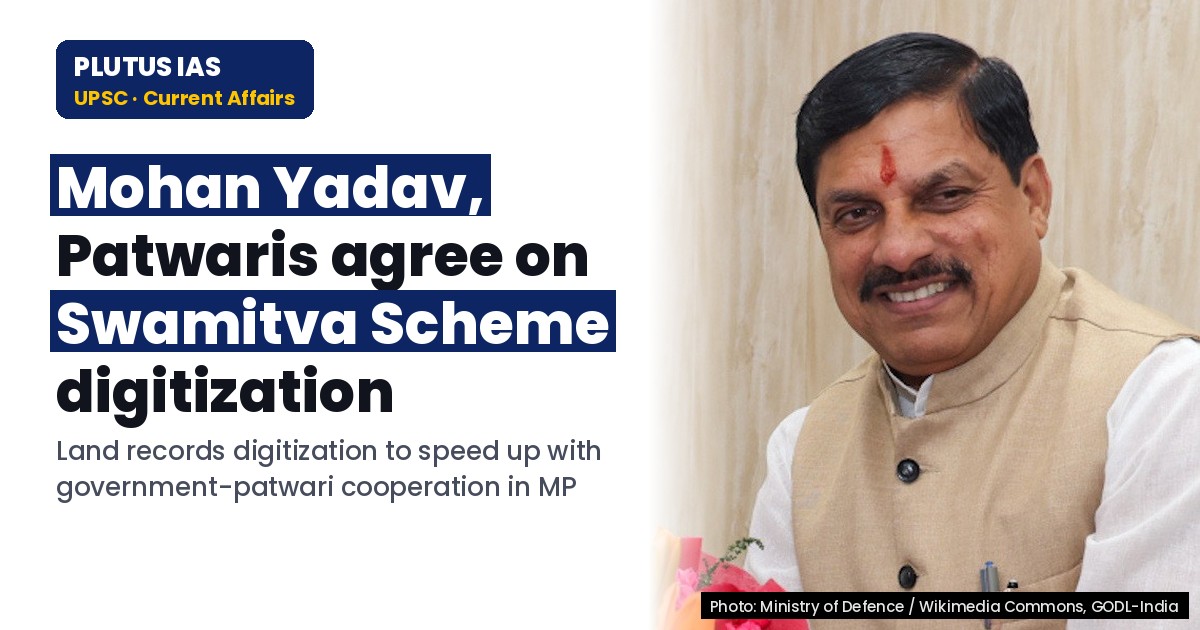
09 Oct MP Swamitva Scheme: Govt-Patwari Consensus Boosts Land Records Digitization
✎ The Swamitva Scheme is a central sector initiative under the Ministry of Panchayati Raj, aimed at providing legal recognition to rural land holdings through drone-based mapping and GIS technology, in alignment with the Digital…
Subject Relevance — Where This Topic Fits
- GS Paper II — Governance, Constitution and Polity | GS Paper III — Land Reforms and Rural Development
- Prelims: Swamitva Scheme, Digital India Land Records Modernisation Programme (DILRMP), Patwari system, Property rights in rural India, Land Titling, Revenue Administration, Article 246 (State List – Land), Concurrent List – Land Reforms
- Essay: Land ownership and socio-economic equity in rural India, Role of technology in governance and citizen empowerment
Quick Revision: The Swamitva Scheme is a central sector initiative under the Ministry of Panchayati Raj, aimed at providing legal recognition to rural land holdings through drone-based mapping and GIS technology, in alignment with the Digital India Land Records Modernisation Programme (DILRMP).
Why is this in the news?
The Swamitva Scheme, a central sector scheme aimed at providing ‘Record of Rights’ to property owners in rural inhabited areas through the use of drone technology and GIS mapping, has gained momentum in Madhya Pradesh following a consensus between the state government and the Patwari Association. This development is significant as it addresses long-standing challenges in rural land records, property disputes, and revenue administration, while also highlighting the interplay between constitutional federalism, land governance, and technological integration in public administration.
Background
- The Swamitva Scheme was launched by the Government of India in April 2020 as a pilot project in six states, including Madhya Pradesh, under the aegis of the Ministry of Panchayati Raj.
- The scheme is a component of the Digital India Land Records Modernisation Programme (DILRMP), which seeks to modernise land records, reduce disputes, and enhance transparency in rural land governance.
- Rural land records in India are predominantly maintained by the Patwari system, a traditional revenue administration mechanism established under colonial-era revenue laws, which has faced criticism for inefficiency, corruption, and lack of transparency.
- The Patwari system operates under the State Revenue Department and is responsible for maintaining land records, conducting surveys, and resolving disputes at the village level.
- Madhya Pradesh, with a significant rural population and a history of land disputes, has been a key focus for the implementation of the Swamitva Scheme to streamline property rights and reduce litigation.
- The scheme leverages drone technology, GIS mapping, and satellite imagery to create accurate and tamper-proof land records, thereby reducing the scope for fraud and disputes.
What is the Swamitva Scheme?
- The Swamitva Scheme is a central sector scheme launched by the Ministry of Panchayati Raj to provide ‘Record of Rights’ to property owners in rural inhabited areas, thereby conferring legal recognition to their land holdings.
- The scheme aims to demarcate rural inhabited areas using drone technology and GIS mapping, ensuring accurate and up-to-date land records that are tamper-proof and accessible to citizens.
- Under the scheme, property cards are issued to rural landowners, which can be used for availing bank loans, resolving disputes, and facilitating land transactions, thereby enhancing economic security and reducing litigation.
- The scheme is implemented in collaboration with the Survey of India, State Revenue Departments, and local Panchayati Raj institutions, ensuring a multi-stakeholder approach to land governance.
- The Swamitva Scheme is aligned with the broader objectives of the Digital India Land Records Modernisation Programme (DILRMP), which seeks to modernise land records, reduce disputes, and enhance transparency in rural land administration.
- The scheme addresses the challenges posed by the traditional Patwari system, which has been criticised for inefficiency, corruption, and lack of transparency in maintaining land records.
- The scheme also aims to reduce the burden on courts by providing a clear and legally recognised record of land ownership, thereby minimising disputes and litigation.
- The Swamitva Scheme is a step towards achieving the Sustainable Development Goal (SDG) 1.4, which seeks to ensure equal rights to economic resources, including access to land, for all, particularly women and marginalised communities.
Key Features
| Feature | Significance |
|---|---|
| Consensus between State Government and Patwari Association | Ensures administrative synergy for the Swamitva Scheme’s implementation, reducing bureaucratic friction. |
| Issuance of Necessary Administrative Orders by the Chief Minister | Provides legal and procedural clarity, enabling the Patwari system to function within the scheme’s framework. |
| Assurance of Full Cooperation by the Patwari Union | Facilitates seamless execution of property mapping and documentation at the grassroots level. |
| Judicial Safeguards for Implementation | Protects Patwari officials from legal or extralegal pressures during the execution of duties under the scheme. |
| Integration with Revenue Administration Reforms | Links Swamitva Scheme outcomes with broader revenue administration efficiency and transparency measures. |
Why it Matters
Economic Implications
- Accelerates rural property rights formalization, potentially unlocking land as collateral for credit access in agriculture and allied sectors.
- Enhances land market efficiency by reducing disputes over ownership, thereby improving investment attractiveness in rural areas.
- Supports the monetization of land assets, contributing to rural economic growth and fiscal federalism through increased land revenue.
Administrative Reforms
- Demonstrates the efficacy of inter-departmental coordination between revenue administration and grassroots functionaries.
- Sets a precedent for participatory governance in land records modernization, aligning with the Digital India Land Records Modernization Programme (DILRMP).
- Strengthens the role of Patwaris as frontline officials in property rights documentation, bridging the digital divide in rural governance.
Legal and Governance Impact
- Reinforces the legal sanctity of property records under the Swamitva Scheme, reducing litigation and enhancing tenure security.
- Promotes transparency in revenue administration by standardizing processes and reducing discretionary powers at the local level.
- Aligns with constitutional provisions on property rights (Article 300A) and the Directive Principles of State Policy (Article 39(b)) on equitable resource distribution.
Challenges
1. Resistance from Local Revenue Functionaries
- Potential reluctance among Patwaris due to perceived loss of discretionary authority in land records maintenance.
- Need for capacity-building to ensure seamless adoption of digital tools and new documentation protocols.
UPSC Link: Revenue administration reforms
2. Data Accuracy and Dispute Resolution
- Risk of errors in property mapping due to outdated or incomplete land records.
- Requirement for robust grievance redressal mechanisms to resolve ownership disputes arising during the scheme’s implementation.
UPSC Link: Land reform and dispute resolution
3. Digital Divide and Infrastructure Gaps
- Limited digital literacy and connectivity in rural areas may hinder the scheme’s reach and effectiveness.
- Dependence on technology requires continuous monitoring to prevent exclusion of marginalized communities.
UPSC Link: Digital India and rural infrastructure
4. Inter-State Coordination for Cross-Border Land Parcels
- Challenges in harmonizing land records across state borders, particularly for contiguous rural properties.
- Need for standardized protocols to ensure consistency in property rights documentation.
UPSC Link: Inter-state coordination in land administration
Challenges — UPSC Perspective
| Issue | Concern |
|---|---|
| Patwari Resistance | Reluctance to adopt digital tools and new documentation protocols due to loss of discretionary powers. |
| Data Accuracy | Errors in property mapping due to outdated or incomplete land records. |
| Dispute Resolution | Lack of robust mechanisms to address ownership disputes during implementation. |
| Digital Divide | Limited digital literacy and connectivity in rural areas hindering scheme effectiveness. |
| Inter-State Coordination | Challenges in harmonizing land records across state borders for contiguous properties. |
Government Initiatives — Must-Memorise for Prelims
- Swamitva Scheme
- Digital India Land Records Modernization Programme (DILRMP)
Way Forward
- Issue detailed administrative orders clarifying the roles and responsibilities of Patwaris under the Swamitva Scheme.
- Conduct capacity-building programs for Patwaris to familiarize them with digital tools and new documentation protocols.
- Establish a dedicated grievance redressal mechanism for addressing ownership disputes arising during the scheme’s implementation.
- Strengthen rural digital infrastructure to ensure seamless integration of land records with the Swamitva Scheme.
- Promote inter-state coordination to harmonize land records for properties spanning multiple states.
- Monitor and evaluate the scheme’s progress through regular audits to ensure data accuracy and transparency.
- Engage civil society organizations to sensitize rural communities about the benefits and processes of the Swamitva Scheme.
UPSC Value Addition
Keywords for Mains Answer-Writing
Swamitva Scheme · property rights documentation · land records modernisation · patwari system reforms · rural property rights · digital land governance · land revenue administration · convergence of technology and bureaucracy · collaborative governance · Madhya Pradesh administration
Constitutional & Policy Linkages
- Article 300A: Right to Property
- Article 39(b): Directive Principles of State Policy on equitable resource distribution
Concept Flow
State Government initiates Swamitva Scheme to map and document rural property rights. → Patwari Association raises concerns over implementation challenges and discretionary authority. → Consensus-building meetings between government and Patwari Association to address concerns. → Issuance of administrative orders to clarify roles and provide legal safeguards for Patwaris. → Patwaris commit to full cooperation, enabling seamless execution of property mapping and documentation. → Digital integration of land records under DILRMP to ensure accuracy and transparency. → Outcome: Enhanced tenure security, reduced disputes, and improved rural economic opportunities.
Prelims Practice Questions
Q1. Consider the following statements regarding the Swamitva Scheme:
1. It is a centrally sponsored scheme aimed at mapping residential properties in rural areas using drone technology.
2. The scheme is implemented by the Ministry of Rural Development in collaboration with state revenue departments.
3. The primary objective is to provide ‘Record of Rights’ to property owners in rural India.
4. The scheme was launched in the year 2020 and is operational across all states and union territories.
How many of the above statements are correct?
- Only one
- Only two
- Only three
- All four
Answer: All four — Statements 1, 2, and 3 are correct. Statement 4 is incorrect as the scheme is being implemented in a phased manner and is not yet operational across all states and union territories.
Q2. Assertion (A): The Swamitva Scheme seeks to digitise land records and reduce disputes over property ownership in rural areas.
Reason (R): The scheme utilises drone-based aerial surveys to create accurate property maps and issue legal titles to landowners.
Options:
A. Both A and R are true, and R is the correct explanation of A.
B. Both A and R are true, but R is not the correct explanation of A.
C. A is true but R is false.
D. A is false but R is true.
Answer: ? — Both Assertion (A) and Reason (R) are true, and Reason (R) correctly explains Assertion (A). The scheme aims to digitise land records and reduce disputes by issuing legal titles based on drone surveys.
Q3. Match the following columns related to land revenue administration in India:
Column I (Institution/Role)
1. Patwari
2. Tehsildar
3. Collector
4. Revenue Court
Column II (Function)
A. Maintains village-level land records and assists in revenue collection.
B. Adjudicates disputes related to land revenue and property rights.
C. Supervises revenue administration at the district level and ensures implementation of government policies.
D. Oversees land consolidation and mutation processes at the sub-district level.
Options:
1. 1-A, 2-D, 3-C, 4-B
2. 1-A, 2-C, 3-D, 4-B
3. 1-B, 2-A, 3-C, 4-D
4. 1-D, 2-A, 3-B, 4-C
Answer: ? — Correct matching: 1-A (Patwari maintains village-level land records), 2-D (Tehsildar oversees land consolidation and mutation), 3-C (Collector supervises revenue administration at the district level), 4-B (Revenue Court adjudicates disputes).
Mains Practice Question
✍ The Swamitva Scheme represents a paradigm shift in rural land governance through the convergence of technology and administrative reform. Critically examine the scheme’s objectives, implementation mechanisms, and the challenges it faces in ensuring equitable property rights documentation. Also, analyse the role of the patwari system in this transformation and the measures required to enhance its efficacy. (15 Marks)
Approach: MODEL-ANSWER SKELETON:
1. Introduction (2 marks):
– Define the Swamitva Scheme: centrally sponsored initiative under the Ministry of Panchayati Raj to map residential properties in rural areas using drone technology and issue ‘Record of Rights’ to property owners.
– Contextualise with the need for land record modernisation to reduce disputes, facilitate financial inclusion, and support welfare schemes.
2. Objectives of the Scheme (3 marks):
– Creation of accurate, tamper-proof land records through drone-based aerial surveys.
– Issuance of legal titles to property owners in rural India, thereby conferring ownership rights.
– Reduction of land disputes and streamlining of land revenue administration.
– Facilitation of access to credit and welfare benefits through clear property titles.
– Digital integration of land records with state revenue systems for transparency and efficiency.
3. Implementation Mechanisms (4 marks):
– Phased rollout: pilot in select states (e.g., Maharashtra, Karnataka) followed by national expansion.
– Collaboration with state revenue departments, local bodies, and technology partners (e.g., Survey of India, NIC).
– Use of drones, GIS mapping, and blockchain for secure record-keeping.
– Training and capacity-building for patwaris and revenue officials to adapt to digital tools.
– Public awareness campaigns to ensure community participation and acceptance.
4. Role of the Patwari System (3 marks):
– Historical context: patwaris as traditional custodians of land records in rural India, responsible for maintaining village-level records and assisting in revenue collection.
– Current challenges: manual record-keeping, delays in mutation, susceptibility to corruption, and lack of technological integration.
– Role in Swamitva Scheme: transition from manual to digital record-keeping, verification of drone-surveyed maps, and issuance of property titles.
– Need for reform: capacity-building, digital literacy, and institutional support to enhance patwari efficacy.
5. Challenges and Way Forward (3 marks):
– Challenges: resistance to change, lack of awareness among rural populations, technological barriers, and inter-departmental coordination issues.
– Equity concerns: ensuring inclusion of marginalised communities (e.g., women, Scheduled Castes/Tribes) in property rights documentation.
– Legal and administrative hurdles: harmonisation of state land laws, dispute resolution mechanisms, and grievance redressal.
– Measures for enhancement: continuous training, stakeholder engagement, and leveraging public-private partnerships for technology adoption.
6. Conclusion (2 marks):
– Reiterate the transformative potential of the Swamitva Scheme in rural land governance.
– Emphasise the need for sustained political will, administrative reforms, and community participation for successful implementation.
Source: amarujala.com
Generated by AanyaAi for educational purpose.
Related guides on our sites
- Best PSIR optional coaching for upsc
- Best PSIR optional teacher for upsc
- Best teacher of PSIR optional for upsc
- Best PSIR optional coaching in delhi for UPSC

- UPSC Alert: India Launches National Action Plan for Inland Small Fisheries - October 24, 2026
- विशेष अभियान 6: कपड़ा आयुक्त कार्यालय ने सफाई और दक्षता में बढ़ाया योगदान - October 24, 2026
- Inter-Caste Marriage Scheme: UPSC Exam Polity & Governance Insight - October 24, 2026

No Comments