


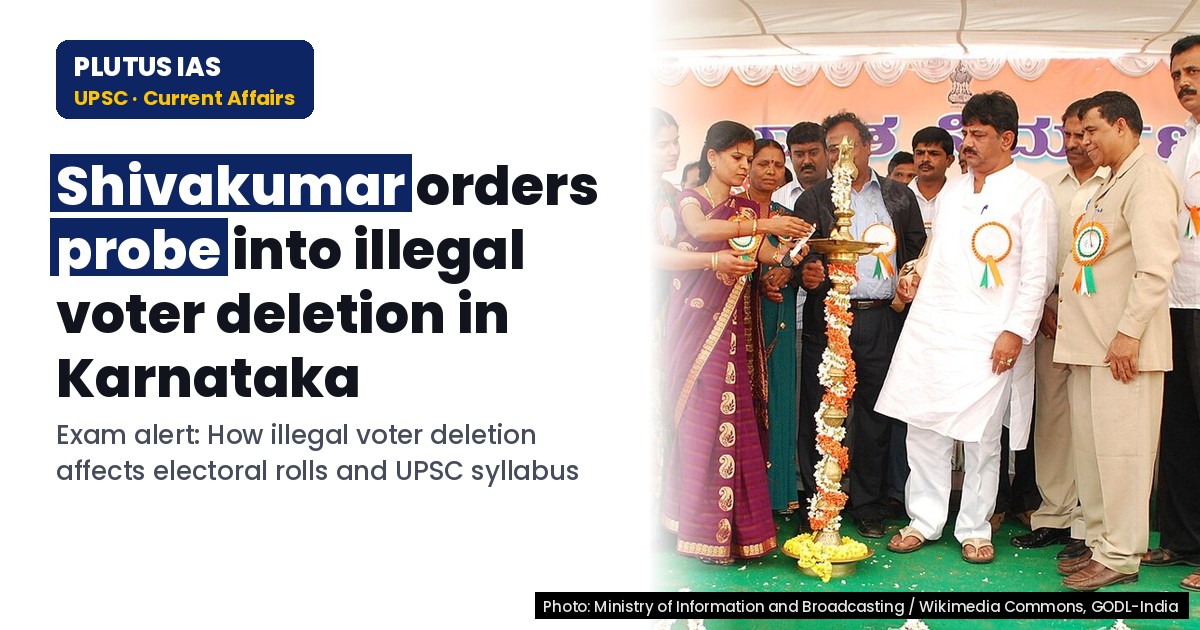
13 Oct Karnataka to Probe Illegal Voter Deletion: UPSC & State PCS Analysis
✎ The Election Commission of India, under Article 324 of the Constitution, holds the constitutional mandate to ensure the integrity of electoral rolls, including preventing illegal deletions of voter names through mechanisms like…
Subject Relevance — Where This Topic Fits
- GS Paper II — Polity and Governance (Constitutional Provisions, Electoral Reforms, Role of Election Commission of India)
- Prelims: Electoral Rolls, Revision of Electoral Rolls, Form 7, Section 22 of the Representation of the People Act, 1951, Model Code of Conduct, Voter Verification, Special Intensive Revision (SIR), Article 324 of the Constitution of India, ECI’s powers under Article 324, Election Commission of India, Voter ID, Electoral Fraud, Right to Vote, Universal Adult Franchise
- Essay: Electoral Integrity as a Pillar of Democratic Governance, The Role of Constitutional Institutions in Safeguarding Democratic Processes
Quick Revision: The Election Commission of India, under Article 324 of the Constitution, holds the constitutional mandate to ensure the integrity of electoral rolls, including preventing illegal deletions of voter names through mechanisms like Form 7 and Special Intensive Revision.
Why is this in the news?
The Chief Minister of Karnataka has announced the continuation of an inquiry into alleged efforts to illegally delete the names of genuine voters from electoral rolls, including those of minorities and economically disadvantaged sections. This development underscores the critical importance of electoral integrity, the mechanisms available to prevent misuse of voter deletion processes, and the institutional responses required to address such irregularities. The episode also highlights the procedural safeguards embedded in the electoral framework to protect the right to vote under the Constitution of India.
Background
- The Representation of the People Act, 1951, governs the preparation and revision of electoral rolls in India, ensuring that the electoral process remains inclusive and accurate.
- The Election Commission of India (ECI), established under Article 324 of the Constitution, is the constitutional authority responsible for the superintendence, direction, and control of elections to the Parliament and State Legislatures.
- The Special Intensive Revision (SIR) of electoral rolls is a periodic exercise conducted by the ECI to update and purify electoral rolls, ensuring that only eligible voters are included and ineligible voters are deleted.
- The use of Form 7, which allows any person to apply for the deletion of a voter’s name from the electoral roll, is a potential avenue for misuse if not monitored rigorously.
- Instances of alleged misuse of voter deletion mechanisms have been reported in multiple states, prompting judicial and administrative scrutiny to safeguard electoral integrity.
What is the Legal and Institutional Framework Governing the Deletion of Voter Names from Electoral Rolls?
- The Representation of the People Act, 1951, and the Conduct of Elections Rules, 1961, provide the legal basis for the preparation, revision, and maintenance of electoral rolls.
- The ECI has issued detailed guidelines to prevent misuse of Form 7, including mandatory verification of applications, public display of draft electoral rolls, and provision for objections and claims.
- The ECI has the power to suo motu or on receipt of complaints, order an inquiry into any irregularities in the electoral process, including the deletion of voter names. Such inquiries may be conducted by the Chief Electoral Officer of the state or the ECI itself.
- The right to vote, as enshrined in Article 326 of the Constitution, is a political right and any arbitrary deletion of names constitutes a violation of this right. The ECI is duty-bound to protect this right through transparent and accountable electoral processes.
UPSC Value Addition
Keywords for Mains Answer-Writing
Electoral Rolls · Form 7 Applications · Electoral Reforms · Election Commission of India · Voter Deletion Controversy · Special Intensive Revision (SIR) · Constitutional Right to Vote · Electoral Integrity · Chief Electoral Officer · Model Code of Conduct · Electoral Malpractice · Judicial Review of Electoral Rolls · Constitutional Provisions on Elections · Election Petitions · Voter Awareness and Inclusion
Constitutional & Policy Linkages
- {‘link’: ‘Article 326 – Universal Adult Suffrage’, ‘note’: ‘Guarantees voting rights to all citizens’}
- {‘link’: ‘Article 324 – Election Commission Powers’, ‘note’: ‘Empowers ECI to supervise elections’}
- {‘link’: ‘Article 325 – No discrimination in electoral rolls’, ‘note’: ‘Prohibits exclusion based on religion, race, caste, or sex’}
Concept Flow
Misuse of Form 7 applications for deletion of names → Systemic vulnerability in electoral roll revision (SIR) → Targeting of marginalised groups (minorities, poor) → Allegations of deliberate disenfranchisement → Legal action and withdrawal of fraudulent applications → State-led probe to restore electoral integrity → Role of Election Commission in oversight → Constitutional safeguards (Article 326, 324) → Need for electoral reforms and transparency
Prelims Practice Questions
Q1. Consider the following statements regarding the deletion of names from electoral rolls in India:
1. Form 7 is used to apply for deletion of a voter’s name from the electoral rolls.
2. The Election Commission of India (ECI) can suo motu delete names from electoral rolls without any application.
3. The deletion of a voter’s name can be challenged through an election petition under Section 81 of the Representation of the People Act, 1951.
4. The Chief Electoral Officer (CEO) is the final authority to decide on the deletion of a voter’s name.
How many of the above statements are correct?
- Only one
- Only two
- Only three
- All four
Answer: Only three — Statements 1 and 3 are correct. Form 7 is indeed used for deletion requests, and election petitions can challenge deletions under Section 81 of the RP Act. Statement 2 is incorrect as the ECI does not suo motu delete names without application. Statement 4 is incorrect as the CEO is not the final authority; disputes are adjudicated by courts.
Q2. Assertion (A): The deletion of a voter’s name from the electoral rolls without due process violates Article 326 of the Constitution of India.
Reason (R): Article 326 guarantees the right to vote as a fundamental right, and any arbitrary deletion undermines this constitutional guarantee.
Options:
A. Both A and R are true, and R is the correct explanation of A.
B. Both A and R are true, but R is not the correct explanation of A.
C. A is true, but R is false.
D. A is false, but R is true.
Answer: ? — Both A and R are true, and R correctly explains A. Article 326 of the Constitution guarantees the right to vote as a fundamental right, and arbitrary deletion of names from electoral rolls would indeed violate this right.
Q3. Match the following electoral reforms with their respective provisions or authorities:
Column I (Reform) | Column II (Provision/Authority)
——————————————–|————————————–
1. Form 7 | A. Final authority for electoral roll preparation
2. Section 81 of RP Act, 1951 | B. Application for deletion of voter’s name
3. Chief Electoral Officer (CEO) | C. Election petition for challenging deletions
4. Model Code of Conduct | D. Regulates conduct during elections
Options:
A. 1-B, 2-C, 3-A, 4-D
B. 1-A, 2-B, 3-C, 4-D
C. 1-C, 2-A, 3-D, 4-B
D. 1-D, 2-C, 3-B, 4-A
Answer: ? — Correct match: 1-B (Form 7 is for deletion), 2-C (Section 81 allows election petitions), 3-A (CEO is responsible for electoral roll preparation), 4-D (Model Code of Conduct regulates election conduct).
Mains Practice Question
✍ The integrity of the electoral rolls is the bedrock of democratic elections in India. In light of the recent controversy in Karnataka regarding the illegal deletion of names of genuine voters, critically examine the constitutional and statutory safeguards available to protect the right to vote under Article 326 of the Constitution. Also, assess the role of the Election Commission of India in ensuring electoral purity and the challenges it faces in this regard. (15 Marks)
Approach: MODEL-ANSWER SKELETON:
1. **Constitutional Safeguards under Article 326** (3 points):
– Article 326 guarantees the right to vote as a fundamental right, ensuring universal adult suffrage.
– The right to vote is a statutory right under the Representation of the People Act, 1951, and the Constitution (Article 326).
– Any arbitrary deletion of voter names violates this constitutional guarantee and undermines democratic principles.
2. **Statutory Safeguards** (4 points):
– **Form 7 and Form 6**: Mechanisms for inclusion and deletion, with provisions for objections and appeals.
– **Section 81 of the RP Act, 1951**: Allows election petitions to challenge deletions or inclusions.
– **Section 22 of the RP Act**: Empowers the Election Commission to prepare and revise electoral rolls.
– **Judicial Review**: Courts can intervene if deletions are arbitrary or mala fide (e.g., *Lokniti Foundation v. Union of India* and *Krishna Kumar v. Union of India*).
3. **Role of the Election Commission of India (ECI)** (4 points):
– **Constitutional Authority**: The ECI is a constitutional body (Article 324) responsible for conducting free and fair elections.
– **Powers under the RP Act**: The ECI can direct the preparation and revision of electoral rolls and ensure transparency.
– **Special Intensive Revision (SIR)**: A periodic exercise to update electoral rolls, but prone to misuse if not monitored.
– **Voter Awareness and Inclusion Drives**: ECI conducts drives to include excluded voters and rectify deletions (e.g., recent drives in Karnataka).
4. **Challenges Faced by the ECI** (3 points):
– **Political Interference**: Pressure from political parties to manipulate electoral rolls for electoral gains.
– **Misuse of Form 7**: Instances of malicious applications for deletion of genuine voters (as reported in Karnataka).
– **Resource Constraints**: Limited capacity to verify every deletion request, leading to errors or omissions.
5. **Way Forward** (1 point):
– Strengthening **grievance redressal mechanisms** (e.g., dedicated helplines, online portals for objections).
– **Judicial Oversight**: Faster disposal of election petitions to ensure timely justice.
– **Public Awareness**: Educating voters about their rights and the process for inclusion/deletion to prevent misuse.
Source: The Hindu
Karnataka PCS (KPSC) — State PCS Practice
Prelims: What is the primary concern raised by the Chief Minister of Karnataka regarding the deletion of voter names in the electoral rolls?
- A. Illegal deletion of genuine voter names
- B. Delay in updating voter details
- C. Inclusion of fake voter names
- D. Lack of voter awareness programs
Answer: A. Illegal deletion of genuine voter names — The Chief Minister highlighted the illegal deletion of genuine voter names as the primary concern in the electoral process.
Mains: Discuss the constitutional and administrative challenges involved in ensuring the integrity of electoral rolls in Karnataka. Suggest measures to prevent illegal deletion of voter names and strengthen the voter registration system.
Generated by AanyaAi for educational purpose.
Related guides on our sites
- Current affairs for upsc 2026
- How to prepare for GS paper 1 for UPSC CSE mains exam
- Best UPSC coaching for IFOS exam
- Best mentorship programme for upsc

- केरल उच्च न्यायालय में जलभराव समस्या: पीटी अपार्टमेंट की स्थिति पर रिपोर्ट आज - October 13, 2026
- PM’s Dhan-Dhaanya Krishi Yojana: One Year Milestones for UPSC & PCS - October 13, 2026
- तमिलनाडु सरकार ने पल्लिकारनई दलदल क्षेत्र के लिए अंतरिम प्रभाव क्षेत्र को 36 सर्वेक्षण संख्याओं तक सीमित किया - October 13, 2026

No Comments