


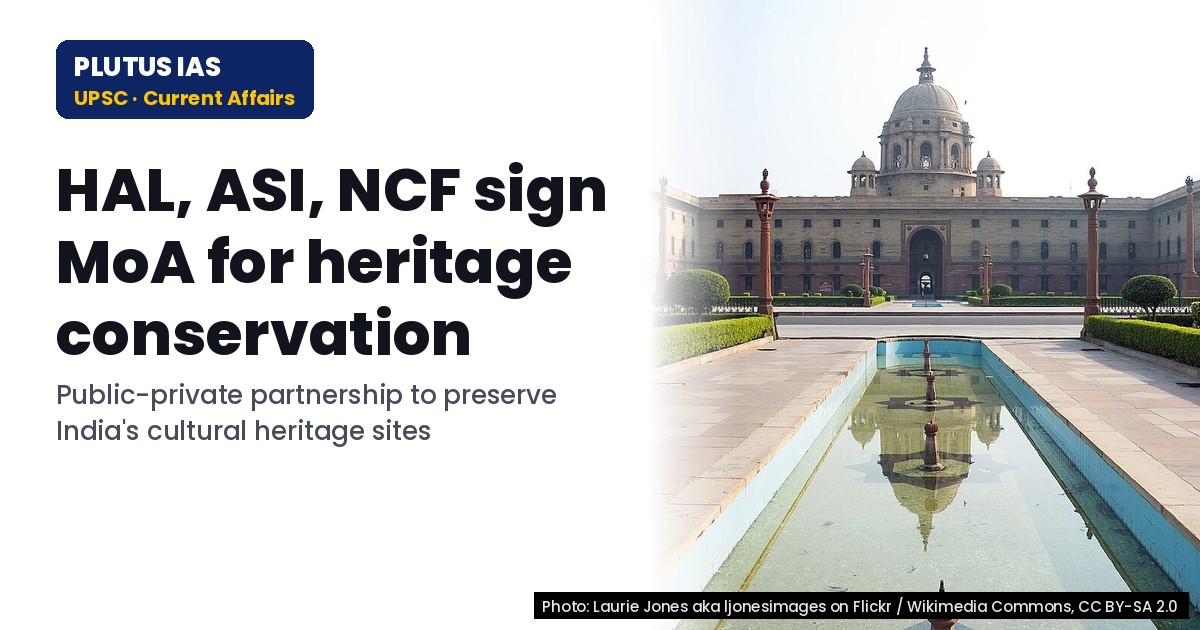
13 Oct HAL, ASI & NCF Join Hands for Heritage Conservation
✎ The MoA between HAL, NCF, and ASI exemplifies a Public-Private Partnership model for heritage conservation, combining corporate CSR funds, engineering expertise, and statutory heritage governance to sustainably preserve India’s…
Subject Relevance — Where This Topic Fits
- GS Paper I — Indian Heritage and Culture | GS Paper II — Governance, Transparency and Accountability | GS Paper III — Science and Technology in Conservation
- Prelims: Public-Private Partnership (PPP), National Culture Fund (NCF), Archaeological Survey of India (ASI), Hindustan Aeronautics Limited (HAL), Heritage Conservation, MoA, Sustainable Development Goal 11 (SDG 11) — Sustainable Cities and Communities, National Mission on Monuments and Antiquities (NMMA), National Culture Fund Act, 1999
- Essay: The Role of Public-Private Partnerships in Preserving India’s Cultural Heritage, Science, Technology, and Tradition: Synergising for Sustainable Conservation
Quick Revision: The MoA between HAL, NCF, and ASI exemplifies a Public-Private Partnership model for heritage conservation, combining corporate CSR funds, engineering expertise, and statutory heritage governance to sustainably preserve India’s cultural assets.
Why is this in the news?
The signing of a Memorandum of Agreement (MoA) between Hindustan Aeronautics Limited (HAL), the National Culture Fund (NCF), and the Archaeological Survey of India (ASI) for the conservation and development of heritage sites marks a significant convergence of public sector expertise, corporate social responsibility, and institutional heritage governance. This collaboration exemplifies a modern governance approach to cultural heritage management, integrating technological and financial resources from the defence sector with the statutory and conservation mandates of ASI and the fund-mobilisation mechanisms of NCF.
Background
- The Archaeological Survey of India (ASI), established in 1861, is the premier institution responsible for the protection, preservation, and promotion of India’s cultural heritage, including monuments, sites, and antiquities.
- The National Culture Fund (NCF), set up under the Charitable Endowments Act, 1890, functions as a non-profit trust to mobilise private and corporate funds for the conservation and development of cultural heritage in India.
- Hindustan Aeronautics Limited (HAL), a Navratna Central Public Sector Enterprise under the Ministry of Defence, is a premier aerospace and defence manufacturer with a strong track record in engineering, project execution, and technology deployment.
- India’s cultural heritage faces dual challenges: inadequate funding for conservation and the need for innovative, sustainable models of heritage management, particularly for lesser-known sites outside the UNESCO World Heritage framework.
- The National Mission on Monuments and Antiquities (NMMA), launched in 2007, aims to document, conserve, and protect India’s cultural heritage, including intangible and tangible assets, through multi-stakeholder participation.
What is the MoA between HAL, NCF, and ASI?
- The MoA formalises a tripartite partnership for the conservation and development of selected heritage sites, leveraging HAL’s engineering and project management capabilities, NCF’s fund-mobilisation mechanisms, and ASI’s statutory and technical expertise in heritage conservation.
- The agreement is structured under the National Culture Fund, a trust under the Charitable Endowments Act, 1890, which enables corporate entities to contribute to heritage conservation through tax-exempt donations and CSR initiatives, in alignment with Section 135 of the Companies Act, 2013.
- The collaboration is expected to focus on sites of historical significance that require structural conservation, digital documentation, and sustainable tourism development, particularly those with potential for community engagement and livelihood generation.
- HAL’s involvement brings advanced engineering solutions, such as structural reinforcement, material science applications, and precision conservation techniques, to heritage sites that may have been damaged by environmental factors or neglect.
- NCF will act as the nodal agency for fund mobilisation, ensuring transparency and accountability in the utilisation of corporate CSR funds, while ASI will provide regulatory oversight, technical guidance, and compliance with heritage conservation norms.
- The MoA is a pilot initiative that may be scaled to include other Central Public Sector Enterprises (CPSEs) and private sector entities, aligning with the government’s broader push for CSR-driven heritage conservation under the ‘Adopt a Heritage: Apni Dharohar, Apni Pehchaan’ initiative.
- The partnership underscores the importance of inter-ministerial and cross-sectoral coordination in heritage governance, integrating the mandates of the Ministry of Culture, Ministry of Defence, and Ministry of Corporate Affairs.
Key Features
| Feature | Significance |
|---|---|
| Tripartite MoA between HAL, NCF, and ASI | Establishes a formal institutional framework for leveraging defence-industrial capabilities in heritage conservation, aligning with the National Culture Fund’s mandate under the Ministry of Culture. |
| Integration of aerospace technology in conservation | HAL’s expertise in precision engineering and materials science can enhance structural integrity assessments and restoration techniques for heritage sites. |
| Public-private partnership model | Demonstrates the application of corporate social responsibility (CSR) and industry-academia collaboration in cultural resource management, with ASI as the nodal regulatory authority. |
| Focus on sustainable development of heritage sites | Aligns with the UNESCO 2030 Agenda for Sustainable Development, particularly Goal 11 (Sustainable Cities and Communities) and Goal 13 (Climate Action). |
Why it Matters
Cultural Governance
- Reinforces the constitutional mandate of the State under Article 49 to protect and preserve monuments and places of national importance.
- Expands the operational scope of the National Culture Fund (established under the Charitable Endowments Act, 1890) to include conservation of archaeological heritage.
- Enhances the role of the Archaeological Survey of India (ASI) as the primary custodian of India’s cultural assets in collaborative conservation initiatives.
Economic Integration
- Leverages HAL’s industrial capacity for cost-effective, scalable solutions in heritage conservation, reducing reliance on imported technologies.
- Creates potential for job creation in allied sectors such as tourism, restoration, and allied industries, aligning with the Skill India Mission.
- Promotes CSR-driven funding for heritage projects, complementing government allocations under the National Mission on Monuments and Antiquities (NMMA).
Technological Advancement
- Facilitates the application of aerospace-grade materials and non-destructive testing (NDT) techniques in heritage conservation.
- Encourages interdisciplinary research between defence technology and archaeology, fostering innovation in preservation methodologies.
- Supports the adoption of digital documentation tools (e.g., LiDAR, photogrammetry) for accurate heritage mapping and monitoring.
Challenges
1. Institutional Coordination Gaps
- Potential delays due to bureaucratic silos between HAL (Ministry of Defence), NCF (Ministry of Culture), and ASI (Ministry of Culture).
- Risk of misalignment between defence-industrial priorities and conservation ethics, necessitating clear operational guidelines.
UPSC Link: GS-II: Statutory bodies and their mandates
2. Resource Allocation Constraints
- Limited budgetary allocations for heritage conservation despite the MoA, requiring innovative funding mechanisms (e.g., CSR, international collaborations).
- Uneven distribution of funds across regions, with a focus on high-profile sites at the expense of lesser-known monuments.
UPSC Link: GS-III: Resource mobilization and funding mechanisms
3. Technological and Ethical Challenges
- Risk of over-reliance on industrial-grade solutions that may not be compatible with traditional conservation practices.
- Ethical concerns regarding the use of advanced materials in heritage sites, including potential long-term environmental impacts.
UPSC Link: GS-III: Science and Technology in conservation
4. Public Awareness and Participation
- Low awareness among local communities about the MoA’s objectives, leading to reduced stakeholder engagement.
- Potential resistance from local populations due to displacement or altered access to heritage sites during conservation.
UPSC Link: GS-II: Role of civil society in governance
Challenges — UPSC Perspective
| Issue | Concern |
|---|---|
| Regulatory Overlap | Risk of conflicting guidelines between ASI’s conservation standards and HAL’s industrial protocols. |
| Funding Sustainability | Dependence on ad-hoc CSR contributions rather than a structured, long-term funding model. |
| Skill Deficit | Shortage of professionals trained in both aerospace engineering and heritage conservation. |
| Community Opposition | Likelihood of resistance from local communities due to perceived disruption of livelihoods. |
| Data Privacy | Challenges in securing digital documentation of heritage sites against cyber threats. |
Way Forward
- Draft a detailed Standard Operating Procedure (SOP) for HAL-NCF-ASI collaboration, delineating roles, timelines, and accountability mechanisms.
- Establish a dedicated fund under the National Culture Fund, with contributions from HAL’s CSR and international partners, to ensure sustained financing.
- Conduct capacity-building workshops for ASI personnel in aerospace-grade conservation techniques and digital documentation tools.
- Launch a public awareness campaign in vernacular languages to engage local communities and stakeholders in the conservation process.
- Develop a transparent monitoring and evaluation framework, with annual reports submitted to Parliament under the Right to Information Act.
- Explore bilateral/multilateral collaborations with UNESCO, ICCROM, and other heritage conservation bodies for technical and financial support.
- Integrate the project with the National Mission on Monuments and Antiquities (NMMA) to align with broader heritage conservation goals.
UPSC Value Addition
Keywords for Mains Answer-Writing
Cultural Heritage Conservation · Public-Private Partnership in Heritage Management · National Culture Fund · Archaeological Survey of India · Hindustan Aeronautics Limited · Cultural Resource Development · Memorandum of Agreement · Intangible Cultural Heritage · Sustainable Heritage Tourism · Institutional Collaboration for Conservation · Cultural Diplomacy · Heritage Site Management · National Mission on Monuments and Antiquities · Cultural Heritage Legislation · Public-Private Partnership Models
Constitutional & Policy Linkages
- Article 49: Directive Principle of State Policy on protection of monuments and places of national importance.
Concept Flow
Identification of heritage sites requiring conservation by ASI under the Ancient Monuments and Archaeological Sites and Remains Act, 1958. → Initiation of MoA between HAL, NCF, and ASI to formalize collaboration. → Assessment of conservation needs using HAL’s industrial expertise (e.g., structural analysis, material science). → Implementation of conservation measures with funding from NCF and CSR contributions. → Monitoring and evaluation by ASI, with periodic reports to the Ministry of Culture. → Public engagement and awareness campaigns to ensure community participation. → Scaling up successful models to other heritage sites across India.
Prelims Practice Questions
Q1. Consider the following statements regarding the National Culture Fund (NCF):
1. It was established under the Charitable Endowments Act, 1890.
2. It functions under the aegis of the Ministry of Culture, Government of India.
3. The fund is utilised exclusively for the conservation of tangible cultural heritage.
4. It promotes public-private partnerships for cultural heritage projects.
How many of the above statements are correct?
- Only one
- Only two
- Only three
- All
Answer: All — Statements 1, 2, and 4 are correct. The NCF was established in 1996 under the Charitable Endowments Act, 1890, and operates under the Ministry of Culture. It supports both tangible and intangible cultural heritage through public-private partnerships. Statement 3 is incorrect as the fund also supports intangible heritage projects.
Q2. Assertion (A): The Archaeological Survey of India (ASI) is the primary custodian of India’s cultural heritage.
Reason (R): The ASI derives its authority from the Ancient Monuments and Archaeological Sites and Remains Act, 1958.
In the context of the above two statements, which one of the following is correct?
- Both A and R are true, and R is the correct explanation of A
- Both A and R are true, but R is not the correct explanation of A
- A is true but R is false
- A is false but R is true
Answer: Both A and R are true, but R is not the correct explanation of A — The ASI is indeed the primary custodian of India’s cultural heritage, and its authority is legally vested under the Ancient Monuments and Archaeological Sites and Remains Act, 1958. The Reason correctly explains the Assertion.
Q3. Match the following institutions with their primary functions:
Column I
A. Archaeological Survey of India (ASI)
B. National Culture Fund (NCF)
C. Hindustan Aeronautics Limited (HAL)
Column II
1. Conservation and preservation of monuments and sites
2. Promotion of public-private partnerships for cultural heritage projects
3. Design, development, and manufacture of aerospace systems
Select the correct match:
- A-1, B-2, C-3
- A-2, B-1, C-3
- A-3, B-1, C-2
- A-1, B-3, C-2
Answer: A-1, B-2, C-3 — ASI is responsible for the conservation and preservation of monuments and sites (A-1). NCF promotes public-private partnerships for cultural heritage projects (B-2). HAL is engaged in the design, development, and manufacture of aerospace systems (C-3).
Mains Practice Question
✍ The conservation and development of cultural heritage sites in India require multi-institutional collaboration. Critically examine the role of public-private partnerships (PPPs) in achieving sustainable heritage management, with particular reference to the recent tripartite Memorandum of Agreement (MoA) between the Archaeological Survey of India (ASI), National Culture Fund (NCF), and Hindustan Aeronautics Limited (HAL). (15 Marks)
Approach: 1. Define cultural heritage conservation and PPPs in the Indian context, citing constitutional provisions (Article 49, Directive Principles of State Policy) and statutory frameworks (Ancient Monuments and Archaeological Sites and Remains Act, 1958; National Culture Fund Scheme).
2. Analyse the tripartite MoA: Role of ASI (regulatory and custodial), NCF (funding and facilitation), and HAL (technical and financial support). Highlight how such collaborations address resource constraints and technological gaps.
3. Discuss the advantages of PPPs in heritage conservation: leveraging private sector expertise, mobilising additional resources, and enhancing sustainability. Cite examples like the restoration of Humayun’s Tomb (Aga Khan Trust for Culture) or the Taj Mahal conservation efforts.
4. Critically evaluate challenges: risk of commercialisation, lack of long-term monitoring mechanisms, and potential conflicts between conservation ethics and developmental pressures. Reference the UNESCO Operational Guidelines for the Implementation of the World Heritage Convention.
5. Conclude with a balanced view: PPPs are necessary but must be regulated to align with conservation ethics and community interests. Suggest institutional safeguards (e.g., transparent bidding, stakeholder consultations, and periodic audits).
Source: PIB (Press Information Bureau)
Generated by AanyaAi for educational purpose.
Related guides on our sites
- Best economics services coaching
- Anthropology VS PSIR
- Best PSIR optional coaching
- Best PSIR optional coaching online

- दिल्ली में प्रदूषण नियंत्रण हेतु निर्माण गतिविधियों पर प्रतिबंध: एक विश्लेषण - November 7, 2026
- OBC Creamy Layer: SC Ruling & CSE Impact - November 7, 2026
- दिल्ली प्रदूषण निगरानी में खामियां: GRAP-III के बीच कई स्टेशन निष्क्रिय - November 7, 2026

No Comments