


13 Oct Karnataka’s Tourism Start-up Policy: Boosting Innovation in Tourism Sector
✎ The Karnataka Tourism Start-up Promotion Policy is a state-led initiative to harness innovation and technology for addressing tourism challenges, with a focus on piloting and scaling start-up solutions in areas such as digital…
Subject Relevance — Where This Topic Fits
- GS Paper II — Governance, Administration and Policies for Development | GS Paper III — Role of Start-ups in Economic Growth and Employment Generation
- Prelims: Tourism Policy, Start-up India initiative, Digital Public Infrastructure, Sustainable Tourism, Ease of Doing Business, State-level Start-up Policies
- Essay: The Role of Innovation in Public Policy: Lessons from Karnataka’s Tourism Start-up Promotion Policy, Balancing Economic Growth and Environmental Sustainability in Tourism
Quick Revision: The Karnataka Tourism Start-up Promotion Policy is a state-led initiative to harness innovation and technology for addressing tourism challenges, with a focus on piloting and scaling start-up solutions in areas such as digital services, sustainability, and visitor experience.
Why is this in the news?
The Karnataka Tourism Department has announced the formulation of a Tourism Start-up Promotion Policy to leverage the state’s robust start-up ecosystem for addressing real-world challenges in tourism through innovation, technology adoption, and sustainable solutions. This policy aims to create a structured framework for piloting and scaling start-up-driven solutions in areas such as visitor experience, digital services, and sustainable tourism, thereby enhancing the state’s tourism competitiveness and inclusivity.
Background
- Karnataka has emerged as a leading state in India’s start-up ecosystem, home to a significant number of unicorns, incubators, and accelerators, particularly in Bengaluru.
- The tourism sector in Karnataka is a key contributor to the state’s economy, with a diverse range of destinations including historical sites, wildlife sanctuaries, and cultural hubs.
- The COVID-19 pandemic highlighted the need for digital transformation and innovation in tourism, particularly in areas such as contactless services, remote destination management, and sustainable practices.
- The Government of India’s Start-up India initiative (2016) and subsequent policies have incentivized start-ups across sectors, including tourism, by providing funding, mentorship, and regulatory support.
- State-level policies, such as Karnataka’s Start-up Policy 2022-27, provide a conducive environment for innovation, but sector-specific policies like the proposed Tourism Start-up Promotion Policy are essential to address unique challenges in tourism.
- The policy aligns with global trends in tourism, where digitalization, sustainability, and local community engagement are increasingly prioritized to enhance visitor experiences and preserve cultural heritage.
What is the Karnataka Tourism Start-up Promotion Policy?
- The policy is a state-level initiative aimed at fostering innovation and entrepreneurship in the tourism sector by creating a structured framework for start-ups, young entrepreneurs, and innovators to develop solutions for identified challenges.
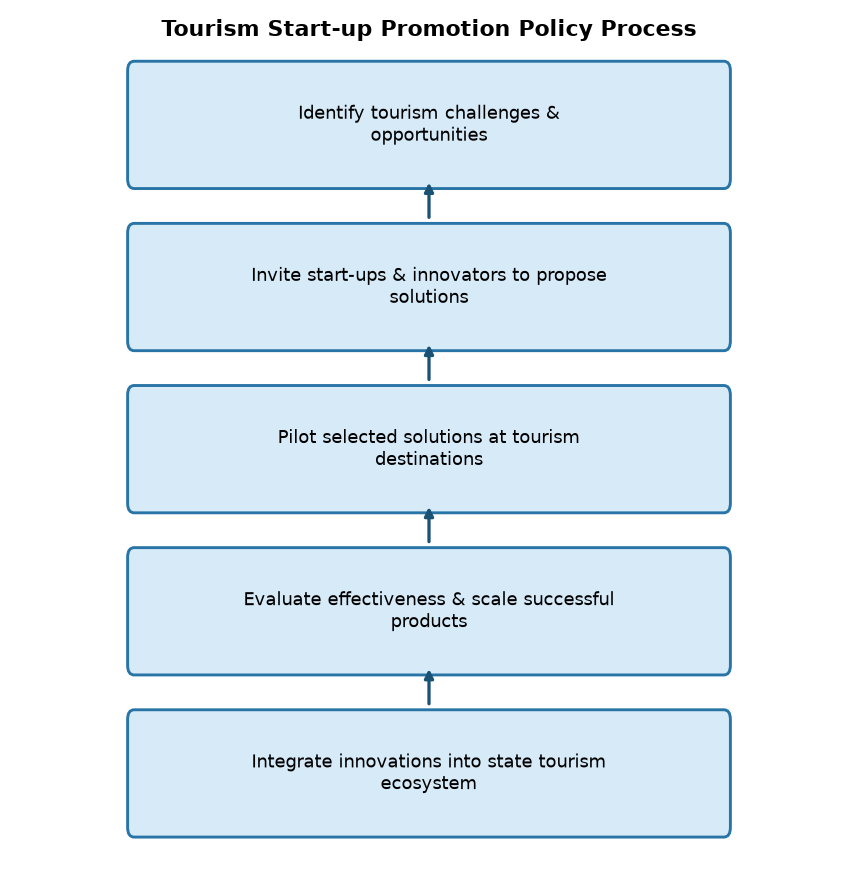
- It seeks to identify real-world challenges in tourism, such as improving visitor experience, enhancing digital services, promoting sustainable tourism, and ensuring accessibility and safety, and then invite start-ups to propose practical solutions.
- Selected solutions will be piloted at identified tourism destinations, allowing start-ups to test their products in a real-world environment and gain market access while enabling the government to evaluate their effectiveness.
- The policy emphasizes scalability, with successful pilot projects eligible for scaling up across the state’s tourism ecosystem, thereby accelerating the adoption of innovation and technology in tourism management.
- Key focus areas include digital services (e.g., AI-driven tourist information systems, virtual reality experiences), sustainable tourism (e.g., eco-friendly accommodations, waste management solutions), and locally rooted experiences (e.g., community-based tourism, heritage conservation).
- The policy is expected to complement existing schemes such as the ‘Swadesh Darshan Scheme’ and ‘PRASAD Scheme’ by integrating innovation and technology to enhance destination management and visitor satisfaction.
Key Features
| Feature | Significance |
|---|---|
| Identification of real-world challenges | Ensures policy solutions are grounded in practical tourism sector needs, avoiding abstract or misaligned interventions. |
| Pilot testing at identified destinations | Provides start-ups with a controlled environment to validate innovations before large-scale deployment, reducing market risk. |
| Scalability mechanism | Enables successful pilot solutions to be replicated across the tourism ecosystem, enhancing systemic efficiency. |
| Multi-stakeholder collaboration | Bridges the gap between government, entrepreneurs, and local communities, fostering inclusive innovation. |
| Focus on sustainable tourism | Aligns with global best practices and India’s commitments under international agreements like the Paris Agreement. |
Why it Matters
Economic
- Stimulates job creation in tourism-adjacent sectors by supporting start-ups and young entrepreneurs.
- Enhances the competitiveness of Karnataka’s tourism sector through technological adoption and innovation.
- Attracts investment in tourism infrastructure by demonstrating a conducive ecosystem for start-ups.
Technological
- Accelerates the integration of digital solutions (e.g., AI-driven visitor management, blockchain for authenticity) in tourism governance.
- Encourages the development of locally relevant technologies tailored to India’s diverse tourism landscape.
- Facilitates data-driven decision-making for destination management and policy formulation.
Social
- Promotes inclusive growth by empowering local innovators and small-scale entrepreneurs in tourism.
- Enhances tourist experience through improved accessibility, safety, and sustainability measures.
- Strengthens community ownership of tourism by integrating locally rooted experiences into the ecosystem.
Environmental
- Encourages sustainable tourism practices, such as waste management and carbon-neutral operations, through targeted innovation.
- Supports the preservation of cultural and natural heritage sites by promoting eco-friendly tourism models.
Challenges
1. Regulatory and Bureaucratic Hurdles
- Delays in approvals for pilot projects may discourage start-ups from participating.
- Complex compliance requirements for foreign and domestic investors could deter participation.
UPSC Link: Governance – Ease of Doing Business
2. Access to Funding
- Start-ups in tourism may struggle to secure seed or growth-stage funding due to perceived sectoral risks.
- Limited venture capital or angel investment networks focused on tourism innovation.
UPSC Link: Economic Development – Start-up Ecosystem
3. Skill Gaps and Capacity Building
- Shortage of skilled professionals in tourism technology, digital marketing, and sustainable practices.
- Need for targeted capacity-building programs to equip entrepreneurs with sector-specific knowledge.
UPSC Link: Human Resource Development – Skill India
4. Data Privacy and Security
- Risks associated with collecting and processing tourist data, especially in digital services.
- Compliance with frameworks like the Digital Personal Data Protection Act (DPDP) 2023 may pose challenges.
UPSC Link: Governance – Data Governance
5. Cultural and Ethical Sensitivities
- Balancing innovation with preservation of local cultures and traditions in tourism experiences.
- Avoiding over-commercialization that could dilute the authenticity of tourist destinations.
UPSC Link: Society – Cultural Heritage
Challenges — UPSC Perspective
| Issue | Concern |
|---|---|
| Regulatory delays | May erode investor confidence and slow down innovation adoption. |
| Limited funding avenues | Could restrict the participation of early-stage start-ups in the policy. |
| Skill shortages | Hinders the development of high-quality, scalable solutions for tourism. |
| Data security risks | Potential breaches could undermine trust in digital tourism services. |
| Cultural misalignment | Risk of solutions that do not resonate with local communities or tourists. |
Way Forward
- Establish a dedicated fund under the policy to provide seed grants and low-interest loans to tourism start-ups.
- Create a single-window clearance mechanism for pilot projects to expedite approvals and reduce bureaucratic delays.
- Partner with academic institutions and industry bodies to design capacity-building programs in tourism technology and innovation.
- Develop a robust data governance framework to ensure compliance with privacy laws while enabling data-driven tourism solutions.
- Institute a feedback loop with local communities to ensure solutions align with cultural and ethical sensitivities.
- Collaborate with financial institutions to design sector-specific funding instruments for tourism start-ups.
- Launch a public-private partnership (PPP) model for scaling successful pilot solutions across the state.
- Conduct periodic reviews of the policy to assess its impact and incorporate emerging challenges and opportunities.
UPSC Value Addition
Keywords for Mains Answer-Writing
Tourism Start-up Promotion Policy · Karnataka Tourism Department · start-up ecosystem · sustainable tourism · digital services in tourism · destination management · innovation in tourism · tourism policy framework · public-private partnership in tourism · UN Sustainable Development Goal 8 (Decent Work and Economic Growth) · UN Sustainable Development Goal 12 (Responsible Consumption and Production) · tourism entrepreneurship · tourism technology adoption · tourism governance · tourism infrastructure · tourism start-up incubation
Concept Flow
State Government identifies gaps in tourism sector through consultations and data analysis. → Tourism Department formulates a policy framework to address these gaps via innovation. → Start-ups and entrepreneurs respond to identified challenges with practical solutions. → Selected solutions are piloted at designated tourism destinations for validation. → Effectiveness of pilots is evaluated, and successful models are scaled across the ecosystem. → Policy outcomes are monitored, and feedback is used to refine the framework iteratively.
Prelims Practice Questions
Q1. Consider the following statements regarding the proposed Tourism Start-up Promotion Policy by the Karnataka Tourism Department:
1. The policy aims to harness the State’s start-up ecosystem for developing new technologies and solutions for the tourism sector.
2. The policy will focus exclusively on digital services and will not address sustainable tourism or accessibility.
3. Selected products or solutions may be piloted at identified tourism destinations before scaling up.
How many of the above statements are correct?
- Only one
- Only two
- All three
- None
Answer: Only two — Statement 1 is correct as the policy seeks to harness the start-up ecosystem for tourism innovation. Statement 2 is incorrect because the policy explicitly includes sustainable tourism, accessibility, and other areas. Statement 3 is correct as the Secretary mentioned piloting selected solutions at tourism destinations.
Q2. Assertion (A): The Tourism Start-up Promotion Policy in Karnataka aims to create opportunities for start-ups to develop practical solutions for real-world challenges in tourism.
Reason (R): The policy seeks to identify emerging requirements in tourism and provide a real-world testing environment for start-ups through pilot projects at identified destinations.
In the context of the above two statements, which one of the following is correct?
- Both A and R are true, and R is the correct explanation of A.
- Both A and R are true, but R is not the correct explanation of A.
- A is true, but R is false.
- A is false, but R is true.
Answer: Both A and R are true, and R is the correct explanation of A. — Both the assertion and reason are true, and the reason correctly explains the assertion. The policy explicitly aims to create opportunities for start-ups to address real-world challenges and provides a real-world testing environment through pilot projects.
Q3. Match the following areas of innovation identified under the Karnataka Tourism Start-up Promotion Policy with their respective focus areas:
Column I (Area of Innovation) | Column II (Focus Area)
1. Visitor Experience | A. Use of digital platforms for seamless tourism services
2. Destination Management | B. Enhancing accessibility for differently-abled tourists
3. Digital Services | C. Developing immersive and interactive tourism experiences
4. Accessibility | D. Efficient management of tourism resources and infrastructure
Select the correct match:
- 1-C, 2-D, 3-A, 4-B
- 1-A, 2-B, 3-C, 4-D
- 1-B, 2-A, 3-D, 4-C
- 1-D, 2-C, 3-B, 4-A
Answer: 1-C, 2-D, 3-A, 4-B — The correct matches are: 1-C (Visitor Experience focuses on immersive experiences), 2-D (Destination Management involves efficient resource management), 3-A (Digital Services pertain to digital platforms), and 4-B (Accessibility aims to enhance inclusivity for differently-abled tourists).
Mains Practice Question
✍ Critically examine the significance of the Karnataka Tourism Start-up Promotion Policy in the context of India’s broader tourism governance framework. How does the policy align with global best practices in sustainable and inclusive tourism development? (15 Marks)
Approach: MODEL-ANSWER SKELETON:
1. **Introduction (2 marks)**
– Briefly define the Karnataka Tourism Start-up Promotion Policy and its stated objectives.
– Contextualise within India’s tourism governance framework, highlighting the role of state-level policies in complementing central schemes like the ‘Swadesh Darshan Scheme’ and ‘PRASAD Scheme’.
2. **Policy Framework and Key Features (4 marks)**
– Identify the core areas of innovation: visitor experience, digital services, destination management, sustainable tourism, accessibility, mobility, safety, and locally rooted experiences.
– Highlight the policy’s emphasis on start-up incubation, pilot projects, and scaling successful solutions.
– Reference the UN Sustainable Development Goals (SDG 8: Decent Work and Economic Growth, SDG 12: Responsible Consumption and Production) to underscore the policy’s alignment with global sustainability frameworks.
3. **Comparative Analysis with Global Best Practices (5 marks)**
– Compare the Karnataka policy with international models such as:
– **Singapore’s Tourism Technology Innovation Framework**: Focus on smart tourism and digital transformation.
– **European Union’s Smart Tourism Destinations Initiative**: Emphasis on sustainability, accessibility, and digitalisation.
– **Costa Rica’s Sustainable Tourism Certification (CST)**: Integration of environmental and social sustainability in tourism practices.
– Discuss how Karnataka’s policy incorporates elements of these models while tailoring them to local contexts.
4. **Challenges and Critique (3 marks)**
– Acknowledge potential challenges: ensuring equitable access to start-up opportunities, balancing innovation with cultural preservation, and addressing infrastructure gaps in pilot destinations.
– Critique the policy’s reliance on pilot projects and scaling mechanisms—whether these are sufficient for systemic change or require stronger institutional backing.
5. **Conclusion (1 mark)**
– Summarise the policy’s potential to position Karnataka as a leader in sustainable and inclusive tourism innovation.
– Emphasise the need for continuous evaluation and adaptive governance to sustain long-term impact.
Source: The Hindu
Generated by AanyaAi for educational purpose.
Related guides on our sites
- Anthropology VS PSIR
- Best PSIR optional coaching
- Best PSIR optional coaching online
- Best PSIR optional teacher

- NAMASTE Scheme: Enhancing Sanitation Workers’ Livelihoods & Safety - November 14, 2026
- एमएसएमई का विशेष अभियान 6.0: स्वच्छता और लंबित मामलों का निपटारा - November 14, 2026
- Sea Vigil-26: Coastal Defence Drills Off Visakhapatnam - November 14, 2026

No Comments