


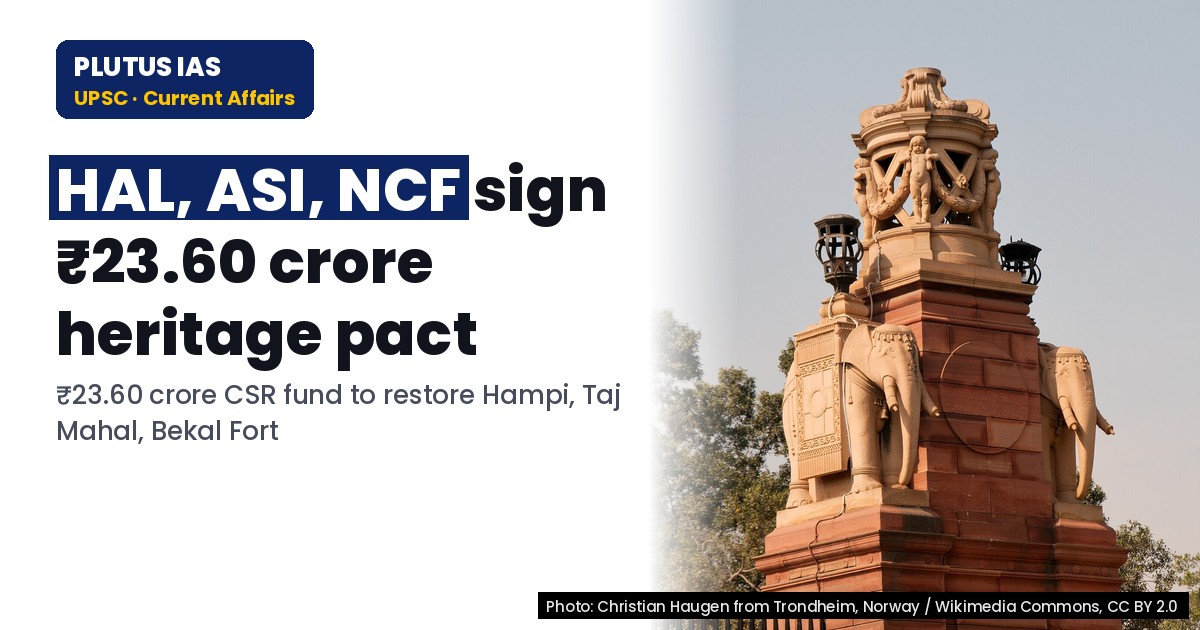
13 Oct एचएएल, एएसआई, एनसीएफ ने तीन धरोहर स्थलों के संरक्षण के लिए किया समझौता
✎ The MoA between HAL, NCF, and ASI exemplifies how CSR funds can be channelised into heritage conservation under the technical guidance of ASI, ensuring sustainable tourism and preservation of India’s heritage sites.
Subject Relevance — Where This Topic Fits
- GS Paper I — Indian Heritage and Culture | GS Paper II — Governance, Transparency and Accountability | GS Paper III — Corporate Social Responsibility and Sustainable Development
- Prelims: Heritage Conservation, UNESCO World Heritage Sites, Corporate Social Responsibility (CSR), National Culture Fund (NCF), Archaeological Survey of India (ASI), Hampi, Taj Mahal, Bekal Fort
- Essay: The Role of Public-Private Partnerships in Preserving National Heritage, Corporate Philanthropy and Cultural Sustainability
Quick Revision: The MoA between HAL, NCF, and ASI exemplifies how CSR funds can be channelised into heritage conservation under the technical guidance of ASI, ensuring sustainable tourism and preservation of India’s heritage sites.
Why is this in the news?
On 13 October 2026, the Ministry of Culture announced a tripartite Memorandum of Agreement (MoA) among Hindustan Aeronautics Limited (HAL), the National Culture Fund (NCF), and the Archaeological Survey of India (ASI) for the conservation and development of three heritage sites: Hampi (Karnataka), Taj Mahal (Uttar Pradesh), and Bekal Fort (Kerala). The agreement formalises HAL’s in-principle approval of ₹23.60 crore under its CSR initiatives for FY 2026-27 to 2028-29, aimed at enhancing visitor facilities and ensuring sustainable heritage tourism while adhering to conservation standards.
Background
- Hampi and the Taj Mahal are UNESCO World Heritage Sites of global cultural significance.
- The Archaeological Survey of India (ASI), established in 1861, is the premier institution responsible for the maintenance and protection of centrally protected monuments.
- The National Culture Fund (NCF), established in 1996 under the Charitable Endowments Act, 1890, acts as a bridge between government and corporate entities to fund cultural heritage projects.
- Corporate Social Responsibility (CSR) in India is governed by Section 135 of the Companies Act, 2013, mandating eligible companies to allocate 2% of their average net profits for social development initiatives, including heritage conservation.
- Public-Private Partnerships (PPPs) in heritage conservation are increasingly recognised as essential to address funding gaps and leverage technical expertise for sustainable management.
- The Union Budget 2023-24 emphasised the integration of cultural heritage with tourism as a key pillar for economic growth and cultural diplomacy.
Understanding the Key Institutions and the MoA Framework
- Hindustan Aeronautics Limited (HAL): A government-owned aerospace and defence company under the Ministry of Defence, HAL has expanded its CSR mandate to include cultural heritage conservation, aligning with its commitment to societal welfare beyond its core industrial operations.
- National Culture Fund (NCF): An autonomous body under the Ministry of Culture, NCF facilitates financial contributions from corporate entities and individuals for projects related to the conservation, preservation, and promotion of India’s tangible and intangible cultural heritage.
- Archaeological Survey of India (ASI): An attached office of the Ministry of Culture, ASI is responsible for archaeological research, conservation of monuments, and regulation of antiquities. It ensures that conservation projects adhere to internationally recognised standards, including those set by UNESCO.
- Memorandum of Agreement (MoA): An agreement that outlines the roles, responsibilities, and financial commitments of the signatory parties. In this case, HAL has given in-principle approval for ₹23.60 crore for conservation projects at three sites, with ASI providing technical oversight and NCF coordinating implementation.
- Scope of Projects: The initiatives include restoration of historical market areas in Hampi (North and South Bazaars), conservation measures at Taj Mahal, and site development at Bekal Fort, all aimed at improving visitor experience while preserving structural integrity and authenticity.
- Conservation Principles: ASI’s interventions are guided by the Venice Charter (1964) and India’s Ancient Monuments and Archaeological Sites and Remains Act, 1958, which prioritise minimal intervention, reversibility of actions, and respect for the original fabric of monuments.
Key Features
| Feature | Significance |
|---|---|
| Tripartite MoA between HAL, NCF, and ASI | Establishes a formal public-private partnership framework for heritage conservation, integrating technical expertise (ASI), financial resources (HAL), and institutional coordination (NCF). |
| Financial Commitment by HAL (₹23.60 crore over 3 years) | Demonstrates corporate social responsibility (CSR) in the preservation of cultural assets, aligning with statutory CSR obligations under the Companies Act, 2013. |
| Focus on Three UNESCO World Heritage Sites (Hampi, Taj Mahal, Bekal Fort) | Targets globally recognized cultural landmarks, ensuring interventions align with international conservation standards while addressing domestic tourism infrastructure gaps. |
| Technical Oversight by ASI | Ensures adherence to India’s heritage conservation guidelines, including the Ancient Monuments and Archaeological Sites and Remains Act, 1958, and UNESCO’s Operational Guidelines for the World Heritage Convention. |
| Role of National Culture Fund (NCF) | Acts as a nodal agency to facilitate fund utilisation, monitor project progress, and ensure transparency in public-private partnerships for heritage management. |
Why it Matters
Cultural Preservation
- Strengthens India’s compliance with UNESCO’s World Heritage Convention by enhancing conservation measures at designated sites.
- Promotes sustainable heritage tourism, balancing preservation with economic benefits for local communities.
- Integrates intangible cultural heritage (e.g., traditional crafts, practices) into conservation frameworks through community engagement.
Economic Impact
- Leverages corporate CSR funds (₹23.60 crore) to supplement government allocations for heritage projects, reducing fiscal strain.
- Boosts local economies via enhanced tourism infrastructure, job creation, and skill development in heritage conservation.
Institutional Synergy
- Demonstrates inter-ministerial and cross-sector collaboration (Culture Ministry, ASI, NCF, HAL) to address complex heritage challenges.
- Sets a precedent for future PPP models in heritage conservation, aligning with the National Mission on Monuments and Antiquities.
Policy Alignment
- Supports the objectives of the National Culture Policy (2022) by fostering public-private partnerships in cultural heritage.
- Complements the Sustainable Development Goals (SDG 11: Sustainable Cities and Communities) through heritage-led urban revitalisation.
Challenges
1. Regulatory and Compliance Risks
- Ensuring that corporate-led interventions comply with the Ancient Monuments and Archaeological Sites and Remains Act, 1958, and ASI’s conservation guidelines.
- Balancing modern infrastructure development with heritage authenticity to avoid violations of UNESCO’s Operational Guidelines.
UPSC Link: GS-II: Heritage Conservation Policies
2. Sustainability of Funding
- Securing long-term financial commitments from corporate partners beyond the initial CSR allocation to sustain conservation efforts.
- Mitigating risks of fund misutilisation or delays in project execution due to bureaucratic or corporate governance hurdles.
UPSC Link: GS-III: Corporate Social Responsibility (CSR)
3. Community and Stakeholder Engagement
- Addressing potential conflicts between conservation goals and local livelihoods (e.g., restricted access to heritage sites for traditional practices).
- Ensuring inclusive participation of local artisans, historians, and communities in project design and implementation.
UPSC Link: GS-I: Cultural Heritage and Community Rights
4. Technical and Environmental Challenges
- Mitigating environmental degradation (e.g., pollution, climate change impacts) on heritage sites during and after conservation work.
- Adopting innovative technologies (e.g., 3D scanning, geo-spatial mapping) while ensuring they do not compromise structural integrity.
UPSC Link: GS-III: Environmental Conservation
Challenges — UPSC Perspective
| Issue | Concern |
|---|---|
| Regulatory Overreach | Risk of ASI’s stringent guidelines stifling innovative conservation methods or delaying project timelines. |
| Corporate Withdrawal | Potential mid-term withdrawal of HAL’s CSR funds due to financial constraints or strategic shifts in corporate priorities. |
| Heritage vs. Development Trade-offs | Balancing modern infrastructure (e.g., pathways, lighting) with the preservation of original architectural integrity. |
| Local Resistance | Opposition from communities or heritage activists over perceived commercialisation of sacred or culturally sensitive sites. |
| Monitoring and Evaluation Gaps | Lack of robust third-party audits to assess the efficacy of conservation interventions post-implementation. |
Government Initiatives — Must-Memorise for Prelims
- National Culture Fund (NCF) – Established under the Charitable Endowments Act, 1890, to facilitate public-private partnerships in heritage conservation.
Way Forward
- Conduct a detailed heritage impact assessment for each site to prioritise interventions based on urgency and cultural significance.
- Establish a multi-stakeholder monitoring committee (including ASI, NCF, HAL, and local experts) to oversee project progress and compliance.
- Develop a phased rollout plan for conservation works, ensuring minimal disruption to tourism and local communities during implementation.
- Integrate traditional knowledge systems (e.g., indigenous conservation techniques) into modern restoration methodologies.
- Launch public awareness campaigns to educate stakeholders on the importance of heritage conservation and sustainable tourism.
- Explore additional funding avenues (e.g., international grants, state contributions) to supplement HAL’s CSR allocation.
- Institute a grievance redressal mechanism for local communities and heritage activists to address concerns proactively.
UPSC Value Addition
Keywords for Mains Answer-Writing
Public-Private Partnership · Cultural Heritage Conservation · Corporate Social Responsibility (CSR) · National Culture Fund (NCF) · Archaeological Survey of India (ASI) · Hampi World Heritage Site · Taj Mahal Conservation · Bekal Fort Heritage · Sustainable Heritage Tourism · Institutional Collaboration for Heritage Preservation · UNESCO World Heritage Sites in India · Cultural Resource Management · Heritage Infrastructure Development · Ministry of Culture Initiatives
Constitutional & Policy Linkages
- Article 49 – Directive Principles of State Policy: Protection and preservation of monuments and places of historic interest.
Concept Flow
Corporate Social Responsibility (CSR) obligations under Companies Act, 2013 → HAL’s financial commitment → MoA with NCF and ASI → Public-Private Partnership (PPP) framework → NCF’s role as nodal agency → ASI’s technical oversight → Heritage conservation guidelines (Ancient Monuments Act, 1958) → UNESCO World Heritage Convention compliance → Site-specific interventions → Sustainable tourism development → Local economic upliftment → Community engagement and capacity building → Monitoring and evaluation → Impact assessment → Policy feedback for future heritage conservation initiatives
Prelims Practice Questions
Q1. Consider the following statements regarding the National Culture Fund (NCF):
1. It is established under the Ministry of Culture to promote public-private partnerships for cultural heritage conservation.
2. The NCF functions as a statutory body under the Ancient Monuments and Archaeological Sites and Remains Act, 1958.
3. It facilitates funding for the conservation of both tangible and intangible cultural heritage in India.
How many of the above statements are correct?
- Only one
- Only two
- All three
- None
Answer: Only two — Statement 1 is correct as the NCF is indeed established under the Ministry of Culture to foster public-private partnerships. Statement 2 is incorrect because the NCF is not a statutory body under the 1958 Act; it operates under the administrative purview of the Ministry of Culture. Statement 3 is correct as the NCF supports conservation of both tangible (e.g., monuments) and intangible (e.g., traditions) cultural heritage.
Q2. Assertion (A): The Archaeological Survey of India (ASI) is the nodal agency for the conservation and maintenance of centrally protected monuments in India.
Reason (R): The ASI derives its authority from the Ancient Monuments and Archaeological Sites and Remains Act, 1958, and the Antiquities and Art Treasures Act, 1972.
Options:
A. Both A and R are true, and R is the correct explanation of A.
B. Both A and R are true, but R is NOT the correct explanation of A.
C. A is true, but R is false.
D. A is false, but R is true.
Answer: ? — The ASI is indeed the nodal agency for conservation of centrally protected monuments (Assertion A is true). The ASI’s legal authority is derived from the Ancient Monuments and Archaeological Sites and Remains Act, 1958, and the Antiquities and Art Treasures Act, 1972 (Reason R is true). The Reason correctly explains the Assertion as these statutes empower the ASI to undertake conservation activities.
Q3. Match the following heritage sites with their respective states:
Column I (Heritage Site) Column II (State)
A. Hampi 1. Kerala
B. Taj Mahal 2. Karnataka
C. Bekal Fort 3. Uttar Pradesh
Options:
A. A-2, B-3, C-1
B. A-1, B-2, C-3
C. A-3, B-1, C-2
D. A-2, B-1, C-3
Answer: ? — Hampi is located in Karnataka, the Taj Mahal is in Uttar Pradesh, and Bekal Fort is in Kerala. The correct pairing is A-2, B-3, C-1.
Mains Practice Question
✍ The preservation of India’s cultural heritage is increasingly being pursued through public-private partnerships (PPPs). Critically examine the role of such collaborations in ensuring sustainable heritage conservation and tourism, with reference to the recent Memorandum of Agreement (MoA) signed among HAL, NCF, and ASI for the conservation of Hampi, Taj Mahal, and Bekal Fort. (15 Marks)
Approach: MODEL-ANSWER SKELETON:
1. **Context and Significance of the MoA**:
– Briefly outline the MoA signed among HAL, NCF, and ASI for heritage conservation at Hampi (Karnataka), Taj Mahal (Uttar Pradesh), and Bekal Fort (Kerala).
– Highlight the financial commitment (₹23.60 crore over FY 2026-27 to 2028-29) and the stated objectives: infrastructure development, visitor facilitation, and sustainable tourism.
2. **Role of PPPs in Heritage Conservation**:
– Define PPPs and their relevance in the heritage sector: leveraging corporate resources (CSR funds) for public goods.
– Explain the institutional framework: NCF as a bridge between government and corporate sectors, ASI as the technical authority, and HAL as the corporate partner.
3. **Advantages of PPPs in Heritage Conservation**:
– **Resource Mobilisation**: Corporate CSR funds supplement limited government budgets for heritage projects.
– **Technical Expertise**: ASI’s technical oversight ensures adherence to conservation principles (e.g., UNESCO guidelines for Hampi).
– **Sustainable Tourism**: Improved infrastructure (e.g., visitor amenities at Taj Mahal) enhances tourist experience while preserving heritage integrity.
– **Community Engagement**: PPPs can foster local stakeholder participation in conservation efforts.
4. **Challenges and Limitations**:
– **Accountability and Transparency**: Risk of misallocation of funds or prioritisation of commercial interests over conservation.
– **Long-term Sustainability**: Ensuring continuity of projects beyond the initial funding period.
– **Cultural Sensitivity**: Balancing development with the preservation of the site’s historical and cultural authenticity.
– **Regulatory Gaps**: Lack of a comprehensive legal framework for PPPs in heritage conservation.
5. **Comparative Perspective**:
– Cite global examples (e.g., UK’s Heritage Lottery Fund, Australia’s National Trust) where PPPs have successfully balanced conservation and tourism.
6. **Way Forward**:
– Strengthen institutional mechanisms: formal MoUs with clear deliverables, timelines, and audit provisions.
– Expand the scope of PPPs to include intangible heritage (e.g., traditional crafts, festivals).
– Promote awareness campaigns to sensitise corporates and the public about heritage conservation.
7. **Conclusion**:
– PPPs are a pragmatic solution to the resource constraints in heritage conservation but require robust governance to mitigate risks and ensure sustainability.
Source: PIB (Press Information Bureau)
Generated by AanyaAi for educational purpose.
Related guides on our sites
- Best economics services coaching
- Anthropology VS PSIR
- Best PSIR optional coaching
- Best PSIR optional coaching online

- कर्नाटक कैबिनेट ने सन्नति विकास प्राधिकरण विधेयक को मंजूरी दी - November 7, 2026
- Calicut University Garden: Kerala’s Second Biodiversity Heritage Site - November 7, 2026
- हैदराबाद अवैध ऊसाइट रैकेट: तेलंगाना महिला आयोग की निष्क्रियता पर प्रश्न - November 7, 2026

No Comments