



14 Oct Ministry of Cooperation Introduces New Audit Framework for Multi-State Cooperative Societies
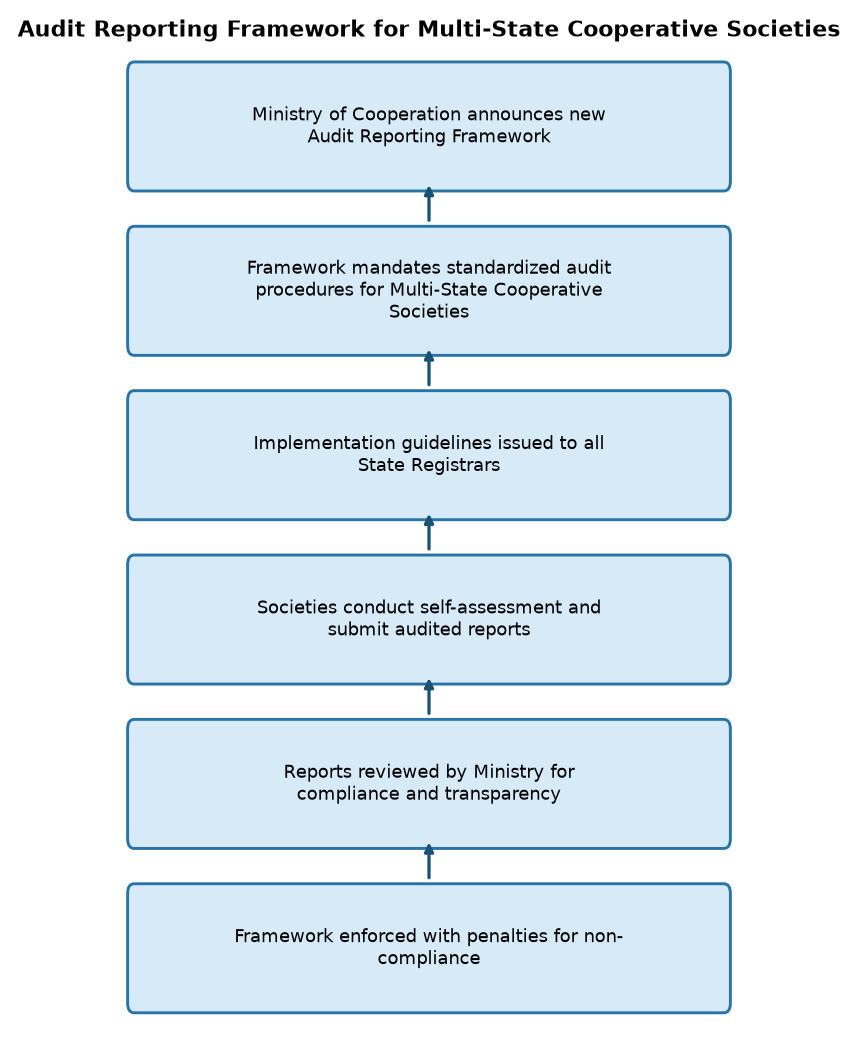
✎ The new Audit Reporting Framework for Multi-State Cooperative Societies mandates independent, risk-based audits with standardised disclosures, timely reporting, and penalties for non-compliance, aimed at enhancing transparency…
Subject Relevance — Where This Topic Fits
- GS Paper II — Governance, Transparency and Accountability | GS Paper III — Cooperative Sector and Rural Development
- Prelims: Multi-State Cooperative Societies Act, 2002, Audit provisions under Cooperative Societies, Institutional Governance Reforms, Transparency in Public Institutions, Financial Accountability Mechanisms
- Essay: The Role of Institutions in Ensuring Good Governance in India, Balancing Autonomy and Accountability in Public Institutions
Quick Revision: The new Audit Reporting Framework for Multi-State Cooperative Societies mandates independent, risk-based audits with standardised disclosures, timely reporting, and penalties for non-compliance, aimed at enhancing transparency and accountability in the cooperative sector.
Why is this in the news?
The Ministry of Cooperation has recently notified a new Audit Reporting Framework for Multi-State Cooperative Societies, aimed at enhancing transparency, accountability, and good governance within the cooperative sector. This initiative is significant as it addresses long-standing concerns regarding financial irregularities, weak oversight, and governance deficits in multi-state cooperatives, which play a critical role in India’s rural and agricultural economy.
Background
- Multi-State Cooperative Societies (MSCS) are governed by the Multi-State Cooperative Societies Act, 2002, which provides a legal framework for their formation, registration, and functioning across multiple states.
- The cooperative sector in India comprises over 8.5 lakh cooperatives, with MSCS contributing significantly to sectors such as agriculture, dairy, credit, and housing.
- Historically, the cooperative sector has faced challenges such as weak internal controls, lack of transparency in financial reporting, and instances of mismanagement or financial misconduct.
- The Ministry of Cooperation was established in July 2021 to strengthen the cooperative movement in India, with a focus on institutional reforms and policy interventions.
- The new framework aligns with global best practices in cooperative governance, including the International Cooperative Alliance (ICA) principles and the UN Sustainable Development Goals (SDGs).
What is the Audit Reporting Framework for Multi-State Cooperative Societies?
- The framework introduces a **standardised audit reporting mechanism** for MSCS, ensuring uniformity in financial audits, compliance checks, and governance evaluations across states.
- It mandates **independent audits** by qualified auditors registered with the Institute of Chartered Accountants of India (ICAI) or the Institute of Cost Accountants of India (ICMAI), reducing conflicts of interest.
- The framework requires **detailed disclosure** of financial statements, including balance sheets, profit and loss accounts, and cash flow statements, in a prescribed format for public access.
- A **risk-based audit approach** is introduced, prioritising high-risk areas such as related-party transactions, fund utilisation, and compliance with statutory provisions.
- The framework includes **mandatory reporting on governance practices**, such as board composition, adherence to bye-laws, and implementation of internal audit systems.
- It introduces **timely reporting obligations**, requiring MSCS to submit audit reports to the Registrar of Cooperative Societies within a stipulated period (e.g., 6 months from the end of the financial year).
- The framework empowers the **Central Registrar of Cooperative Societies (CRCS)** to impose penalties for non-compliance, including fines, suspension of operations, or de-registration.
Key Features
| Feature | Significance |
|---|---|
| Mandatory Audit Reporting Framework | Introduces a uniform, structured audit process for Multi-State Cooperative Societies (MSCS), ensuring consistency in financial reporting and governance standards. |
| Enhanced Transparency | Requires detailed disclosures on financial transactions, internal controls, and compliance with cooperative principles, reducing opacity in operations. |
| Accountability Mechanisms | Strengthens the role of auditors and governing bodies by mandating timely and comprehensive audit reports, with provisions for corrective actions. |
| Good Governance Standards | Aligns MSCS operations with principles of accountability, fairness, and responsibility, fostering stakeholder trust. |
| Regulatory Oversight | Empowers the Ministry of Cooperation to monitor compliance, intervene in governance lapses, and enforce corrective measures proactively. |
Why it Matters
Governance and Institutional Strengthening
- Addresses systemic weaknesses in cooperative governance by institutionalising audit processes, reducing the risk of financial mismanagement and fraud.
- Enhances the credibility of Multi-State Cooperative Societies, which play a critical role in sectors like agriculture, credit, and housing.
- Promotes a culture of compliance among cooperatives, aligning them with global best practices in corporate and cooperative governance.
Economic Impact
- Improves financial discipline in cooperatives, which collectively manage substantial public funds and assets, ensuring optimal resource utilisation.
- Facilitates better access to credit and investments by enhancing transparency and reducing perceived risks for lenders and investors.
- Supports the cooperative sector’s contribution to the economy, particularly in rural and semi-urban areas where cooperatives are key economic actors.
Legal and Regulatory Framework
- Fills gaps in the existing Cooperative Societies Act, 1912, and state-specific cooperative laws by introducing a centralised audit framework.
- Ensures uniformity in audit standards across states, addressing inconsistencies in compliance and enforcement mechanisms.
- Provides a legal basis for the Ministry of Cooperation to enforce governance norms, reducing arbitrariness in regulatory oversight.
Challenges
1. Implementation and Compliance
- Ensuring uniform adoption of the framework across all Multi-State Cooperative Societies, including those with limited resources or capacity.
- Addressing resistance from cooperatives accustomed to less stringent audit practices, which may perceive the new framework as burdensome.
- Balancing the need for rigorous audits with the operational realities of small and medium-sized cooperatives.
UPSC Link: Cooperative Societies Act, 1912
2. Capacity Building
- Training auditors and cooperative officials to understand and implement the new framework effectively, particularly in states with weaker institutional capacity.
- Developing standardised audit tools and templates to streamline the reporting process and reduce ambiguity.
- Ensuring the availability of qualified professionals to conduct audits in compliance with the framework.
UPSC Link: NITI Aayog reports on cooperative sector
3. Data Integrity and Reporting
- Preventing manipulation or misreporting of financial data by cooperatives, which may attempt to conceal irregularities to avoid scrutiny.
- Ensuring the accuracy and reliability of audit reports, which are critical for regulatory oversight and stakeholder trust.
- Addressing delays in audit completion and reporting, which could undermine the framework’s effectiveness.
UPSC Link: Financial Reporting Standards
4. Stakeholder Engagement
- Fostering cooperation between cooperatives, auditors, and regulatory bodies to ensure smooth implementation of the framework.
- Educating members of cooperatives about their rights and the benefits of transparent governance to encourage buy-in.
- Addressing concerns of minority stakeholders who may lack representation in cooperative governance structures.
UPSC Link: Cooperative Principles
Challenges — UPSC Perspective
| Issue | Concern |
|---|---|
| Resource Constraints | Limited financial and human resources in small cooperatives may hinder effective implementation of the audit framework. |
| Resistance to Change | Cooperatives accustomed to informal governance structures may resist adopting stricter audit and reporting norms. |
| Regulatory Fragmentation | Inconsistencies between state laws and the central framework could create compliance challenges. |
| Audit Quality | Ensuring that audits are conducted by competent professionals and are free from bias or collusion. |
| Member Awareness | Low awareness among cooperative members about their rights and the importance of transparent governance. |
| Data Security | Protecting sensitive financial and operational data from breaches or misuse during the audit process. |
Way Forward
- Conduct nationwide capacity-building programmes for auditors, cooperative officials, and board members to familiarise them with the new framework.
- Develop standardised audit templates and guidelines in consultation with professional bodies like the Institute of Chartered Accountants of India (ICAI).
- Establish a dedicated grievance redressal mechanism within the Ministry of Cooperation to address implementation challenges and non-compliance.
- Strengthen state-level cooperative departments by providing them with technical and financial support to monitor compliance effectively.
- Promote awareness campaigns among cooperative members to educate them about their rights, the audit process, and the benefits of transparency.
- Introduce incentives for cooperatives that demonstrate exemplary compliance with the framework, such as preferential access to government schemes.
- Regularly review the framework’s effectiveness through pilot audits and feedback from stakeholders, making iterative improvements as needed.
- Collaborate with academic institutions and research bodies to study the impact of the framework on cooperative governance and economic outcomes.
UPSC Value Addition
Keywords for Mains Answer-Writing
Multi-State Cooperative Societies · Audit Reporting Framework · Ministry of Cooperation · transparency in cooperatives · 97th Constitutional Amendment Act 2011 · cooperative governance · institutional accountability · cooperative movement in India · corporate governance norms · financial discipline in cooperatives · Parliamentary Standing Committee on Cooperation · cooperative federalism · audit reforms in India · public accountability mechanisms · cooperative sector reforms
Constitutional & Policy Linkages
- Article 43B (Promotion of Cooperative Societies) – Directly relevant as it mandates the state to promote voluntary formation and autonomous functioning of cooperatives.
Concept Flow
Multi-State Cooperative Societies (MSCS) operate across state boundaries with limited regulatory oversight -> Existing governance and audit practices are inconsistent and opaque -> Ministry of Cooperation introduces a Mandatory Audit Reporting Framework -> Framework mandates uniform audit standards, enhanced disclosures, and accountability mechanisms -> Cooperatives must comply with reporting, internal controls, and corrective actions -> Improved transparency and governance enhance stakeholder trust and economic credibility -> MSCS attract better investments and credit access -> Sector contributes more effectively to rural and agricultural economies -> Broader socio-economic development through cooperative-led initiatives.
Prelims Practice Questions
Q1. Consider the following statements regarding the 97th Constitutional Amendment Act, 2011:
1. It inserted Part IXB in the Constitution to regulate cooperative societies.
2. It empowers the Parliament to legislate on cooperative societies.
3. It mandates that the Chairperson of every cooperative society shall be elected by a secret ballot.
4. It applies to cooperative societies operating within a single state only.
How many of the above statements are correct?
- Only one
- Only two
- Only three
- All four
Answer: Only three — Statements 1 and 2 are correct as the 97th Amendment inserted Part IXB (Articles 243ZH to 243ZT) and empowered Parliament to legislate on cooperative societies. Statement 3 is incorrect as the Act does not mandate a secret ballot for the Chairperson’s election. Statement 4 is incorrect as it applies to multi-state cooperative societies as well.
Q2. Assertion (A): The Ministry of Cooperation was established in 2021 to provide a separate administrative, legal and policy framework for the cooperative sector.
Reason (R): The creation of the Ministry was necessitated by the need to align cooperative governance with corporate governance norms and enhance transparency.
(a) Both A and R are true, and R is the correct explanation of A.
(b) Both A and R are true, but R is NOT the correct explanation of A.
(c) A is true, but R is false.
(d) A is false, but R is true.
- (a)
- (b)
- (c)
- (d)
Answer: (b) — Both the Assertion and Reason are true. The Ministry of Cooperation was indeed established in 2021 to strengthen the cooperative sector. The Reason correctly explains the necessity behind its creation, as the sector required reforms to align with corporate governance norms and improve transparency.
Q3. Match the following committees/reports with their respective recommendations regarding cooperative sector reforms in India:
List-I (Committee/Report)
A. Vaidyanathan Committee (2004)
B. Parliamentary Standing Committee on Cooperation (2019)
C. High-Level Committee on Cooperatives (2021)
D. NITI Aayog’s Strategy for New India @75 (2018)
List-II (Recommendation)
1. Recommended the establishment of a separate Ministry for Cooperatives to strengthen governance.
2. Suggested reforms in the audit and accounting practices of cooperative banks.
3. Proposed the creation of a National Cooperative Development Corporation (NCDC) for financial support.
4. Emphasised the need for transparency and accountability in multi-state cooperative societies.
Select the correct match using the codes below:
- A-2, B-4, C-1, D-3
- A-1, B-3, C-2, D-4
- A-3, B-2, C-4, D-1
- A-4, B-1, C-3, D-2
Answer: A-2, B-4, C-1, D-3 — A-2: Vaidyanathan Committee (2004) focused on reforms in cooperative banks, including audit and accounting practices. B-4: The Parliamentary Standing Committee (2019) highlighted transparency and accountability in multi-state cooperative societies. C-1: The High-Level Committee on Cooperatives (2021) recommended the creation of a separate Ministry for Cooperatives. D-3: NITI Aayog’s Strategy for New India @75 (2018) proposed strengthening the NCDC for financial support.
Mains Practice Question
✍ The Ministry of Cooperation has recently mandated a new Audit Reporting Framework for Multi-State Cooperative Societies to enhance transparency, accountability, and good governance. In this context, critically examine the significance of such reforms for the cooperative sector in India. Also, analyse the constitutional and statutory provisions that govern cooperative societies, and discuss the challenges in their effective implementation. (15 Marks)
Approach: MODEL-ANSWER SKELETON:
1. **Introduction (2 marks)**
– Briefly define cooperative societies and their role in India’s economy (e.g., agriculture, credit, housing).
– Mention the 97th Constitutional Amendment Act, 2011, and its provisions (Part IXB: Articles 243ZH–243ZT).
– Highlight the need for reforms in the cooperative sector due to governance deficits and financial irregularities.
2. **Significance of the new Audit Reporting Framework (4 marks)**
– **Transparency**: Standardised audit reporting will reduce opacity in financial dealings and enhance stakeholder trust.
– **Accountability**: Mandatory disclosures and third-party audits will hold office-bearers and management accountable.
– **Good Governance**: Alignment with corporate governance norms (e.g., SEBI’s LODR norms) to improve decision-making.
– **Comparative Advantage**: Positioning cooperatives as credible economic entities, attracting investment and credit.
3. **Constitutional and Statutory Framework Governing Cooperatives (4 marks)**
– **Constitutional Provisions**: Part IXB (Articles 243ZH–243ZT) mandates state legislation for cooperatives, including provisions for audit and elections.
– **Statutory Provisions**: Multi-State Cooperative Societies Act, 2002 (Sections 42–46 on audit and accounts), and the new Audit Reporting Framework under the Ministry of Cooperation.
– **Role of Registrar of Cooperative Societies**: Oversight authority for compliance and enforcement.
4. **Challenges in Implementation (3 marks)**
– **Federalism**: Overlapping jurisdictions between central and state laws (e.g., state-specific cooperative laws vs. central reforms).
– **Capacity Constraints**: Limited technical expertise in audit and governance in smaller cooperatives.
– **Political Interference**: Resistance from vested interests in delaying or diluting reforms.
– **Compliance Burden**: Small cooperatives may struggle with the cost and complexity of new reporting requirements.
5. **Way Forward (2 marks)**
– **Capacity Building**: Training programs for cooperative leaders and auditors on new frameworks.
– **Digital Integration**: Leveraging technology (e.g., blockchain for transparent audits) to streamline compliance.
– **Incentivisation**: Linking compliance with access to credit or subsidies to encourage adherence.
**Balance of Views**: Acknowledge that while reforms are necessary, their success depends on effective implementation, political will, and stakeholder cooperation. Contrast the potential benefits with the risks of bureaucratic overreach or unintended consequences.
Source: PIB (Press Information Bureau)
Generated by AanyaAi for educational purpose.
Related guides on our sites
- Current affairs for upsc 2026
- Best PSIR optional coaching for upsc
- Best economics optional coaching for upsc
- Best PSIR optional teacher for upsc

- Shivraj Singh Chouhan launches ‘Khet Bachao Abhiyan’ to save farmland - October 23, 2026
- उत्तराखंड राज्यपाल की पीएम मोदी से महत्वपूर्ण बैठक: जानिए मुख्य बिंदु - October 23, 2026
- How India’s Rs 20,000 Cr CCUS Budget Can Drive Net-Zero Goals - October 23, 2026

No Comments