


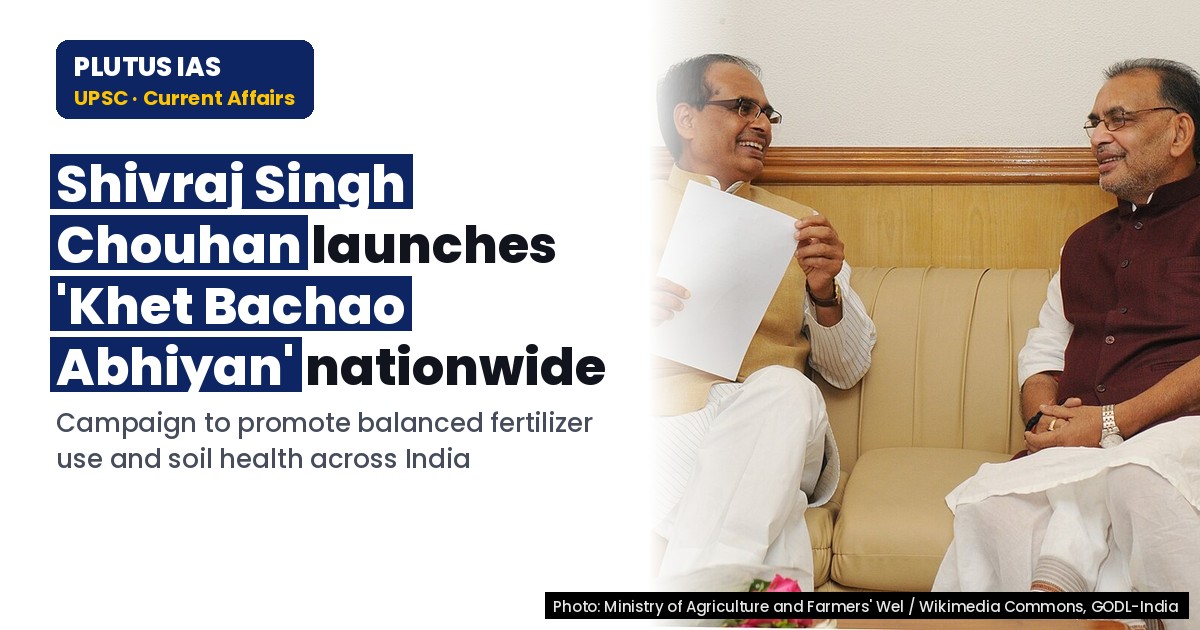
23 Oct Shivraj Singh Chouhan launches ‘Khet Bachao Abhiyan’ to save farmland
✎ Soil Health Card Scheme and balanced fertiliser use are critical for sustainable agriculture; overuse of urea and DAP degrades soil health and increases input costs.
Subject Relevance — Where This Topic Fits
- GS Paper III — Agriculture, Environment and Sustainable Development
- Prelims: Soil Health Card Scheme, Pradhan Mantri Kisan Samman Nidhi (PM-KISAN), Balanced Fertiliser Use, Natural Farming, Green Ammonia, Sub-Mission on Agricultural Mechanisation
- Essay: Sustainable agriculture as a pathway to food security and ecological balance, Balancing productivity and environmental conservation in India’s development trajectory
Quick Revision: Soil Health Card Scheme and balanced fertiliser use are critical for sustainable agriculture; overuse of urea and DAP degrades soil health and increases input costs.
Why is this in the news?
The Union Minister for Agriculture and Farmers’ Welfare and Rural Development, Shri Shivraj Singh Chouhan, launched the nationwide ‘Khet Bachao Abhiyan’ (Save the Fields Campaign) from Taraori, Karnal, Haryana, on 22 October 2026. The campaign underscores the critical need for sustainable soil management, balanced fertiliser use, and the adoption of natural farming practices to safeguard agricultural land and human health. It aligns with broader national initiatives to enhance soil health, reduce chemical dependency in agriculture, and promote environmentally resilient farming systems.
Background
- Soil degradation in India is a pressing concern, with approximately 30% of the country’s land facing moderate to severe degradation due to erosion, nutrient depletion, and chemical overuse.
- The Soil Health Card Scheme (launched in 2015) aims to assess soil nutrient status and provide recommendations for balanced fertiliser use, benefiting over 14 crore farmers.
- India’s fertiliser subsidy regime, which exceeds ₹1.5 lakh crore annually, is designed to ensure affordable access to inputs but risks encouraging overuse of urea and DAP without adequate soil testing.
- The Pradhan Mantri Kisan Samman Nidhi (PM-KISAN) provides direct income support to farmers, enabling them to invest in sustainable practices and reduce dependency on chemical inputs.
- Natural farming, as promoted under the Bharatiya Prakritik Krishi Paddhati / National Mission on Natural Farming, emphasises the use of indigenous inputs like *Beejamrit* and *Ghan Jeevamrit* to enhance soil microbial activity and reduce costs.
- The concept of ‘Green Ammonia’ has gained traction as a sustainable alternative to conventional ammonia production, aligning with India’s goal of achieving self-reliance in fertiliser production.
What is the ‘Khet Bachao Abhiyan’ and its objectives?
- A nationwide awareness campaign launched on 22 October 2026, running until 30 November 2026, to educate farmers on sustainable soil and land management practices.
- The campaign targets the reduction of chemical fertiliser and pesticide overuse through soil health card-based recommendations and balanced nutrient management.
- It promotes the adoption of natural farming techniques, including the use of *Beejamrit* (seed treatment solution) and *Ghan Jeevamrit* (compost microbial solution), to enhance soil fertility and reduce input costs.
- The initiative emphasises the preservation of soil microbial diversity, including earthworms and beneficial insects, by discouraging the burning of crop residues.
- It highlights the role of farmers in diversifying crops and adopting practices such as green ammonia production to reduce reliance on imported fertilisers.
- The campaign aligns with the broader national agenda of achieving self-reliance in fertiliser production and ensuring long-term food security.
- It includes a pledge-taking ceremony by farmers to commit to balanced fertiliser use, soil conservation, and sustainable agricultural practices.
- The campaign leverages the network of Krishi Vigyan Kendras (KVKs) and agricultural institutions to disseminate scientific knowledge and best practices across rural India.
Key Features
| Feature | Significance |
|---|---|
| Nationwide ‘Khet Bachao Abhiyan’ (22 Oct–30 Nov 2026) | A time-bound mass awareness campaign to sensitize farmers on balanced fertiliser use, soil health, and sustainable agricultural practices across all agro-climatic zones of India. |
| Soil Health Card (SHC) Integration | Mandates pre-fertiliser application soil testing to determine nutrient requirements, reducing chemical overuse and enhancing long-term land productivity. |
| Natural Farming Promotion (Subsidy Support) | Encourages adoption of zero-budget natural farming (ZBNF) techniques such as ‘Beejamrit’ and ‘Ghan Jeevamrit’ to reduce input costs and improve soil microbial health. |
| Balanced Nutrient Management | Advocates calibrated use of urea, DAP, and micronutrients based on SHC recommendations to prevent soil degradation and groundwater contamination. |
| Crop Residue Management | Promotes in-situ incorporation or alternate uses of crop residues to prevent stubble burning, thereby conserving soil organic matter and beneficial soil fauna. |
Why it Matters
Agricultural Productivity
- Safeguards long-term soil fertility by curtailing chemical overuse, which is critical for sustaining India’s food security amid climate variability.
- Enhances crop yield resilience through balanced nutrition, reducing dependency on high-input agriculture.
- Supports the goal of doubling farmer income by lowering input costs via natural farming adoption.
Environmental Sustainability
- Mitigates soil acidification, nutrient depletion, and groundwater pollution caused by indiscriminate fertiliser application.
- Reduces greenhouse gas emissions from stubble burning by promoting residue management practices.
- Protects biodiversity by preventing harm to soil microflora and fauna from synthetic chemicals.
Public Health
- Lowers exposure to harmful chemicals in food chains, thereby reducing risks of pesticide-related ailments among rural and urban populations.
- Encourages consumption of chemical-free produce, aligning with the National Health Policy’s objective of reducing non-communicable diseases.
Rural Livelihoods
- Strengthens farmer autonomy by reducing input costs and dependency on market-priced fertilisers through natural farming techniques.
- Enhances rural housing security via Pradhan Mantri Awaas Yojana-Gramin (PMAY-G) allocations, improving living standards in agrarian communities.
Policy Coherence
- Integrates multiple central schemes—Soil Health Card, PM-KISAN, PMAY-G, and natural farming initiatives—into a unified framework for sustainable agriculture.
- Reinforces India’s commitment to the Sustainable Development Goals (SDG 2, SDG 12, SDG 15) through actionable field-level interventions.
Challenges
1. Farmer Adoption Barriers
- Risk aversion among small and marginal farmers due to perceived yield trade-offs in transitioning from chemical to natural farming.
- Limited access to training and extension services in remote and tribal regions, hindering widespread adoption of balanced nutrient management.
- Market linkages for natural farming produce remain underdeveloped, discouraging farmers from shifting away from high-input agriculture.
UPSC Link: GS3: Agricultural Extension
2. Soil Degradation Trends
- Approximately 30% of India’s land is degraded due to erosion, salinity, and nutrient depletion, threatening food security.
- Overuse of urea and DAP has led to micronutrient deficiencies in soils, reducing crop response to fertilisers over time.
- Climate change exacerbates soil degradation through increased frequency of extreme weather events (droughts, floods).
UPSC Link: GS3: Land Degradation Neutrality
3. Subsidy Regime Distortions
- Fertiliser subsidy policies (₹1.5 lakh crore annually) inadvertently incentivise chemical overuse by keeping prices artificially low.
- Lack of price signals for balanced fertilisers (e.g., NPK blends) discourages their adoption despite soil health benefits.
- Subsidy rationalisation efforts face political economy constraints due to farmer lobby pressures.
UPSC Link: GS3: Agricultural Subsidies
4. Institutional Capacity Gaps
- Agricultural extension services (Krishi Vigyan Kendras) are understaffed and lack specialised expertise in natural farming techniques.
- Soil testing infrastructure is inadequate, with only 20% of villages having access to Soil Health Card laboratories.
- Monitoring and evaluation mechanisms for campaign outcomes are weak, limiting evidence-based policy adjustments.
UPSC Link: GS2: Public Service Delivery
5. Climate Change Impacts
- Rising temperatures and erratic rainfall patterns reduce soil moisture retention, increasing fertiliser leaching and runoff.
- Increased pest and disease incidence under warming climates necessitates higher chemical inputs, counteracting campaign objectives.
- Heat stress on crops lowers nutrient uptake efficiency, exacerbating the need for balanced fertiliser management.
UPSC Link: GS3: Climate Change and Agriculture
Challenges — UPSC Perspective
| Issue | Concern |
|---|---|
| Farmer Risk Aversion | Perceived yield loss during transition to natural farming deters adoption despite long-term benefits. |
| Subsidy Distortions | Low prices of urea/DAP encourage overuse, undermining balanced nutrient management goals. |
| Soil Testing Gaps | Inadequate lab capacity delays Soil Health Card issuance, reducing campaign effectiveness. |
| Extension Service Shortfalls | Lack of trained personnel limits dissemination of natural farming techniques in remote areas. |
| Market Linkages | Absence of premium markets for natural farming produce reduces economic incentives for farmers. |
| Climate Variability | Extreme weather events degrade soil health and increase fertiliser inefficiency, threatening campaign outcomes. |
Government Initiatives — Must-Memorise for Prelims
- Soil Health Card Scheme
- Pradhan Mantri Kisan Samman Nidhi (PM-KISAN)
- Pradhan Mantri Awaas Yojana-Gramin (PMAY-G)
- National Mission on Sustainable Agriculture (NMSA)
- Sub-Mission on Agroforestry (SMAF)
Way Forward
- Strengthen Soil Health Card implementation by expanding lab infrastructure and digitising soil test results for real-time farmer access.
- Enhance agricultural extension services through capacity-building of Krishi Vigyan Kendras in natural farming techniques and balanced nutrient management.
- Rationalise fertiliser subsidies by introducing Nutrient-Based Subsidy (NBS) for all fertilisers, including balanced NPK blends, to correct price distortions.
- Develop market linkages for natural farming produce via certification schemes (e.g., Participatory Guarantee System) and procurement by FPOs.
- Integrate climate-resilient agriculture practices into the campaign, such as drought-resistant crop varieties and moisture-conserving techniques.
- Establish a robust monitoring framework with GIS-based tracking of soil health parameters and campaign outreach metrics.
- Promote farmer producer organisations (FPOs) to facilitate collective adoption of natural farming and bulk procurement of inputs.
- Launch state-specific pilots for zero-budget natural farming (ZBNF) in high-degradation zones, with performance-linked incentives for early adopters.
UPSC Value Addition
Keywords for Mains Answer-Writing
Soil health management · Sustainable agriculture · Natural farming · Balanced fertilizer use · Soil Health Card Scheme · Chemical fertilizer subsidy · Pradhan Mantri Awas Yojana-Gramin · Crop residue management · Green ammonia · Agroecological practices · Land degradation neutrality · National Mission for Sustainable Agriculture
Concept Flow
Indiscriminate chemical fertiliser use → Soil degradation (acidification, nutrient depletion) → Reduced crop yields and groundwater contamination → Farmer health risks from chemical residues → Soil Health Card (SHC) scheme → Mandates soil testing → Provides nutrient recommendations → Enables balanced fertiliser use → Balanced nutrient management → Improves soil organic matter and microbial health → Enhances crop resilience to climate stress → Natural farming adoption (Beejamrit, Ghan Jeevamrit) → Reduces input costs and chemical residues → Enhances farm profitability and public health → Crop residue management → Prevents stubble burning → Conserves soil moisture and beneficial soil fauna → Reduces air pollution → Sustainable agriculture outcomes → Supports food security, rural livelihoods, and environmental sustainability → Aligns with SDGs and India’s climate commitments
Prelims Practice Questions
Q1. Consider the following statements regarding the Soil Health Card Scheme in India:
1. It aims to provide farmers with soil health cards containing recommendations for use of balanced fertilizers.
2. The scheme is implemented by the Ministry of Agriculture and Farmers’ Welfare.
3. The scheme provides subsidies for purchase of chemical fertilizers based on soil test results.
4. The scheme mandates the use of organic fertilizers only in the recommendations provided to farmers.
How many of the above statements are correct?
- Only one
- Only two
- Only three
- All
Answer: Only three — Statements 1 and 2 are correct. Statement 3 is incorrect as the scheme does not provide subsidies for fertilizers; it only provides recommendations. Statement 4 is incorrect as the scheme promotes balanced use of both chemical and organic fertilizers based on soil health.
Q2. Assertion (A): The excessive use of chemical fertilizers and pesticides in agriculture has led to soil degradation and health risks.
Reason (R): The Government of India provides subsidies worth over ₹1.5 lakh crore annually to support balanced fertilizer use among farmers.
In the context of the above two statements, which one of the following is correct?
- Both A and R are true and R is the correct explanation of A.
- Both A and R are true but R is not the correct explanation of A.
- A is true but R is false.
- A is false but R is true.
Answer: A is true but R is false. — Assertion (A) is true as excessive chemical use degrades soil and poses health risks. Reason (R) is also true as the government provides substantial subsidies, but R does not directly explain A, as the subsidies are meant to promote balanced use, not excessive use.
Q3. Match the following initiatives with their respective ministries/departments:
Column I (Initiative) | Column II (Ministry/Department)
— | —
1. Pradhan Mantri Awas Yojana-Gramin | A. Ministry of Agriculture and Farmers’ Welfare
2. Soil Health Card Scheme | B. Ministry of Rural Development
3. National Mission for Sustainable Agriculture | C. Ministry of Housing and Urban Affairs
4. Green Ammonia Mission | D. Ministry of Chemicals and Fertilizers
Select the correct match:
- 1-B, 2-A, 3-D, 4-C
- 1-C, 2-A, 3-B, 4-D
- 1-B, 2-A, 3-C, 4-D
- 1-A, 2-B, 3-D, 4-C
Answer: 1-B, 2-A, 3-D, 4-C — 1-B: Pradhan Mantri Awas Yojana-Gramin is under the Ministry of Rural Development. 2-A: Soil Health Card Scheme is under the Ministry of Agriculture and Farmers’ Welfare. 3-D: National Mission for Sustainable Agriculture is under the Ministry of Agriculture and Farmers’ Welfare. 4-C: Green Ammonia Mission is under the Ministry of Chemicals and Fertilizers.
Mains Practice Question
✍ The indiscriminate use of chemical fertilizers and pesticides has led to severe soil degradation and poses significant health risks. In this context, critically examine the role of government policies and schemes in promoting sustainable agriculture in India. Also, assess the challenges in their effective implementation. (15 Marks)
Approach: MODEL-ANSWER SKELETON:
1. **Introduction (2 Marks)**
– Briefly define soil degradation and its causes (excessive chemical use, crop residue burning, monoculture).
– State the objectives of sustainable agriculture: soil health, biodiversity, farmer livelihoods, and food security.
2. **Government Policies and Schemes (5 Marks)**
– **Soil Health Card Scheme (SHC):** Purpose, implementation (2015), benefits (soil testing, balanced fertilizer recommendations), coverage (12.8 crore farmers).
– **Pradhan Mantri Krishi Sinchayee Yojana (PMKSY):** Focus on micro-irrigation to reduce water and fertilizer use.
– **National Mission for Sustainable Agriculture (NMSA):** Objectives, components (climate-resilient agriculture, soil health management).
– **Subsidy Rationalisation:** Reduction in urea subsidy (Neem-coated urea), promotion of nano-fertilizers, and organic farming (Sub-Mission on Organic Farming).
– **Crop Residue Management:** Promoting Happy Seeders, bio-decomposers, and in-situ management to reduce stubble burning.
3. **Challenges in Implementation (5 Marks)**
– **Farmer Awareness:** Low adoption of SHC recommendations due to lack of awareness or trust in organic alternatives.
– **Economic Constraints:** Higher cost of organic inputs compared to subsidised chemical fertilizers.
– **Market Linkages:** Inadequate supply chains for organic inputs and premium pricing for organic produce.
– **Policy Coordination:** Fragmented implementation across states, lack of convergence between agriculture and rural development schemes.
– **Technological Barriers:** Limited access to soil testing labs and advisory services in remote areas.
4. **Way Forward (3 Marks)**
– Strengthening farmer-producer organisations (FPOs) for collective action in organic farming.
– Expanding soil testing infrastructure and digital platforms for real-time advisory.
– Incentivising natural farming through direct benefit transfers (DBT) and certification support.
– Promoting agroecological practices (crop diversification, integrated nutrient management) through demonstration farms.
– Enhancing research and extension services to bridge the knowledge gap.
Source: PIB (Press Information Bureau)
Generated by AanyaAi for educational purpose.
Related guides on our sites
- Best agriculture optional coaching
- Anthropology VS PSIR
- Best PSIR optional coaching
- Best PSIR optional coaching online

- सी-डैक और बैंक ऑफ इंडिया का क्वांटम प्रौद्योगिकी हेतु सहयोग - October 23, 2026
- Indian Navy to Host Indo-Pacific Dialogue 2026: Security - October 23, 2026
- विशेष अभियान 6: जल संसाधन विभाग की उपलब्धियाँ, गंगा पुनरुद्धार सहित - October 23, 2026

No Comments