


15 Oct जल जीवन मिशन 2.0: जिला कलेक्टरों का 13वां पेयजल संवाद
✎ The Jal Jeevan Mission 2.0 integrates community ownership, data-driven governance, and convergence with national schemes to ensure sustainable rural water supply, with district collectors playing a pivotal role in implementation…
Subject Relevance — Where This Topic Fits
- GS Paper II — Governance, Transparency and Accountability | GS Paper II — Role of Civil Services in Development | GS Paper III — Water Resources and their Management | GS Paper III — Rural Development and Panchayati Raj
- Prelims: Jal Jeevan Mission (JJM), Har Ghar Jal, Village Water and Sanitation Committee (VWSC), District Water and Sanitation Mission (DWSM), Sujalam Shakti Kendra, Jal Aapda, Groundwater Recharge, Source Sustainability Plan, Decision Support System (DSS), Vijaya Bharat Ground Water Augmentation (VBG Ram Ji)
- Essay: Role of district administration in achieving Sustainable Development Goal 6: Clean Water and Sanitation, Community-led governance as a model for public service delivery in rural India
Quick Revision: The Jal Jeevan Mission 2.0 integrates community ownership, data-driven governance, and convergence with national schemes to ensure sustainable rural water supply, with district collectors playing a pivotal role in implementation and oversight.
Why is this in the news?
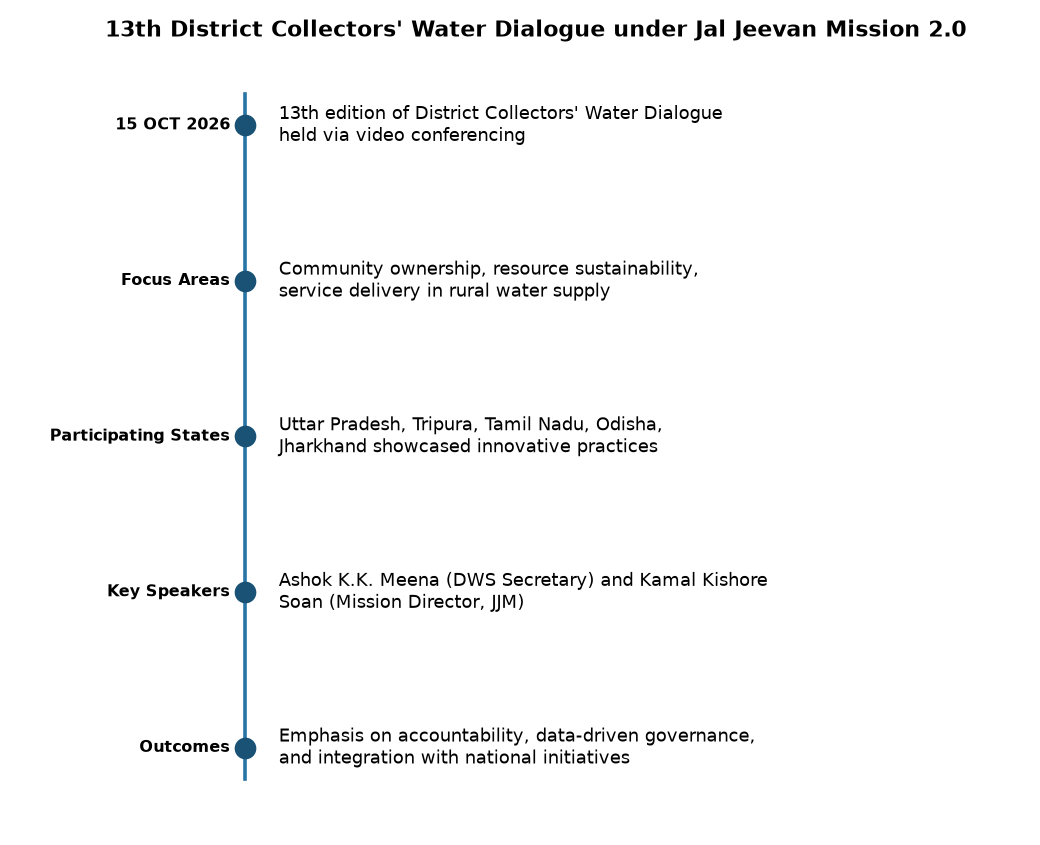
The Department of Drinking Water and Sanitation (DDWS), Ministry of Jal Shakti, organised the 13th edition of the District Collectors’ Jal Jeevan Mission (JJM) 2.0 Dialogue on 15 October 2026 through video conferencing. The event focused on accelerating the implementation of JJM 2.0 by facilitating peer learning among district administrations, sharing best practices, and addressing operational challenges in rural water supply systems. Senior officials, district collectors, and mission directors from five districts in Uttar Pradesh, Tripura, Tamil Nadu, Odisha, and Jharkhand participated and showcased innovative approaches in rural water administration.
Background
- The Jal Jeevan Mission (JJM) was launched in August 2019 with the goal of providing functional household tap connections (Har Ghar Jal) to every rural household by 2024.
- JJM 2.0, launched in 2023, emphasises not only coverage but also the sustainability of water supply systems, community ownership, and operational efficiency.
- The mission operates under the aegis of the Department of Drinking Water and Sanitation (DDWS), Ministry of Jal Shakti, with a decentralised implementation framework involving Panchayati Raj Institutions (PRIs), local communities, and district administrations.
- The mission integrates with other national initiatives such as the Mahatma Gandhi National Rural Employment Guarantee Scheme (MGNREGS), Atal Mission for Rejuvenation and Urban Transformation (AMRUT), and the Jal Shakti Abhiyan for convergence in water conservation and groundwater recharge.
- The role of district collectors as nodal officers for JJM implementation is critical, as they oversee coordination between state agencies, PRIs, and local communities to ensure sustainable water supply.
- The mission’s data-driven governance framework includes the Jal Jeevan Mission Dashboard, Village Water Supply System (VWSS) assessments, and the Decision Support System (DSS) for evidence-based planning.
What is the Jal Jeevan Mission 2.0 and the District Collectors’ Dialogue?
- Jal Jeevan Mission 2.0 is an upgraded version of the original JJM, focusing on the sustainability of water supply infrastructure, community ownership, and operational efficiency in rural areas.
- The mission aims to ensure that every rural household has a functional tap connection with adequate quantity and quality of water on a long-term basis, moving beyond mere provision to sustainable service delivery.
- The District Collectors’ Dialogue is a bi-monthly platform initiated by DDWS to facilitate peer learning, sharing of best practices, and problem-solving among district administrations implementing JJM 2.0.
- The dialogue serves as a mechanism for district collectors to discuss challenges such as groundwater depletion, water quality issues, energy disruptions, and operational inefficiencies in rural water supply systems.
- Key thematic areas discussed include source sustainability planning, groundwater recharge, integration of rainwater harvesting, solarisation of rural water supply schemes, and strengthening of Village Water and Sanitation Committees (VWSCs).
- The dialogue emphasises the use of the Decision Support System (DSS) for evidence-based planning, which integrates data on groundwater, rainfall, hydrology, and mission progress to guide interventions.
- The event also highlights the importance of formal transfer of water supply assets to communities through the Jal Arpan module, ensuring transparency and accountability in asset management.
- Institutional capacity building for VWSCs, Panchayat secretaries, and Sujalam Shakti Kendras is a recurring theme, with a focus on training for operation and maintenance (O&M) of rural water infrastructure.
Key Features
| Feature | Significance |
|---|---|
| District Collector-led Peer Learning Platform | Provides a structured forum for sharing best practices, troubleshooting implementation challenges, and enhancing accountability in rural water supply under JJM 2.0. |
| District Water & Sanitation Missions (DWSM) | Institutional mechanism at the district level for regular monitoring, documentation, and data-driven governance of water supply assets and service delivery. |
| Water Service Assessment Reports | Standardised evaluation of functional performance of water supply systems, enabling evidence-based planning and targeted interventions for reliability improvement. |
| Decision Support System (DSS) | Integrates hydrogeological, rainfall, and JJM data to identify water-stressed areas, prioritise interventions, and enhance operational efficiency in rural water management. |
| Solarisation of Rural Water Supply Schemes | Promotes renewable energy integration to reduce operational disruptions, improve reliability, and ensure sustainable service delivery in off-grid and energy-deficient regions. |
| Community Ownership through Jal Aapan | Formal transfer of water supply assets to local communities post-commissioning, with certification maintained in local languages for transparency and accountability. |
Why it Matters
Governance & Institutional Strengthening
- Enhances decentralised governance by leveraging district-level administrative capacity for efficient implementation of JJM 2.0.
- Strengthens local institutions such as Village Water & Sanitation Committees (VWSCs) and Sujalam Shakti Groups through systematic capacity-building.
- Promotes transparency and accountability via mandatory documentation, monthly DWSM meetings, and real-time data uploads on the DWSM portal.
Technological Integration
- Leverages DSS to integrate multi-source data (geohydrology, rainfall, JJM metrics) for informed decision-making and resource optimisation.
- Facilitates solarisation of water supply schemes to mitigate energy-related disruptions and improve operational reliability.
- Utilises water service assessment reports to identify functional gaps and prioritise maintenance interventions.
Resource Sustainability & Climate Resilience
- Encourages convergence with programmes like Atal Bhujal Yojana (ABY) for groundwater recharge, source conservation, and climate-adaptive water management.
- Promotes source sustainability planning through DSS-driven identification of water-stressed areas and prioritisation of conservation measures.
- Supports integration with national initiatives (e.g., MGNREGS) for convergence in water conservation and recharge activities.
Community Participation & Ownership
- Institutionalises community ownership of water supply assets post-commissioning via Jal Aapan, ensuring long-term sustainability.
- Empowers local communities through structured training of VWSCs, panchayat secretaries, and Sujalam Shakti Groups for O&M of water infrastructure.
- Fosters peer learning among districts to replicate innovative practices in community engagement and service delivery.
Challenges
1. Groundwater Depletion & Source Sustainability
- Chronic over-extraction of groundwater in many districts threatens long-term source sustainability despite JJM infrastructure.
- Seasonal variability in rainfall and recharge rates exacerbates water stress, requiring adaptive planning and conservation strategies.
- Limited integration of hydrogeological data in planning often leads to suboptimal siting of water supply schemes.
UPSC Link: GS-III: Water Resources
2. Operational & Maintenance Bottlenecks
- Inadequate capacity of local institutions (VWSCs, panchayats) in O&M of water supply systems results in frequent breakdowns and service disruptions.
- Energy deficits and unreliable power supply in rural areas hinder the efficient operation of water pumping and treatment systems.
- Lack of standardised protocols for asset maintenance and repair leads to ad-hoc responses and prolonged downtime.
UPSC Link: GS-II: Governance
3. Data Gaps & Monitoring Challenges
- Incomplete or delayed data uploads on DWSM portals impede evidence-based decision-making and real-time monitoring.
- Water quality monitoring remains inconsistent across districts, with gaps in testing infrastructure and reporting mechanisms.
- Limited utilisation of DSS due to inadequate training and awareness among district officials.
UPSC Link: GS-III: Science & Tech
4. Community Engagement & Behavioural Barriers
- Low awareness among rural communities about water conservation and source protection undermines sustainability efforts.
- Resistance to change in traditional water-use practices (e.g., open defecation, unregulated groundwater extraction) persists.
- Inadequate incentives for community participation in O&M and conservation activities reduce long-term ownership.
UPSC Link: GS-II: Social Justice
5. Convergence & Inter-Sectoral Coordination
- Fragmented implementation across departments (e.g., water, rural development, agriculture) leads to duplication or gaps in interventions.
- Limited alignment between JJM and other water-related schemes (e.g., MGNREGS, ABY) reduces the impact of convergence efforts.
- Coordination challenges between state, district, and local bodies delay approvals and fund disbursements.
UPSC Link: GS-II: Governance
Challenges — UPSC Perspective
| Issue | Concern |
|---|---|
| Groundwater Over-Exploitation | Threatens long-term viability of rural water supply schemes despite JJM infrastructure. |
| Energy Deficits in Rural Areas | Disrupts operation of water pumping and treatment systems, reducing reliability. |
| Inadequate Local Capacity for O&M | Leads to frequent breakdowns and prolonged service disruptions. |
| Data Incompleteness on DWSM Portals | Impedes evidence-based planning and real-time monitoring of water supply systems. |
| Low Community Awareness on Conservation | Undermines sustainability of water sources and infrastructure. |
| Fragmented Inter-Sectoral Coordination | Results in duplication or gaps in water-related interventions across departments. |
Government Initiatives — Must-Memorise for Prelims
- Jal Jeevan Mission (JJM) 2.0
- Atal Bhujal Yojana (ABY)
- Mahatma Gandhi National Rural Employment Guarantee Scheme (MGNREGS)
Way Forward
- Strengthen capacity-building programmes for VWSCs, panchayat secretaries, and Sujalam Shakti Groups to improve O&M of water supply systems.
- Accelerate solarisation of rural water supply schemes to mitigate energy-related disruptions and enhance operational reliability.
- Enhance utilisation of the Decision Support System (DSS) by providing district officials with targeted training and technical support.
- Ensure timely and complete data uploads on the DWSM portal, with regular audits to verify accuracy and completeness.
- Promote convergence between JJM and other water-related schemes (e.g., ABY, MGNREGS) for integrated water resource management.
- Develop district-specific source sustainability plans using DSS outputs to prioritise groundwater recharge and conservation measures.
- Increase community awareness campaigns on water conservation, source protection, and the role of VWSCs in O&M.
- Establish a robust grievance redressal mechanism at the district level to address service delivery issues promptly.
UPSC Value Addition
Keywords for Mains Answer-Writing
Jal Jeevan Mission 2.0 · Community ownership of water assets · District Collector’s role in rural water governance · Decentralised water resource management · Sustainable service delivery in rural areas · Village Water and Sanitation Committees (VWSCs) · Solar-powered rural water supply systems · Groundwater recharge and source sustainability · Decision Support System (DSS) for water management · Convergence with MGNREGS and other schemes · Water quality monitoring and energy resilience · Institutional monitoring and documentation in JJM · Gram Panchayat-led water infrastructure maintenance · Sustainable Development Goals (SDG) 6 · National Rural Drinking Water Programme (NRDWP) · Water ATMs and digital governance in JJM
Concept Flow
District-level peer learning platform (Jal Jeevan Mission 2.0) → Identification of best practices and challenges in rural water supply. → Institutional strengthening via DWSM → Regular monitoring, documentation, and data-driven governance. → Integration of hydrogeological, rainfall, and JJM data into DSS → Evidence-based planning and prioritisation of interventions. → Solarisation of water supply schemes → Reduced energy disruptions and improved reliability. → Formal transfer of assets via Jal Aapan → Enhanced community ownership and long-term sustainability. → Convergence with ABY and MGNREGS → Integrated water resource management and climate resilience.
Prelims Practice Questions
Q1. Consider the following statements about Jal Jeevan Mission (JJM) 2.0:
1. JJM 2.0 aims to ensure 100% piped water supply to all rural households by 2024.
2. The mission mandates the establishment of Village Water and Sanitation Committees (VWSCs) for community ownership of water assets.
3. JJM 2.0 includes provisions for the solarisation of rural water supply systems to improve operational efficiency.
4. The mission does not prioritise groundwater recharge or source sustainability measures.
How many of the above statements are correct?
- Only one
- Only two
- Only three
- All four
Answer: Only three — Statements 1 and 4 are incorrect. JJM 2.0 aims for 100% piped water supply by 2024 (Statement 1 is correct), and the mission explicitly prioritises groundwater recharge and source sustainability (Statement 4 is incorrect). Statements 2 and 3 are correct as JJM 2.0 mandates VWSCs and promotes solarisation of water supply systems.
Q2. Assertion (A): The District Collector plays a pivotal role in ensuring the sustainability of rural water supply systems under Jal Jeevan Mission 2.0.
Reason (R): The District Collector is responsible for the operation, maintenance, and community ownership of water assets, as well as ensuring data-driven governance through regular monitoring and documentation.
Options:
A. Both A and R are true, and R is the correct explanation of A.
B. Both A and R are true, but R is not the correct explanation of A.
C. A is true, but R is false.
D. A is false, but R is true.
Answer: ? — Both the Assertion (A) and Reason (R) are true. The District Collector’s role in JJM 2.0 includes ensuring community ownership, operational efficiency, and data-driven governance, making R the correct explanation of A.
Q3. Match the following initiatives with their respective objectives under Jal Jeevan Mission 2.0:
Column I (Initiative) | Column II (Objective)
——————————————-|——————————————-
A. Village Water and Sanitation Committees | 1. Ensuring community ownership of water assets
B. Solarisation of water supply systems | 2. Improving operational efficiency and reducing energy costs
C. Decision Support System (DSS) | 3. Data-driven planning and monitoring of water resources
D. Water ATMs | 4. Enhancing access to safe drinking water through decentralised distribution
Options:
A – 1, B – 2, C – 3, D – 4
A – 1, B – 3, C – 2, D – 4
A – 4, B – 2, C – 3, D – 1
A – 2, B – 1, C – 4, D – 3
- A – 1, B – 2, C – 3, D – 4
- A – 1, B – 3, C – 2, D – 4
- A – 4, B – 2, C – 3, D – 1
- A – 2, B – 1, C – 4, D – 3
Answer: A – 1, B – 2, C – 3, D – 4 — The correct pairing is: A (Village Water and Sanitation Committees) – 1 (Ensuring community ownership), B (Solarisation of water supply systems) – 2 (Improving operational efficiency), C (Decision Support System) – 3 (Data-driven planning), and D (Water ATMs) – 4 (Decentralised distribution).
Mains Practice Question
✍ The District Collector’s role in Jal Jeevan Mission (JJM) 2.0 is pivotal to achieving sustainable rural water supply and community ownership of assets. Critically examine the institutional, operational, and governance dimensions of this role, with reference to the recent 13th District Collectors’ Water Dialogue. Also, analyse how convergence with other national schemes can enhance the mission’s outcomes. (15 Marks)
Approach: MODEL-ANSWER SKELETON:
1. **Institutional Dimensions**:
– Role of District Collector as the nodal authority for JJM 2.0 implementation, including oversight of Village Water and Sanitation Committees (VWSCs), Gram Panchayats, and Sujalam Shakti Groups.
– Emphasis on community ownership (e.g., water ATMs, asset handover certificates) and institutional capacity-building for VWSCs and Panchayats.
– Reference to the 13th District Collectors’ Water Dialogue: focus on peer learning, sharing best practices, and data-driven governance.
2. **Operational Dimensions**:
– Ensuring reliable service delivery through regular monitoring, maintenance of rural water supply systems, and addressing water quality and energy disruptions.
– Integration of solarisation of water supply systems to improve operational efficiency and reduce costs (as highlighted in the dialogue).
– Use of the Decision Support System (DSS) for evidence-based planning, source sustainability, and prioritising interventions in water-stressed areas.
3. **Governance Dimensions**:
– Data-driven governance: Mandate for monthly District Water and Sanitation Mission (DWSM) meetings, documentation on the DWSM portal, and transparency in reporting.
– Accountability mechanisms: Regular reviews of functionality assessment reports and District Improvement Plans (DIPs) on the JJM dashboard.
– Role of digital tools (e.g., water ATMs, GIS mapping) in enhancing transparency and service delivery.
4. **Convergence with Other Schemes**:
– Linkages with MGNREGS for groundwater recharge, source conservation, and water infrastructure maintenance.
– Integration with programmes like the Jal Shakti Abhiyan and the National Rural Drinking Water Programme (NRDWP) for resource mobilisation and sustainability.
– Leveraging convergence opportunities under schemes like VB-GRAM for targeted interventions in water-scarce regions.
5. **Critical Analysis**:
– Challenges: Ensuring sustained community participation, addressing regional disparities, and overcoming operational bottlenecks (e.g., energy disruptions, water quality issues).
– Opportunities: Strengthening local institutions, adopting innovative technologies (e.g., solarisation, DSS), and fostering inter-departmental coordination.
6. **Conclusion**:
– The District Collector’s role is multi-dimensional, requiring a balance of institutional leadership, operational oversight, and governance reforms. Convergence with other schemes can amplify outcomes by addressing systemic gaps and ensuring holistic water security.
Source: PIB (Press Information Bureau)
Generated by AanyaAi for educational purpose.
Related guides on our sites
- Anthropology VS PSIR
- Best PSIR optional coaching
- Best PSIR optional coaching online
- Best PSIR optional teacher

- महाराष्ट्र सरकार ने ‘मिशन मुर्गास’ शुरू किया, जानें कैसे होगा पशुओं का चारा संकट दूर - October 24, 2026
- Allahabad HC Slams UP Govt Over Shop Evictions for Ayodhya Hospital - October 24, 2026
- विदेश मंत्री जयशंकर ने संयुक्त राष्ट्र चार्टर के प्रति भारत की प्रतिबद्धता दोहराई - October 24, 2026

No Comments