


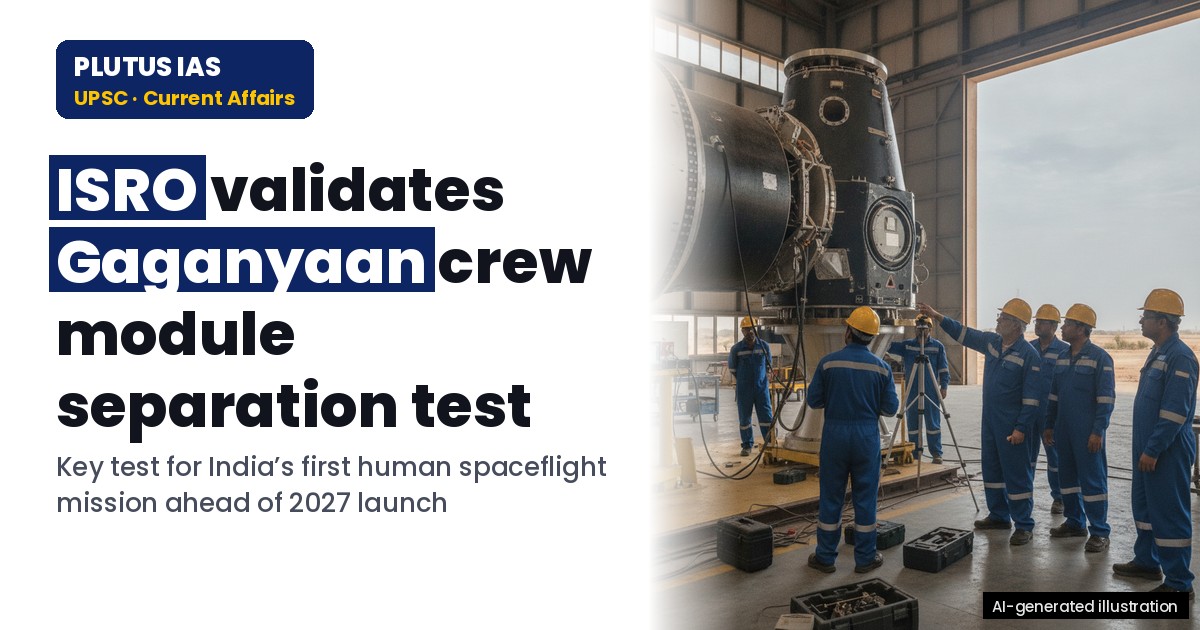
16 Oct Gaganyaan Mission: ISRO’s Critical Crew Module Separation Test Success
✎ The Crew Module-Service Module separation is a critical phase in the Gaganyaan mission, involving pyrotechnic devices and precisely sequenced events to ensure a safe re-entry and splashdown of the astronauts.
Subject Relevance — Where This Topic Fits
- GS Paper III — Science and Technology: Space Technology, Achievements of Indians in Science & Technology
- Prelims: Gaganyaan mission, Crew Module (CM), Service Module (SM), Vikram Sarabhai Space Centre, pyrotechnic separation systems, human spaceflight capability, orbital module, re-entry phase, thermal protection system, inertial navigation system
Quick Revision: The Crew Module-Service Module separation is a critical phase in the Gaganyaan mission, involving pyrotechnic devices and precisely sequenced events to ensure a safe re-entry and splashdown of the astronauts.
Why is this in the news?
The Indian Space Research Organisation (ISRO) has successfully completed a series of critical Crew Module (CM)-Service Module (SM) separation tests for the Gaganyaan mission, a landmark endeavour aimed at demonstrating India’s indigenous human spaceflight capability. These tests validate the robustness of the separation system, a pivotal phase in the mission’s re-entry process, and mark a significant milestone ahead of the first uncrewed mission scheduled for launch in 2026.
Background
- The Gaganyaan mission is India’s maiden human spaceflight programme, designed to demonstrate the capability to launch a crew of three astronauts into a 400 km Low Earth Orbit (LEO) for a three-day mission and safely return them to Earth via a splashdown in Indian waters.
- The mission is being executed by ISRO under the Department of Space, Government of India, with active collaboration from multiple national agencies, including the Indian Air Force, Defence Research and Development Organisation (DRDO), and academic institutions.
- The Gaganyaan programme is part of India’s broader strategic vision to establish a sustained human presence in space, aligning with global trends in space exploration and fostering advancements in aerospace technology.
- The mission’s success will position India as the fourth nation—after the United States, Russia, and China—to independently conduct human spaceflight missions.
- ISRO’s Vikram Sarabhai Space Centre (VSSC), Thiruvananthapuram, is the lead centre for the development of the Crew Module and Service Module, as well as the integration of critical systems for the Gaganyaan mission.
- The Gaganyaan programme follows a phased approach, beginning with uncrewed missions to validate systems, followed by crewed missions, and ultimately the development of a sustained human spaceflight infrastructure.
What is the Gaganyaan Mission and its Crew Module-Service Module Separation System?
- The Gaganyaan mission is India’s flagship human spaceflight programme, aimed at demonstrating the capability to launch a crew of three astronauts into Low Earth Orbit (LEO) and safely return them to Earth, thereby establishing India’s presence in the domain of human spaceflight.
- The Gaganyaan Orbital Module consists of two primary components: the Crew Module (CM) and the Service Module (SM). The CM is designed to house the astronauts and is equipped with life support systems, thermal protection, and re-entry capabilities, while the SM provides propulsion, power, and other essential services during the mission.
- The CM and SM are integrated prior to launch and function as a single unit during the ascent and orbital phases of the mission. Electrical and fluid connections between the two modules are maintained via umbilical systems to ensure continuous power and data transfer.
- The separation of the CM from the SM is a critical phase of the mission, occurring just before re-entry into Earth’s atmosphere. This process involves a precisely sequenced series of events, including the activation of pyrotechnic devices and jettisoning systems to sever umbilical connections and physically detach the modules.
- The separation system is designed to ensure that the CM is cleanly detached from the SM without causing damage to either module, while also managing the mechanical shocks and thermal stresses generated during the process. The robustness of this system is validated through rigorous ground-based tests, including those conducted at ISRO’s Vikram Sarabhai Space Centre (VSSC).
- The Gaganyaan mission’s CM is equipped with advanced avionics systems, including inertial navigation systems, thermal protection systems (including a conical heat shield and aft heat shield), and deployable umbilical shields to safeguard critical components during separation and re-entry.
- The separation tests conducted by ISRO simulate the entire CM-SM assembly, including the severing of multiple umbilical connections and the activation of pyrotechnic devices. These tests validate the design adequacy, robustness, and shock-survivability of the separation system, as well as the functionality of critical subsystems such as thermal and humidity control systems.
- The successful completion of these separation tests provides the necessary confidence in the mission’s readiness for the upcoming uncrewed Gaganyaan (G1) mission, scheduled for launch in 2026, which will serve as a precursor to India’s first crewed spaceflight.
Key Features
| Feature | Significance |
|---|---|
| Crew Module (CM) and Service Module (SM) separation system | Ensures the critical phase of detaching the crewed module from the service module before re-entry, a prerequisite for safe return of astronauts. |
| Pyrotechnic devices and jettisoning systems | Provides controlled and sequenced separation to avoid structural damage or destabilisation during the separation event. |
| Umbilical connections severing mechanism | Facilitates the clean disconnection of electrical and fluid servicing lines between CM and SM without residual hazards. |
| Shock-survivability testing of subsystems | Validates the resilience of avionics, navigation, thermal protection, and life-support systems against mechanical shocks during separation. |
| Aft and conical heat shield thermal protection | Protects the crew module during atmospheric re-entry by dissipating extreme thermal loads generated by friction. |
Why it Matters
Scientific and Technological
- Demonstrates ISRO’s capability to execute complex in-orbit operations, a milestone for autonomous spacecraft systems.
- Validates indigenous design of separation mechanisms, reducing dependency on foreign technologies for human spaceflight.
- Enhances India’s credentials in aerospace engineering, particularly in thermal protection and re-entry systems.
- Contributes to the development of reusable spacecraft technologies, aligning with global trends in cost-efficient space exploration.
Strategic and Geopolitical
- Positions India among the elite group of nations with proven human spaceflight capability, enhancing strategic autonomy.
- Strengthens international collaborations in space exploration, including potential partnerships for lunar or interplanetary missions.
- Bolsters India’s soft power through indigenous technological achievements in high-stakes domains like spaceflight.
Economic
- Stimulates growth in the aerospace and allied industries, fostering innovation and employment in high-technology sectors.
- Encourages private sector participation in space missions, as seen in ISRO’s increasing collaborations with startups and firms.
- Potential for spin-off technologies in materials science, robotics, and life-support systems with commercial applications.
Institutional and Governance
- Reinforces ISRO’s reputation as a premier space agency, enhancing public trust and institutional credibility.
- Demonstrates the efficacy of India’s space policy framework, particularly in human spaceflight and mission assurance.
- Sets a precedent for future missions under the Gaganyaan programme, including crewed flights and extended orbital missions.
Challenges
1. Precision in Separation Sequencing
- Ensuring the exact timing and force of pyrotechnic events to avoid collisions or structural damage between CM and SM.
- Managing residual shocks to sensitive avionics and life-support systems during separation.
- Validating the robustness of separation systems across varying environmental conditions during re-entry.
UPSC Link: GS3: Space Technology
2. Thermal Protection During Re-entry
- Designing heat shields capable of withstanding temperatures exceeding 1,500°C during atmospheric re-entry.
- Balancing thermal protection with structural integrity to prevent ablation-induced failures.
- Ensuring the conical heat shield’s aerodynamic stability to maintain controlled descent.
UPSC Link: GS3: Space Technology
3. Life-Support and Crew Safety
- Maintaining habitable conditions within the CM during the three-day orbital mission.
- Ensuring fail-safe mechanisms for oxygen supply, temperature regulation, and humidity control.
- Testing emergency abort systems to guarantee crew survival in case of mission anomalies.
UPSC Link: GS3: Space Technology
4. Integration and Testing Complexity
- Coordinating the integration of multiple subsystems from diverse agencies and contractors.
- Conducting exhaustive ground tests to simulate microgravity and vacuum conditions.
- Addressing latency and signal integrity issues in real-time telemetry and command systems.
UPSC Link: GS3: Space Technology
5. Regulatory and Ethical Compliance
- Adhering to international space treaties, particularly the Outer Space Treaty and Rescue Agreement.
- Ensuring transparency in mission planning to address public concerns about space debris and safety.
- Balancing technological ambitions with ethical considerations in human spaceflight.
UPSC Link: GS2: International Treaties
Challenges — UPSC Perspective
| Issue | Concern |
|---|---|
| Pyrotechnic separation reliability | Risk of incomplete or premature detonation affecting mission success. |
| Thermal load management | Potential overheating of CM leading to structural failure or crew endangerment. |
| Avionics shock tolerance | Sensitivity of electronic systems to mechanical shocks during separation. |
| Life-support system redundancy | Ensuring backup systems for oxygen, temperature, and pressure control. |
| Re-entry trajectory accuracy | Precision required to land within designated Indian sea waters for recovery. |
Way Forward
- Conduct additional separation tests under varied thermal and mechanical load conditions to validate system robustness.
- Accelerate the development of indigenous life-support systems, including oxygen generation and CO₂ scrubbing technologies.
- Enhance collaboration with international agencies (e.g., NASA, ESA) for knowledge exchange in human-rated spacecraft systems.
- Establish a dedicated Gaganyaan mission control centre with real-time monitoring and decision-making capabilities.
- Develop and test emergency abort procedures to ensure crew safety in all mission phases.
- Expand ground infrastructure for crew training, including parabolic flights and neutral buoyancy simulations.
- Formulate a long-term roadmap for sustained human spaceflight, including lunar and interplanetary missions.
- Increase public outreach and STEM education initiatives to build awareness and support for space programmes.
UPSC Value Addition
Keywords for Mains Answer-Writing
Gaganyaan mission · ISRO human spaceflight · Crew Module-Service Module separation · Orbital Module · pyrotechnic separation systems · Vikram Sarabhai Space Centre · G1 uncrewed mission · thermal protection system · avionics systems · Indian human space programme · re-entry and recovery · orbital mechanics · space mission safety protocols · ISRO test facilities · space capsule design · Gaganyaan mission architecture · space mission umbilical connections · spacecraft separation mechanisms · Indian Ocean splashdown · space mission shock survivability
Concept Flow
ISRO’s Gaganyaan programme aims to demonstrate India’s human spaceflight capability through a three-day orbital mission. → The Crew Module (CM) and Service Module (SM) are integrated prior to launch and function as a single unit during the orbital phase. → Prior to re-entry, the CM must separate from the SM using a precisely sequenced pyrotechnic system to avoid structural damage. → The separation system severs electrical and fluid umbilical connections while ensuring shock survivability of critical subsystems. → The CM undergoes thermal protection during re-entry, dissipating extreme heat generated by atmospheric friction. → Post-separation, the CM deploys parachutes for controlled descent and splashes down in Indian sea waters for recovery.
Prelims Practice Questions
Q1. Consider the following statements regarding the Gaganyaan mission:
1. The Gaganyaan mission aims to demonstrate human spaceflight capability by launching a crew of three members to an orbit of 400 km for a three-day mission.
2. The Crew Module (CM) and Service Module (SM) are connected using umbilical connections that are severed during the separation process.
3. The separation of the CM from the SM involves the use of pyrotechnic devices and jettisoning systems.
4. The Gaganyaan mission is designed to land the crew module in Indian territorial waters.
How many of the above statements are correct?
- Only one
- Only two
- Only three
- All
Answer: All — Statements 1, 2, and 3 are correct as per the official description of the Gaganyaan mission. Statement 4 is incorrect because the landing is planned in Indian sea waters, not necessarily within Indian territorial waters.
Q2. Assertion (A): The Crew Module (CM) and Service Module (SM) of the Gaganyaan Orbital Module remain integrated throughout the launch and on-orbit phases until separation just before re-entry.
Reason (R): The separation system ensures electrical and fluid servicing between the CM and SM through umbilical connections that are designed to be severed during the separation process.
Options:
A. Both A and R are true, and R is the correct explanation of A.
B. Both A and R are true, but R is NOT the correct explanation of A.
C. A is true, but R is false.
D. A is false, but R is true.
Answer: ? — Both Assertion (A) and Reason (R) are true, and Reason (R) correctly explains Assertion (A) as the umbilical connections are severed during separation.
Q3. Match the following components of the Gaganyaan mission with their respective functions:
Column I (Component) Column II (Function)
A. Crew Module (CM) 1. Provides propulsion, power, and other support systems during the mission
B. Service Module (SM) 2. Houses the crew and ensures their safe return to Earth
C. Pyrotechnic separation system 3. Executes controlled separation of CM from SM using explosive devices
D. Thermal Protection System (TPS) 4. Protects the crew module from extreme heat during re-entry
Options:
A. A-2, B-1, C-3, D-4
B. A-1, B-2, C-3, D-4
C. A-2, B-1, C-4, D-3
D. A-1, B-2, C-4, D-3
Answer: ? — Correct matching: A-2 (Crew Module houses the crew), B-1 (Service Module provides propulsion and support), C-3 (Pyrotechnic separation system executes separation), D-4 (Thermal Protection System protects during re-entry).
Mains Practice Question
✍ The Crew Module-Service Module (CM-SM) separation system is a critical technological challenge in the Gaganyaan mission, requiring precise sequencing and robust execution to ensure crew safety. Critically examine the engineering and operational significance of this separation system in the context of human spaceflight. Also, analyse the implications of failure of this system on the mission’s success and crew survivability. (15 Marks)
Approach: MODEL-ANSWER SKELETON:
1. **Introduction (2 Marks)**
– Define the Gaganyaan mission and its objectives (demonstration of human spaceflight capability, 400 km orbit, 3-day mission, safe return via Indian sea waters).
– State the role of the Orbital Module (CM + SM) and the necessity of CM-SM separation before re-entry.
2. **Engineering Significance of CM-SM Separation (5 Marks)**
– **Mechanical and Pyrotechnic Systems**: Explain the use of pyrotechnic devices and jettisoning systems for controlled separation. Reference the Vikram Sarabhai Space Centre tests simulating separation scenarios.
– **Umbilical Connections**: Describe the electrical and fluid servicing connections between CM and SM and their severance during separation.
– **Avionics and Navigation**: Highlight the role of inertial navigation systems and avionics in ensuring precise separation timing and trajectory.
– **Thermal and Structural Considerations**: Discuss the thermal protection system (TPS) in the CM and its importance post-separation for safe re-entry.
3. **Operational Significance (4 Marks)**
– **Mission Phases**: Outline the mission phases where separation is critical (post-orbit phase, pre-re-entry).
– **Safety Protocols**: Explain the redundancy and fail-safe mechanisms in the separation system to mitigate risks.
– **Shock Survivability**: Reference the ISRO tests demonstrating robustness and shock-survivability of subsystems (e.g., thermal protection, deployable umbilical shield).
4. **Implications of Failure (4 Marks)**
– **Mission Abort Scenarios**: Analyse potential failure modes (premature separation, delayed separation, incomplete separation) and their consequences (loss of crew, mission failure, or uncontrolled re-entry).
– **Crew Survivability**: Discuss the impact on crew safety, including thermal exposure, structural integrity, and communication blackout risks.
– **Lessons from Global Missions**: Briefly reference past space mission failures (e.g., Soyuz 11, Columbia disaster) to underscore the criticality of separation systems.
5. **Conclusion (2 Marks)**
– Summarise the importance of the CM-SM separation system as a cornerstone of the Gaganyaan mission’s success.
– Emphasise the need for continuous testing, validation, and international collaboration in human spaceflight programmes.
Source: The Hindu
Generated by AanyaAi for educational purpose.
Related guides on our sites
- Best PSIR optional test series
- Anthropology VS PSIR
- Best PSIR optional coaching
- Best PSIR optional coaching online

- NAMASTE Scheme: Enhancing Sanitation Workers’ Livelihoods & Safety - November 14, 2026
- एमएसएमई का विशेष अभियान 6.0: स्वच्छता और लंबित मामलों का निपटारा - November 14, 2026
- Sea Vigil-26: Coastal Defence Drills Off Visakhapatnam - November 14, 2026

No Comments