


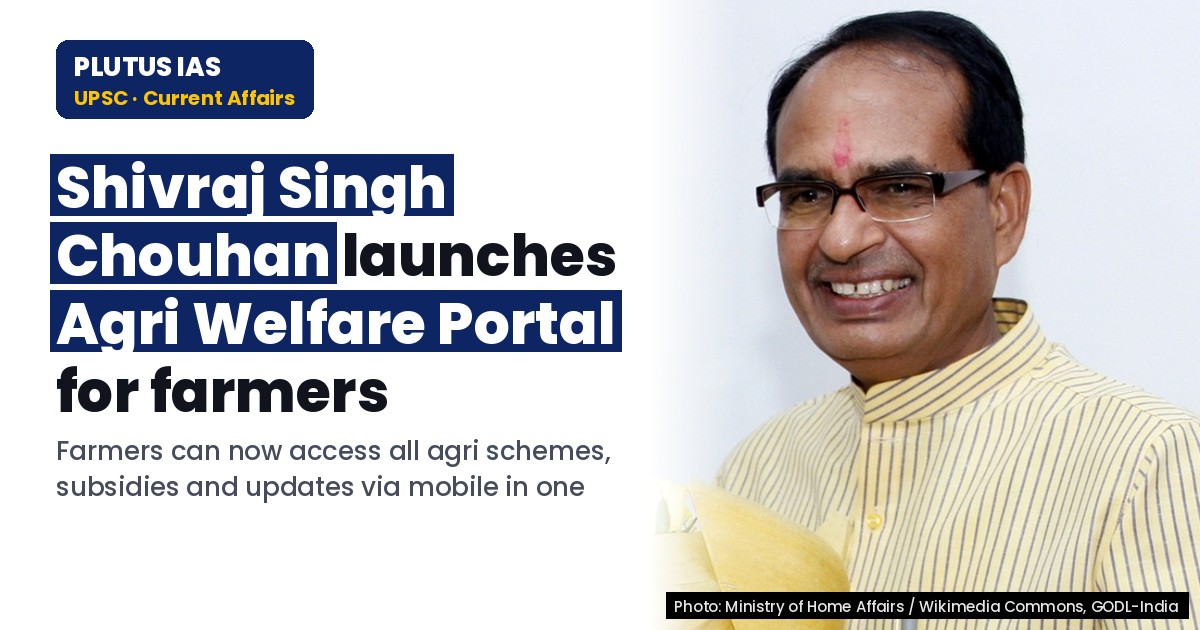
19 Oct Shivraj Singh Launches Agri Welfare Portal for Farmers’ Digital Access
✎ The Agri Welfare Portal is a unified, mobile-first digital platform that provides farmers with real-time access to agricultural schemes, subsidies, and inputs while ensuring transparency, accessibility, and compliance with GIGW 3.
Subject Relevance — Where This Topic Fits
- GS Paper II — Governance, Transparency and Accountability | GS Paper III — Food Processing and Related Industries, Technology Missions
- Prelims: AgriStack, DBT in Agriculture, Digital India, GIGW 3.0, DBIM 3.0, PM-KISAN, PMFBY, FPOs, PACS, KVKs
- Essay: Role of Digital Public Infrastructure in Rural Transformation, Technology as an Enabler for Social Justice
Quick Revision: The Agri Welfare Portal is a unified, mobile-first digital platform that provides farmers with real-time access to agricultural schemes, subsidies, and inputs while ensuring transparency, accessibility, and compliance with GIGW 3.0 and DBIM 3.0 standards.
Why is this in the news?
The Union Minister for Agriculture and Farmers’ Welfare launched the revamped Agri Welfare Portal on 19 October 2026, marking a significant step toward leveraging digital governance to enhance transparency, accessibility, and efficiency in the delivery of agricultural schemes and services. The initiative aligns with the broader vision of ‘Digital India’ and underscores the government’s commitment to ensuring that farmers receive real-time, accurate, and actionable information without intermediaries or bureaucratic delays.
Background
- The Government of India has prioritised agricultural digitalisation through initiatives such as the Digital India programme, which aims to transform governance by making it more citizen-centric, transparent, and efficient.
- Agricultural schemes such as PM-KISAN, PMFBY, and AgriStack have been launched to provide direct financial assistance, crop insurance, and digital identity to farmers, respectively.
- The adoption of Direct Benefit Transfer (DBT) mechanisms has reduced leakages and improved the timeliness of subsidy disbursements to farmers.
- The Government of India has mandated compliance with accessibility and usability standards such as GIGW 3.0 (Guidelines for Indian Government Websites) and DBIM 3.0 (Digital Bharat Interface for Modules) to ensure inclusivity and usability across diverse user groups.
- Agricultural extension services, delivered through Krishi Vigyan Kendras (KVKs), play a crucial role in disseminating scientific farming practices and government schemes to farmers.
- Farmers’ Producer Organisations (FPOs) and Primary Agricultural Credit Societies (PACS) serve as aggregators and facilitators for small and marginal farmers, enhancing their bargaining power and access to inputs and markets.
What is the Agri Welfare Portal?
- The Agri Welfare Portal is a unified digital platform launched by the Ministry of Agriculture and Farmers’ Welfare to provide farmers with real-time access to information on government schemes, subsidies, inputs (such as seeds and fertilisers), and agricultural best practices.
- The portal serves as a single-window gateway for multiple flagship schemes, including PM-KISAN, PMFBY, and AgriStack, thereby simplifying the process of availing benefits and reducing the need for farmers to navigate multiple websites or offices.
- The portal is designed to be mobile-first, lightweight, and compatible with low-bandwidth networks, ensuring accessibility even in rural areas with limited internet connectivity.
- It incorporates accessibility features such as screen-reader compatibility and simplified navigation to cater to farmers with disabilities, aligning with the Rights of Persons with Disabilities Act, 2016.
- The portal facilitates transparent and direct benefit transfer (DBT) mechanisms, enabling farmers to check eligibility, apply for schemes, and receive subsidies directly into their bank accounts without intermediaries.
- The platform integrates with agricultural extension services, including KVKs, to provide farmers with location-specific advisories on weather, soil health, pest management, and market prices.
- The portal is developed in compliance with GIGW 3.0 and DBIM 3.0 standards, ensuring security, usability, and interoperability with other digital governance initiatives.
- The initiative includes a training programme for farmers, KVKs, FPOs, and PACS to enhance digital literacy and ensure effective utilisation of the portal.
Key Features
| Feature | Significance |
|---|---|
| Single-window access to all agricultural schemes | Eliminates the need for farmers to visit multiple offices or websites, reducing time and effort in accessing government services. |
| Direct Benefit Transfer (DBT) integration | Ensures transparent and timely disbursal of subsidies and financial assistance directly to farmers’ bank accounts. |
| Mobile-first, low-bandwidth design | Optimised for rural areas with limited internet connectivity, ensuring accessibility even on basic smartphones. |
| Accessibility compliance (GIGW 3.0 & DBIM 3.0) | Fully compliant with government accessibility standards, enabling use by persons with disabilities through screen readers and simplified navigation. |
| Real-time updates on agricultural inputs and market prices | Provides farmers with verified information on seed/fertiliser availability, weather conditions, and mandi prices to aid decision-making. |
Why it Matters
Governance & Digital Public Infrastructure
- Demonstrates the integration of digital governance with sectoral welfare schemes, aligning with the vision of a ‘Digital India’ and ‘Atmanirbhar Bharat’.
- Reduces bureaucratic delays and intermediaries, enhancing efficiency in service delivery to farmers.
- Sets a precedent for other ministries to adopt similar single-window portals for citizen-centric services.
Agricultural Productivity & Farmer Welfare
- Facilitates access to scientific farming techniques, subsidies, and inputs, potentially increasing agricultural productivity.
- Empowers small and marginal farmers by providing them with timely and accurate information, reducing dependency on informal networks.
- Supports the formalisation of the agricultural economy through digital records and direct benefit transfers.
Institutional & Technological Integration
- Serves as a unified platform for multiple schemes (e.g., PM-KISAN, AgriStack, PMFBY), streamlining data management and reducing redundancy.
- Connects farmers with FPOs, PACS, KVKs, and agricultural startups, fostering collaboration and knowledge-sharing.
- Leverages existing digital infrastructure (NIC, MeitY standards) to ensure security, scalability, and interoperability.
Social Inclusion
- Prioritises accessibility for persons with disabilities, ensuring equitable access to government services.
- Aims to bridge the digital divide by providing training through KVKs, enabling farmers to utilise the portal effectively.
Challenges
1. Digital Literacy and Adoption
- Low digital literacy among small and marginal farmers may hinder effective utilisation of the portal.
- Resistance to change from traditional methods of accessing information and services.
- Need for continuous awareness campaigns to ensure farmers are aware of the portal’s features and benefits.
UPSC Link: GS3: Science & Tech
2. Data Privacy and Security
- Risk of data breaches or misuse of sensitive farmer information, necessitating robust cybersecurity measures.
- Ensuring compliance with data protection laws (e.g., DPDP Act, 2023) while collecting and storing farmer data.
- Balancing transparency with the need to protect personal and financial data.
UPSC Link: GS3: Cyber Security
3. Infrastructure and Connectivity Gaps
- Uneven internet connectivity in rural areas may limit the portal’s reach and functionality.
- Dependence on mobile devices, which may not be universally available among farmers, especially women and marginalised groups.
- Need for periodic maintenance and updates to ensure the portal remains functional and user-friendly.
UPSC Link: GS3: Infrastructure
4. Timely and Accurate Information Updates
- Ensuring real-time updates on weather, market prices, and input availability requires coordination with multiple agencies.
- Risk of outdated or incorrect information reducing trust in the portal.
- Need for a dedicated team to monitor and verify information before dissemination.
UPSC Link: GS3: e-Governance
5. Financial and Administrative Sustainability
- Long-term funding and maintenance of the portal require sustained budgetary support.
- Coordination among central, state, and local agencies to ensure seamless integration and service delivery.
- Need for periodic evaluation to assess the portal’s impact and identify areas for improvement.
UPSC Link: GS2: Governance
Challenges — UPSC Perspective
| Issue | Concern |
|---|---|
| Digital divide | Limited smartphone access and low digital literacy among farmers may exclude marginalised groups. |
| Data security | Risk of unauthorised access or misuse of sensitive farmer data. |
| Connectivity gaps | Poor internet infrastructure in rural areas may hinder portal functionality. |
| Information accuracy | Ensuring real-time updates on weather, prices, and inputs to maintain trust. |
| Sustainability | Long-term funding and maintenance challenges for the portal. |
Government Initiatives — Must-Memorise for Prelims
- PM-KISAN
- AgriStack
- PM Fasal Bima Yojana (PMFBY)
Way Forward
- Conduct targeted digital literacy programmes through KVKs and agricultural cooperatives to train farmers on portal usage.
- Establish a dedicated helpline and grievance redressal mechanism to address farmer queries and technical issues.
- Ensure periodic audits of data accuracy and security to maintain trust and compliance with legal standards.
- Expand internet connectivity in rural areas through partnerships with telecom providers and government initiatives like BharatNet.
- Integrate the portal with state-level agricultural databases to ensure seamless service delivery across regions.
- Monitor and evaluate the portal’s impact on farmer welfare, productivity, and administrative efficiency through periodic surveys.
- Collaborate with agricultural startups and FPOs to enhance the portal’s utility and innovation potential.
UPSC Value Addition
Keywords for Mains Answer-Writing
Digital India · Agricultural welfare · e-governance for farmers · Direct Benefit Transfer (DBT) · Single Window Portal · Pradhan Mantri Kisan Samman Nidhi (PM-KISAN) · Agristack · PM Fasal Bima Yojana · Digital Public Infrastructure (DPI) · Farmers’ Digital Empowerment · Accessibility for Persons with Disabilities · DBT 3.0 and GIGW 3.0 Compliance · Kisan Credit Card (KCC) · Agricultural Extension Services · Digital Divide in Rural India
Concept Flow
Government’s Digital India initiative → Development of digital public infrastructure (DPI) for governance. → Need for efficient service delivery to farmers → Launch of single-window portals like ‘Agri Welfare Portal’. → Integration of multiple schemes (PM-KISAN, AgriStack, PMFBY) → Creation of a unified platform for farmers. → Ensuring accessibility and usability → Compliance with GIGW 3.0 and DBIM 3.0 standards. → Direct Benefit Transfer (DBT) mechanism → Transparent and timely disbursal of subsidies to farmers. → Real-time information dissemination → Empowerment of farmers with accurate data on inputs, weather, and markets. → Training and awareness campaigns → Bridging the digital divide and ensuring equitable access.
Prelims Practice Questions
Q1. Consider the following statements regarding the ‘Agri Welfare Portal’ launched by the Government of India: 1. The portal is designed to provide real-time information on agricultural schemes directly to farmers’ mobile devices. 2. It is compliant with DBT 3.0 and GIGW 3.0 standards. 3. The portal is accessible only to literate farmers due to its complex interface. 4. It serves as a single-window gateway for multiple agricultural schemes including PM-KISAN and PM Fasal Bima Yojana. How many of the above statements are correct?
- Only one
- Only two
- Only three
- All four
Answer: Only three — Statements 1, 2, and 4 are correct. Statement 3 is incorrect as the portal is designed to be user-friendly and accessible even to less literate farmers, including those with disabilities.
Q2. Assertion (A): The Agri Welfare Portal aims to eliminate the need for farmers to visit government offices for availing agricultural schemes. Reason (R): The portal provides a single-window interface for accessing multiple schemes, subsidies, and digital services related to agriculture.
- Both A and R are true, and R is the correct explanation of A
- Both A and R are true, but R is not the correct explanation of A
- A is true, but R is false
- A is false, but R is true
Answer: Both A and R are true, and R is the correct explanation of A — Both the assertion and reason are true. The portal’s single-window design directly addresses the need to reduce bureaucratic visits by consolidating access to schemes and services.
Q3. Match the following agricultural schemes with their corresponding portals or platforms: 1. PM-KISAN 2. PM Fasal Bima Yojana 3. Kisan Credit Card (KCC) 4. Agristack A. Agri Welfare Portal B. PMFBY Portal C. KCC Portal D. Unified Farmers’ Service Platform (UFSP)
- {‘1-A, 2-B, 3-C, 4-D’: ‘Correct’}
- {‘1-B, 2-A, 3-D, 4-C’: ‘Incorrect’}
- {‘1-D, 2-C, 3-B, 4-A’: ‘Incorrect’}
- {‘1-A, 2-D, 3-C, 4-B’: ‘Incorrect’}
Answer: {‘1-A, 2-B, 3-C, 4-D’: ‘Correct’} — PM-KISAN is integrated into the Agri Welfare Portal (A). PM Fasal Bima Yojana operates through its dedicated portal (B). Kisan Credit Card services are accessed via the KCC Portal (C). Agristack is linked to the Unified Farmers’ Service Platform (UFSP) (D).
Mains Practice Question
✍ The launch of the Agri Welfare Portal represents a significant step in bridging the digital divide in rural India through e-governance. Critically examine the potential of such digital public infrastructure (DPI) in transforming agricultural governance and farmer welfare. Also, analyse the challenges in ensuring equitable access and effective utilisation of such platforms by marginalised farmers. (15 Marks)
Approach: MODEL-ANSWER SKELETON:
1. **Introduction (2 Marks)**
– Define Digital Public Infrastructure (DPI) and its relevance in governance.
– Contextualise the Agri Welfare Portal as a DPI initiative for agricultural welfare.
2. **Potential of DPI in Agricultural Governance (5 Marks)**
– **Single-Window Access**: Consolidation of multiple schemes (PM-KISAN, PMFBY, KCC) reduces bureaucratic hurdles and enhances transparency.
– **Direct Benefit Transfer (DBT)**: Ensures timely and leak-proof delivery of subsidies and financial assistance.
– **Data-Driven Decision Making**: Integration with Agristack and real-time data (weather, mandi prices, seed/fertiliser availability) empowers farmers with actionable insights.
– **Accessibility**: Compliance with GIGW 3.0 and DBT 3.0 standards ensures inclusivity for persons with disabilities and low-literacy users.
– **Reduction of Intermediaries**: Minimises corruption and delays by enabling direct farmer-government interaction.
3. **Challenges in Equitable Access and Utilisation (5 Marks)**
– **Digital Divide**: Rural-urban disparities in internet connectivity, smartphone penetration, and digital literacy.
– **Language Barriers**: Need for multilingual support to cater to diverse linguistic groups.
– **Capacity Building**: Training programs (e.g., through KVKs) must be scalable and sustained to ensure long-term adoption.
– **Trust Deficit**: Historical scepticism towards government schemes due to past inefficiencies or misinformation.
– **Infrastructure Gaps**: Last-mile connectivity issues in remote or hilly regions.
4. **Way Forward (3 Marks)**
– **Public-Private Partnerships (PPPs)**: Collaborate with telecom providers and NGOs for infrastructure and training.
– **Gamification and Incentives**: Use of rewards or gamified interfaces to encourage adoption.
– **Feedback Mechanisms**: Regular updates based on farmer feedback to refine the portal.
– **Policy Integration**: Align with broader Digital India initiatives (e.g., Common Service Centres, BharatNet) for synergy.
**Balanced View**: Acknowledge both the transformative potential and the ground realities of implementation, emphasising the need for adaptive governance.
Source: PIB (Press Information Bureau)
Generated by AanyaAi for educational purpose.
Related guides on our sites
- Best agriculture optional coaching
- Anthropology VS PSIR
- Best PSIR optional coaching
- Best PSIR optional coaching online

- NCERT’s AI Module for Classes 9-12: Deepfakes & Ethical AI for UPSC - October 25, 2026
- अक्टूबर 28 को आएगा चक्रवात, आंध्र प्रदेश में बाढ़ और निकासी की तैयारी - October 25, 2026
- Odisha Cyclone Alert: Schools Closed, Response Teams on High Alert - October 25, 2026

No Comments