


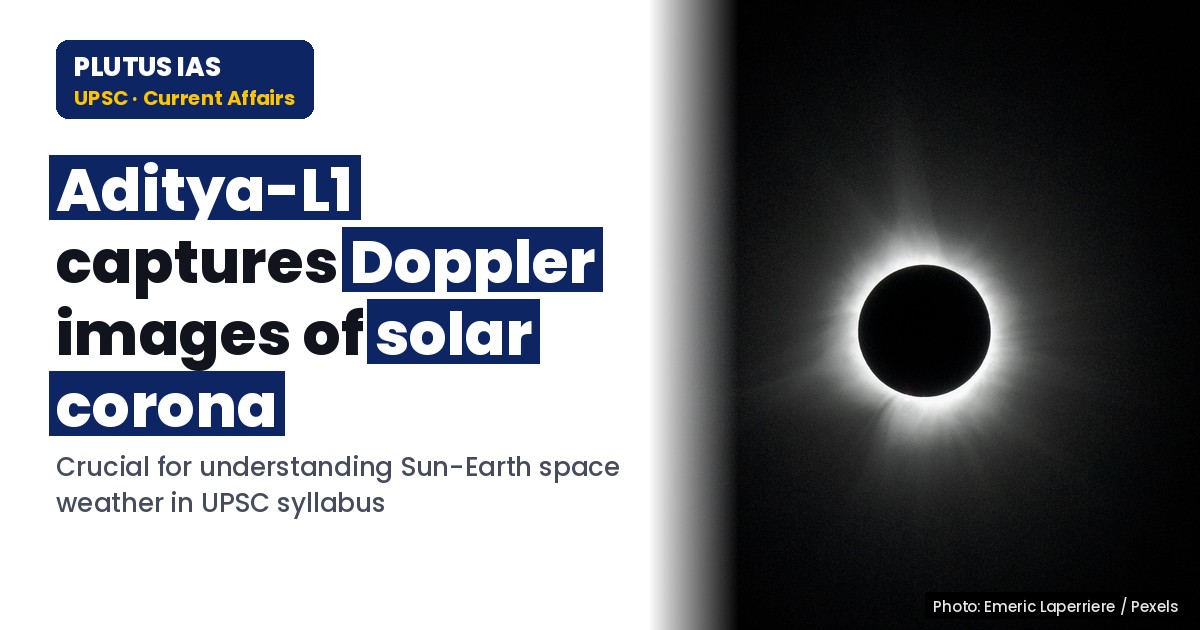
20 Oct Aditya-L1’s Doppler Images: Breakthrough in Solar Coronal Studies for UPSC
✎ Aditya-L1’s Doppler velocity imaging of the solar corona, enabled by the VELC payload, is expected to provide critical data on CME propagation, enhancing India’s capacity for space weather prediction and mitigation of…
Subject Relevance — Where This Topic Fits
- GS Paper III — Science and Technology — Developments and their Applications and Effects in Everyday Life
- Prelims: Aditya-L1 mission, Visible Emission Line Coronagraph (VELC), Doppler effect, solar corona, coronal mass ejections (CMEs), Lagrangian point L1, space weather, plasma dynamics
- Essay: The role of space-based observatories in advancing scientific frontiers and their socio-economic implications
Quick Revision: Aditya-L1’s Doppler velocity imaging of the solar corona, enabled by the VELC payload, is expected to provide critical data on CME propagation, enhancing India’s capacity for space weather prediction and mitigation of solar-induced disruptions.
Why is this in the news?
The Aditya-L1 mission has successfully generated Doppler velocity images of the solar corona using data from the Visible Emission Line Coronagraph (VELC) payload. These images, a first-of-its-kind capability, are expected to provide critical insights into the propagation of coronal mass ejections (CMEs) along the Sun-Earth line, addressing a long-standing gap in space weather monitoring and prediction.
Background
- The Sun’s outer atmosphere, the solar corona, is a region of extreme temperatures and dynamic plasma activity, emitting radiation across the electromagnetic spectrum.
- Coronal Mass Ejections (CMEs) are large-scale expulsions of plasma and magnetic field from the Sun’s corona, capable of disrupting space weather and impacting terrestrial technologies such as satellites, power grids, and communication systems.
- India’s Aditya-L1 mission, launched in September 2023, is the country’s first dedicated solar observatory, positioned at the Lagrangian point L1 to provide uninterrupted observations of the Sun.
- The Visible Emission Line Coronagraph (VELC) onboard Aditya-L1 is designed to observe the solar corona in the visible wavelength range, enabling detailed spectroscopic analysis of plasma dynamics.
- The Doppler effect, a fundamental principle in physics, has been adapted in astronomical observations to measure the velocity of celestial objects by analyzing shifts in spectral lines.
- Prior to Aditya-L1, no Indian mission had the capability to generate Doppler velocity images of the solar corona, limiting real-time monitoring of CME propagation.
What is the Aditya-L1 Mission and its Doppler Velocity Imaging Capability?
- Aditya-L1 is India’s first dedicated solar mission, positioned at the Lagrangian point L1 (1.5 million km from Earth) to observe the Sun continuously without atmospheric interference.
- The mission’s primary objective is to study the solar corona, solar wind, and space weather phenomena, including CMEs, to enhance predictive capabilities for their Earth-directed impacts.
- The Visible Emission Line Coronagraph (VELC) is one of the seven payloads onboard Aditya-L1, designed to image the solar corona in visible light and perform spectroscopic analysis.
- Doppler velocity imaging leverages the Doppler effect to measure the velocity of plasma in the solar corona by analyzing shifts in the wavelengths of emitted light.
- Positive Doppler velocity indicates plasma moving away from the observer, while negative Doppler velocity indicates plasma moving toward the observer, providing directional insights into CME propagation.
- The Doppler velocity images generated by VELC are unique due to its spectroscopic observing capability in the visible wavelength range from the L1 position, offering unprecedented spatial and temporal resolution.
- The processed data and images will be disseminated to the global scientific community, contributing to collaborative research in solar physics and space weather studies.
- The technical development of the Doppler imaging software was led by Dr. V. Muthupriyal and her team at the Indian Institute of Astrophysics (IIA), with findings published in the Astrophysical Journal after peer review.
Key Features
| Feature | Significance |
|---|---|
| Doppler velocity imaging of solar corona | Enables measurement of plasma motion in the corona, distinguishing between plasma moving toward and away from the observer using the Doppler effect in visible light. |
| Visible Emission Line Coronagraph (VELC) payload | Unique spectroscopic instrument onboard Aditya-L1 capable of generating Doppler velocity images from the L1 Lagrange point, providing unparalleled observational capability. |
| Sun-Earth L1 Lagrange point positioning | Strategic orbital location allowing continuous solar observation without Earth’s occultation, enhancing data continuity for solar activity monitoring. |
| Coronal Mass Ejection (CME) tracking | Provides real-time data on CME propagation direction and velocity, critical for space weather forecasting and mitigation of solar storm impacts. |
| Public domain data dissemination | Ensures transparency and broad scientific accessibility, fostering collaborative research in solar physics and space weather studies. |
Why it Matters
Scientific Advancement
- Establishes India as a leading contributor to solar physics through indigenous instrumentation and data processing capabilities.
- Advances understanding of solar corona dynamics, particularly plasma flows and magnetic field interactions.
- Provides high-resolution spectroscopic data, filling observational gaps in solar coronal studies.
Space Weather Forecasting
- Enables early detection and trajectory analysis of CMEs directed toward Earth, improving space weather prediction accuracy.
- Supports mitigation of solar storm impacts on satellite operations, power grids, and communication systems.
- Contributes to global space weather monitoring networks, enhancing international cooperation in solar research.
Technological Innovation
- Demonstrates India’s capability in developing and deploying advanced payloads for deep-space solar observation.
- Showcases indigenous software development for data processing, reducing dependence on foreign collaborations.
- Validates the L1 Lagrange point as an optimal location for continuous solar monitoring.
Institutional Capacity Building
- Strengthens the Indian Institute of Astrophysics (IIA) as a hub for solar research and instrumentation development.
- Enhances India’s standing in international solar physics collaborations, including partnerships with NASA, ESA, and other agencies.
- Fosters a new generation of scientists and engineers specialized in space-based solar observation.
Challenges
1. Data Processing Complexity
- Requires sophisticated algorithms to interpret Doppler velocity signals amid solar corona’s dynamic and turbulent environment.
- Demands high computational resources for real-time data analysis and image generation.
UPSC Link: Science & Technology – Space Technology
2. Instrument Calibration and Maintenance
- Ensuring long-term stability and accuracy of VELC payload in the harsh conditions of space.
- Regular calibration against ground-based observatories to maintain data reliability.
UPSC Link: Science & Technology – Space Technology
3. Interpretation of Solar Phenomena
- Distinguishing between different solar events (CMEs, solar flares, prominences) using Doppler velocity data.
- Correlating Doppler observations with magnetic field data for comprehensive solar activity analysis.
UPSC Link: Science & Technology – Space Technology
4. International Data Sharing Protocols
- Establishing standardized formats for data dissemination to ensure compatibility with global research networks.
- Addressing intellectual property and proprietary concerns in collaborative scientific endeavors.
UPSC Link: Science & Technology – Space Technology
5. Space Debris and Orbital Sustainability
- Mitigating risks associated with the L1 Lagrange point’s orbital environment, including space debris.
- Ensuring long-term mission sustainability amid increasing satellite traffic in the Sun-Earth system.
UPSC Link: Science & Technology – Space Technology
Challenges — UPSC Perspective
| Issue | Concern |
|---|---|
| Spectroscopic data interpretation | Complexity in distinguishing plasma flows from background coronal noise. |
| Payload longevity in space | Degradation of optical components due to solar radiation exposure. |
| Real-time data transmission | Bandwidth limitations for transmitting high-resolution images to Earth. |
| Cross-validation with ground observatories | Ensuring consistency between space-based and terrestrial solar observations. |
| Global data standardization | Harmonizing Aditya-L1 data formats with international solar research networks. |
Way Forward
- Enhance computational algorithms for faster and more accurate Doppler velocity image processing.
- Establish a dedicated ground segment for real-time monitoring and calibration of VELC payload.
- Develop standardized protocols for sharing Aditya-L1 data with international space weather agencies.
- Expand collaboration with global solar observatories for cross-validation of observations.
- Integrate Aditya-L1 data into India’s space weather forecasting models for operational use.
- Invest in public outreach programs to educate stakeholders on the mission’s scientific and societal benefits.
- Strengthen indigenous manufacturing of optical components to reduce dependence on imports.
- Plan follow-up missions to study other solar phenomena, such as solar wind dynamics and magnetic field evolution.
UPSC Value Addition
Keywords for Mains Answer-Writing
Aditya-L1 mission · solar corona · coronal mass ejections (CMEs) · Doppler velocity imaging · Visible Emission Line Coronagraph (VELC) · Lagrange point L1 · space weather · solar plasma dynamics · Indian Institute of Astrophysics (IIA) · ISRO’s solar missions · Sun-Earth interaction · space-based solar observatories · spectroscopy in visible wavelength · coronal heating problem · heliophysics · space plasma physics
Concept Flow
Solar activity (CMEs, flares) → Plasma ejection into corona → Doppler effect in light waves → Velocity imaging by VELC payload → Data transmission to Earth → Image processing and analysis → Space weather forecasting.
Prelims Practice Questions
Q1. Consider the following statements regarding the Aditya-L1 mission of ISRO:
1. Aditya-L1 is India’s first solar mission aimed at studying the solar corona.
2. The mission carries the Visible Emission Line Coronagraph (VELC) payload to generate Doppler velocity images of the solar corona.
3. Aditya-L1 is positioned at the Lagrange point L2 in the Sun-Earth system.
4. The Doppler velocity images generated by VELC help in understanding the propagation of coronal mass ejections (CMEs) toward Earth.
How many of the above statements are correct?
- Only one
- Only two
- Only three
- All four
Answer: Only three — Statements 1, 2, and 4 are correct. Statement 3 is incorrect because Aditya-L1 is positioned at the Lagrange point L1, not L2.
Q2. Assertion (A): The Doppler velocity images of the solar corona generated by the Aditya-L1 mission utilise the Doppler effect to infer the direction of plasma movement.
Reason (R): The Doppler effect in light waves allows scientists to determine whether solar plasma is moving toward or away from the observer based on the shift in wavelength.
Options:
A. Both A and R are true, and R is the correct explanation of A.
B. Both A and R are true, but R is not the correct explanation of A.
C. A is true, but R is false.
D. A is false, but R is true.
Answer: ? — Both the Assertion (A) and Reason (R) are true, and R correctly explains A. The Doppler effect in light waves is used to infer the direction of plasma movement in the solar corona.
Q3. Match the following payloads of the Aditya-L1 mission with their respective scientific objectives:
Column I (Payload) Column II (Objective)
A. Visible Emission Line Coronagraph (VELC) 1. Study of solar wind and energetic particles
B. Solar Ultraviolet Imaging Telescope (SUIT) 2. Imaging of the solar corona and Doppler velocity measurements
C. Aditya Solar Wind Particle Experiment (ASPEX) 3. Imaging of the solar photosphere and chromosphere in UV
D. Plasma Analyser Package for Aditya (PAPA) 4. Measurement of solar wind ions and electrons
Options:
A. A-2, B-3, C-1, D-4
B. A-2, B-3, C-4, D-1
C. A-3, B-2, C-1, D-4
D. A-1, B-3, C-2, D-4
Answer: ? — Correct matching: A-2 (VELC for imaging corona and Doppler velocity), B-3 (SUIT for UV imaging of photosphere and chromosphere), C-4 (ASPEX for solar wind particles), D-1 (PAPA for solar wind and energetic particles).
Mains Practice Question
✍ The Doppler velocity imaging capability of the Visible Emission Line Coronagraph (VELC) onboard India’s Aditya-L1 mission represents a significant advancement in heliophysics. Critically examine the scientific significance of this innovation and its implications for space weather prediction and solar physics research. (15 Marks)
Approach: MODEL-ANSWER SKELETON:
1. **Scientific Significance of Doppler Velocity Imaging**:
– Explain the Doppler effect in the context of light waves and its application to solar plasma dynamics.
– Describe how VELC’s spectroscopic observing capability enables measurement of plasma velocities in the solar corona.
– Highlight the uniqueness of VELC’s position at the L1 Lagrange point for uninterrupted solar observations.
2. **Contribution to Heliophysics**:
– Discuss the coronal heating problem and how Doppler velocity data aids in understanding energy transfer mechanisms.
– Explain the role of such data in studying solar wind acceleration and coronal mass ejections (CMEs).
3. **Implications for Space Weather Prediction**:
– Outline how real-time Doppler velocity imaging can improve early warning systems for CMEs directed toward Earth.
– Discuss the potential to mitigate risks to satellites, communication systems, and power grids from space weather events.
4. **Broader Research and Collaborative Potential**:
– Emphasise the dissemination of processed images and data to the global scientific community.
– Mention the technological and computational advancements (e.g., software developed by IIA) enabling this innovation.
5. **Limitations and Future Directions**:
– Acknowledge challenges such as data processing complexity and the need for continuous calibration.
– Suggest future missions or payloads that could build on VELC’s findings (e.g., multi-wavelength observations, in-situ measurements).
Balance the answer with specific references to the Aditya-L1 mission, VELC payload, and contributions from institutions like IIA and ISRO.
Source: The Hindu
Generated by AanyaAi for educational purpose.
Related guides on our sites
- Best PSIR optional coaching for upsc
- Best PSIR optional teacher for upsc
- Best teacher of PSIR optional for upsc
- Best PSIR optional coaching in delhi for UPSC

- सितंबर 2026 का कोर इंडस्ट्री इंडेक्स: जानिए अगस्त 2026 का अंतिम आँकड़ा - October 21, 2026
- Treasury Bills Auction: RBI Releases Full Results for UPSC Exam - October 21, 2026
- यूपीएससी के लिए महत्वपूर्ण: 91, 182 और 364 दिन के टी-बिल नीलामी परिणाम - October 21, 2026

No Comments