


21 Oct Treasury Bills Auction: RBI Releases Full Results for UPSC Exam
✎ Treasury Bills are zero-coupon, short-term government securities issued at a discount to face value, with tenors of 91, 182, and 364 days, auctioned by the RBI to manage fiscal deficit and liquidity.
Subject Relevance — Where This Topic Fits
- GS Paper III — Indian Economy: Issues Relating to Planning, Mobilisation of Resources, Growth, Development and Employment | GS Paper III — Money and Banking
- Prelims: Treasury Bills (T-Bills), Public Debt Management, Fiscal Deficit, RBI, Money Market Instruments, Primary Auction, Non-Competitive Bidding, Cut-off Yield, Weighted Average Price
- Essay: Role of Treasury Bills in India’s Fiscal Policy and Debt Management, Monetary Policy Instruments and Their Interplay with Fiscal Policy
Quick Revision: Treasury Bills are zero-coupon, short-term government securities issued at a discount to face value, with tenors of 91, 182, and 364 days, auctioned by the RBI to manage fiscal deficit and liquidity.
Why is this in the news?
The Reserve Bank of India (RBI) conducted a full auction of Treasury Bills (T-Bills) on 21 October 2026, with notified amounts of ₹8,000 crore each for 91-day and 182-day tenors and ₹7,000 crore for the 364-day tenor. The auction results highlight the demand dynamics, bid-cover ratios, and acceptance patterns, which are critical indicators of liquidity conditions, investor sentiment, and the government’s short-term borrowing strategy. This auction assumes significance in the context of India’s evolving debt management framework and the RBI’s role in ensuring stable market conditions for government securities.
Background
- Treasury Bills are short-term government securities issued by the Government of India to meet its immediate revenue requirements and manage the fiscal deficit. They are issued under the authority of the Public Debt Management Cell (PDMC), Ministry of Finance, and auctioned by the RBI.
- T-Bills are issued in three standard tenors: 91 days, 182 days, and 364 days, with maturities ranging from less than one year to one year.
- The RBI acts as the debt manager for the Government of India and is responsible for conducting auctions, managing the issuance calendar, and ensuring smooth settlement of trades in government securities.
- T-Bills are zero-coupon securities, meaning they are issued at a discount to their face value and redeemed at par, with the difference representing the interest earned by the investor.
- Demand for T-Bills is influenced by factors such as liquidity conditions, inflation expectations, global monetary policy trends, and the overall risk appetite of investors.
What are Treasury Bills?
- Treasury Bills (T-Bills) are short-term, negotiable, and zero-coupon government securities issued by the Government of India to finance its fiscal deficit and manage cash flows.
- They are issued with maturities of 91 days, 182 days, and 364 days, making them the shortest-term instruments in the government securities market.
- T-Bills are issued at a discount to their face value and redeemed at par, with the difference constituting the implicit interest rate (yield) for the investor.
- The auction process for T-Bills is conducted by the RBI on behalf of the Government of India, ensuring a transparent and competitive bidding mechanism.
- Investors in T-Bills include commercial banks, primary dealers, mutual funds, insurance companies, provident funds, and non-competitive bidders such as retail investors and small financial institutions.
- The yield on T-Bills is determined by market forces and reflects the prevailing liquidity conditions, inflation expectations, and the government’s borrowing requirements.
- T-Bills are highly liquid instruments and are actively traded in the secondary market, serving as a benchmark for short-term interest rates in the economy.
- The issuance of T-Bills is governed by the Public Debt Act, 1944, and the RBI’s guidelines on government securities market operations.
Key Features
| Feature | Significance |
|---|---|
| Notified Amount | The notified amounts (₹8,000 crore for 91-day and 182-day T-Bills, ₹7,000 crore for 364-day T-Bills) represent the Government of India’s borrowing requirement for short-term liquidity management. |
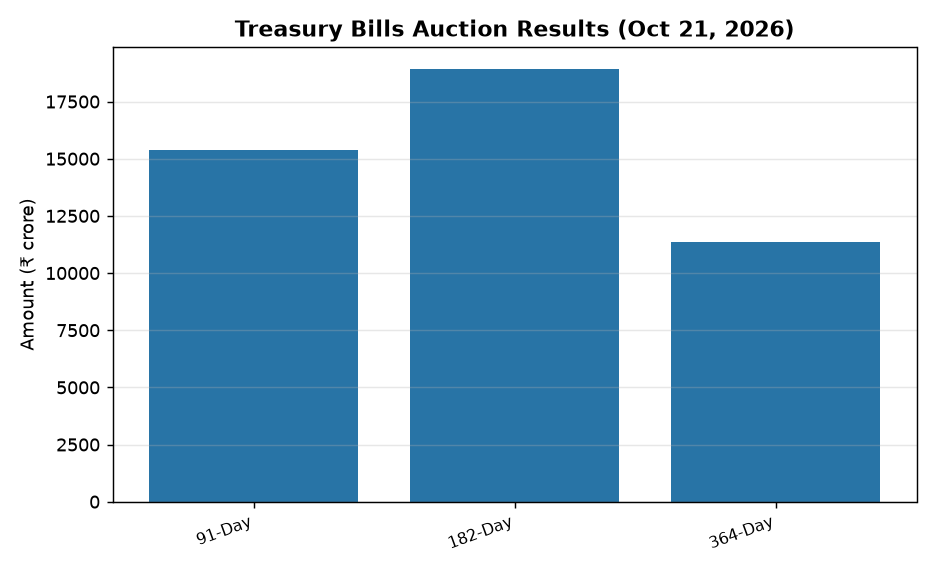
| Competitive Bids Received | The volume of competitive bids (₹15,366.60 crore for 91-day, ₹18,925.50 crore for 182-day, ₹11,352.50 crore for 364-day) indicates strong market appetite for government securities, reflecting investor confidence in sovereign debt instruments. |
| Non-Competitive Bids | Non-competitive bids (₹12,028.76 crore for 91-day, ₹1,712.42 crore for 182-day, ₹1,683.57 crore for 364-day) demonstrate retail and small institutional participation in government borrowing, enhancing financial inclusion. |
| Cut-off Price/Yield | The absence of published cut-off prices or yields in this release underscores the RBI’s discretion in determining pricing based on market conditions, ensuring transparency in debt management. |
| Partial Allotment Percentage | The lack of partial allotment data highlights the RBI’s preference for full allotment in competitive bidding, which may be aimed at maintaining liquidity and stability in the secondary market. |
Why it Matters
Public Debt Management
- Treasury Bills (T-Bills) are a key instrument for managing the Union Government’s short-term borrowing, crucial for fiscal sustainability and liquidity management.
- The auction results reflect the Government’s ability to meet its fiscal obligations without crowding out private investment or destabilising interest rates.
- Efficient T-Bill auctions reduce the cost of borrowing for the Government, indirectly benefiting taxpayers through lower interest payments on public debt.
- The RBI’s role as the debt manager ensures alignment with monetary policy objectives, such as inflation control and exchange rate stability.
Financial Market Development
- Robust participation in T-Bill auctions signals deepening of the government securities market, a prerequisite for a mature financial system.
- Increased non-competitive bids indicate growing retail investor participation, aligning with the objective of broadening the investor base for government securities.
- The auction process fosters price discovery, which is essential for efficient capital allocation and risk pricing in the economy.
- A liquid secondary market for T-Bills enhances monetary policy transmission by allowing the RBI to conduct open market operations effectively.
Macroeconomic Stability
- Short-term government borrowing through T-Bills is a stabilising mechanism during periods of fiscal deficit, provided it is managed within sustainable limits.
- The auction results provide insights into market expectations of inflation and interest rates, which are critical for macroeconomic forecasting.
- Excessive reliance on short-term borrowing, however, may expose the Government to rollover risks, necessitating prudent debt management practices.
- The RBI’s oversight ensures that T-Bill issuances do not exacerbate fiscal imbalances or undermine investor confidence in sovereign debt.
Investor Confidence
- Strong bid volumes relative to notified amounts reflect investor trust in the Government’s ability to honour its debt obligations.
- Diversification of the investor base, including non-competitive bidders, strengthens the resilience of the government securities market.
- Transparency in the auction process, including the publication of bid volumes and allotment details, enhances market integrity and predictability.
- The absence of partial allotment suggests a preference for full allocation, which may reduce uncertainty for investors and promote market stability.
Challenges
1. Roll-Over Risk in Short-Term Borrowing
- Frequent reliance on short-term instruments like T-Bills exposes the Government to roll-over risk, where maturing debt must be refinanced at potentially higher interest rates.
- This risk is exacerbated during periods of rising interest rates or tightening liquidity conditions in global financial markets.
- Mitigation requires a balanced debt maturity profile, with a judicious mix of short-term and long-term instruments to reduce refinancing pressure.
- The RBI’s debt management strategy must account for such risks to ensure fiscal sustainability.
UPSC Link: Economic Survey: Debt Management
2. Liquidity Management Challenges
- Excessive issuance of T-Bills can lead to temporary liquidity shortages in the banking system, especially if the RBI does not conduct offsetting open market operations.
- This may force banks to resort to higher-cost borrowing from the RBI’s marginal standing facility (MSF), increasing their operational costs.
- The RBI must carefully calibrate T-Bill issuances to avoid disrupting the liquidity conditions necessary for monetary policy transmission.
- Dynamic adjustments in the notified amounts and auction schedules are essential to maintain equilibrium in the money market.
UPSC Link: RBI’s Liquidity Operations
3. Investor Base Concentration
- Over-reliance on a narrow set of institutional investors (e.g., banks, mutual funds) for T-Bill subscriptions can lead to market concentration risks.
- This may reduce the diversity of funding sources and increase vulnerability to sudden shifts in investor sentiment.
- Expanding the investor base, particularly among retail and small institutional investors, is critical for long-term market stability.
- Incentives such as tax benefits or simplified subscription processes can encourage broader participation.
UPSC Link: Financial Inclusion: Investor Base
4. Interest Rate Volatility
- Fluctuations in interest rates, driven by macroeconomic factors or policy changes, can lead to volatility in T-Bill yields, affecting the Government’s borrowing costs.
- Sudden spikes in yields may increase the cost of servicing debt, impacting fiscal deficits and debt sustainability.
- The RBI must monitor yield movements closely and adjust auction strategies to mitigate adverse effects on the Government’s borrowing programme.
- Forward guidance and communication on monetary policy can help anchor market expectations and reduce volatility.
UPSC Link: Monetary Policy Transmission
5. Secondary Market Liquidity
- A thin secondary market for T-Bills can limit price discovery and increase transaction costs for investors, discouraging participation.
- Low liquidity may also hinder the RBI’s ability to conduct open market operations effectively, undermining monetary policy objectives.
- Enhancing secondary market liquidity through measures such as market-making incentives or electronic trading platforms is essential.
- The RBI’s role in fostering a liquid secondary market is pivotal for the overall efficiency of the government securities market.
UPSC Link: Secondary Market Development
Challenges — UPSC Perspective
| Issue | Concern |
|---|---|
| Rollover Risk | Potential for higher borrowing costs during refinancing of maturing T-Bills, especially in rising interest rate environments. |
| Liquidity Disruptions | Risk of temporary liquidity shortages in the banking system due to excessive T-Bill issuances. |
| Investor Base Concentration | Over-reliance on a limited set of institutional investors, increasing market vulnerability to sentiment shifts. |
| Interest Rate Volatility | Fluctuations in T-Bill yields due to macroeconomic factors, impacting Government borrowing costs. |
| Secondary Market Illiquidity | Limited trading activity in T-Bills, reducing price discovery and increasing transaction costs. |
| Fiscal Sustainability | Excessive short-term borrowing may undermine long-term fiscal stability if not managed prudently. |
Way Forward
- The RBI should consider diversifying the maturity profile of government borrowing to reduce roll-over risks, including a higher proportion of long-term instruments like Government Bonds.
- Enhance retail investor participation in T-Bill auctions through simplified subscription processes, digital platforms, and targeted awareness campaigns.
- Strengthen the secondary market for T-Bills by introducing market-making incentives, electronic trading platforms, and improving settlement mechanisms.
- Monitor liquidity conditions closely and calibrate T-Bill issuances to avoid disrupting the banking system’s liquidity, using tools like the Cash Reserve Ratio (CRR) and Statutory Liquidity Ratio (SLR).
- Improve transparency in auction processes by publishing detailed bid and allotment data, including yield curves and partial allotment percentages, to enhance market predictability.
- Conduct regular consultations with market participants to assess demand-supply dynamics and adjust auction schedules accordingly.
- Integrate T-Bill issuances with broader debt management strategies to ensure alignment with fiscal consolidation goals and macroeconomic stability.
- Leverage technology to streamline the auction process, reduce operational costs, and improve accessibility for small investors.
UPSC Value Addition
Keywords for Mains Answer-Writing
Treasury Bills · Money Market Instruments · Government Securities · RBI Auction Mechanism · Public Debt Management · Fiscal Policy · Monetary Policy · Liquidity Management · Yield Curve · Non-Competitive Bidding · Primary Dealer System · Statutory Liquidity Ratio (SLR) · Cash Management Bills · Government Borrowing Programme · Market Stabilisation Scheme · Fiscal Responsibility and Budget Management (FRBM) Act
Concept Flow
Government identifies short-term borrowing requirement → RBI notifies T-Bill auctions with specified amounts and maturities → Investors submit competitive and non-competitive bids → RBI evaluates bids and determines allotment → Successful bidders receive T-Bills in exchange for funds → T-Bills mature, and Government repays principal with interest → Proceeds are used to finance fiscal deficits or refinance existing debt → Market conditions (interest rates, liquidity) influence future auction outcomes → RBI adjusts debt management strategy based on feedback and macroeconomic indicators
Prelims Practice Questions
Q1. Consider the following statements about Treasury Bills (T-Bills) in India:
1. Treasury Bills are issued by the Government of India to meet short-term financial requirements.
2. T-Bills are money market instruments with maturities of 91 days, 182 days, and 364 days.
3. The Reserve Bank of India (RBI) conducts auctions for T-Bills on behalf of the Government.
4. Non-competitive bidding in T-Bill auctions is restricted to retail investors only.
How many of the above statements are correct?
- Only one
- Only two
- Only three
- All four
Answer: Only three — Statements 1, 2, and 3 are correct. Treasury Bills are indeed issued by the Government of India for short-term financing, have maturities of 91, 182, and 364 days, and are auctioned by the RBI. Statement 4 is incorrect as non-competitive bidding is open to all investors, including retail and institutional investors, subject to eligibility criteria.
Q2. Assertion (A): Treasury Bills are zero-coupon securities.
Reason (R): Treasury Bills are issued at a discount to their face value and redeemed at par, thus not paying any explicit interest.
Options:
A. Both A and R are true, and R is the correct explanation of A.
B. Both A and R are true, but R is not the correct explanation of A.
C. A is true, but R is false.
D. A is false, but R is true.
Answer: ? — Both the Assertion (A) and Reason (R) are true, and R correctly explains A. Treasury Bills are zero-coupon securities because they are issued at a discount and redeemed at face value without any periodic interest payments.
Q3. Match the following columns related to Treasury Bills in India:
Column I (Type of Treasury Bill) | Column II (Maturity Period)
1. 91-Day T-Bill | A. 182 days
2. 182-Day T-Bill | B. 364 days
3. 364-Day T-Bill | C. 91 days
Options:
A. 1-C, 2-A, 3-B
B. 1-A, 2-B, 3-C
C. 1-B, 2-C, 3-A
D. 1-C, 2-B, 3-A
Answer: ? — The correct match is: 1-C (91-Day T-Bill), 2-A (182-Day T-Bill), and 3-B (364-Day T-Bill). This aligns with the standard maturities for Treasury Bills issued in India.
Mains Practice Question
✍ The Reserve Bank of India (RBI) conducts auctions for Treasury Bills (T-Bills) to manage the Government of India’s borrowing programme. Examine the role of Treasury Bills in India’s fiscal and monetary policy frameworks. Also, analyse the significance of the auction mechanism in ensuring efficient price discovery and liquidity in the money market. (15 Marks)
Approach: MODEL-ANSWER SKELETON:
1. **Introduction**: Define Treasury Bills (T-Bills) as short-term government securities issued to meet fiscal deficits, governed by the Public Debt Management Cell (PDMC) and RBI.
2. **Fiscal Policy Role**:
– T-Bills are a key instrument for the Government of India to finance short-term fiscal deficits under the FRBM Act.
– They help bridge the revenue-expenditure gap without resorting to long-term debt, which carries higher interest costs.
– Cite data on recent gross borrowings (e.g., ₹12 lakh crore in FY 2025-26) to illustrate scale.
3. **Monetary Policy Role**:
– T-Bills are part of the liquidity management toolkit under the RBI’s Liquidity Adjustment Facility (LAF) and Marginal Standing Facility (MSF).
– Their yields influence the broader yield curve, impacting commercial bank lending rates and deposit rates.
– Discuss the role of T-Bills in the Statutory Liquidity Ratio (SLR) framework, where banks must hold a portion of their net demand and time liabilities in government securities.
4. **Auction Mechanism**:
– Explain the RBI’s auction process for T-Bills (competitive and non-competitive bidding) as per the Public Debt Management Framework (2022).
– Highlight the significance of price discovery: competitive bidding ensures market-determined yields, while non-competitive bidding provides retail access.
– Reference the October 21, 2026 auction data (e.g., notified vs. bids received) to illustrate demand-supply dynamics.
5. **Liquidity Management**:
– T-Bills are highly liquid instruments traded in the secondary market, contributing to the depth of the money market.
– Their use in Market Stabilisation Scheme (MSS) operations to absorb excess liquidity.
– Discuss the role of Primary Dealers (PDs) in ensuring market liquidity and efficient price discovery.
6. **Challenges and Criticisms**:
– Over-reliance on short-term borrowing may increase rollover risks.
– Impact of global monetary conditions (e.g., US Fed rates) on domestic T-Bill yields.
– Address the trade-off between fiscal needs and monetary policy objectives (e.g., RBI’s dual role as debt manager and monetary authority).
7. **Conclusion**: Summarise the indispensable role of T-Bills in India’s fiscal-monetary nexus, while acknowledging the need for balanced borrowing strategies to mitigate systemic risks.
Source: RBI
Generated by AanyaAi for educational purpose.
Related guides on our sites
- Best PSIR optional coaching for upsc
- Best economics optional coaching for upsc
- Best PSIR optional teacher for upsc
- Best teacher of PSIR optional for upsc

- Treasury Bills Auction: RBI Releases Full Results for UPSC Exam - October 21, 2026
- यूपीएससी के लिए महत्वपूर्ण: 91, 182 और 364 दिन के टी-बिल नीलामी परिणाम - October 21, 2026
- Army Commanders’ Conference 2024: Key Security Discussions & Outcomes - October 21, 2026

No Comments