


25 Oct India-Uzbekistan Bilateral Ties: Key Agreements & Strategic Focus
✎ The India–Uzbekistan Comprehensive Strategic Partnership, established in 2026, aims to enhance bilateral trade to USD 5 billion, secure uranium supply, and strengthen connectivity through the INSTC.
Subject Relevance — Where This Topic Fits
- GS Paper II — International Relations — India’s bilateral relations with Central Asian countries | GS Paper III — Economy — Bilateral trade, investment, and connectivity corridors
- Prelims: INSTC (International North-South Transport Corridor), Oliy Darajali Do’stlik Order, Comprehensive Strategic Partnership, Uranium supply agreements, Ateshgah Fire Temple
- Essay: India’s evolving strategic partnerships in Central Asia: opportunities and challenges, The role of historical and cultural diplomacy in modern foreign policy
Quick Revision: The India–Uzbekistan Comprehensive Strategic Partnership, established in 2026, aims to enhance bilateral trade to USD 5 billion, secure uranium supply, and strengthen connectivity through the INSTC.
Why is this in the news?
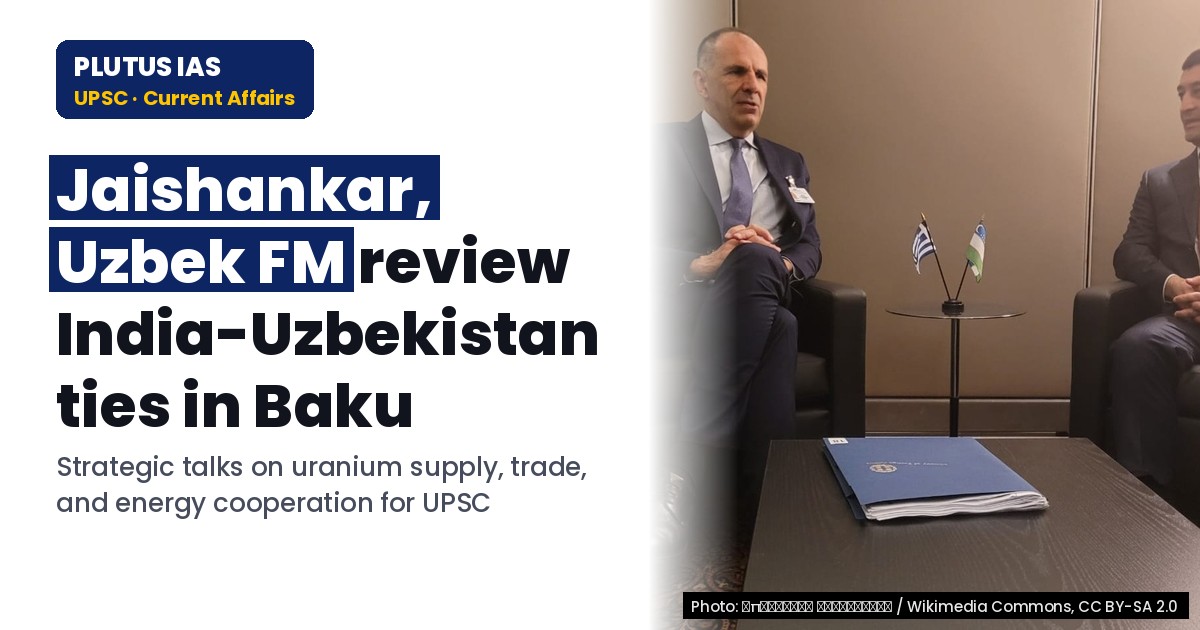
External Affairs Minister S Jaishankar’s meeting with Uzbekistan’s Foreign Minister Bakhtiyor Saidov on the sidelines of his official visit to Azerbaijan underscored the strategic importance of India–Uzbekistan bilateral ties. The discussions focused on accelerating the implementation of agreements reached at the highest level, including trade targets, uranium supply frameworks, and connectivity initiatives such as the International North-South Transport Corridor (INSTC). This engagement follows Prime Minister Narendra Modi’s recent visit to Uzbekistan, where bilateral relations were elevated to a comprehensive strategic partnership.
Background
- India and Uzbekistan established diplomatic relations in 1991 following Uzbekistan’s independence from the Soviet Union.
- Bilateral ties were elevated to a Strategic Partnership in 2011 and further upgraded to a Comprehensive Strategic Partnership during Prime Minister Narendra Modi’s visit to Uzbekistan in August 2026.
- The International North-South Transport Corridor (INSTC) is a 7,200 km multi-modal freight network connecting India with Iran, the Caspian region, Russia, Central Asia, and Europe, aimed at reducing transit time and costs for trade.
- Uzbekistan is a significant supplier of uranium to India, with agreements formalised during high-level visits in recent years.
- The Ateshgah Fire Temple in Baku, visited by Jaishankar, is a historical site symbolising cultural and religious linkages between India and Central Asia, particularly the presence of Hindu and Sikh merchants in the 17th–18th centuries.
What is the India–Uzbekistan Comprehensive Strategic Partnership?
- The Comprehensive Strategic Partnership between India and Uzbekistan, established in August 2026, encompasses cooperation in trade, investment, energy, mining, tourism, and people-to-people exchanges.
- The partnership includes a target of achieving USD 5 billion in bilateral trade, with a focus on diversifying trade beyond traditional sectors.
- A framework for long-term uranium supply from Uzbekistan to India has been agreed upon, addressing India’s energy security needs.
- The partnership emphasises connectivity, including cooperation in the International North-South Transport Corridor (INSTC) and air links to enhance trade and economic integration.
- Cultural and historical ties are strengthened through initiatives such as the preservation and promotion of the Ateshgah Fire Temple and other shared heritage sites.
- The partnership also includes agreements in mining, tourism, and technical cooperation, with 11 agreements signed during Prime Minister Modi’s visit in 2026.
- Both countries are committed to timely implementation of agreements, as reiterated during Jaishankar’s meeting with Uzbekistan’s Foreign Minister in Baku.
Key Features
| Feature | Significance |
|---|---|
| Bilateral meeting between India and Uzbekistan in Baku | Reaffirmed commitment to deepen strategic partnership and expedite implementation of high-level agreements. |
| Comprehensive Strategic Partnership (CSP) upgrade (2026) | Elevated bilateral ties to a higher institutional framework, enabling broader cooperation across sectors. |
| USD 5 billion bilateral trade target | Provides a measurable economic anchor for long-term engagement and resource allocation. |
| Uranium supply framework agreement | Enhances India’s energy security by securing long-term access to a critical nuclear fuel source. |
| International North-South Transport Corridor (INSTC) coordination | Strengthens regional connectivity, reducing trade costs and transit times between South Asia, Central Asia, and Europe. |
Why it Matters
Bilateral Diplomacy and Strategic Partnerships
- Demonstrates India’s proactive engagement with Central Asian states to counterbalance regional power dynamics.
- Reinforces Uzbekistan’s role as a key partner in India’s Connect Central Asia Policy (2012).
- High-level exchanges (PM visit, EAM visit) signal sustained political commitment to the relationship.
Economic Integration and Trade Expansion
- Bilateral trade target of USD 5 billion aligns with India’s goal of diversifying trade partners beyond traditional markets.
- Uranium supply agreement supports India’s nuclear energy ambitions and reduces import dependence on other sources.
- INSTC coordination enhances India’s access to Eurasian markets, bypassing traditional chokepoints.
Connectivity and Infrastructure Development
- INSTC is a multi-modal corridor linking India to Europe via Iran, Caspian Sea, and Russia, reducing transit time by 40% compared to traditional routes.
- Air connectivity and tourism agreements facilitate people-to-people exchanges, fostering cultural and economic ties.
- Historical and cultural linkages (e.g., Ateshgah fire temple) provide soft-power foundations for deeper engagement.
Energy Security and Resource Diplomacy
- Uranium supply framework ensures stable fuel supply for India’s nuclear reactors, critical for baseload energy generation.
- Cooperation in mining and energy sectors diversifies India’s import basket and reduces vulnerability to supply chain disruptions.
Regional Geopolitics and Multilateral Engagement
- India’s participation in Central Asian foreign ministers’ meeting (Georgia + 5) highlights its role in regional multilateral forums.
- Coordinated stance on INSTC with Azerbaijan strengthens India’s position in Eurasian connectivity initiatives.
Challenges
1. Implementation Gaps in Bilateral Agreements
- Risk of delays in translating high-level agreements into ground-level projects due to bureaucratic hurdles or resource constraints.
- Need for robust monitoring mechanisms to track progress on trade targets and infrastructure projects.
UPSC Link: Mains: GS-II (International Relations) – Bilateral Agreements
2. Geopolitical Constraints in Connectivity Projects
- INSTC’s success depends on stable transit routes through Iran and Russia, which face sanctions and geopolitical tensions.
- Azerbaijan’s role in INSTC is critical but requires alignment with broader regional stability.
UPSC Link: Mains: GS-II (International Relations) – Connectivity Projects
3. Energy Supply Chain Vulnerabilities
- Uranium supply from Uzbekistan may face disruptions due to global sanctions, price volatility, or domestic policy changes in Uzbekistan.
- India’s nuclear sector requires diversification of suppliers to mitigate long-term risks.
UPSC Link: Mains: GS-III (Energy Security) – Nuclear Energy
4. Trade Diversification Challenges
- Achieving USD 5 billion trade target requires addressing non-tariff barriers, improving logistics, and expanding market access in both countries.
- Competition from China’s Belt and Road Initiative (BRI) in Central Asia may limit India’s market share.
UPSC Link: Mains: GS-III (Economy) – Trade Policy
5. Soft Power and Cultural Diplomacy Limitations
- While historical linkages exist (e.g., Ateshgah temple), sustained cultural engagement requires institutional support and funding.
- Competing narratives in the region may dilute India’s cultural influence.
UPSC Link: Mains: GS-II (Soft Power) – Cultural Diplomacy
Challenges — UPSC Perspective
| Issue | Concern |
|---|---|
| Bureaucratic delays in agreement implementation | Risk of stagnation in bilateral projects due to procedural inefficiencies. |
| Geopolitical instability along INSTC routes | Potential disruptions in trade flows due to sanctions or conflicts in transit countries. |
| Supply chain disruptions in uranium imports | Vulnerability to global uranium market fluctuations or policy changes in Uzbekistan. |
| Non-tariff barriers in trade | Tariffs, regulatory hurdles, and logistical inefficiencies limiting trade growth. |
| Competition from alternative connectivity initiatives | China’s BRI and other regional projects may divert trade and investment away from INSTC. |
| Limited institutional funding for cultural diplomacy | Insufficient resources to sustain long-term people-to-people exchanges. |
Way Forward
- Establish a joint monitoring committee (JMC) with Uzbekistan to track progress on trade targets, uranium supply, and infrastructure projects.
- Accelerate negotiations on INSTC operational protocols to ensure seamless transit and reduce bottlenecks.
- Expand air connectivity by negotiating additional flight routes and liberalizing visa policies for business travelers.
- Enhance cooperation in renewable energy sectors to diversify energy partnerships beyond uranium.
- Strengthen cultural diplomacy through joint archaeological projects, student exchange programs, and tourism promotion.
- Leverage India’s presidency of G20 (2023) and SCO (2023-24) to integrate Uzbekistan’s priorities into multilateral forums.
- Develop a long-term strategic roadmap for bilateral ties, including annual review mechanisms at the foreign minister level.
UPSC Value Addition
Keywords for Mains Answer-Writing
India-Uzbekistan strategic partnership · Comprehensive Strategic Partnership · International North-South Transport Corridor (INSTC) · Uzbekistan uranium supply to India · India-Azerbaijan economic cooperation · Cultural diplomacy India-Central Asia · Multi-modal connectivity projects · Bilateral trade and investment frameworks · Historical cultural linkages India-Central Asia · Energy security and uranium supply agreements
Concept Flow
High-level diplomatic engagement (PM/ EAM visits) → Upgrade to Comprehensive Strategic Partnership → Signing of sectoral agreements (uranium, trade, connectivity) → Implementation phase with monitoring mechanisms → Geopolitical and economic outcomes (trade growth, energy security, regional connectivity) → Feedback loop for policy refinement and deeper integration.
Prelims Practice Questions
Q1. Consider the following statements regarding the International North-South Transport Corridor (INSTC):
1. The INSTC is a multi-modal freight network linking India with Iran, the Caspian region, Russia, Central Asia, and Europe.
2. The corridor spans approximately 7,200 km.
3. The INSTC includes a dedicated rail link between India and China.
4. The corridor is operationalized through the Chabahar Port in Iran.
How many of the above statements are correct?
- Only one
- Only two
- Only three
- All
Answer: Only three — Statements 1, 2, and 4 are correct. Statement 3 is incorrect as the INSTC does not include a rail link between India and China, which is a separate geopolitical and strategic route.
Q2. Assertion (A): The Oliy Darajali Do’stlik Order is Uzbekistan’s highest honour conferred upon foreign leaders.
Reason (R): The order was conferred upon the Prime Minister of India during his visit to Uzbekistan in August 2026.
Evaluate the assertion and reason using the following options:
- Both A and R are true, and R is the correct explanation of A.
- Both A and R are true, but R is not the correct explanation of A.
- A is true, but R is false.
- A is false, but R is true.
Answer: A is true, but R is false. — Assertion (A) is true as the Oliy Darajali Do’stlik Order is indeed Uzbekistan’s highest honour for foreign leaders. Reason (R) is also true, but the conferment of the order is not the correct explanation for the assertion itself, which is a general statement about the order.
Q3. Match the following pairs related to India’s bilateral engagements with Central Asian countries:
Column I (Country) — Column II (Key Bilateral Initiative/Partnership)
A. Uzbekistan — 1. Comprehensive Strategic Partnership
B. Kazakhstan — 2. Uranium supply framework
C. Azerbaijan — 3. INSTC coordination
D. Turkmenistan — 4. Cultural and historical linkages
Select the correct match:
- A-1, B-2, C-3, D-4
- A-2, B-1, C-3, D-4
- A-1, B-2, C-4, D-3
- A-2, B-1, C-4, D-3
Answer: A-2, B-1, C-3, D-4 — A-1: India and Uzbekistan upgraded ties to a Comprehensive Strategic Partnership in 2026. B-2: Kazakhstan is a key supplier of uranium to India. C-3: Azerbaijan and India are coordinating closely on the INSTC. D-4: Turkmenistan shares historical and cultural linkages with India, including the Ateshgah fire temple.
Mains Practice Question
✍ India’s engagement with Central Asian countries has evolved into a multi-dimensional strategic partnership in recent years. Critically examine the role of connectivity projects, energy cooperation, and cultural diplomacy in shaping this relationship. Also, assess the significance of the International North-South Transport Corridor (INSTC) in this context. (15 Marks)
Approach: MODEL-ANSWER SKELETON:
1. **Connectivity Projects**:
– Define the INSTC: a multi-modal freight corridor linking India to Central Asia, Russia, and Europe via Iran and the Caspian Sea.
– Highlight recent developments: India’s participation in the INSTC, coordination with Azerbaijan, and integration with the Chabahar Port.
– Discuss challenges: geopolitical complexities (e.g., sanctions on Iran), infrastructure gaps, and regulatory hurdles.
2. **Energy Cooperation**:
– Outline key agreements: uranium supply framework with Uzbekistan, discussed during PM Modi’s visit in August 2026.
– Explain India’s energy security imperatives: diversification of fuel sources and long-term supply agreements.
– Critique: dependence on a single supplier (Uzbekistan) and geopolitical risks.
3. **Cultural Diplomacy**:
– Historical linkages: the Ateshgah fire temple in Azerbaijan as a symbol of shared heritage between India and Central Asia.
– Modern instruments: people-to-people exchanges, tourism promotion, and academic collaborations.
– Evaluate effectiveness: cultural diplomacy as a soft power tool to strengthen bilateral ties.
4. **Significance of INSTC**:
– Economic integration: reduction in trade costs and time for goods moving between India and Europe.
– Strategic autonomy: bypassing traditional routes and reducing dependence on China-dominated corridors.
– Geopolitical implications: India’s role in reviving ancient trade routes and countering China’s Belt and Road Initiative.
5. **Conclusion**:
– Summarise the multi-dimensional nature of India-Central Asia ties.
– Argue that while connectivity and energy cooperation are critical, cultural diplomacy provides a sustainable foundation for long-term engagement.
– Offer a balanced view: highlight achievements and acknowledge challenges in implementation.
Source: orissapost.com
Generated by AanyaAi for educational purpose.
Related guides on our sites
- Best PSIR optional coaching for upsc
- Best PSIR optional teacher for upsc
- Best teacher of PSIR optional for upsc
- Best PSIR optional coaching in delhi for UPSC

- India-Uzbekistan Bilateral Ties: Key Agreements & Strategic Focus - October 25, 2026
- केरल उच्च न्यायालय ने अवैध कचरा फेंकने वाले वाहन की नीलामी को दी मंजूरी - October 25, 2026
- Madras HC Rules: Life Convicts Can Avail 40 Days Leave in Two Instalments - October 25, 2026

No Comments