


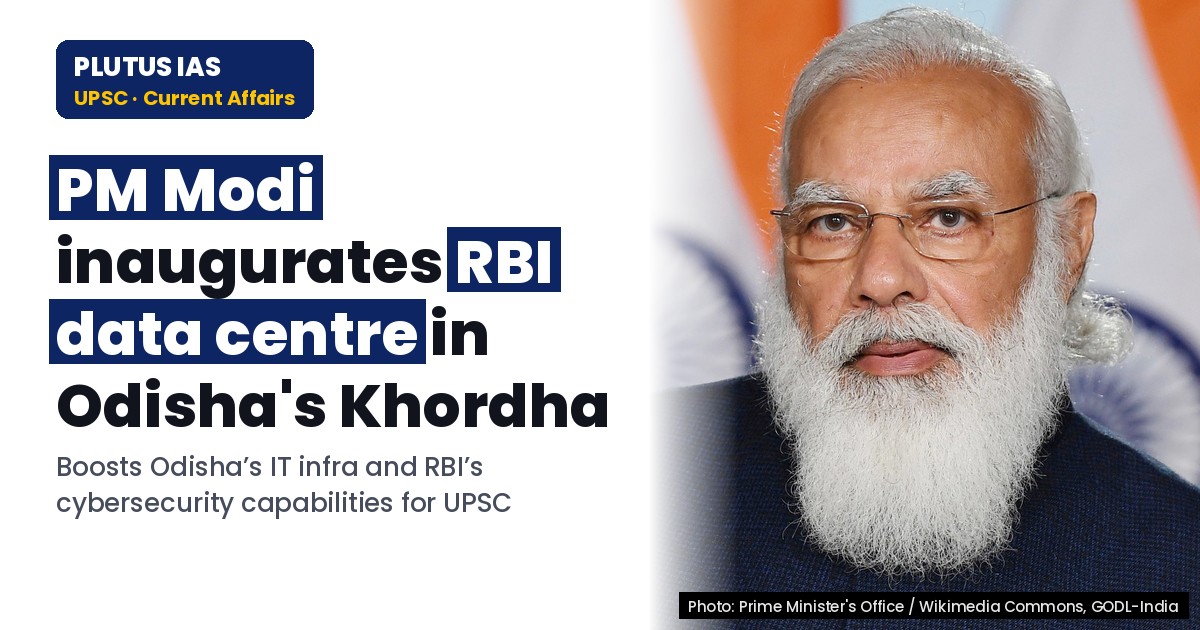
25 Oct PM Modi to inaugurate RBI’s data centre in Odisha: Key highlights for UPSC & State PCS
✎ The RBI’s data centre and cybersecurity training institute in Odisha represent a strategic investment in India’s financial digital infrastructure, ensuring operational resilience, regulatory compliance, and institutional…
Subject Relevance — Where This Topic Fits
- GS Paper III — Indian Economy: Role of RBI, Digital Infrastructure, Financial Sector Reforms | GS Paper III — Science and Technology: Cybersecurity, Emerging Technologies in Governance
- Prelims: RBI, Cybersecurity, Digital Public Infrastructure, Financial Inclusion, Data Localisation, Quantum Computing, Artificial Intelligence, BFSI Sector
- Essay: The Role of Technology in Modern Governance and Financial Systems, Cybersecurity as a Pillar of National Economic Resilience
Quick Revision: The RBI’s data centre and cybersecurity training institute in Odisha represent a strategic investment in India’s financial digital infrastructure, ensuring operational resilience, regulatory compliance, and institutional preparedness for emerging technological risks.
Why is this in the news?
The Prime Minister’s scheduled inauguration of the Reserve Bank of India’s (RBI) greenfield data centre and cybersecurity training institute in Khordha, Odisha, on 25 October 2026, underscores the central bank’s strategic investments in secure, scalable, and future-ready digital infrastructure. This initiative aligns with the RBI’s broader mandate to enhance the operational resilience of India’s financial system while fostering institutional capacity in emerging technologies such as quantum computing and artificial intelligence. The event also highlights Odisha’s emergence as a hub for data infrastructure, reinforcing India’s digital sovereignty and economic competitiveness.
Background
- The RBI, as India’s central bank, is mandated under the Reserve Bank of India Act, 1934, to regulate the country’s monetary system and ensure the stability of financial institutions.
- Digital transformation in the banking and financial sector (BFSI) has accelerated post-demonetisation (2016) and the COVID-19 pandemic, necessitating robust IT infrastructure to support real-time transactions, cybersecurity, and regulatory compliance.
- Cyber threats to financial institutions have grown in sophistication, with ransomware, phishing, and state-sponsored attacks targeting critical infrastructure globally, prompting central banks to prioritise cyber resilience.
- Odisha has been identified as a strategic location for data centres due to its reliable power supply, fibre-optic connectivity, and policy support for IT/ITeS investments, including the Odisha Data Centre Policy, 2020.
- The foundation stone for the facility was laid in March 2023 by former RBI Governor Shaktikanta Das, reflecting long-term institutional commitment to this project.
What are the Reserve Bank of India’s Data Centre and Cybersecurity Training Institute?
- The RBI Data Centre in Khordha is a greenfield facility developed over 18.55 acres in Info Valley-II, designed to meet the central bank’s high-performance computing requirements with secure, resilient, and scalable infrastructure.
- The Cybersecurity Training Institute is a dedicated institutional platform for capacity building, focusing on emerging technologies such as quantum computing and artificial intelligence.
- The institute will conduct research, simulations, and hands-on training for RBI personnel, as well as sector-wide stakeholders, to develop a cadre of cybersecurity professionals equipped to address India’s evolving digital threat landscape.
- The project exemplifies the RBI’s role in fostering a secure digital financial architecture, complementing initiatives like the Unified Payments Interface (UPI), Digital Rupee (e₹), and the Account Aggregator Framework.
Key Features
| Feature | Significance |
|---|---|
| Greenfield Data Centre | A state-of-the-art computing facility designed to meet the Reserve Bank of India’s (RBI) high-performance computing requirements, ensuring secure, resilient, and scalable digital infrastructure for monetary operations and financial stability. |
| Cybersecurity Training Institute | A dedicated institutional platform for training RBI personnel and financial sector stakeholders in emerging cyber threats, with a focus on frontier technologies such as Quantum Computing and Artificial Intelligence. |
| Secure Digital Ecosystem | The facility enhances the RBI’s operational security and reliability, critical for maintaining trust in India’s financial system and supporting the digital transformation of the banking and financial services sector. |
| Strategic Location in Odisha | The establishment of the facility in Khordha district, Odisha, positions the state as a key destination for IT and data infrastructure investments, aligning with national efforts to decentralise digital infrastructure. |
| Foundation Stone Laid in 2023 | The project was initiated under the tenure of former RBI Governor Shaktikanta Das, reflecting a long-term vision for technological modernisation within the central bank. |
Why it Matters
Economic and Financial Stability
- The RBI data centre and cybersecurity institute are critical for enhancing the digital resilience of India’s financial system, ensuring uninterrupted operations of monetary policy, payment systems, and regulatory functions.
- Strengthening cybersecurity capabilities mitigates risks of cyber-attacks, fraud, and data breaches, which could otherwise destabilise public confidence in digital banking and financial transactions.
- The facility supports the RBI’s mandate under the Reserve Bank of India Act, 1934, to regulate and supervise the financial system, including oversight of digital payment systems and financial technology innovations.
Technological Modernisation
- The integration of frontier technologies like Quantum Computing and AI into the RBI’s operational framework aligns with India’s broader digital transformation agenda, as outlined in the National Strategy for Artificial Intelligence (2018) and the Digital India initiative.
- The cybersecurity institute will foster research and capability development in emerging technologies, ensuring that the RBI and the financial sector remain at the forefront of technological advancements.
- The data centre’s scalable architecture supports the growing demands of digital payments, real-time settlements, and centralised monitoring of systemic risks.
Regional Development and Infrastructure
- The establishment of the facility in Odisha promotes balanced regional development by attracting IT and data infrastructure investments, creating employment opportunities, and enhancing the state’s digital economy.
- The project aligns with the Odisha State Data Centre Policy (2020), which aims to develop the state as a hub for data-driven governance and digital services.
- The facility’s location in Khordha district, near Bhubaneswar, leverages the state’s existing IT ecosystem and human capital, contributing to the ‘Make in Odisha’ vision.
Governance and Institutional Capacity
- The RBI’s investment in technological infrastructure reflects its commitment to institutional modernisation, ensuring that the central bank remains agile and responsive to evolving financial and technological landscapes.
- The cybersecurity institute will enhance the RBI’s capacity to address emerging threats, including those posed by state-sponsored cyber espionage, ransomware attacks, and supply-chain vulnerabilities.
- The project underscores the RBI’s role as a regulator and facilitator of innovation, balancing technological advancement with prudential oversight.
Challenges
1. Cybersecurity Threats
- The financial sector remains a prime target for cyber-attacks, including phishing, malware, and advanced persistent threats (APTs), necessitating continuous investment in threat detection and mitigation.
- Quantum computing, while transformative, also poses risks by potentially breaking current encryption standards, requiring proactive adaptation of cryptographic protocols.
- The RBI must ensure robust third-party risk management, as vulnerabilities in fintech partnerships or outsourced IT services could expose the financial system to breaches.
UPSC Link: GS3: Cyber Security
2. Data Privacy and Compliance
- The RBI data centre must comply with the Digital Personal Data Protection Act, 2023, ensuring that financial data is processed and stored in accordance with stringent privacy norms.
- Cross-border data flows and the use of cloud services raise jurisdictional challenges, requiring clear regulatory frameworks to balance innovation with data sovereignty.
- The RBI must ensure that its data centre adheres to international standards such as ISO 27001 for information security management.
UPSC Link: GS2: Fundamental Rights
3. Infrastructure and Logistics
- The greenfield data centre requires uninterrupted power supply, high-speed connectivity, and redundant cooling systems to ensure 24/7 operational reliability.
- The project’s success depends on the availability of skilled manpower in cybersecurity, data science, and IT infrastructure management, particularly in Odisha.
- Logistical challenges, such as secure transportation of sensitive equipment and data, must be addressed to mitigate risks during the facility’s operational phase.
UPSC Link: GS3: Infrastructure
4. Regulatory and Policy Alignment
- The RBI must align its technological initiatives with evolving regulatory frameworks, such as the Payment and Settlement Systems Act, 2007, and the proposed Digital India Act.
- The central bank must balance innovation with prudential regulation, ensuring that rapid technological adoption does not compromise financial stability or consumer protection.
- Collaboration with other financial regulators, such as SEBI and IRDAI, is essential to harmonise standards across the financial ecosystem.
UPSC Link: GS3: Regulatory Bodies
5. Public Trust and Adoption
- The RBI must ensure transparency in its technological initiatives to build public trust, particularly in the context of digital payments and financial inclusion.
- Cybersecurity incidents, even if minor, can erode confidence in digital banking, necessitating proactive communication and redressal mechanisms.
- The RBI’s cybersecurity institute should also focus on educating the broader public about safe digital practices, reducing vulnerabilities at the user end.
UPSC Link: GS3: Financial Inclusion
Challenges — UPSC Perspective
| Issue | Concern |
|---|---|
| Cybersecurity Vulnerabilities | Potential for data breaches, ransomware attacks, or state-sponsored espionage targeting the RBI’s digital infrastructure. |
| Regulatory Compliance | Ensuring adherence to evolving data protection laws, cross-border data transfer norms, and sector-specific regulations. |
| Infrastructure Reliability | Dependence on uninterrupted power, high-speed connectivity, and redundant systems to prevent operational disruptions. |
| Skill Gaps | Shortage of specialised talent in cybersecurity, quantum computing, and AI within the RBI and the financial sector. |
| Public Perception | Risk of erosion of trust in digital banking due to high-profile cyber incidents or perceived mishandling of data. |
| Inter-Regulator Coordination | Need for harmonised standards and collaborative frameworks among RBI, SEBI, IRDAI, and other financial regulators. |
Way Forward
- Enhance the RBI’s cybersecurity framework by adopting next-generation encryption, zero-trust architecture, and AI-driven threat detection systems.
- Invest in upskilling programmes for RBI personnel and financial sector stakeholders, focusing on quantum computing, AI, and cloud security.
- Establish a dedicated cybersecurity incident response team (C-SIRT) within the RBI to monitor, analyse, and mitigate cyber threats in real time.
- Develop a national-level framework for cross-border data flows, ensuring compliance with the Digital Personal Data Protection Act, 2023.
- Strengthen public-private partnerships to foster innovation in financial technology while maintaining regulatory oversight.
- Conduct regular audits and penetration testing of the RBI’s digital infrastructure to identify and address vulnerabilities.
- Promote awareness campaigns to educate the public on safe digital banking practices and the importance of cybersecurity hygiene.
- Collaborate with academic institutions and research organisations to advance indigenous capabilities in frontier technologies.
UPSC Value Addition
Keywords for Mains Answer-Writing
Reserve Bank of India · Data Centre · Cybersecurity · Financial Sector Infrastructure · Digital Public Infrastructure · Odisha · Information Technology · BFSI Sector · Quantum Computing · Artificial Intelligence · Central Bank Digital Infrastructure · Cybersecurity Training Institute · Financial Technology · Governance of Digital Infrastructure · Pradhan Mantri’s Official Visit · Economic Governance · Technological Sovereignty · Secure Digital Ecosystem
Constitutional & Policy Linkages
- [‘Article 300A: Right to Property (Data Sovereignty)’]
Concept Flow
RBI’s mandate under the Reserve Bank of India Act, 1934 → Need for secure digital infrastructure → Technological modernisation agenda → Establishment of data centre and cybersecurity institute in Odisha → Enhanced financial stability and regional development → Addressing cybersecurity challenges and regulatory compliance → Public trust and adoption of digital banking → Long-term resilience of India’s financial system.
Prelims Practice Questions
Q1. Consider the following statements regarding the Reserve Bank of India (RBI):
1. The RBI operates its own data centres to meet its computing requirements.
2. The RBI has recently established a cybersecurity training institute in Odisha to address emerging threats in the BFSI sector.
3. The RBI’s cybersecurity initiatives include a focus on Quantum Computing and Artificial Intelligence.
4. The RBI’s data centre in Odisha is located in the state’s capital city, Bhubaneswar.
How many of the above statements are correct?
- Only one
- Only two
- Only three
- All
Answer: Only three — Statements 1, 2, and 3 are correct as the RBI has established data centres and a cybersecurity training institute, with a focus on emerging technologies. Statement 4 is incorrect because the data centre is located in Jatni, Khordha district, not in Bhubaneswar city.
Q2. Assertion (A): The establishment of a dedicated cybersecurity training institute by the RBI aims to enhance the technical capabilities of its personnel in addressing emerging cyber threats.
Reason (R): The RBI’s cybersecurity training institute focuses exclusively on traditional cybersecurity tools and does not incorporate frontier technologies like Quantum Computing or Artificial Intelligence.
- Both A and R are true, and R is the correct explanation of A
- Both A and R are true, but R is not the correct explanation of A
- A is true, but R is false
- A is false, but R is true
Answer: A is true, but R is false — Assertion (A) is correct as the institute is designed to strengthen technical capabilities against cyber threats. Reason (R) is incorrect because the institute explicitly includes frontier technologies such as Quantum Computing and Artificial Intelligence.
Q3. Match the following pairs related to the Reserve Bank of India’s recent initiatives:
Column I (Initiative) | Column II (Location/Feature)
1. RBI Data Centre | A. Bhubaneswar, Odisha
2. Cybersecurity Training Institute | B. Jatni, Khordha district
3. Frontier Technologies Focus | C. Quantum Computing and AI
4. Pradhan Mantri’s Inauguration Venue | D. Info Valley-II, Khordha
Select the correct match:
- 1-A, 2-B, 3-C, 4-D
- 1-B, 2-D, 3-C, 4-A
- 1-D, 2-B, 3-C, 4-A
- 1-B, 2-A, 3-C, 4-D
Answer: 1-B, 2-A, 3-C, 4-D — The RBI Data Centre is located at Info Valley-II near Bhubaneswar (1-D), the Cybersecurity Training Institute is in Jatni, Khordha district (2-B), the focus includes Quantum Computing and AI (3-C), and the inauguration venue is Jatni (4-A).
Mains Practice Question
✍ The establishment of the Reserve Bank of India’s (RBI) data centre and cybersecurity training institute in Odisha represents a strategic shift towards enhancing India’s digital financial infrastructure. Critically examine the significance of this initiative for the financial sector and the broader implications for India’s technological sovereignty. (15 Marks)
Approach: MODEL-ANSWER SKELETON:
1. **Context and Objectives**:
– Briefly describe the RBI’s data centre and cybersecurity training institute in Odisha (location: Jatni, Khordha; area: 18.55 acres; inaugurated by PM Modi).
– State the RBI’s stated objectives: secure, resilient, and scalable computing ecosystem; strengthening cybersecurity capabilities; and fostering capability building in frontier technologies (Quantum Computing, AI).
2. **Significance for the Financial Sector**:
– **Enhanced Security and Resilience**: Explain how a dedicated data centre reduces vulnerabilities in financial transactions and strengthens the BFSI sector’s operational reliability.
– **Cybersecurity Capability Building**: Discuss the role of the training institute in addressing emerging cyber threats, including ransomware, phishing, and state-sponsored attacks, with reference to India’s growing digital economy.
– **Technological Modernisation**: Highlight the inclusion of frontier technologies (Quantum Computing, AI) and their relevance to real-time fraud detection, risk assessment, and regulatory compliance.
3. **Broader Implications for Technological Sovereignty**:
– **Reduction of Dependence on Foreign Infrastructure**: Explain how in-house data centres and training institutes reduce reliance on foreign cloud services and proprietary technologies, aligning with the vision of ‘Atmanirbhar Bharat’ in the digital domain.
– **Strategic Geographical Distribution**: Discuss the significance of locating such facilities in Odisha, a state emerging as an IT and data infrastructure hub, and its potential to attract further investments in the sector.
– **Regulatory and Governance Framework**: Briefly mention the RBI’s role in regulating digital infrastructure and the need for robust governance mechanisms to ensure data privacy and security.
4. **Challenges and Considerations**:
– **Cyber Threat Landscape**: Acknowledge the evolving nature of cyber threats and the need for continuous upskilling and technological adaptation.
– **Cost and Sustainability**: Discuss the financial and operational sustainability of maintaining such high-tech infrastructure, including energy efficiency and environmental considerations.
– **Interoperability and Standardisation**: Highlight the importance of standardised protocols and interoperability with existing financial systems.
5. **Conclusion**:
– Summarise the initiative’s role in strengthening India’s digital financial ecosystem and technological sovereignty.
– Emphasise the need for a balanced approach that combines technological advancement with robust security and governance frameworks.
Source: orissapost.com
Odisha PCS (OPSC (OAS)) — State PCS Practice
Prelims: Which district of Odisha is hosting the newly inaugurated RBI Data Centre by Prime Minister Narendra Modi?
- Khordha
- Bhubaneswar
- Cuttack
- Puri
Answer: Khordha — The RBI Data Centre was inaugurated by PM Modi in Khordha district of Odisha, marking a significant step in digital infrastructure development.
Mains: Discuss the significance of the RBI Data Centre in Khordha for Odisha’s economy and digital governance. How can the state leverage this infrastructure for inclusive growth and financial inclusion?
Generated by AanyaAi for educational purpose.
Related guides on our sites
- Current affairs for upsc 2026
- Best economics optional coaching for upsc
- Best economics optional teacher for upsc
- How to prepare for GS paper 1 for UPSC CSE mains exam

- PM Modi to inaugurate RBI’s data centre in Odisha: Key highlights for UPSC & State PCS - October 25, 2026
- हौथी-बनाम-सऊदी गठबंधन के भयंकर हमलों में नई जानहानियाँ, जानिए पूरा हाल - October 25, 2026
- Odisha’s cyclone preparedness: How farmers’ safety net is being strengthened - October 25, 2026

No Comments