


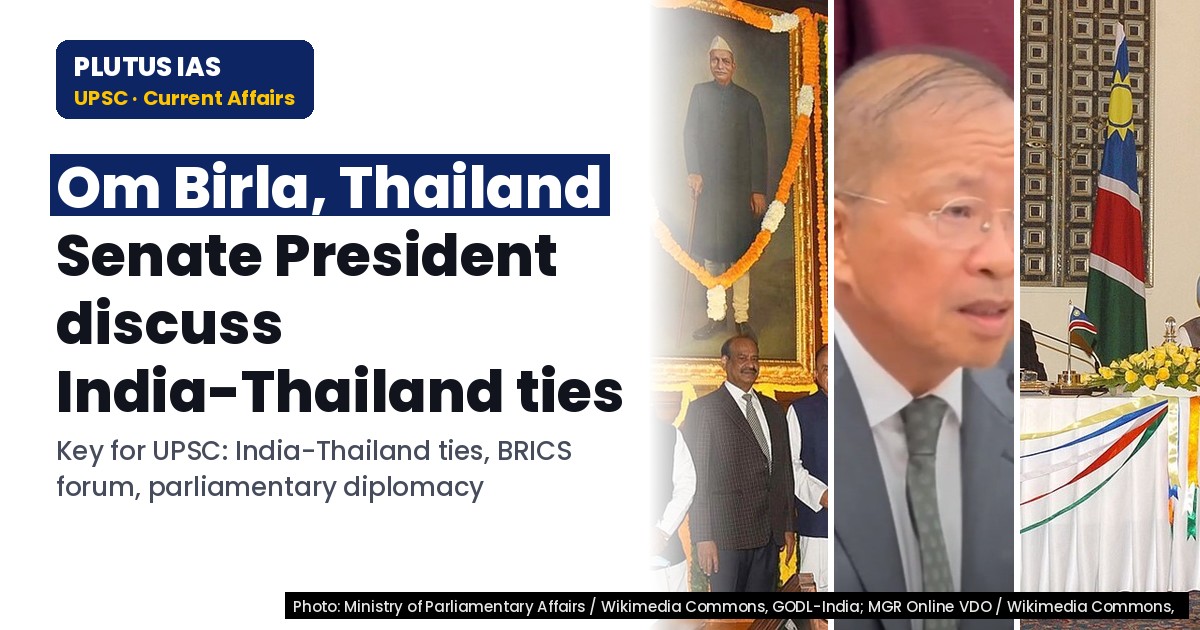
27 Oct Om Birla, Thailand Senate President discuss India-Thailand bilateral ties
✎ The BRICS Parliamentary Forum institutionalises parliamentary diplomacy to harmonise legislative approaches on global challenges, complementing India’s Act East Policy and its engagement with Southeast Asian partners like…
Subject Relevance — Where This Topic Fits
- GS Paper II — International Relations: India’s Act East Policy, India-Thailand bilateral relations, BRICS framework, parliamentary diplomacy
- Prelims: Act East Policy, BRICS Parliamentary Forum, Lok Sabha Speaker, Senate of Thailand, Ayurveda, Yoga, counterterrorism, disaster management
- Essay: The Role of Parliamentary Diplomacy in Enhancing Global Governance, Cultural and Civilisational Ties as Foundations for Modern Bilateral Relations
Quick Revision: The BRICS Parliamentary Forum institutionalises parliamentary diplomacy to harmonise legislative approaches on global challenges, complementing India’s Act East Policy and its engagement with Southeast Asian partners like Thailand.
Why is this in the news?
The meeting between Lok Sabha Speaker Om Birla and Thailand’s Senate President Mongkol Surasajja, held on the sidelines of the 12th BRICS Parliamentary Forum in New Delhi, underscores the evolving institutional mechanisms for India-Thailand cooperation. The discussions highlighted the integration of cultural, economic, and security dimensions within the broader framework of India’s Act East Policy and the BRICS multilateral platform, reflecting a concerted effort to institutionalise parliamentary exchanges for mutual benefit.
Background
- The India-Thailand bilateral relationship is rooted in centuries-old cultural and civilisational ties, particularly through the spread of Buddhism and shared maritime heritage.
- India’s Act East Policy, launched in 2014, prioritises enhanced engagement with Southeast Asia, including Thailand, across trade, connectivity, and strategic domains.
- The BRICS grouping has expanded its agenda to include parliamentary cooperation, with the BRICS Parliamentary Forum serving as a platform for dialogue among member legislatures.
- The 12th BRICS Parliamentary Forum, held in New Delhi in October 2026, focused on parliamentary cooperation to advance people-centric development, aligning with the broader BRICS objectives of inclusive growth and global governance reform.
- Parliamentary diplomacy has emerged as a key tool in fostering mutual understanding and cooperation, complementing traditional diplomatic channels.
- Thailand is a strategic partner for India in Southeast Asia, with historical linkages in trade, defence, and cultural exchanges.
BRICS Parliamentary Forum: Institutionalising Multilateral Parliamentary Cooperation
- The BRICS Parliamentary Forum is an annual platform established to facilitate dialogue among legislatures of BRICS member states and partner countries, aiming to strengthen parliamentary cooperation and promote people-centric governance.
- The Forum serves as a mechanism to harmonise legislative approaches on issues such as counterterrorism, disaster management, trade facilitation, and sustainable development, thereby contributing to the broader BRICS agenda.
- Parliamentary exchanges under the Forum provide an opportunity for legislators to share best practices, legislative innovations, and policy frameworks, fostering mutual learning and capacity-building.
- The Forum aligns with the BRICS commitment to reform global governance institutions, including the United Nations, by advocating for a more inclusive and representative multilateral architecture.
- Thematic sessions during the Forum often focus on socio-economic development, climate change, health security, and digital governance, reflecting the evolving priorities of BRICS member states.
- The participation of external legislatures, such as Thailand’s Senate President, underscores the Forum’s role as a bridge between BRICS and non-BRICS states, enhancing its global relevance.
- The Forum’s outcomes are typically non-binding but serve as a basis for subsequent bilateral and multilateral engagements, reinforcing the principles of cooperative federalism and shared sovereignty.
- The 12th BRICS Parliamentary Forum in 2026, hosted by India, highlighted the role of parliamentary diplomacy in advancing the BRICS vision of a multipolar world order.
Key Features
| Feature | Significance |
|---|---|
| Bilateral Meeting between Lok Sabha Speaker and Thailand Senate President | Demonstrates high-level diplomatic engagement to enhance multi-sectoral cooperation between India and Thailand, reinforcing historical and cultural ties. |
| 12th BRICS Parliamentary Forum | Provides a multilateral platform for parliamentary leaders to discuss shared priorities, including counterterrorism, disaster management, and sustainable development within the BRICS framework. |
| Focus on Counterterrorism and Disaster Management | Highlights the mutual recognition of transnational threats and the need for institutional collaboration to address non-traditional security challenges. |
| Emphasis on Trade, Tourism, Education, and Healthcare (Ayurveda and Yoga) | Aligns with India’s Act East Policy, aiming to deepen economic and people-to-people exchanges while leveraging traditional knowledge systems. |
| Parliamentary Diplomacy | Underscores the role of legislative bodies in shaping foreign policy and fostering mutual understanding through best practices and institutional exchanges. |
Why it Matters
Economic and Strategic
- Strengthening trade and tourism ties can boost economic growth in both nations, particularly in sectors like pharmaceuticals, information technology, and hospitality.
- Defence cooperation, while not detailed in the report, may include joint exercises, technology transfer, or maritime security initiatives, given Thailand’s strategic location in Southeast Asia.
- Act East Policy integration with Thailand’s regional engagement can enhance India’s influence in the ASEAN bloc, counterbalancing geopolitical shifts in the Indo-Pacific.
- Ayurveda and Yoga collaborations present opportunities for India to export traditional healthcare services, contributing to soft power and economic diplomacy.
Institutional and Governance
- The BRICS Parliamentary Forum serves as a mechanism for parliamentary diplomacy, enabling peer learning and policy harmonisation among member states.
- Shared best practices in counterterrorism and disaster management reflect a commitment to multilateral frameworks for addressing global challenges.
- High-level parliamentary exchanges reinforce democratic governance and institutional resilience, particularly in the context of regional stability.
Cultural and Civilisational
- Centuries-old cultural and civilisational ties between India and Thailand, rooted in Theravada Buddhism and shared maritime history, provide a strong foundation for contemporary cooperation.
- Promotion of Yoga and Ayurveda aligns with India’s efforts to globalise traditional knowledge systems, fostering cultural diplomacy and people-centric development.
Challenges
1. Geopolitical Fragmentation in the Indo-Pacific
- Divergent strategic interests among major powers in the region may impede cohesive multilateral initiatives, including those within BRICS.
- Balancing relations with Thailand while navigating alliances with other ASEAN states requires nuanced diplomatic engagement to avoid over-reliance on any single partner.
UPSC Link: GS-II: Regional groupings and agreements involving India
2. Non-Tariff Barriers in Trade
- Regulatory divergence in sectors such as pharmaceuticals, food processing, and services may hinder seamless trade expansion between India and Thailand.
- Addressing sanitary and phytosanitary measures, as well as intellectual property concerns, is critical for realising the full potential of bilateral economic ties.
UPSC Link: GS-III: Issues relating to intellectual property rights and trade barriers
3. Climate Change and Disaster Resilience
- Both nations face increasing vulnerability to climate-induced disasters, necessitating coordinated adaptation strategies and resource-sharing mechanisms.
- Limited institutional capacity in disaster management in certain regions may constrain effective collaboration despite shared political will.
UPSC Link: GS-III: Disaster and disaster management
4. Counterterrorism Coordination
- Differences in legal frameworks and intelligence-sharing protocols may impede joint counterterrorism operations.
- Asymmetric threats, including cyberterrorism and radicalisation, require harmonised approaches to prevent cross-border spillovers.
UPSC Link: GS-III: Linkages between development and spread of extremism
Challenges — UPSC Perspective
| Issue | Concern |
|---|---|
| Trade Imbalances | Persistent deficits in certain sectors may lead to protectionist measures, undermining long-term economic cooperation. |
| Maritime Security | Unresolved disputes in the South China Sea and the Andaman Sea could complicate defence and trade logistics. |
| Cultural Misalignment in Healthcare Standards | Variations in regulatory frameworks for Ayurveda and Yoga may hinder mutual recognition of qualifications. |
| Parliamentary Diplomacy Gaps | Limited institutional memory and bureaucratic inertia may slow the implementation of agreed-upon initiatives. |
| Climate Vulnerability | Shared exposure to cyclones, floods, and rising sea levels necessitates joint adaptation funding and technology transfer. |
Way Forward
- Conclude a Memorandum of Understanding (MoU) on parliamentary exchanges to institutionalise regular high-level visits and joint committees.
- Establish a joint working group on counterterrorism and disaster management to operationalise collaboration through joint exercises and training programmes.
- Facilitate business delegations in sectors like pharmaceuticals, IT, and tourism to identify investment opportunities and address non-tariff barriers.
- Expand academic partnerships under the Act East Policy by increasing scholarships for Thai students in India and vice versa, focusing on traditional medicine and cultural studies.
- Develop a joint framework for the certification and recognition of Ayurveda and Yoga practitioners to enhance cross-border healthcare services.
- Strengthen maritime security dialogue to address piracy, illegal fishing, and search-and-rescue operations in the Bay of Bengal and Andaman Sea.
- Leverage the BRICS framework to advocate for climate finance and technology transfer, positioning India and Thailand as leaders in South-South cooperation.
UPSC Value Addition
Keywords for Mains Answer-Writing
Act East Policy · BRICS Parliamentary Forum · Parliamentary diplomacy · India-Thailand bilateral relations · Cultural diplomacy · Counter-terrorism cooperation · Disaster management collaboration · Ayurveda and Yoga diplomacy · Legislative exchanges · Multilateral parliamentary forums
Constitutional & Policy Linkages
- [‘Article 73: Executive power of the Union’, ‘Defines the scope of executive action in foreign affairs.’]
Concept Flow
Historical and cultural ties between India and Thailand → Diplomatic engagement through parliamentary diplomacy → BRICS Parliamentary Forum as a multilateral platform → Focus on trade, tourism, education, defence, and traditional healthcare → Addressing non-traditional security challenges (counterterrorism, disaster management) → Implementation of joint initiatives under the Act East Policy → Strengthening regional stability and economic integration.
Prelims Practice Questions
Q1. Consider the following statements regarding the Act East Policy of India:
1. It was launched in 2014 to promote economic, strategic, and cultural ties with the Asia-Pacific region.
2. The policy includes sub-regional initiatives such as BIMSTEC and Mekong-Ganga Cooperation.
3. The policy focuses solely on trade and economic cooperation without addressing defence or cultural ties.
How many of the above statements are correct?
- Only one
- Only two
- All three
- None
Answer: Only two — Statements 1 and 2 are correct. Statement 3 is incorrect as the Act East Policy explicitly includes defence, cultural, and people-to-people ties alongside trade and economic cooperation.
Q2. Assertion (A): The BRICS Parliamentary Forum serves as a platform for parliamentary leaders to discuss ways to strengthen parliamentary cooperation and advance people-centric development.
Reason (R): The forum is held annually and is attended exclusively by members of the BRICS member countries.
- Both A and R are true, and R is the correct explanation of A
- Both A and R are true, but R is NOT the correct explanation of A
- A is true, but R is false
- A is false, but R is true
Answer: A is true, but R is false — Assertion (A) is correct as the BRICS Parliamentary Forum is designed for parliamentary cooperation and people-centric development. Reason (R) is incorrect because the forum includes partner countries and is not held exclusively for BRICS member countries.
Q3. Which of the following sectors were explicitly mentioned as areas of cooperation during the meeting between Lok Sabha Speaker Om Birla and Thailand’s Senate President Mongkol Surasajja?
1. Trade
2. Education
3. Defence
4. Space Technology
5. Ayurveda
Select the correct answer using the code below:
- 1, 2, 3, and 5 only
- 1, 2, 3, 4, and 5
- 2, 3, and 4 only
- 1, 3, and 5 only
Answer: 1, 2, 3, and 5 only — The sectors explicitly mentioned in the meeting were Trade, Education, Defence, and Ayurveda. Space Technology was not mentioned.
Mains Practice Question
✍ Critically examine the role of parliamentary diplomacy in enhancing India’s Act East Policy. Substantiate your answer with reference to recent engagements such as the BRICS Parliamentary Forum and bilateral parliamentary exchanges. (15 Marks)
Approach: MODEL-ANSWER SKELETON:
1. **Definition and Significance of Parliamentary Diplomacy**:
– Explain parliamentary diplomacy as a tool of soft power and its role in fostering bilateral and multilateral relations.
– Reference: K. R. Narayanan’s advocacy for parliamentary diplomacy in India’s foreign policy.
2. **Act East Policy and its Objectives**:
– Outline the key pillars of the Act East Policy: economic integration, strategic partnerships, cultural ties, and regional connectivity.
– Reference: Ministry of External Affairs documents and speeches by the Prime Minister.
3. **Role of Parliamentary Diplomacy in Act East Policy**:
– **Bilateral Engagements**: Discuss how parliamentary exchanges (e.g., Om Birla’s meeting with Thailand’s Senate President) strengthen cooperation in trade, education, defence, and cultural sectors like Ayurveda and Yoga.
– **Multilateral Platforms**: Highlight the BRICS Parliamentary Forum as a mechanism for sharing best practices in counter-terrorism, disaster management, and international affairs.
– **Institutional Mechanisms**: Mention the role of parliamentary committees and forums in monitoring and advancing bilateral agreements.
4. **Challenges and Limitations**:
– Address constraints such as bureaucratic hurdles, lack of sustained follow-up, and the need for greater financial and logistical support for parliamentary exchanges.
– Reference: Reports by the Lok Sabha Secretariat or international parliamentary bodies.
5. **Way Forward**:
– Propose measures to institutionalise parliamentary diplomacy, such as creating dedicated parliamentary committees for Act East Policy countries and increasing frequency of exchanges.
– Reference: Recommendations from the 12th BRICS Parliamentary Forum or similar forums.
Source: orissapost.com
Generated by AanyaAi for educational purpose.
Related guides on our sites
- Anthropology VS PSIR
- Best PSIR optional coaching
- Best PSIR optional coaching online
- Best PSIR optional teacher

- Om Birla, Thailand Senate President discuss India-Thailand bilateral ties - October 27, 2026
- भारत-इंडोनेशिया विशेष बल अभ्यास: सुरक्षा सहयोग में नया आयाम - October 27, 2026
- India’s Commitment to Clean Sport at COP10 UNESCO Convention - October 27, 2026

No Comments