


27 Oct ECL achieves 107% cleanliness target under Special Campaign 6
✎ Special Campaign 6 (2–25 Oct 2026) aimed to institutionalise cleanliness, scrap disposal, and digital governance in PSUs, with measurable outcomes like site coverage, revenue generation, and file rationalisation.
Subject Relevance — Where This Topic Fits
- GS Paper II — Governance, Transparency and Accountability | GS Paper III — Environment and Sustainable Development
- Prelims: Swachh Bharat Mission (Urban & Rural), Public Sector Undertakings (PSUs), Coal India Limited (CIL), Special Campaigns for Cleanliness, Scrap Management Policy, E-Governance Initiatives
- Essay: Administrative Reforms and Public Sector Efficiency, Sustainable Resource Management in Industrial Sectors
Quick Revision: Special Campaign 6 (2–25 Oct 2026) aimed to institutionalise cleanliness, scrap disposal, and digital governance in PSUs, with measurable outcomes like site coverage, revenue generation, and file rationalisation.
Why is this in the news?
The Eastern Coalfields Limited (ECL), a subsidiary of Coal India Limited under the Ministry of Coal, has exceeded cleanliness targets under Special Campaign 6 by achieving 107% of site coverage and 192% of area sanitation goals. The campaign, conducted from 2–25 October 2026, also generated ₹2.3 crore through systematic scrap disposal, alongside significant improvements in file management and digital governance. This performance underscores ECL’s commitment to institutionalising cleanliness, resource optimisation, and administrative efficiency in public sector operations.
Background
- Special Campaigns are time-bound, mission-mode initiatives launched by the Government of India to promote cleanliness, digitisation, and efficiency in government offices and public sector undertakings (PSUs).
- Special Campaign 6 (2–25 October 2026) focused on three key pillars: physical cleanliness, scrap management, and digital record rationalisation.
- Eastern Coalfields Limited (ECL), headquartered in Sanctoria, West Bengal, is a major coal-producing PSU under Coal India Limited (CIL), contributing significantly to India’s coal supply.
- Coal India Limited (CIL) operates through eight subsidiaries, including ECL, and is the world’s largest coal producer, with a mandate to ensure sustainable and efficient resource utilisation.
- The campaign aligns with broader national initiatives such as the Swachh Bharat Mission and the Digital India programme, emphasising cleanliness and e-governance in public institutions.
- Scrap management in PSUs involves the systematic identification, disposal, and revenue generation from obsolete materials, contributing to circular economy principles.
What is Special Campaign 6?
- Special Campaign 6 was a pan-India initiative conducted from 2 to 25 October 2026, aimed at enhancing cleanliness, digitisation, and administrative efficiency in government offices and PSUs.
- The campaign was structured around three core objectives: (1) physical cleanliness of office premises and identified sites, (2) systematic disposal of scrap and obsolete materials to generate revenue, and (3) rationalisation of physical and digital records to improve governance.
- Under physical cleanliness, agencies were tasked with cleaning identified sites, removing encroachments, and ensuring maintenance of cleanliness standards.
- Scrap management involved the identification, segregation, and disposal of obsolete materials through authorised channels, with proceeds credited to the government exchequer.
- Digital governance efforts included the review, closure, and archiving of redundant electronic files to streamline record-keeping and reduce administrative bottlenecks.
- The campaign was coordinated by the Department of Administrative Reforms and Public Grievances (DARPG), Ministry of Personnel, Public Grievances and Pensions, in collaboration with line ministries and PSUs.
- Performance under the campaign was measured through quantifiable metrics, including percentage coverage of cleanliness targets, revenue generated from scrap disposal, and reduction in physical and digital file backlogs.
- The initiative reflects the government’s broader commitment to the Swachh Bharat Mission and the Digital India programme, integrating cleanliness and technology into governance practices.
Key Features
| Feature | Significance |
|---|---|
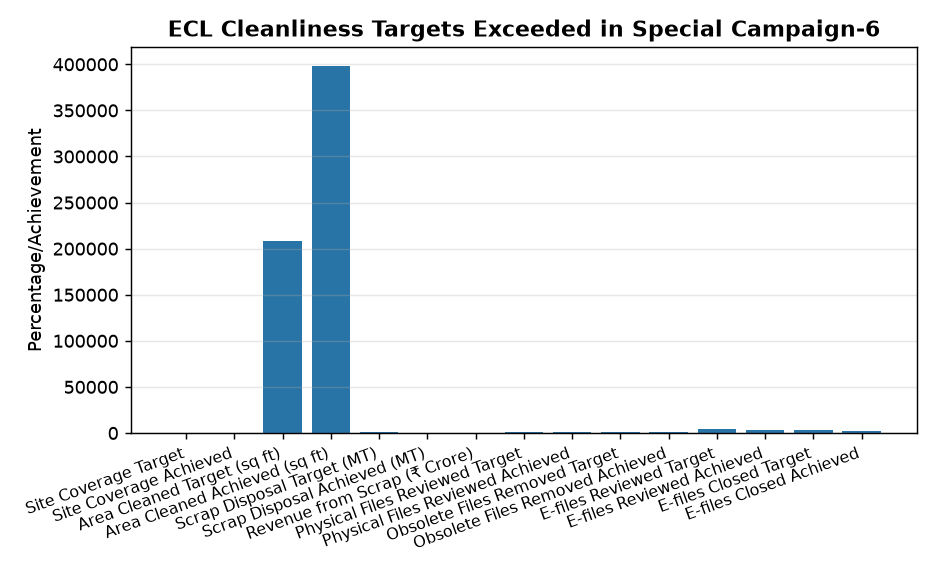
| Site Cleanliness Coverage (107% of target) | Exceeding targets indicates robust implementation of sanitation protocols across operational sites, enhancing worker safety and operational efficiency. |
| Area Cleanliness (192% of target) | Achieving nearly double the area cleanliness target demonstrates systematic waste segregation and disposal mechanisms in coal mining zones. |
| Scrap Disposal Revenue (₹2.3 crore) | Monetisation of industrial scrap through systematic disposal aligns with circular economy principles and resource optimisation. |
| Physical File Review (89.25% of target) | Streamlining physical records reduces administrative bottlenecks and improves decision-making efficiency. |
| Digital File Closure (67.67% of target) | Digitisation and closure of redundant e-files enhance transparency and reduce storage costs in governance. |
Why it Matters
Governance & Administrative Efficiency
- Demonstrates measurable progress in institutionalising cleanliness and record management within public sector undertakings under the Ministry of Coal.
- Highlights the role of structured campaigns like ‘Special Campaign 6’ in driving administrative reforms and resource optimisation.
- Shows how quantifiable targets and real-time monitoring can improve governance outcomes in PSUs.
Economic & Resource Optimisation
- Scrap disposal revenue (₹2.3 crore) exemplifies the integration of waste management with financial sustainability in industrial operations.
- Enhanced utilisation of recovered space (3.98 lakh sq. ft.) can be repurposed for operational or environmental remediation activities.
- Reduction in redundant physical and digital records lowers storage costs and administrative overheads.
Environmental & Occupational Safety
- Systematic cleanliness drives in coal mining areas mitigate dust and waste accumulation, reducing health hazards for workers.
- Area cleanliness targets address legacy pollution in mining sites, contributing to environmental remediation.
- Efficient scrap management prevents illegal dumping and associated environmental degradation.
Institutional Capacity Building
- The campaign underscores the capacity of PSUs to self-audit and improve internal processes without external mandates.
- Success metrics (e.g., 192% area cleanliness) serve as benchmarks for other coal and mining PSUs to emulate.
- Digitisation efforts align with the broader national push for e-governance and paperless administration.
Challenges
1. Legacy Waste Management
- Coal mining sites often accumulate decades of industrial waste, requiring systematic identification and disposal mechanisms.
- Balancing operational continuity with clean-up drives poses logistical challenges in large-scale mining operations.
UPSC Link: Environmental Pollution and Degradation
2. Digital Transformation Bottlenecks
- Migrating from physical to digital records in legacy systems requires significant time and training investments.
- Resistance to change among staff accustomed to traditional record-keeping practices can slow digitisation efforts.
UPSC Link: e-Governance and Digital Infrastructure
3. Resource Allocation for Cleanliness Drives
- Allocating dedicated manpower and machinery for cleanliness campaigns competes with core mining activities.
- Sustaining momentum beyond campaign periods requires institutionalising cleanliness as a permanent operational culture.
UPSC Link: Public Sector Undertakings and Governance
4. Monitoring and Verification Mechanisms
- Ensuring accurate measurement of cleanliness targets across dispersed mining sites demands robust data collection systems.
- Preventing misreporting or superficial compliance requires third-party audits and transparent reporting.
UPSC Link: Administrative Reforms and Accountability
Challenges — UPSC Perspective
| Issue | Concern |
|---|---|
| Legacy Industrial Waste | Accumulated waste in mining sites requires costly remediation and specialised disposal methods. |
| Staff Resistance to Digitisation | Traditional work cultures may hinder adoption of digital record-keeping systems. |
| Operational Disruption During Clean-up | Balancing clean-up drives with uninterrupted mining operations is logistically complex. |
| Data Accuracy in Cleanliness Metrics | Ensuring verifiable and consistent measurement of cleanliness across sites is challenging. |
| Sustainability Post-Campaign | Maintaining achieved cleanliness levels requires continuous monitoring and incentives. |
Way Forward
- Institutionalise cleanliness protocols as standard operating procedures (SOPs) in all mining sites to ensure sustainability beyond campaign periods.
- Expand digitisation drives to cover 100% of physical and digital records, with automated tracking systems for compliance.
- Develop partnerships with waste management agencies to enhance scrap disposal efficiency and revenue generation.
- Conduct quarterly audits of cleanliness metrics and digitisation progress to maintain accountability and transparency.
- Integrate environmental, health, and safety (EHS) audits into regular operational reviews to prevent relapse into poor practices.
- Invest in training programmes for staff on modern record-keeping, waste segregation, and digital tools to build long-term capacity.
- Explore the use of AI and IoT for real-time monitoring of cleanliness and waste management in mining zones.
- Benchmark ECL’s achievements against global best practices in industrial cleanliness and resource optimisation to identify further improvements.
UPSC Value Addition
Keywords for Mains Answer-Writing
Special Campaign 6 · Swachhata Abhiyan · Eastern Coalfields Limited (ECL) · Coal India Limited · Scrap management · Administrative reforms · Digital governance · Public sector efficiency · Workplace cleanliness · Resource optimisation · Government cleanliness drives · Public sector undertakings (PSUs) · File management · E-governance · Sustainable resource utilisation
Concept Flow
Special Campaign 6 (Government-wide cleanliness drive) → Target-setting by ECL → Site-specific cleanliness and scrap disposal activities → Exceeding targets (107% and 192%) → Revenue generation (₹2.3 crore) and administrative efficiency gains → Institutionalisation of cleanliness protocols → Long-term environmental and operational benefits.
Prelims Practice Questions
Q1. Consider the following statements regarding Special Campaign 6:
1. It is a nationwide cleanliness drive launched by the Government of India.
2. The campaign focuses on physical site cleanliness, scrap disposal, and administrative reforms.
3. Eastern Coalfields Limited (ECL) achieved 107% of its site cleanliness target under this campaign.
How many of the above statements are correct?
- Only one
- Only two
- All
- None
Answer: All — Statements 1 and 2 are correct as Special Campaign 6 is a nationwide cleanliness initiative focusing on multiple domains including physical cleanliness, scrap disposal, and administrative reforms. Statement 3 is correct as ECL achieved 107% of its site cleanliness target.
Q2. Assertion (A): Special Campaign 6 mandates the systematic disposal of scrap to generate financial returns.
Reason (R): The campaign aims to optimise resource utilisation and enhance administrative efficiency in government institutions.
Options:
A. Both A and R are true, and R is the correct explanation of A
B. Both A and R are true, but R is NOT the correct explanation of A
C. A is true, but R is false
D. A is false, but R is true
Answer: ? — Both Assertion (A) and Reason (R) are true. Special Campaign 6 indeed mandates systematic scrap disposal to generate financial returns, and the campaign’s broader objective includes optimising resource utilisation and enhancing administrative efficiency.
Q3. Match the following initiatives under Special Campaign 6 with their objectives:
Column I (Initiative) | Column II (Objective)
1. Site cleanliness | A. Revenue generation through disposal of obsolete materials
2. Scrap disposal | B. Enhancing workplace cleanliness and safety
3. File management | C. Streamlining administrative records and reducing pendency
4. Digital governance | D. Modernising record-keeping through e-files
Options:
A. 1-B, 2-A, 3-C, 4-D
B. 1-A, 2-B, 3-C, 4-D
C. 1-D, 2-A, 3-B, 4-C
D. 1-C, 2-B, 3-A, 4-D
Answer: ? — The correct match is: 1-B (Site cleanliness enhances workplace cleanliness and safety), 2-A (Scrap disposal generates revenue), 3-C (File management streamlines administrative records), 4-D (Digital governance modernises record-keeping).
Mains Practice Question
✍ Critically examine the significance of Special Campaign 6 in transforming the operational efficiency of Public Sector Undertakings (PSUs) in India. How does the campaign’s focus on cleanliness, scrap management, and administrative reforms contribute to sustainable governance? (15 Marks)
Approach: MODEL-ANSWER SKELETON:
1. **Introduction (2 marks)**
– Define Special Campaign 6 as a government-led initiative under the Department of Administrative Reforms and Public Grievances (DARPG).
– State its objective: institutionalising cleanliness, optimising resources, and enhancing administrative efficiency.
2. **Cleanliness and Workplace Efficiency (3 marks)**
– Discuss the role of cleanliness in improving workplace productivity, safety, and morale.
– Highlight ECL’s achievement of 107% site cleanliness target and 191.5% area cleanliness, reflecting measurable outcomes.
– Link to the broader Swachh Bharat Mission and the 7-Step Model of Cleanliness.
3. **Scrap Management and Financial Optimisation (3 marks)**
– Explain the economic and environmental benefits of systematic scrap disposal.
– Cite ECL’s revenue generation of ₹2.3 crore through disposal of 466 metric tonnes of scrap.
– Reference the National Mineral Policy, 2019, and the circular economy principles.
4. **Administrative Reforms and Digital Governance (4 marks)**
– Discuss the campaign’s focus on file management, reduction of pendency, and digitisation.
– Highlight ECL’s achievements: review of 89.25% physical files and closure of 85.45% e-files.
– Reference the Right to Information Act, 2005, and the Digital India initiative.
5. **Sustainable Governance and Long-term Impact (3 marks)**
– Argue how these reforms contribute to sustainable governance through resource optimisation and transparency.
– Discuss the role of PSUs in India’s economic development and the need for continuous improvement.
– Conclude with the importance of institutionalising such campaigns for long-term efficiency.
Source: PIB (Press Information Bureau)
Generated by AanyaAi for educational purpose.
Related guides on our sites
- Anthropology VS PSIR
- Best PSIR optional coaching
- Best PSIR optional coaching online
- Best PSIR optional teacher

- ECL achieves 107% cleanliness target under Special Campaign 6 - October 27, 2026
- महिलाओं की सुरक्षा: एनएचआरसी ने जारी किया परामर्श, जानिए प्रमुख बिंदु - October 27, 2026
- BRICS Presiding Officers Meet: Key Takeaways for UPSC & State PCS - October 27, 2026

No Comments