


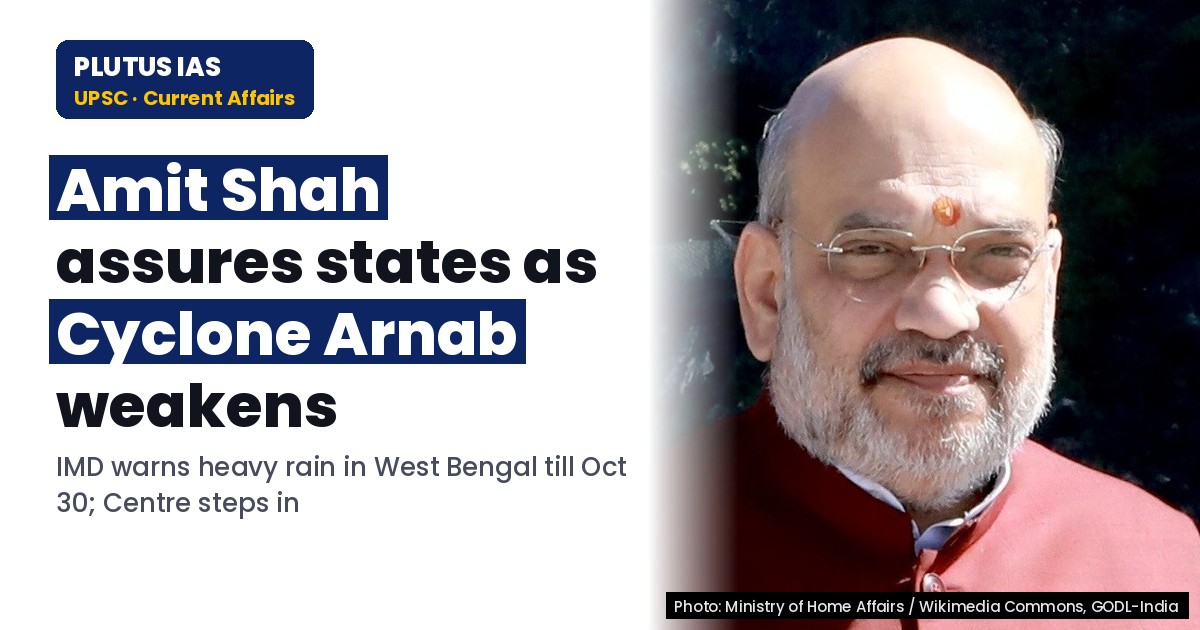
29 Oct Cyclone Arnab UPSC: IMD Forecast & Centre-State Response Explained
✎ Cyclones are classified by the IMD based on wind speed, with 'Very Severe Cyclonic Storm' (166–221 km/h) posing the highest risk; the Disaster Management Act, 2005, mandates a multi-tiered institutional framework for cyclone…
Subject Relevance — Where This Topic Fits
- GS Paper III — Disaster Management | GS Paper III — Environment and Disaster Management
- Prelims: Cyclone, Depression, Well-marked low pressure area, National Disaster Response Force (NDRF), National Cyclone Risk Mitigation Project (NCRMP), Disaster Management Act, 2005, India Meteorological Department (IMD), Storm surge, Flooding, Landslides, Cyclone Warning Division, Airlift operations, Search and Rescue (SAR), National Highway 326
- Essay: Resilience in governance: Balancing preparedness and response in disaster management, Climate change and the increasing frequency of extreme weather events in India
Quick Revision: Cyclones are classified by the IMD based on wind speed, with ‘Very Severe Cyclonic Storm’ (166–221 km/h) posing the highest risk; the Disaster Management Act, 2005, mandates a multi-tiered institutional framework for cyclone preparedness and response.
Why is this in the news?
Cyclone Arnab, classified as a ‘very severe cyclonic storm’, made landfall along the east coast of India on 28 October 2026, causing widespread damage across Andhra Pradesh, Odisha, West Bengal, and adjoining regions. The event has highlighted the operational challenges in disaster response, including search-and-rescue operations, infrastructure restoration, and inter-state coordination. The Union Home Minister’s intervention underscores the role of the central government in crisis management, while the formation of a new low-pressure system in the Andaman Sea raises concerns about cascading climatic events.
Background
- Cyclones are recurrent meteorological hazards in India, particularly along the Bay of Bengal coast, where approximately 7% of the world’s cyclones form annually.
- The Bay of Bengal accounts for nearly 58% of the total cyclones striking India, with peak activity during the post-monsoon season (October–December).
- The India Meteorological Department (IMD) is the nodal agency for cyclone forecasting, issuing colour-coded alerts (Yellow, Orange, Red) based on severity.
- The Disaster Management Act, 2005, establishes the National Disaster Management Authority (NDMA) and State Disaster Management Authorities (SDMAs) for coordinated disaster response.
- The National Cyclone Risk Mitigation Project (NCRMP), launched in 2011, aims to reduce the vulnerability of coastal communities through early warning systems, cyclone shelters, and coastal embankments.
- Recent cyclones such as Fani (2019), Amphan (2020), and Yaas (2021) have demonstrated the evolving nature of cyclonic hazards, exacerbated by climate change and coastal urbanisation.
What is a Cyclone and its Associated Hazards?
- A cyclone is a low-pressure system with organised thunderstorm activity, rotating counter-clockwise in the Northern Hemisphere, characterised by strong winds, heavy rainfall, and storm surges.
- Cyclones are classified by the IMD into five categories: Depression (winds < 63 km/h), Deep Depression (63–87 km/h), Cyclonic Storm (88–117 km/h), Severe Cyclonic Storm (118–165 km/h), Very Severe Cyclonic Storm (166–221 km/h), and Super Cyclonic Storm (>222 km/h).
- Key hazards include storm surges (abnormal rise in sea level), torrential rainfall leading to flooding, high-velocity winds causing structural damage, and landslides in hilly regions.
- Storm surges are particularly devastating in low-lying coastal areas, as seen in the 1970 Bhola cyclone (Bangladesh) and 1999 Odisha super cyclone, which caused catastrophic loss of life.
- The IMD’s Cyclone Warning Division issues four-stage warnings: (1) Cyclone Alert (48 hours before landfall), (2) Cyclone Warning (24 hours before), (3) Landfall Warning (12 hours before), and (4) Post-landfall Outlook.
- Cyclones are tracked using satellite imagery, Doppler weather radars, and numerical weather prediction models, with data assimilated from global meteorological agencies.
- The warming of the Indian Ocean due to climate change is linked to an increase in the intensity and frequency of cyclones in the Bay of Bengal.
Key Features
| Feature | Significance |
|---|---|
| Cyclone Arnab’s landfall and subsequent weakening into a depression | Marked the transition from a severe cyclonic storm to a less intense system, reducing immediate wind-related risks but prolonging heavy rainfall and flooding in coastal and adjoining regions. |
| IMD’s real-time monitoring and forecasting | Enabled early warnings, facilitated coordinated disaster response, and guided evacuation and relief operations across affected states. |
| Central-State coordination mechanism | Demonstrated the operationalisation of the National Disaster Management Authority (NDMA) guidelines through direct communication between the Union Home Minister and Chief Ministers of affected states. |
| Coastal and inland flooding in Odisha and Andhra Pradesh | Resulted in infrastructure damage (e.g., washed-away highways), agricultural losses (e.g., paddy and banana crops), and displacement of populations, necessitating immediate relief and rehabilitation measures. |
| Formation of a fresh low-pressure area over the Andaman Sea | Indicated the potential for prolonged monsoon conditions, requiring sustained vigilance and preparedness for subsequent weather systems impacting peninsular India. |
Why it Matters
Economic
- Disruption of agricultural output (e.g., paddy and banana crops in Guntur) may impact local economies, food security, and export earnings, particularly in Andhra Pradesh.
Strategic/Operational
- The deployment of the Indian Coast Guard and airlift operations for stranded villagers highlighted the importance of multi-agency coordination in disaster response.
Environmental
- Heavy rainfall and flooding exacerbated soil erosion and sediment deposition, potentially affecting coastal ecosystems and long-term agricultural productivity.
Administrative
- The central government’s assurance of support underscored the role of the Union in augmenting state-level disaster management capacities under the Disaster Management Act, 2005.
Social
- Displacement of populations and damage to infrastructure (e.g., railways, highways) disrupted livelihoods and access to essential services, necessitating immediate relief measures.
Challenges
1. Flooding and Inundation
- Prolonged rainfall led to widespread flooding in Odisha (Ganjam, Gajapati) and Andhra Pradesh, isolating villages and damaging critical infrastructure such as National Highway 326.
UPSC Link: Geography: Floods and their management
2. Agricultural Losses
- Cyclone-related damage to standing crops (e.g., paddy, banana) threatened food security and rural incomes, requiring rapid assessment and compensation mechanisms.
UPSC Link: Economy: Impact of disasters on agriculture
3. Logistical Constraints in Relief Operations
- Adverse weather conditions (e.g., low clouds, rain) delayed airlift operations for stranded villagers, highlighting the need for adaptive logistics in disaster scenarios.
UPSC Link: Disaster Management: Challenges in relief
4. Coastal Vulnerability and Infrastructure Damage
- Washed-away roads and railway bridges disrupted connectivity, underscoring the need for climate-resilient infrastructure in cyclone-prone regions.
UPSC Link: Disaster Management: Infrastructure resilience
5. Forecasting and Early Warning Systems
- While IMD’s warnings were timely, the formation of a fresh low-pressure area post-cyclone necessitated continuous monitoring to prevent complacency.
UPSC Link: Science & Tech: Weather forecasting
6. Inter-State Coordination
- Ensuring seamless coordination between multiple states (Odisha, Andhra Pradesh, West Bengal) and central agencies (NDMA, IMD) remains a persistent challenge in large-scale disasters.
UPSC Link: Governance: Centre-State relations
Challenges — UPSC Perspective
| Issue | Concern |
|---|---|
| Flooding in Ganjam and Gajapati districts | Isolation of ~2,000 villagers and damage to 200+ villages, requiring airlift operations and immediate relief. |
| Damage to National Highway 326 | Disrupted connectivity between Ganjam and Mohana, impeding relief and rehabilitation efforts. |
| Agricultural losses in Guntur | Impact on paddy and banana crops threatens food security and rural livelihoods. |
| Railway bridge inundation near Ichchapuram | Led to cancellation of three trains, disrupting passenger and freight transport. |
| Formation of fresh low-pressure area | Potential for prolonged monsoon conditions increases the risk of secondary flooding and landslides. |
| Delayed airlift operations due to weather | Adverse conditions hindered evacuation efforts, highlighting logistical challenges in disaster response. |
Way Forward
- Strengthen real-time monitoring of post-cyclonic weather systems (e.g., low-pressure areas) to preempt secondary disasters like flooding and landslides.
- Accelerate damage assessment of agricultural and infrastructure losses to expedite compensation under the Pradhan Mantri Fasal Bima Yojana (PMFBY) and state-specific schemes.
- Enhance climate-resilient infrastructure in cyclone-prone regions, including elevated roads, drainage systems, and cyclone shelters.
- Conduct mock drills and capacity-building exercises for multi-agency coordination (NDMA, IMD, Coast Guard, state agencies) to improve response efficiency.
- Leverage satellite imagery and GIS mapping for rapid identification of flood-affected areas and prioritisation of relief operations.
- Promote community-based disaster preparedness through awareness campaigns on evacuation routes, emergency kits, and early warning systems.
- Integrate agricultural advisory services to guide farmers on post-cyclone crop management and soil restoration techniques.
- Establish rapid-repair protocols for critical infrastructure (e.g., railways, highways) to restore connectivity and economic activities.
UPSC Value Addition
Keywords for Mains Answer-Writing
Disaster Management Act, 2005 · National Disaster Response Force (NDRF) · State Disaster Response Fund (SDRF) · Cyclone Arnab · Cyclone management protocols · IMD cyclone classification · Disaster Risk Reduction (DRR) · Multi-hazard early warning systems · Inter-State coordination in disasters · Disaster relief and rehabilitation · Coastal vulnerability and preparedness · National Crisis Management Committee (NCMC) · Odisha Disaster Management Authority (OSDMA) · Andhra Pradesh State Disaster Management Authority (APSDMA) · Cyclone tracking and forecasting mechanisms
Concept Flow
Formation of Cyclone Arnab over the Bay of Bengal → Rapid intensification into a ‘very severe cyclonic storm’ → Landfall and weakening into a depression → Heavy rainfall and flooding in coastal and inland regions (Odisha, Andhra Pradesh, West Bengal) → Disruption of infrastructure (roads, railways) and agricultural losses → Activation of IMD warnings and NDMA-coordinated disaster response → Central-State coordination (Home Minister’s communication with CMs) → Relief and rehabilitation operations (airlifts, damage assessment) → Formation of a fresh low-pressure area → Potential for prolonged monsoon conditions → Sustained monitoring and preparedness for secondary disasters.
Prelims Practice Questions
Q1. Consider the following statements regarding the classification of cyclones in India as per the India Meteorological Department (IMD):
1. A ‘very severe cyclonic storm’ is classified when wind speeds are between 118–221 km/h.
2. A ‘super cyclonic storm’ is classified when wind speeds exceed 222 km/h.
3. Cyclone Arnab was classified as a ‘very severe cyclonic storm’ before weakening into a depression.
How many of the above statements are correct?
- Only one
- Only two
- All three
- None
Answer: All three — Statements 1 and 3 are correct. Statement 2 is incorrect because a ‘super cyclonic storm’ is classified when wind speeds exceed 221 km/h (not 222 km/h). Cyclone Arnab was indeed classified as a ‘very severe cyclonic storm’ before weakening into a depression.
Q2. Assertion (A): The National Disaster Response Force (NDRF) is the primary agency responsible for conducting rescue and relief operations during cyclones in India.
Reason (R): The Disaster Management Act, 2005 empowers the NDRF to deploy its battalions across the country for disaster response, including cyclones, without requiring state-specific approvals.
Options:
A. Both A and R are true, and R is the correct explanation of A.
B. Both A and R are true, but R is not the correct explanation of A.
C. A is true, but R is false.
D. A is false, but R is true.
Answer: ? — Both A and R are true. The NDRF, established under the Disaster Management Act, 2005, is the primary agency for disaster response, including cyclones. However, R is not the correct explanation of A because the NDRF operates under the National Disaster Management Authority (NDMA) and coordinates with state agencies, including State Disaster Response Forces (SDRF).
Q3. Match the following cyclone-prone states in India with their respective State Disaster Management Authorities (SDMAs):
Column I (State) | Column II (SDMA)
——————————————|——————————————
1. Odisha | A. Andhra Pradesh State Disaster Management Authority (APSDMA)
2. Andhra Pradesh | B. Odisha State Disaster Management Authority (OSDMA)
3. West Bengal | C. West Bengal Disaster Management & Civil Defence Department
4. Tamil Nadu | D. Tamil Nadu State Disaster Management Authority (TNSDMA)
Options:
A. 1-B, 2-A, 3-C, 4-D
B. 1-A, 2-B, 3-D, 4-C
C. 1-C, 2-D, 3-A, 4-B
D. 1-D, 2-C, 3-B, 4-A
Answer: ? — The correct matches are: 1. Odisha – B (OSDMA), 2. Andhra Pradesh – A (APSDMA), 3. West Bengal – C (West Bengal Disaster Management & Civil Defence Department), 4. Tamil Nadu – D (TNSDMA).
Mains Practice Question
✍ The management of cyclones in India is a shared responsibility between the Union and State governments, with the Union Home Ministry playing a pivotal role. Critically examine the institutional and legal framework governing cyclone preparedness, response, and rehabilitation in India. Also, assess the effectiveness of this framework in the context of recent cyclones such as Cyclone Arnab. (15 Marks)
Approach: MODEL-ANSWER SKELETON:
1. **Legal and Institutional Framework**:
– **Disaster Management Act, 2005**: Outline the key provisions, including the roles of the National Disaster Management Authority (NDMA), State Disaster Management Authorities (SDMAs), and District Disaster Management Authorities (DDMAs).
– **National Disaster Response Force (NDRF)**: Explain its composition, deployment mechanisms, and coordination with state agencies during cyclones.
– **State Disaster Response Fund (SDRF) and National Disaster Mitigation Fund (NDMF)**: Discuss their utilisation for relief, rehabilitation, and mitigation.
– **Cyclone-specific protocols**: Highlight the Standard Operating Procedures (SOPs) for cyclone warning, evacuation, and relief operations.
2. **Institutional Coordination**:
– **Inter-State coordination**: Discuss the role of the National Crisis Management Committee (NCMC) and the Union Home Ministry in coordinating multi-state responses (e.g., Cyclone Arnab affecting Andhra Pradesh, Odisha, and West Bengal).
– **Early Warning Systems**: Explain the role of the India Meteorological Department (IMD) in cyclone tracking, classification, and dissemination of warnings.
– **Local Governance**: Assess the role of Panchayati Raj Institutions (PRIs) and Urban Local Bodies (ULBs) in evacuation and relief operations.
3. **Challenges and Gaps**:
– **Infrastructure vulnerabilities**: Discuss issues such as washed-away roads (e.g., NH-326 in Odisha) and power disruptions.
– **Delayed compensation**: Highlight the need for expeditious disbursement of relief funds (e.g., Andhra Pradesh’s directive for fast-tracking compensation).
– **Air operations**: Assess the logistical challenges in airlifting stranded populations (e.g., Odisha’s airlift plans for marooned villagers).
4. **Effectiveness in Cyclone Arnab**:
– **Strengths**: Cite examples of successful coordination (e.g., NDRF deployment, IMD warnings, and state-level preparedness).
– **Weaknesses**: Identify gaps such as infrastructure damage, delayed relief, and coordination challenges between states and central agencies.
5. **Way Forward**:
– **Enhancing resilience**: Discuss measures like coastal zone management, mangrove restoration, and multi-hazard early warning systems.
– **Technology integration**: Highlight the role of AI, satellite imagery, and IoT in improving forecasting and response.
– **Community participation**: Emphasise the need for awareness campaigns and training of local communities in disaster preparedness.
Source: The Hindu
Generated by AanyaAi for educational purpose.
Related guides on our sites
- Current affairs for upsc 2026
- How to prepare for GS paper 1 for UPSC CSE mains exam
- Best UPSC coaching for IFOS exam
- Best geography optional coaching

- MP Government Shuts 30+ Portals Over Cyber Threat: UPSC Polity Insights - October 30, 2026
- वायु सेना के नए उप प्रमुख: एयर मार्शल इंदरपाल सिंह वालिया की नियुक्ति - October 30, 2026
- UP CM & Railway Minister to Flag Off Vande Bharat Sleeper Trains - October 30, 2026

No Comments